Freelancers using PerplexityFreelancers using Perplexity
The only person you need to strategize your marketing
9x
Hired
5.0
Rating
47
Followers
The only person you need to strategize your marketing
Turn Your Ideas Into AI powerd SaaS with @Sunstroke

43
Followers
Turn Your Ideas Into AI powerd SaaS with @Sunstroke
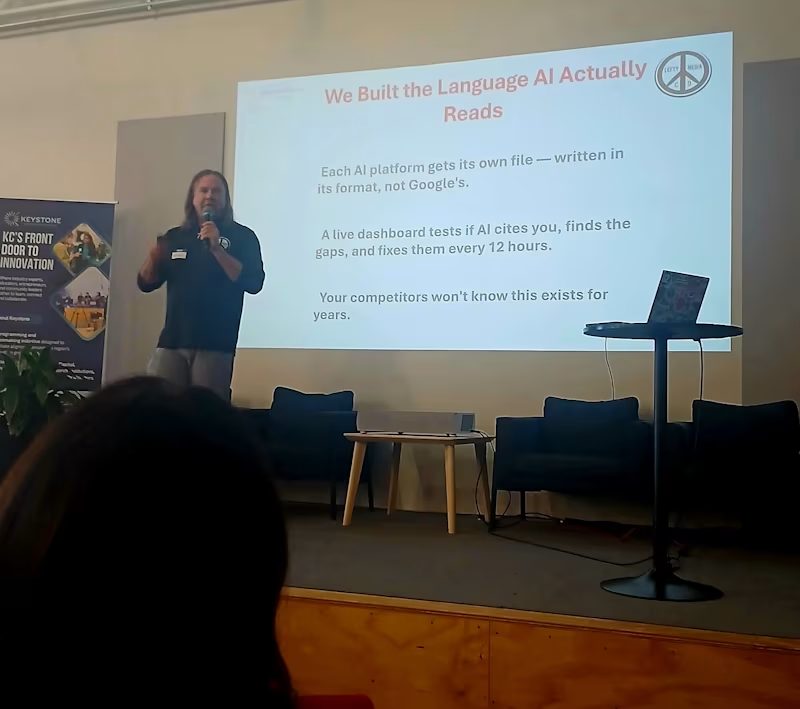
AI plays favorites. We make sure it's you. KC AI discovery
46
Followers
AI plays favorites. We make sure it's you. KC AI discovery
Cover image for A few of you asked
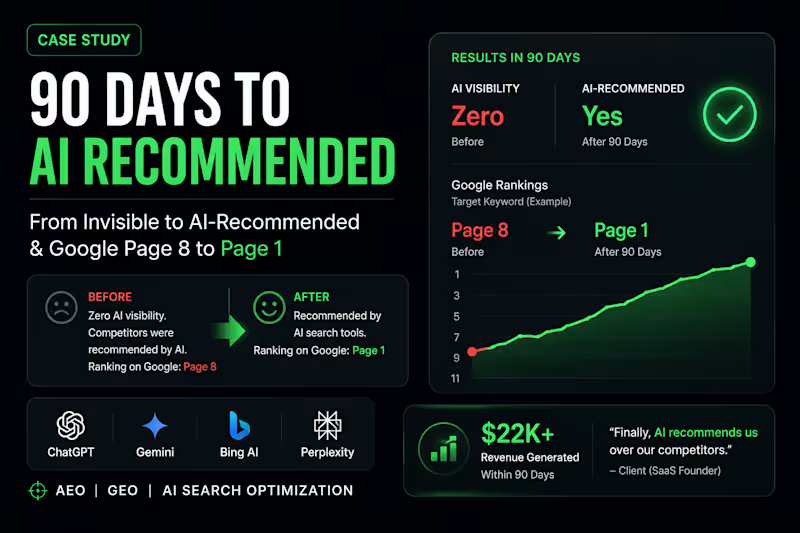
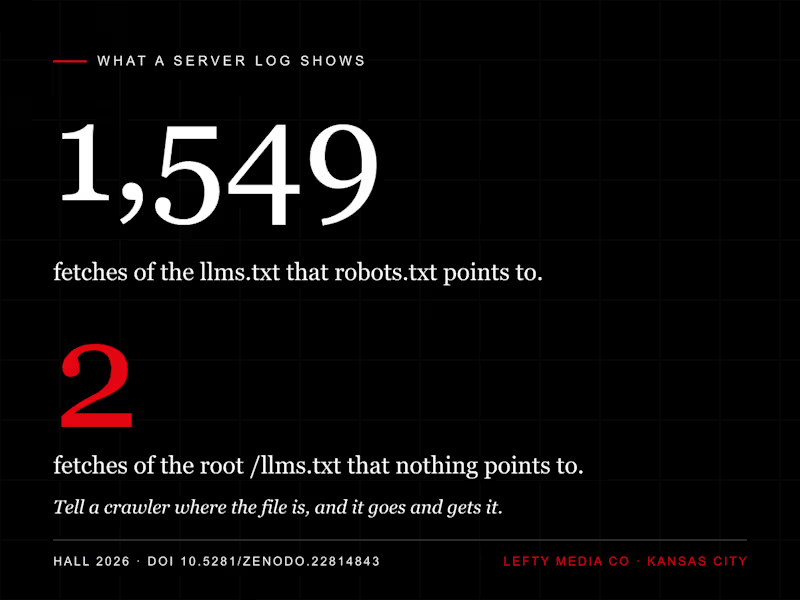
A few of you asked what Lefty Media Co actually does. Here it is without the jargon. You know how you used to Google "best web designer near me"? People are not doing that as much anymore. They ask ChatGPT, or Perplexity, or Claude. And the AI hands them a short list of names. Two things decide whether you're on that list. First, does the AI even know you exist? That's the structural side. If your site isn't built so a machine can actually read who you are, what you do, and who you serve, you're invisible before the conversation even starts. The industry calls that GEO. Think of it as being findable in the new front door. Second, when someone asks "who's the best," does the AI pick YOU? That's the part I care about most. I call it Pick Rate. Being known just gets you in the door. Being chosen is the whole game, and it comes down to whether the internet trusts you: reviews, earned mentions, the kind of third-party proof that says you're the one. Here's the honest part nobody says out loud. Even Nike only gets named about 23% of the time when people ask AI for the best shoes. Nobody is at 100%. So this isn't a magic trick that makes you the only answer. It's making sure you're in the room when the question gets asked, instead of watching the AI hand your customer to somebody else. And none of it is a set-it-and-forget-it button. There's a human on it every day, reading what the AI is actually saying about you and adjusting. That's the part the software can't do alone. That's the work. It sits on top of your SEO, it doesn't replace it. Google still matters. This is just the layer for the room everybody's walking into now.
1
147
Investigative & Technical Writer | AI, Cyber, Climate
Cover image for The Supply Chain Beneath the
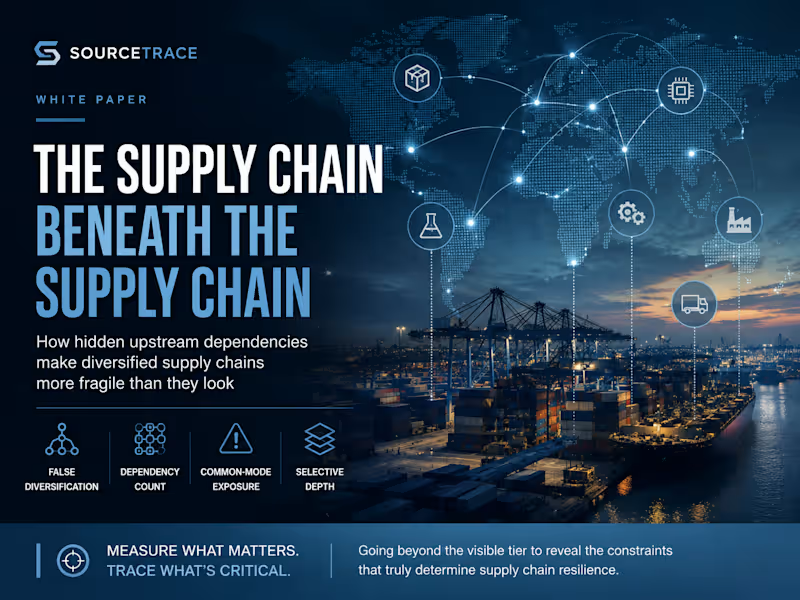
The Supply Chain Beneath the Supply Chain Evidence-Based Supply Chain Risk Research How hidden upstream dependencies can make a diversified supply chain much less resilient than it appears. A company can have four suppliers for the same critical component and still have a serious supply problem. Why? Because those four suppliers may depend on the same upstream material, manufacturing process, piece of equipment, or geographic region. That is the question behind this SourceTrace research project: When we look beyond the suppliers we can see, how many genuinely independent supply routes are actually left? What I investigated I looked beyond the usual Tier-1 supplier view and traced where critical dependencies can come together further upstream. The research examines: Why having more suppliers does not always mean having more independent supply routes How several suppliers can share the same hidden upstream dependency Semiconductor supply chains and concentrated manufacturing equipment Pharmaceutical supply chains and concentrated upstream inputs How one upstream disruption can affect many companies at the same time Why technology lock-in, qualification requirements, capital costs and geography create hidden bottlenecks When deeper supply-chain research is worth the time and money What boards and risk teams should ask before assuming a supply chain is truly diversified The research approach I did not try to map every company and every supplier in a global supply chain. Instead, I used selective depth. The idea is simple: Keep tracing a critical dependency until the information can change a real decision — such as finding another supplier, increasing inventory, redesigning a component, or accepting the risk. The research was then turned into dependency maps, evidence cards, industry examples, comparison tables and practical questions for decision-makers. The central finding Supplier count is not the same as dependency count. Four suppliers may look safer than one. But if all four ultimately depend on the same upstream constraint, the apparent diversification can disappear when that constraint fails. This is what I call common-mode exposure: different suppliers can be affected by the same problem because they share part of the same upstream system. What I created Evidence-based research paper Multi-tier supply-chain dependency maps Semiconductor and pharmaceutical case analysis Supply-chain risk framework High-value vs. low-value mapping matrix Executive and board-level questions Visual evidence cards and comparison tables SourceTrace research methodology My role Researcher + Investigative Writer I researched the evidence, followed the dependencies beyond the obvious supplier relationships, tested the assumptions behind conventional diversification, and turned the findings into clear, visual and decision-focused research. The goal was not to make the supply chain look more complicated. It was to show where the real dependency sits. SourceTrace principle: Truth before persuasion. Evidence before opinion.
0
352
Cover image for Greenwashing Risk for Mid-Size &
Greenwashing Risk for Mid-Size & SaaS Companies How Weak Environmental Claims Create Commercial and Regulatory Exposure Environmental claims are no longer just a marketing issue. For mid-size and SaaS companies, a simple phrase such as “sustainable,” “eco-friendly,” or “carbon neutral” can create regulatory and commercial risk when the evidence behind it is weak or incomplete. This Source-Trace white paper investigates how greenwashing risk is changing across the UK, US, and EU, and what businesses can do to make their environmental claims more defensible. What I researched and developed Investigated the regulatory landscape for environmental claims across the UK, US, and EU Examined primary regulatory guidance, enforcement records, court decisions, and agency sources Analyzed real-world cases involving environmental claims and misleading marketing Identified 7 recurring claim patterns that can create compliance problems Developed a 6-level evidence scale for evaluating environmental claims Created a practical 9-point pre-publishing checklist Built guidance for turning broad environmental statements into specific, evidence-backed claims Developed recommendations for founders, marketing, legal, compliance, and sales teams Designed evidence tables, case-study analysis, and practical decision frameworks My Role I worked as the investigative researcher and sole author, taking a complex and evolving regulatory subject and turning primary-source research into a practical business-risk framework. SourceTrace Investigative Research & Writing Author: Nutan Navsariwala, Founder The project demonstrates my ability to connect environmental regulation, evidence, commercial risk, and clear communication, and to turn complex research into useful decision-making tools. Full whitepaper: [Link will be added here]👇
0
343
Product designer crafting bespoke websites, apps, and brands

LinkedIn Ghostwriter for AI Founders | Clarity Beats Volume