Visual & Motion Designer
Combining 2D & 3D animation has never been easier with AI! My process here: I used the credit card image as the first frame - fed it to Google Flow and gave this EXACT prompt:
“A three-dimensional credit card scaling from zero to full size, twirling logically into its final position to reveal its 3D body and settling calmly, on a transparent background; if not possible, a white background.”
For smaller projects, I give AI the image of a product and sometimes the first and last frame and ask it to generate the motion the way I direct it.
You are still the director! Sound on 🔊
6
5
800
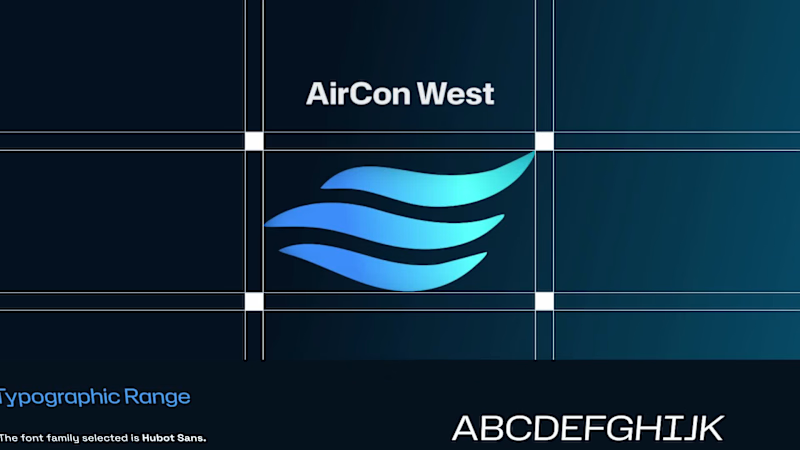
Branding & Visual Identity for AirCon West based in London.
Designers! Present your work with motion! It breathes life into your work and conveys your ideas in a dynamic way.
Use free online motion tools to do it.
My favorites:
https://animos.app/
(https://animos.app/)https://arqe.ai/
(https://arqe.ai/)https://orelin.app/editor
(https://orelin.app/editor)https://openvid.dev/en
(https://openvid.dev/en)(Or animate it yourself, like I did here using EffectCraft!)
68
96
4.2K

Product Designer | Web3, Fintech & DeFi | Framer & Webflow
- 5.0
- Rating
- 8
- Followers
Product Designer | Web3, Fintech & DeFi | Framer & Webflow

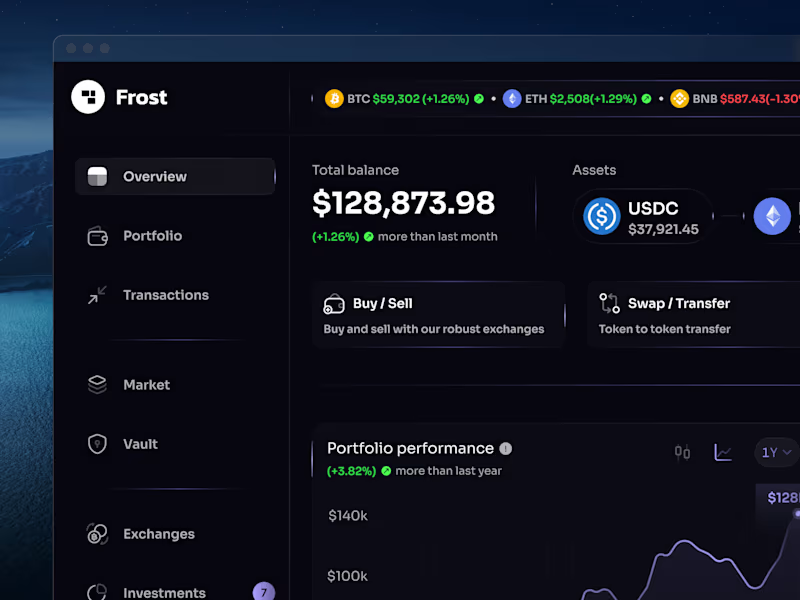
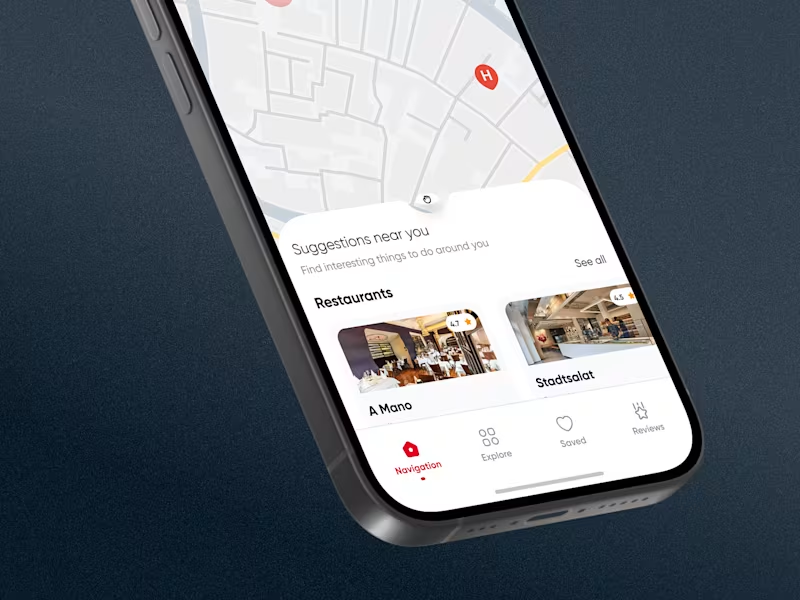

Most fintech apps show how much you’ve saved.
They don’t show what it’s costing you.
Saving for travel can delay debt payoff.
So I explored a better approach: A goal-based savings experience where multiple goals compete for the same income, and users can see the trade-offs clearly.
I used AI across my workflow:
Perplexity to ground the scenario
ChatGPT to refine flows and edge cases
Figma Make to shape early directions
Cursor to prototype the interaction locally.
Then I designed the experience in Figma, focusing on clarity and decision-making.
Key ideas:
• Multiple goals with clear priorities
• A trade-off slider showing how timelines shift
• Scroll interactions that reveal goals progressively
Still refining, but the goal is simple: Help users make smarter financial decisions, not just track savings.
4
182

Illustration & Motion Design Specialist
Hello there!
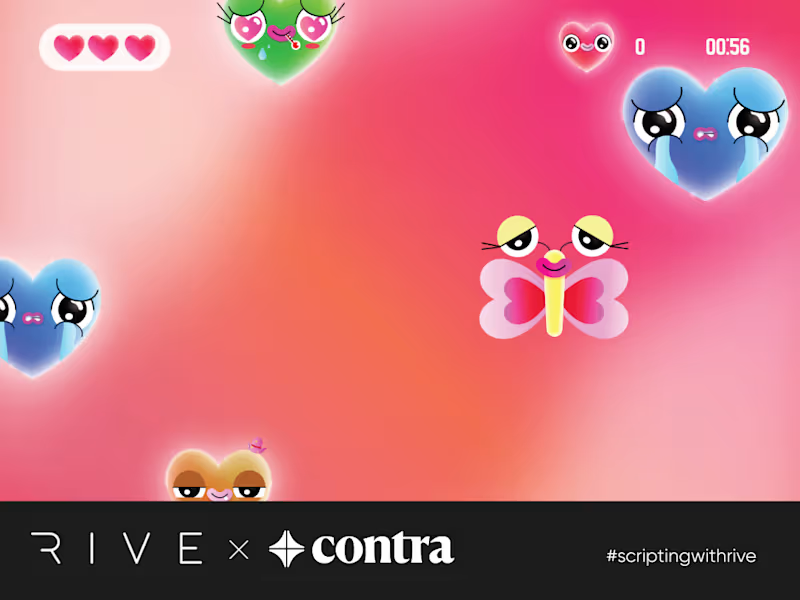
This is my contest submission, a small mini game called “HeartBreaker.”
Break as many hearts as you can before the one minute timer runs out. Click anything that isn’t a heart and you lose a life. Lose three lives and it’s game over.
At the end, you’ll see a recap of how many hearts you broke, plus a sentence that changes based on your score.
All visuals were made in Illustrator and finished in Rive. I used Rive’s AI agent to help build a modular particle system that adapts to different artboard sizes and ramps up in speed and chaos as time runs out.
It’s a simple game, but a lot of fun to make. Hope you enjoy it now go break some hearts!
Links:
Phone version> https://catita-heartbreaker.b-cdn.net/
Desktop version> https://catita-heartbreaker.b-cdn.net/web/
63
82
2.6K
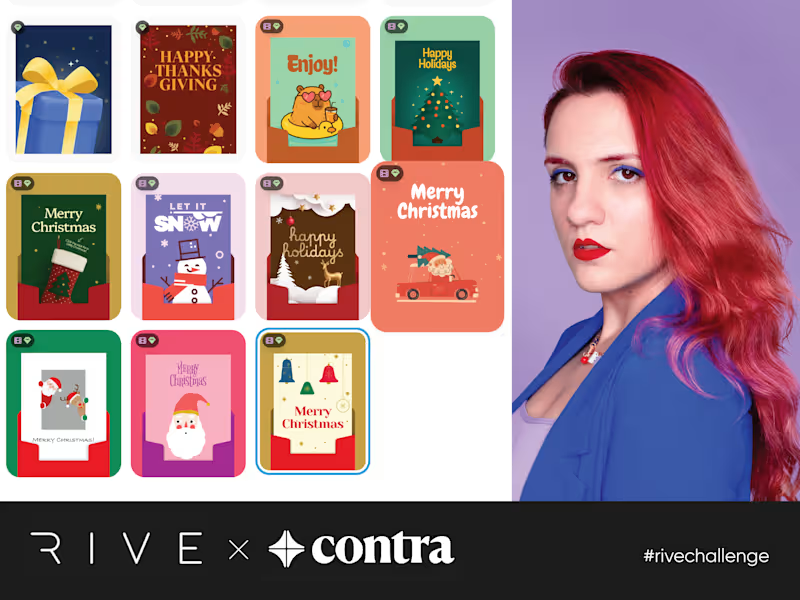
NEW GENERATION OF GREETING CARDS
Hi Contra Riverinos!
For my challenge submission I present you the new generation of greeting cards!
Instead of sending a typical e-card, you can now send an animated, fully interactive greeting card.
We used Data Binding across the file structure to allow change based on user input and preferences, to unite artboards with shared properties, to bind text changed at runtime, image binding for a photo uploader!
View Models were a game changer, making it easy to bring external animations into a base file. Layouts feature ensured every card looks great on any device.
All cards were animated in Rive and I illustrated some myself.
Rather than explain more, I’ll let the video do the talking.
So what are you waiting for? Watch the demo and visit Giftly (https://www.giftly.com/) for the full experience.
28
93
3.3K


ALETRA founder · AI-powered hospitality brands & web design
- $•••••
- Earned
- 3x
- Hired
- 5.0
- Rating
- 25
- Followers
ALETRA founder · AI-powered hospitality brands & web design
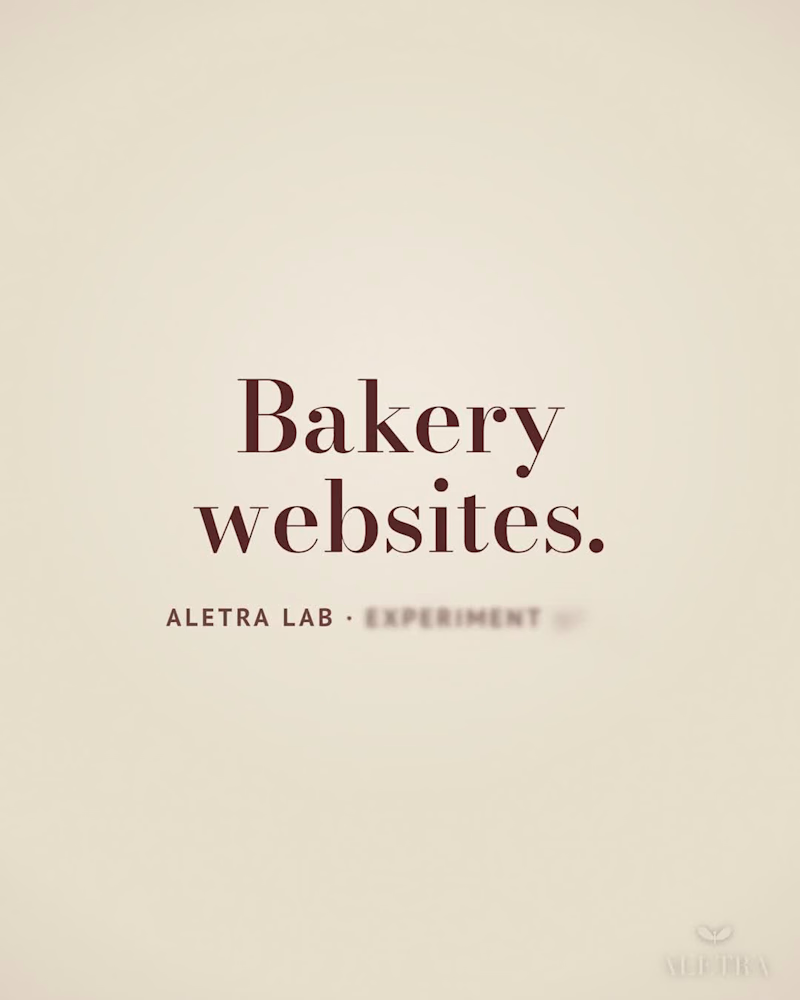
ALETRA Lab · Experiment Nº 01: The Night Baker
Every bakery website shows the same thing: a croissant on white. But nobody falls in love with a bakery because of a croissant. They fall in love at 7 a.m., when the door opens and the warmth hits them before the smell does.
So I asked: what if a bakery's website sold that moment, not the product?
→ Contrast: it starts at 4 a.m., one lit window in a sleeping street.
→ Ritual: the brand is someone awake while the city sleeps.
→ Participation: you don't watch the baker, you knead with him.
→ Senses: glowing oven, soft light. A screen can't smell, but it can make you imagine it.
→ Peak-end: it ends on a person and warm bread, not a product.
Not a client project. It's how I think before I design anything: the feeling first, the pixels last.
Concept & creative direction: ALETRA, Berlin. Crafted with AI. © 2026
2
313


AI Creative Professional |Art Direcor |Sr. Product Desiger





Product Designer with 5+ years of experience in Fintech, B2B
Product Designer with 5+ years of experience in Fintech, B2B
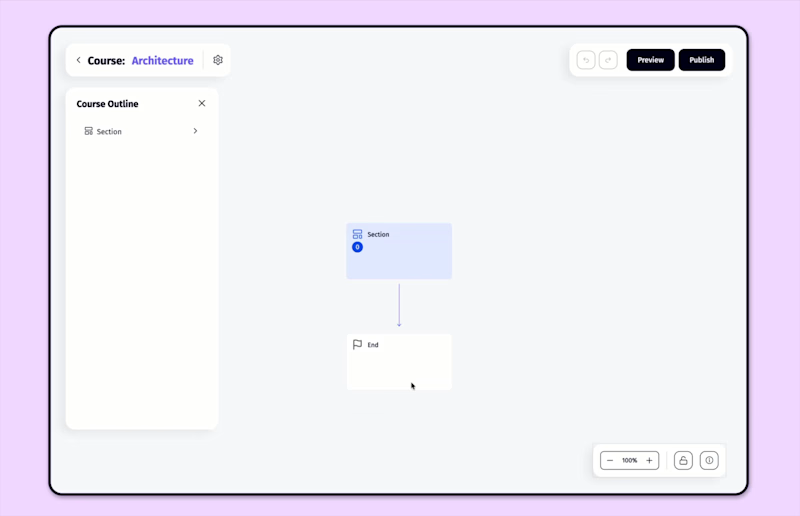
Rethinking course-building as a canvas, not a form
(https://dariamorozova.framer.website/seturon)Seturon is an EdTech startup in Luxembourg building a platform where companies, lecturers, and solo experts structure their knowledge into courses and sell them.
I built the brand from scratch, the design system, six pages of the marketing site, and go-to-market materials.
I redesigned the student and admin panels around the new system, including a full mobile experience for students.
Outcome
A course builder, rebuilt from a form into a canvas. I designed the course constructor from the ground up across two iterations: replacing a linear, step-by-step builder with a canvas-based editor inspired by Miro and FigJam.
Measured with the team and with users (we were in direct contact with users, so we had real product data):
~30 min → ~5 min to build a course skeleton
A 5–6-block non-linear course that took ~30 minutes to set up could now be sketched in ~5 minutes using drag-and-drop, dropdowns, and nested "Section" blocks.
−42% support tickets related to the builder
tracked on the team's ClickUp board by ticket topic, after the mechanics and bugs were fixed.
~34% of users created more than two courses
In the first months after the MVP, it was a sign that the builder was something people came back to.
4–4.5 / 5 in public reviews
The product is frequently praised as user-friendly and understandable even for non-technical users.
(From public reviews)
1
136
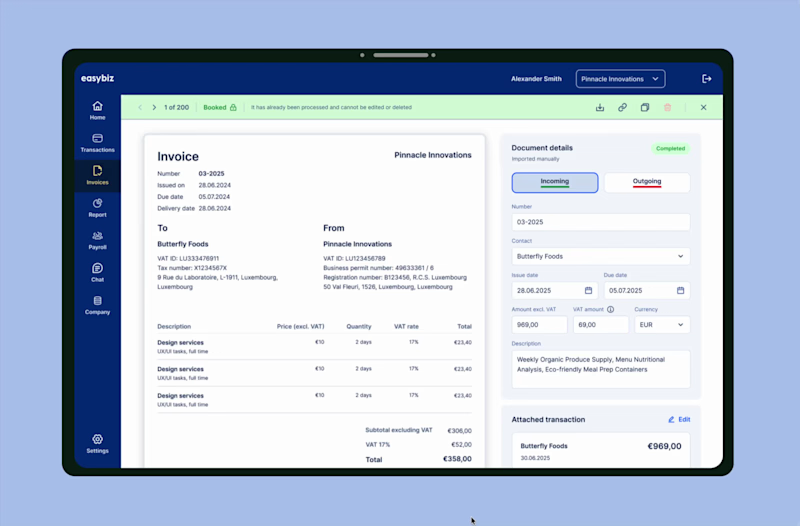
Re-architecting B2B invoicing: from MVP to daily driver
(https://dariamorozova.framer.website/invoices)EasyBiz helps SMEs in Luxembourg register and run their business. I was the sole designer on the product and owned invoicing end-to-end: from MVP 1.0 through the redesign that followed as we grew to our first 100 users over 2025 and saw what broke at scale.
As a founding designer, I owned invoicing end-to-end, validated with real users, the back-office team, and support feedback as we grew to our first 100 users over 2025.
Outcome
I rebuilt EasyBiz invoicing from a card-based MVP into a flow that holds up at real volume. Measured with the support team after release, across all 100 users:
−30% support tickets in the invoicing area
Users stopped forgetting to attach transactions. The single biggest recurring ticket type dropped off.
~2× faster booking for the back-office team
Staff no longer had to chase users to fix or attach transactions, or hunt for half-filled invoices (back-office estimate).
1
142
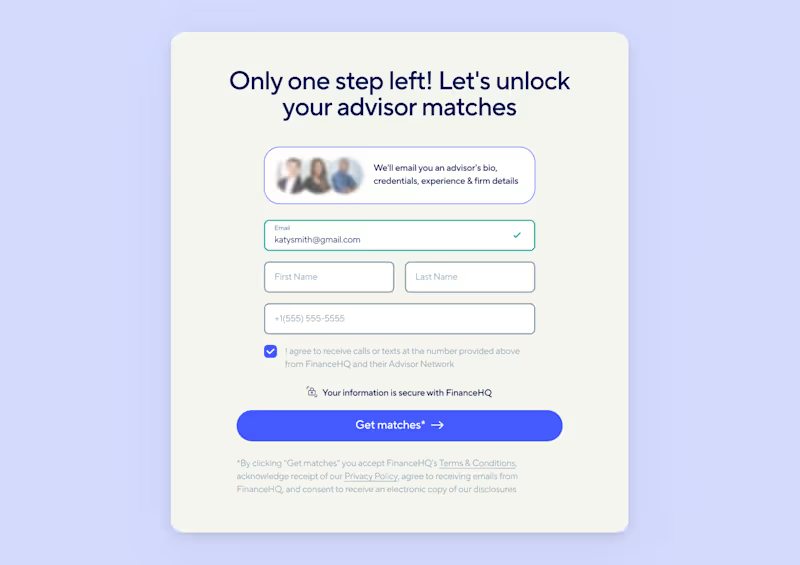
Rebuilding trust in a financial advisor journey
(https://dariamorozova.framer.website/Finance-HQ)FinanceHQ matches people with pre-screened financial advisors. On paper, the product was competitive, but users were leaving at every step of a long lead flow, with drop-off hitting 70% at the moment they were asked for financial details. I joined mid-project, inherited the flow and visual direction, and led the research and redesign that followed.
As a product designer, I worked under a design lead who reviewed direction and owned the client relationship. I inherited the visual language and lead flow, then led the research and redesign that improved conversion after launch.
Outcome
Measured from the client's production analytics after launch, validated with moderated call-throughs during design and A/B tests in production:
+60% conversions
The final step reassured users about data security, and the client's post-launch analytics showed it in conversion.
−4 min time to complete
Range toggles across five stages saved users 4–5 minutes by eliminating exact input and reducing cognitive load.
8-step flow
The flow was condensed to eight steps, completable in under a minute, down from a fragmented, drop-off-heavy process.
40-sec testimonial engagement
On the first step, the longest dwell time in the flow and its key trust moment.
1
150
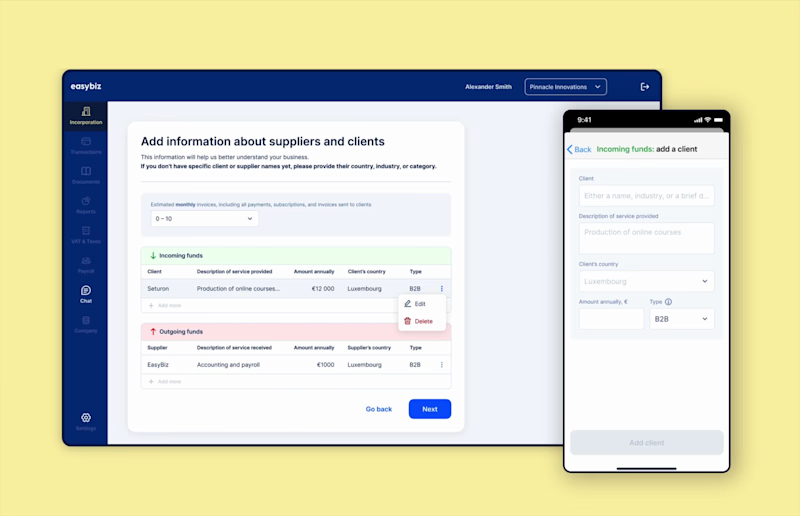
From 28 days to 24 hours: rebuilding company incorporation
(https://dariamorozova.framer.website/onboarding)EasyBiz helps SMEs in Luxembourg register and run their business. Opening a company in Luxembourg took founders up to 28 days: fragmented stages, endless document uploads, and a compliance process no one could see into.
I redesigned it end-to-end into a transparent, AI-assisted pipeline, and cut registration to under 24 hours, making EasyBiz the first in the country to do it in a day.
As a founding designer, I built the product's design function from scratch: the design system, website, core features, and marketing, and rebuilt the KYC onboarding that sits at its heart.
Outcome
Measured over 2.5 years on the product, from support and marketing data and from interviews and HubSpot analytics with 100+ real users through 2025–26:
28 days → under 24 hours
to complete company registration. Confirmed by the back-office team (see the Slack messages at the end).
−60% KYC process time
I digitised the full document workflow and added auto-validation.
−90% compliance follow-ups
A structured client & supplier registry meant the back office stopped chasing missing answers.
−80% file mismatches
A linear checklist and focused modals cut wrong files and final-stage delays.
1
144

Graphic designer creating bold, high-converting visuals
New to Contra
Graphic designer creating bold, high-converting visuals