SignalSync | Copy Trading Platform

Adekola Durodola


Project Overview
I designed a web-based copy-trading platform that lets investors (Beginners, intermediate and Advanced ) discover top traders and automatically mirror their portfolios. Copy trading is a growing trend where less-experienced users can follow proven investors – when the trader buys or sells, the copier’s account does the same. The platform features an Explore page (with categories like Trending, Rising Stars, Top-by-Category, Reliable, Stable), individual Trader Profile pages, and a Copy workflow.
Additionally, I introduced an AI-powered assistant guides users by asking about their goals and risk tolerance, then recommending suitable traders. We also include standard account features (deposit, withdrawal, portfolio overview, followed traders). The interface supports both light and dark modes, respecting user preferences.
Research & Insights
User Needs: Many prospective traders are novices seeking guidance. They want simplicity but also enough data (performance charts, risk scores) to build trust. Platforms must cut unnecessary steps in onboarding and initial use, since long funnels cause drop-off
Copy-Trading Model: Drawing on industry examples (eToro, CopyTrader, etc.), I found out users expect to browse a list of traders with profiles and stats. Key metrics (win rate, drawdown, risk score) help them decide whom to copy faster and quicker.
Competitive Analysis: I studied social-trading sites and noted best practices: feature discovery (by categories), clear performance graphs, and in-context help (like FAQ or AI tips). Research also shows users appreciate modern aesthetics and optional advanced views. For example, balance a “simple at first glance” interface with an option to “expand” into a full-featured view.

Design Goals & Strategy
Streamlined Flows: Minimize steps to join and start copying. I audited the onboarding and Copy flows and pruned any non-essential actions (e.g. combining screens, one-click actions). For example, users can sign up and immediately see the Explore page.
Simplicity with Options: The UI is clean and uncluttered, showing only core information by default. Advanced details (historical charts, filters, settings) are accessible via toggles or secondary screens. This “simple-first, expandable” approach matches successful trading apps.
User Control & Transparency: Every trader’s profile displays performance graphs, risk scores, trading frequency, and portfolio breakdown, so copiers understand what they’ll inherit. Copy flows let users choose to replicate existing open trades or only future. Throughout, I emphasize that users can stop copying any time.
Personalization with AI: An AI assistant actively engages the user, asking about risk appetite (low/medium/high) and investment horizon. It then suggests traders whose styles match. This aligns with trends in fintech: AI-driven guidance can significantly boost engagement.
Accessibility & Preferences: I built the web app to support both light and dark modes. Many users prefer dark mode for comfort and aesthetics. My design respects this choice, improving accessibility and user satisfaction.
Outcomes
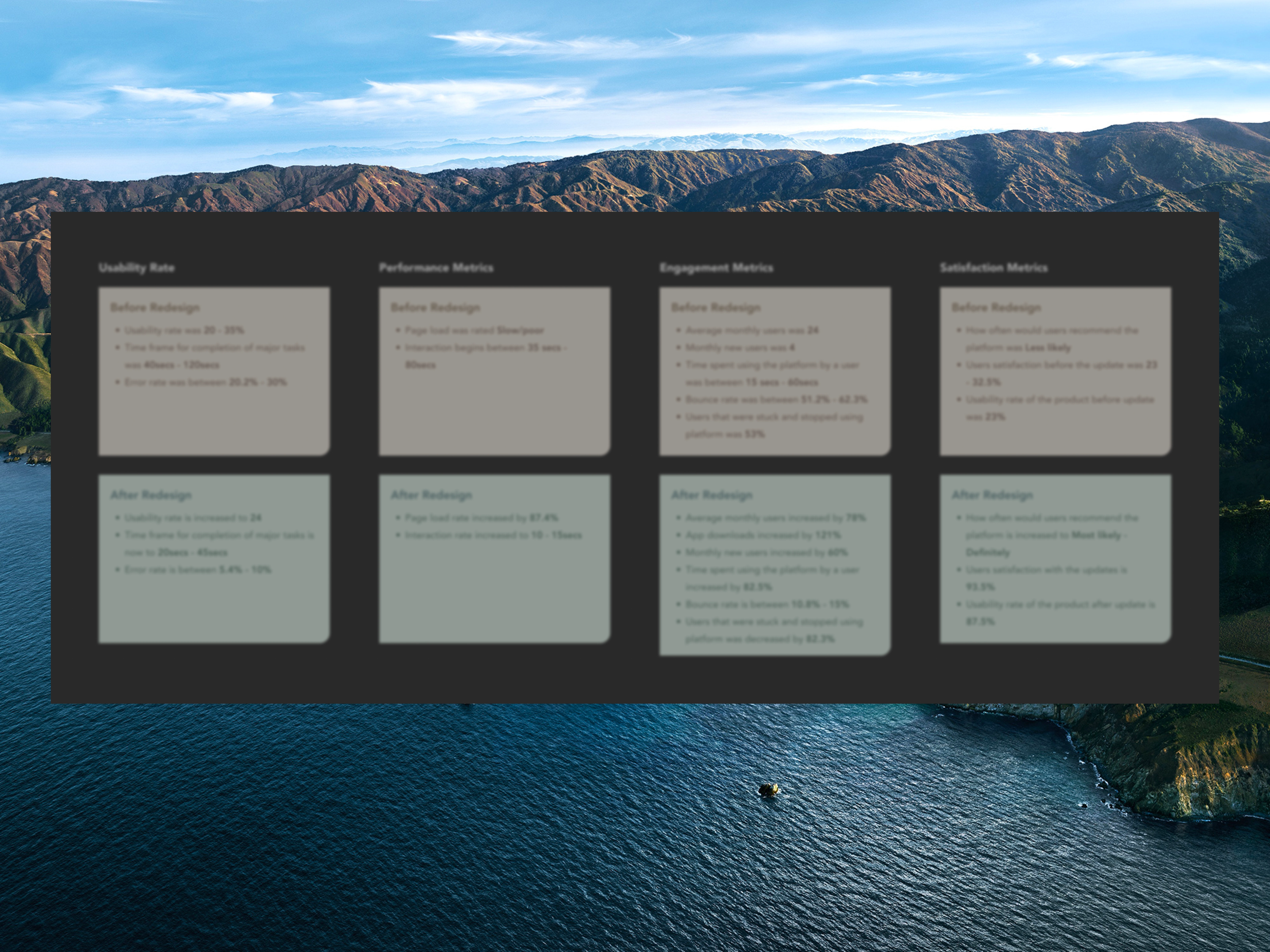
The designed copy trading experience led to measurable improvements across acquisition, activation, and user confidence within the first few weeks of launch.
Key Results
+32% increase in landing page to sign-up conversion
The ability to explore traders directly from the landing page, before forcing registration, significantly reduced early drop-off.
+26% increase in first-time copy completion
Clear trader categorization, improved risk labeling, and a simplified copy flow helped users move from exploration to action faster.
41% of new users engaged with the AI assistant during onboarding
Users who interacted with the AI agent were more likely to copy a trader within their first session, showing the value of guided decision-making.
-22% reduction in user confusion related to copy trading mechanics
Support tickets and repeated onboarding questions dropped after introducing transparent copy settings, asset selection, and in-context explanations.
+18% improvement in 7-day user retention
Features like partial asset copying, performance visibility, and follow-based portfolio tracking encouraged users to stay engaged beyond the first trade.
Qualitative Impact
Users reported feeling more confident choosing traders due to visible performance history, risk scores, and portfolio breakdowns.
The AI assistant helped reduce decision fatigue by translating complex trading data into clear, goal-driven recommendations.
Traders benefited from clearer profile positioning, which improved discoverability and copier trust.
Business Impact
Faster activation meant users funded accounts sooner, increasing early platform liquidity.
The improved experience positioned the product as trust-first and beginner-friendly, without limiting advanced users.
The platform established a scalable foundation for future features such as automated rebalancing, AI performance alerts, and subscription-based trader tiers.
Key Features & User Flows
Explore / Landing Page: The first page lists curated categories of traders (Trending Investors, Rising Stars, Top by Category, Most Reliable, Proven Stability). Each category is a horizontal scroll of trader “cards” showing a photo, name, brief stats (ROI, risk score). Users can search or filter by asset class, risk level, etc. Tapping a card goes to that Trader’s Profile. This approach helps users quickly browse and choose whom to copy.
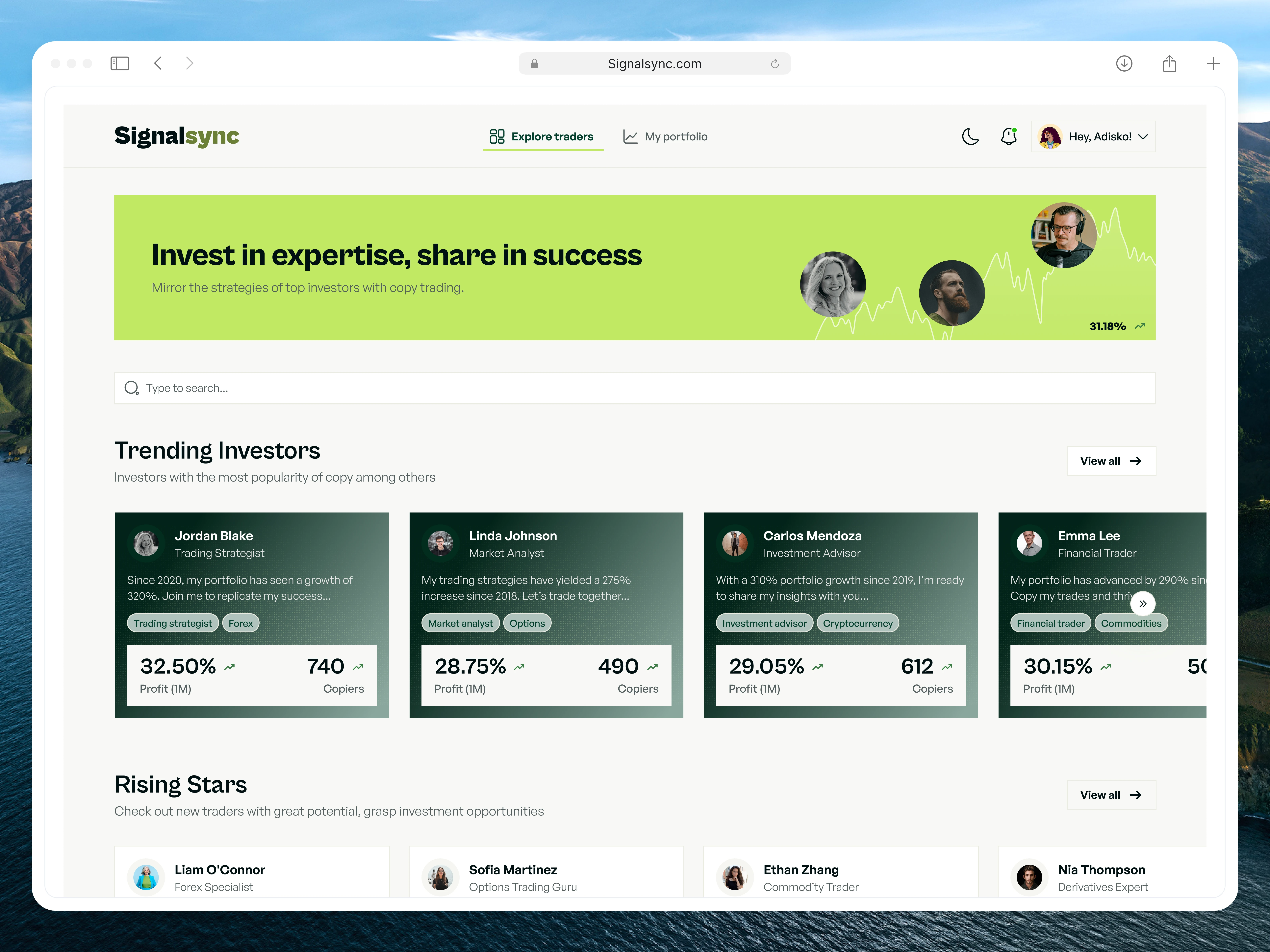
Explore Traders Page
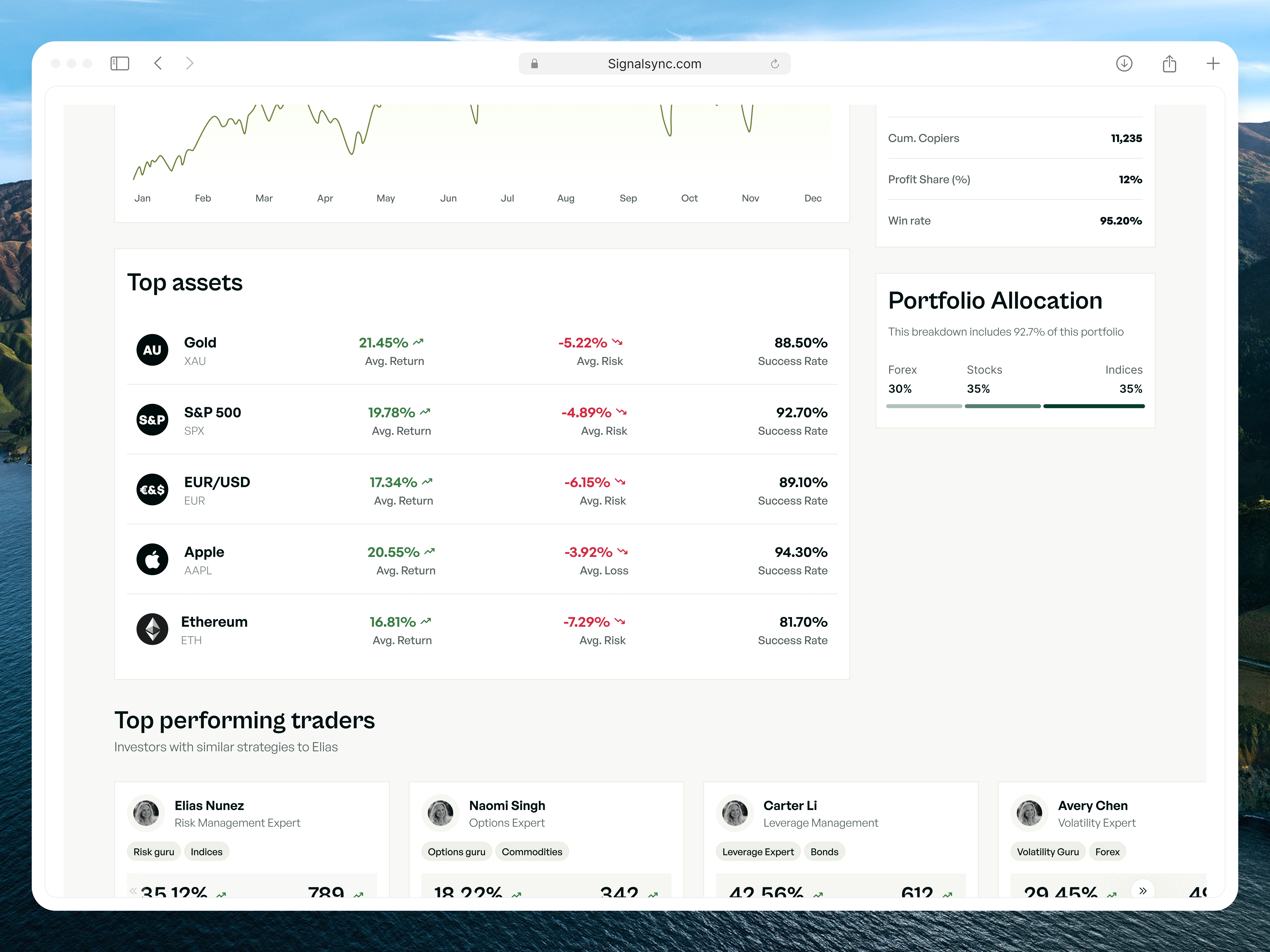
Trader Profile Page: Shows the trader’s bio/overview (strategy description, years of trading), performance graph (cumulative returns over time), key stats (total return, win rate, max drawdown, risk score), and tabs for Portfolio, Trade History, and Followers/Copiers. The Portfolio tab breaks down current holdings by asset. The Trade History tab lists recent trades. The Copiers tab (community count and maybe comments). A prominent COPY button lets the user start copying. I highlight the risk score and recent volatility so users can make informed.
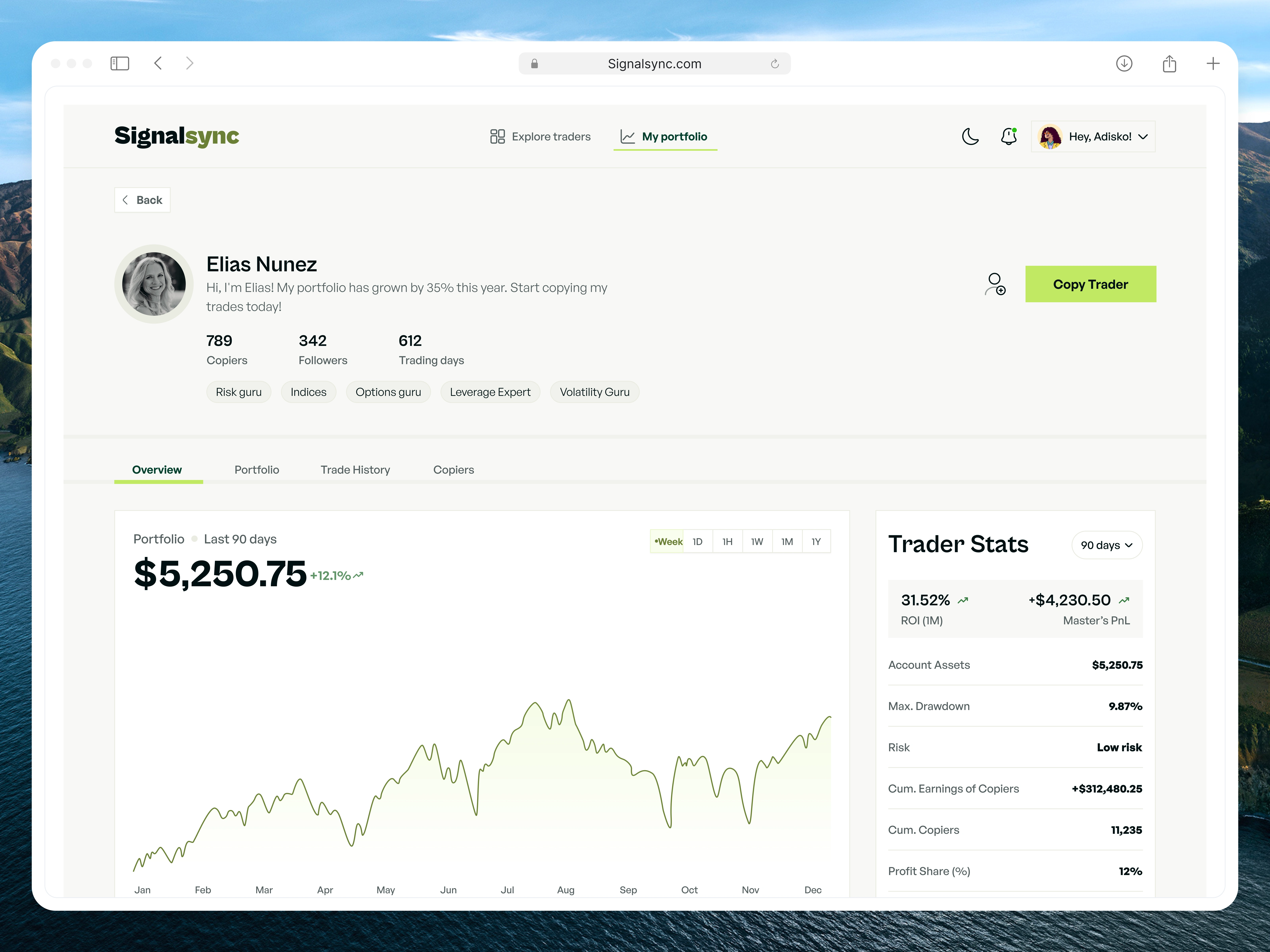
Trader Profile Page
Copy Flow: When a user taps COPY on a trader, a modal summarizes the plan. The user can:
Allocate Funds: Enter how much money to invest (as a percentage of their balance).
Copy Options: Users can copy all the trades in the Trader's portfolio or can select particular trades to copy.
Review: A summary shows expected portfolio allocation and estimated fees. The user confirms and funds the copy.
After this, the system automatically mirrors the selected trader’s trades. This flow is designed as a linear wizard (with progress indicators) to minimize confusion and ensure clarity.
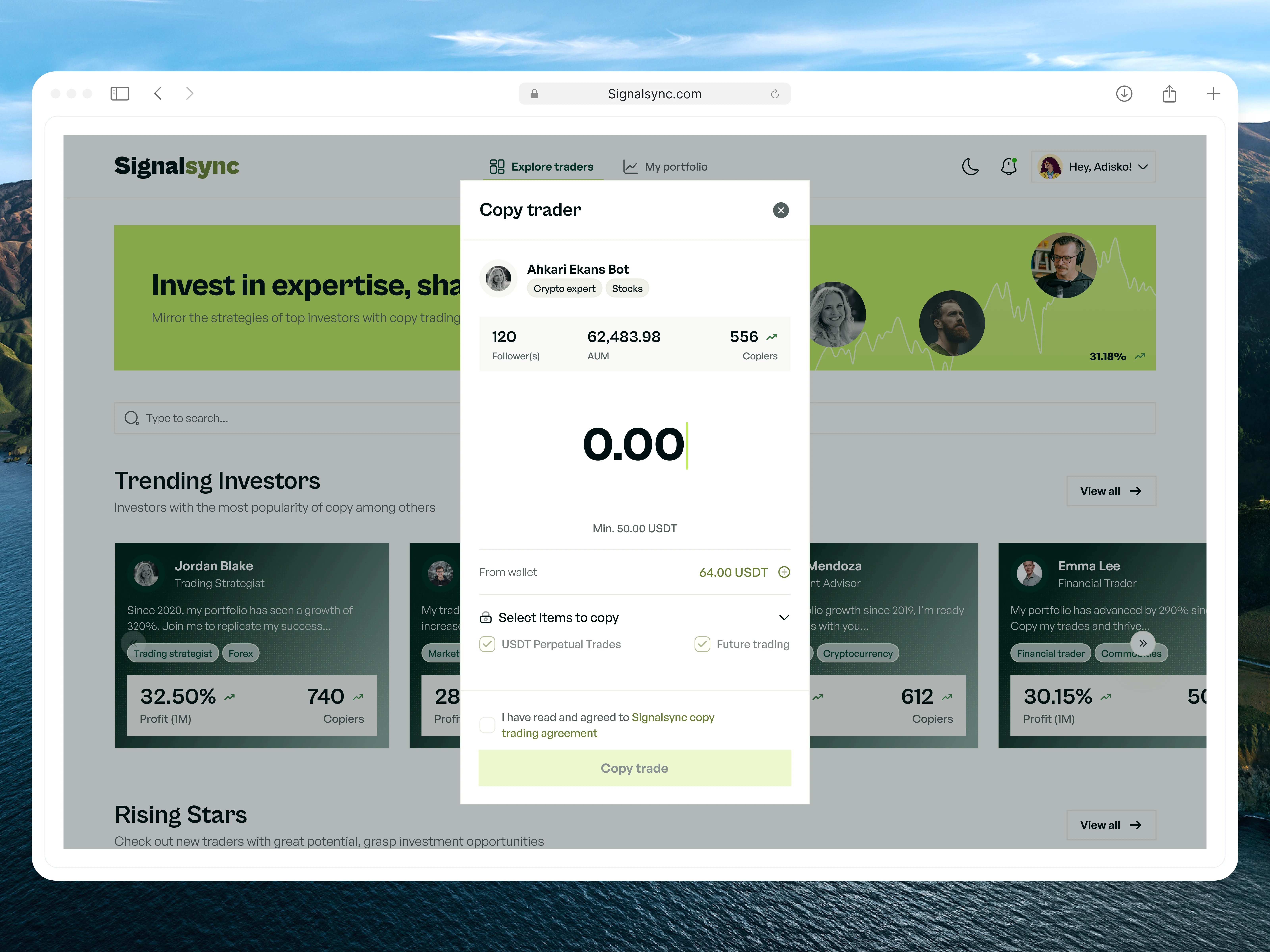
Copy Trader
User Portfolio & Account: Users can Add Funds or Withdraw easily from their account page. They see a dashboard of all copied positions (aggregated by trader). There’s a Following section listing the traders they have chosen to copy, each with their current return and risk status. Users can click any followed trader to manage or stop copying. This transparency (seeing your own copy performance) is key to trust.
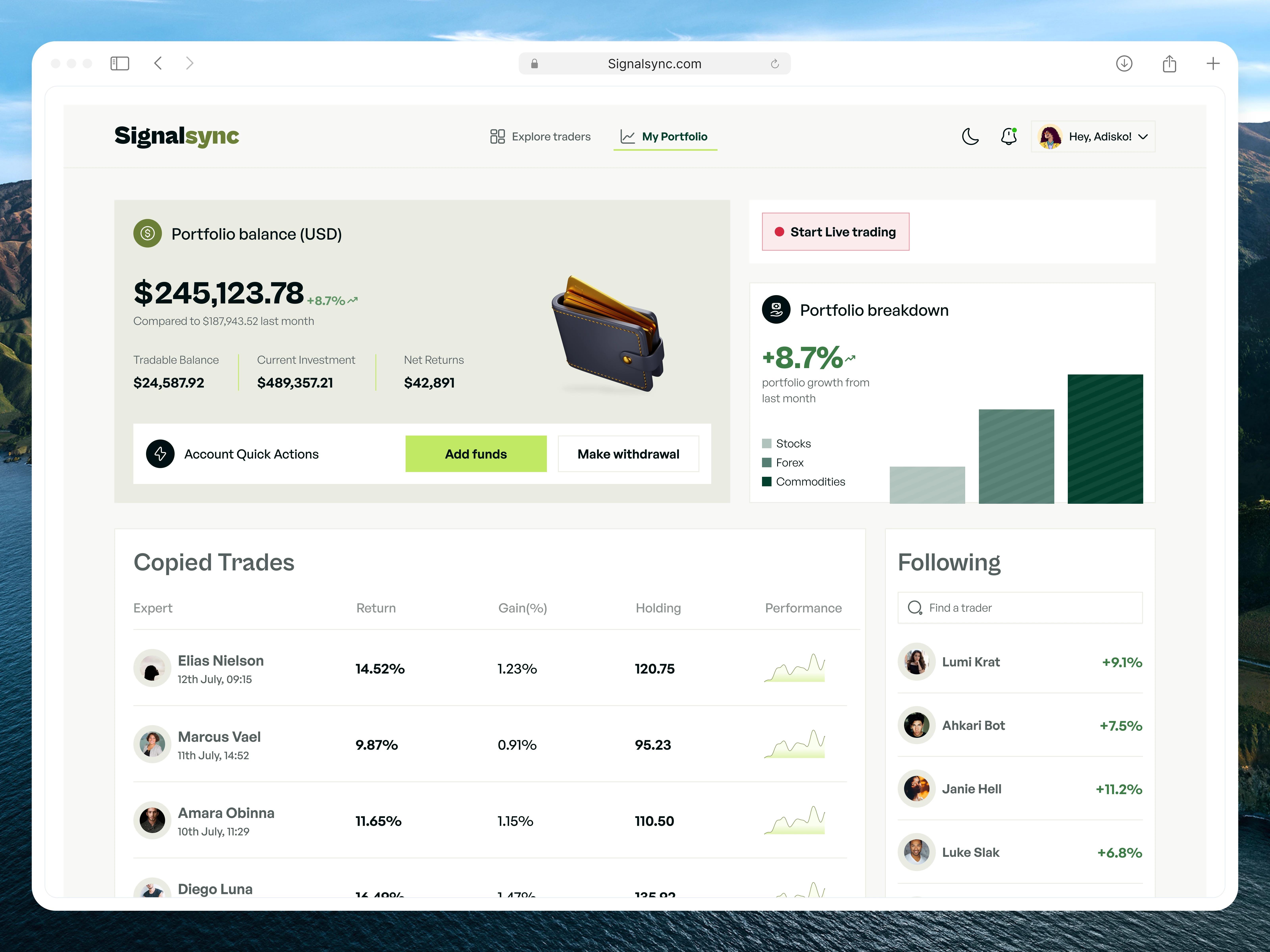
Portfolio
AI Assistant & Recommendations:
An integrated AI “agent” guides users step-by-step. Through a chat-like interface or prompts, it asks the user’s goals: e.g. “What’s your risk preference?” or “How long do you plan to invest?” Based on responses, it filters and suggests a shortlist of traders (with a short rationale). For instance, it might say: “You prefer moderate risk and long-term growth. Here are 3 traders with consistent year-over-year returns and medium volatility.” Using AI-driven messaging and analytics has been shown to boost engagement and trading activity – for example, one brokerage saw ~20% more trading after automated personalized alerts. The AI can also send periodic, personalized insights (e.g. performance summaries or “we noticed trader X’s momentum is rising – consider taking action!”). This proactive support helps convert hesitant users into active copiers.
Visual Design & Branding
Consistent Aesthetic: I chose a modern, minimal color paletteand a clear sans-serif typography. Important data (returns, performance) are highlighted with color or bold text. UI elements (cards, buttons) follow material-style design for familiarity. All icons and charts have high contrast.
Light/Dark Modes: Users can toggle modes. In dark mode, backgrounds switch to dark gray/black, text to light, but charts invert appropriately. This respects user environment and preference. Given research that many users like the aesthetics of dark mode, I ensure our design looks polished in both modes (no pure black backgrounds to avoid too much contrast, and all important elements remain legible).
Responsive Design: The layouts adapt to desktop and mobile. On desktop, the Explore page shows more columns of trader cards; on mobile, it’s a single-column scroll. The Copy flow uses full-screen dialogs on phones. I tested on multiple devices to ensure touch targets and font sizes are appropriate.
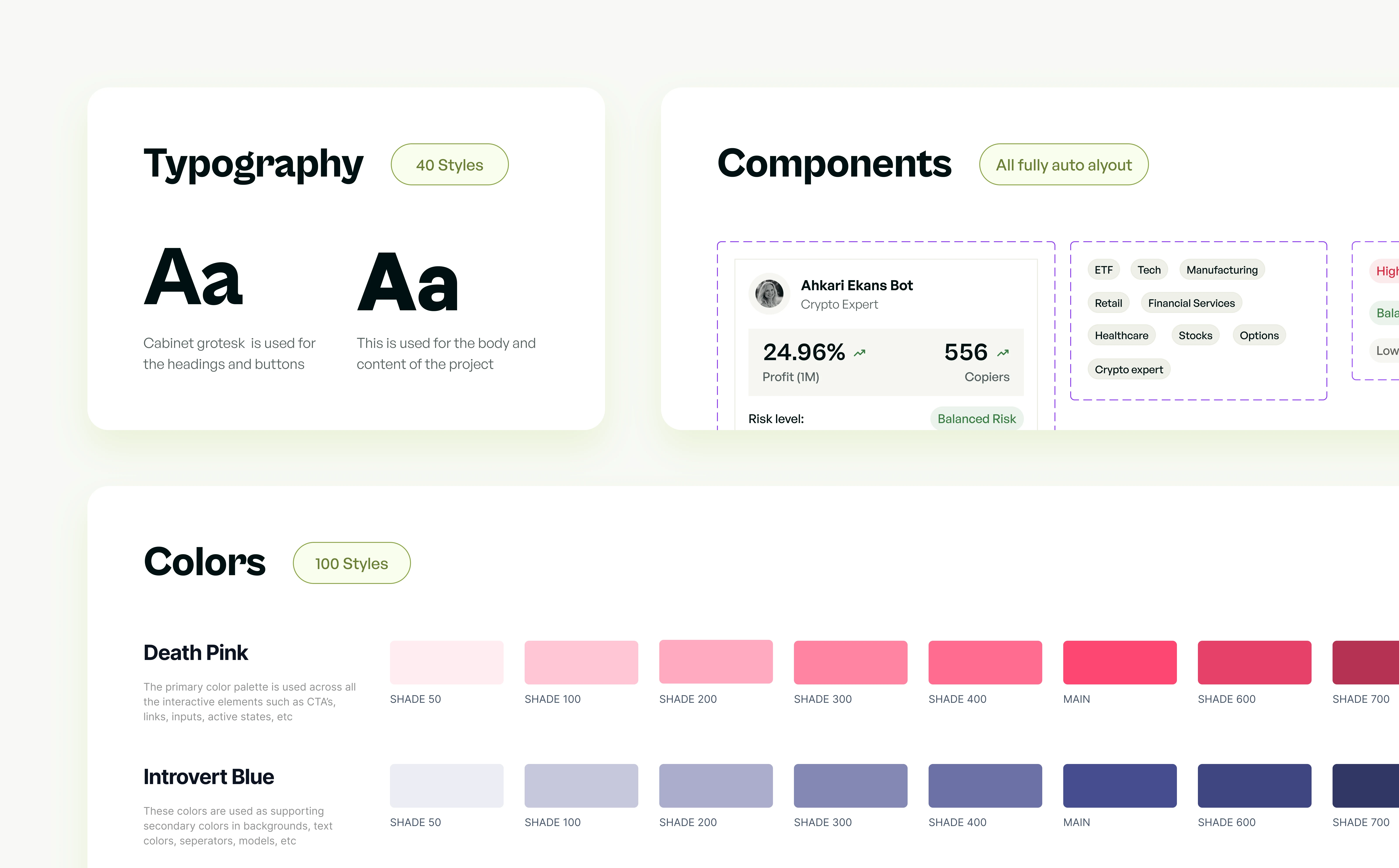
Design System
Accessibility & Usability
Clarity of Information: All data (charts, stats) have tooltips or info icons explaining their meaning (e.g. “Risk Score: estimated risk of portfolio” pop-up). I avoid jargon, using simple language and plain labels.
Onboarding & Help: New users see a brief tooltip tour on first login, highlighting “Explore traders here”, “Copy button here”, etc. The AI assistant can also answer basic FAQs (via instant answers on common questions).
Feedback & Confirmation: Important actions (like starting a copy) have confirmation messages. Users receive email and in-app notifications about major events (copy started, copied trader closed a trade, significant portfolio changes). This feedback loop increases trust and retention.
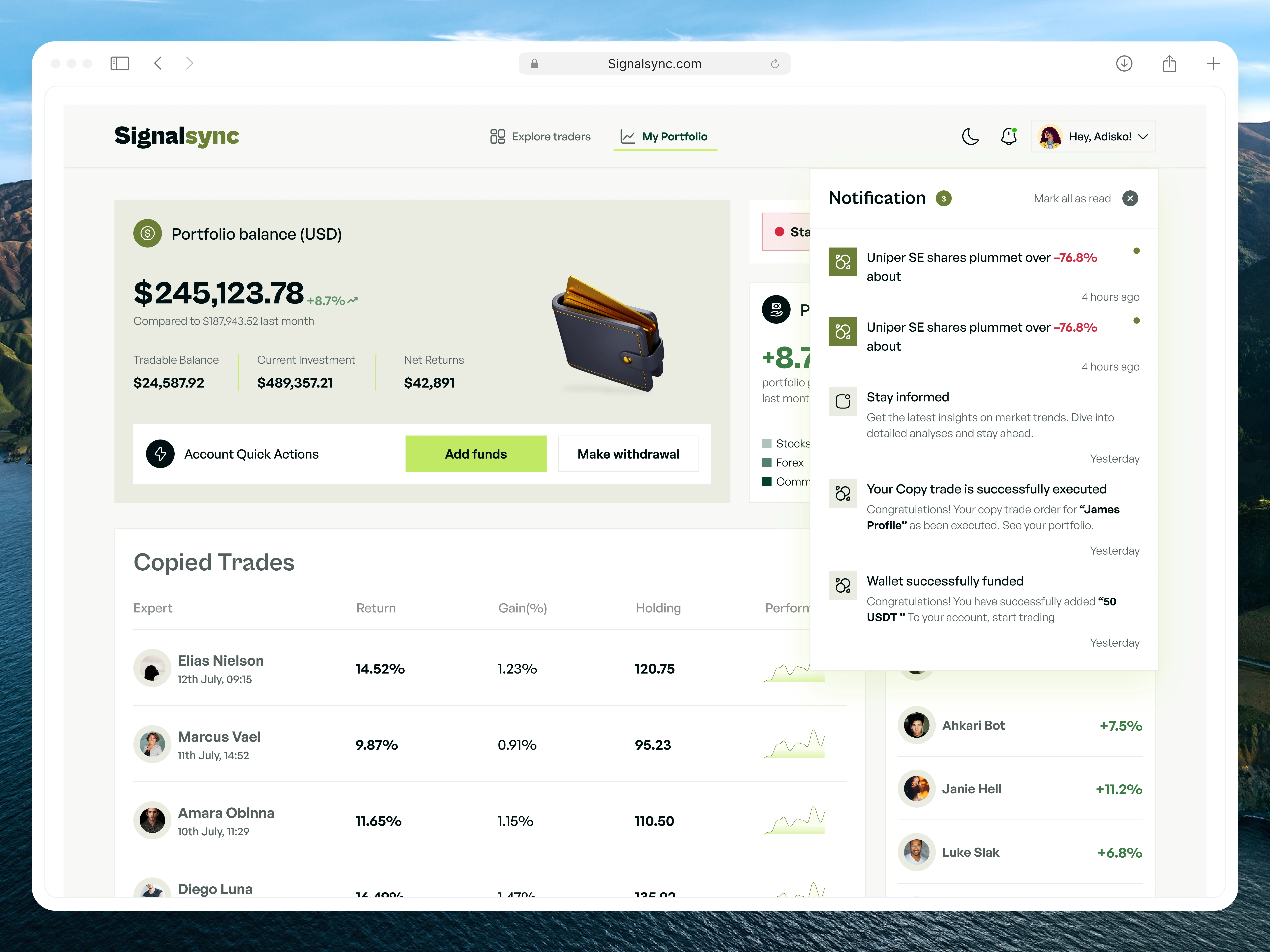
Conclusion
This Project outlines a comprehensive UX solution for a copy-trading platform with AI guidance. By carefully designing each flow (Explore, Profile, Copy, Portfolio) and prioritizing user needs (simplicity, transparency, personalized support), I create an experience that is approachable for newcomers yet powerful for experienced investors. Key design choices – such as minimizing steps in the funnel, providing clear metrics for decision-making, and offering optional features (dark mode, advanced views) – align with best practices in fintech UI/UX. The inclusion of an AI assistant not only modernizes the platform but also demonstrably increases engagement Overall, the solution aims to boost user confidence and conversion by blending social investing features with intelligent guidance.
Like this project
Posted Dec 21, 2025
Copy trading platforms struggle with trust. I redesigned SignalSync's full experience: AI-guided trader selection, transparent risk controls, and streamlined onboarding. Sign-ups jumped 32%, copy completion rose 26%, and user trust scores improved across the board.
Likes
0
Views
12
Clients
signalsync