
Framer Sites Built to Match Your Brand's Voice


Framer Sites Built to Match Your Brand's Voice

Design and build that moves established businesses forward
Design and build that moves established businesses forward


AI Strategy-to-Execution Partner | 5.0 Reviews

AI Strategy-to-Execution Partner | 5.0 Reviews

Curex
Curex partnered with RapidDev to scale patient acquisition nationwide without relying on costly paid advertising. The goal was to replace one-off content efforts with a repeatable, AI-powered system that could generate compounding organic growth and capture millions of untapped high-intent searches across the telehealth and allergy treatment category.
About
Curex is the largest online allergy clinic in the United States, trusted by over 50,000 patients nationwide. As a telehealth-first provider, Curex leads the category in allergy diagnosis and treatment — delivering accessible, doctor-guided care to patients across the country without the need for in-person visits.
The Challenge
As Curex looked to scale patient acquisition nationally, paid search proved unsustainable, with Google Ads CPCs running between $4 and $7 per click and climbing. Thousands of high-intent queries related to allergy symptoms, treatments, and telehealth remained completely untapped, and producing content at the volume needed to capture that demand was not operationally feasible through traditional methods.
The company needed more than a content strategy — they needed a system built for sustainable, compounding growth that would continue delivering results long after the initial investment, rather than disappearing the moment ad spend was paused.
The Solution
RapidDev (https://www.rapidevelopers.com/) designed and launched an AI-powered programmatic SEO system that automatically created thousands of highly targeted, search-driven pages covering allergy conditions, symptoms, treatments, and telehealth queries. Every page was built around buyer intent, ensuring traffic captured was high-converting rather than broadly informational.
The infrastructure was engineered for compounding growth, meaning the system became more powerful over time as page authority accumulated. Retargeting-ready architecture was layered in to convert organic visitors into patients, while full AI search readiness ensured Curex's content ranked across both traditional and emerging AI-powered search platforms.
The Result
The impact was measurable and rapid — delivered within just five months:
Daily clicks grew from 586 to 3,400+, reflecting rapid and sustained organic expansion
1,012,950 total organic clicks generated, with 91% of all traffic driven entirely by the programmatic SEO system
The $120K SEO investment produced an estimated $4.0M – $7.09M in equivalent paid ad value, based on prevailing Google Ads CPCs for the same queries
Built a fully repeatable, scalable growth engine that continues compounding — eliminating reliance on paid acquisition and delivering long-term ownership of high-intent patient traffic nationwide.
1
1.2K

Omi
Omi partnered with RapidDev to scale developer and creator acquisition through a programmatic SEO system built specifically for a highly technical, niche audience. The goal was to move beyond reliance on paid channels and generic content, and instead build a sustainable, compounding organic growth engine that would attract developers, makers, IoT enthusiasts, and early adopters at scale.
About
Omi is an open-source AI wearable companion — similar to a smart necklace — that helps users stay organized across tasks, apps, and daily life by providing summaries and suggesting action items based on real-time activity, both online and in person. Designed for creators, thinkers, and tech builders who want productivity and privacy on the go, the AI wearables platform includes an app marketplace, supports offline transcription, and offers developer-friendly SDKs.
The Challenge
Omi's target audience is highly technical and niche — developers, makers, IoT enthusiasts, and early adopters — making it difficult to reach them through broad paid channels or generic content strategies. The market for AI wearables remained relatively new and highly competitive, requiring Omi to attract its audience with precision rather than volume.
The company had limited capacity to produce technical, niche-specific content at the scale needed to build meaningful organic traffic. Without a repeatable system, Omi risked being unable to grow its owned search presence in a high-value, niche market before competitors established dominance.
The Solution
RapidDev designed and launched a scalable, sustainable content infrastructure tailored to Omi's core developer and maker ecosystem. Using strategic intent mapping, the team identified high-intent search patterns across IoT, AI wearables, developer tools, and productivity use cases. A dual-layer keyword optimization approach was implemented to capture traffic from both broad discovery queries and highly specific, conversion-ready searches.
The team built modular content architecture using scalable page templates, enabling the rapid deployment of 3,900+ targeted pages in under six months. The entire system was built on future-ready infrastructure designed to grow with Omi's platform and new feature releases — ensuring the content engine compounds in value over time rather than requiring ongoing manual effort.
The Result
The impact was delivered within six months:
Daily clicks grew from 100 to 2,500+, reflecting rapid penetration into a highly targeted developer and creator audience
204,000+ total organic clicks generated alongside 7M+ total impressions, establishing Omi as a visible authority in the AI wearables space
3,900+ targeted pages launched and ranked for competitive keywords, directly driving developer and creator acquisition
Delivered a sustainable reduction in Customer Acquisition Cost (CAC) and built long-term owned search presence in a niche, high-value market
Built a fully repeatable, scalable organic acquisition system that continues compounding over time — independent of paid channels or one-off content campaigns
0
1.2K

Hoffman Brothers
Hoffman Brothers partnered with RapidDev to scale service inquiries through a sustainable, AI-driven programmatic SEO system. The goal was to reduce dependence on costly paid ads, capture thousands of untapped high-intent searches, and build a compounding growth engine that could support long-term business expansion.
About
Hoffman Brothers is a full-service residential and commercial provider specializing in HVAC, plumbing, electrical, and appliance repair services across St. Louis, KY, and Nashville, TN. With over 40 years of experience, they have built a strong reputation for reliability, professionalism, and a customer-first approach — serving both homeowners and commercial clients across multiple markets.
The Challenge
As Hoffman Brothers looked to scale their service inquiries, they faced a critical constraint: their existing growth relied heavily on paid search, where CPCs ranged from $195 to $849, making sustainable scaling cost-prohibitive. Meanwhile, thousands of high-intent searches remained completely untapped.
Content creation at the volume needed to capture that demand was not operationally feasible through traditional methods. The company needed a system built for long-term, compounding growth — not short-term traffic spikes that disappeared the moment ad spend stopped.
The Solution
RapidDev developed an AI-driven programmatic SEO system that generated 3,000+ pages targeting appliance error codes, repair guides, and local service inquiries — all optimized for buyer intent rather than general traffic. The system was built to be AI search ready, ensuring content ranked across both traditional Google results and emerging AI-powered search engines.
The infrastructure was designed for compounding growth, meaning every page published increased the overall authority and reach of the site over time. Retargeting-ready architecture was also implemented, allowing Hoffman Brothers to convert captured organic traffic into long-term customer relationships and reduce dependency on paid acquisition entirely.
The Result
The impact was measurable and rapid — delivered within just five months:
Daily clicks grew from 221 to 1,776, demonstrating significant organic reach expansion
146,027 total clicks generated, accounting for 80% of the site's total traffic
Achieved a 10–13x traffic value ROI through high-intent organic search
Organic traffic equivalent to approximately $1.0M in paid ad spend — saving millions in acquisition costs
Built long-term ownership of high-intent search traffic, reducing dependency on paid campaigns entirely
Achieved full programmatic SEO infrastructure, ensuring compounding growth well beyond the initial engagement
1
1.1K


Turning Consumer Brands into Category Leaders
- $10k+
- Earned
- 4x
- Hired
- 5.0
- Rating
- 71
- Followers
Turning Consumer Brands into Category Leaders

"Your packaging might be invisible. Not bad. Not ugly. Just... forgettable."
It's one of the more uncomfortable conversations to have with a client — when the work looks fine but strategically misses the mark. When it fits the category so well it disappears into it.
The shelf is a crowded place. Every category has a look, and most brands follow it. That's exactly the problem.
When I look at how well a package stands out, I focus on four things: color, shape, typography, and positioning. Not as design choices — as competitive advantages. The question isn't whether each element looks good. It's whether the combination is unmistakably theirs.
If you're working on a packaging project and want a second opinion on where it lands competitively — reach out.
1
316


Branding and Website Designer


Hello Contra Fam!
I'm thrilled to share my first attempt at Procreate Dreams with you all! I've just completed a logo animation for my personal brand, Amoah Design, and it's been an exciting departure from my usual workflow in Adobe After Effects.
This project was all about exploring the art of frame-by-frame animation, and I'm really pleased with how it turned out.
I'm curious to hear from those of you who have experience with Procreate Dreams. What are your impressions of the software? I'd love to get your insights!
2
20
885

Software engineer - ex-Spotify, ex-Wayfair
- $5k+
- Earned
- 1x
- Hired
- 5.0
- Rating
- 3
- Followers
Software engineer - ex-Spotify, ex-Wayfair
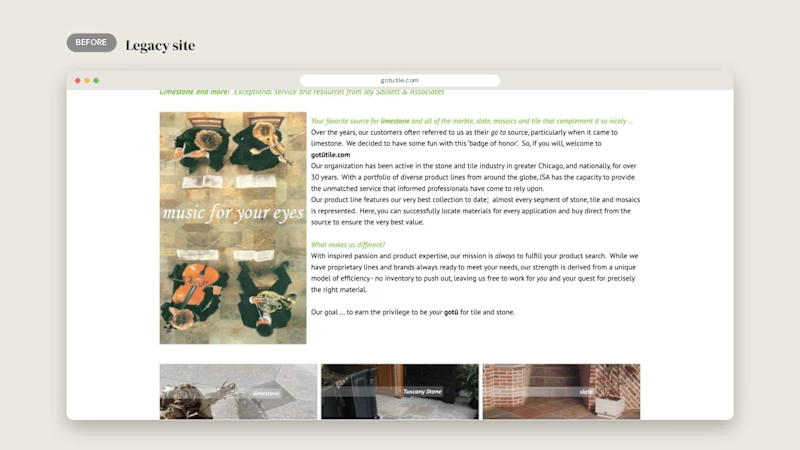
I was lucky to have Jay Sackett of Jay Sackett & Associates reach out to me about refreshing gotūtile, his Chicago-area stone and tile site. His site was built on Weebly and hosted with Network Solutions, and it was showing its age, so we moved it to a modern setup and gave it a fresh look.
Before: Weebly site builder on Network Solutions shared hosting.
After: a lightweight custom site (HTML, CSS and a little JavaScript) hosted on Cloudflare Pages, with Cloudflare DNS and automatic SSL.
Along the way I pulled all 17 pages and 800+ product images over from Weebly and gave the site a clean, showroom-style design. It now has easy dropdown navigation, swatch galleries you can click to enlarge, and works well on phones.
If you’re in the Chicago area and looking for limestone, marble, slate, mosaics or tile, check out Jay’s work at gotutile.com (http://gotutile.com). He’s been helping people find the right stone for over 30 years.
1
49
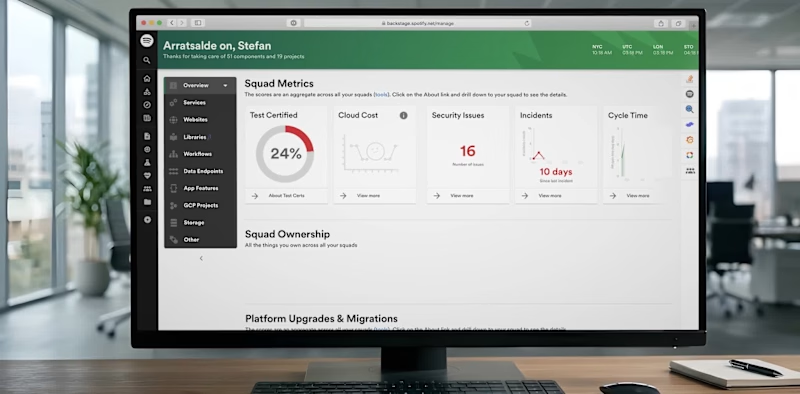
During my time at Spotify (2020–2024), I built custom Backstage plugins across several engineering teams within Core Infra. My contributions include:
- Reliability: Built a Service Level Platform to enable teams to define SLIs/SLOs, visualize time-series metrics against SLO targets using RechartsJS, and access executive-level summary stats across all services.
- Observability: Designed and built the Heroic Migration UI, a tool created to track a company-wide metrics migration effort from our in-house time-series database (HeroicDB) to our Prometheus-based databases.
- Storage: Supported a high-priority (P0) initiative by building the GCS Retention Backstage plugin. Partnered with backend storage engineers to design UI workflows that simplified Google Cloud Storage bucket labeling and tracked compliance across the company.
- Fleetshift: Provided frontend consulting (architectural design, mob programming, implementation, and handoff) to build the UI for Fleetshift, an internal tool used for large-scale automated code changes.
1
51
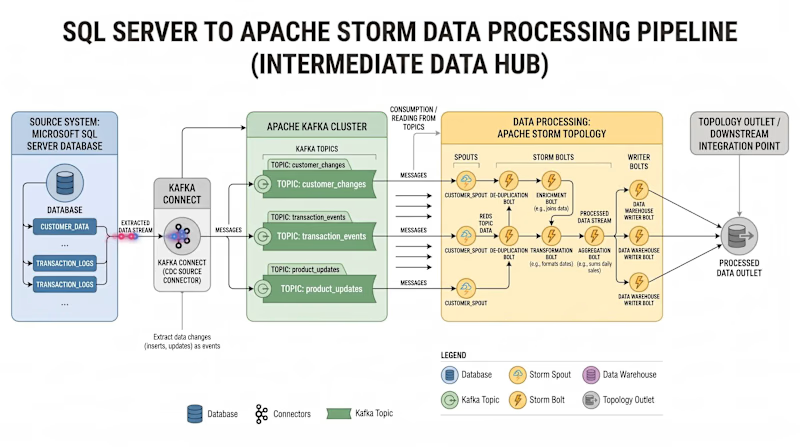
During my five years at Wayfair (2015–2020), I spent my first two years building internal tools within Warehouse Management Systems. As the demands of our data workflows evolved, my work naturally led me to transition our legacy, cron-based pipelines into event-driven architecture. To overcome key limitations in the upstream open-source code, I researched, modified, and provisioned Wayfair’s earliest Kafka Connect clusters. To scale this impact, I founded a new Infrastructure team dedicated to supporting event-driven systems company-wide, serving as an internal consultant to help engineering teams migrate from database polling to real-time stream processing.
1
62
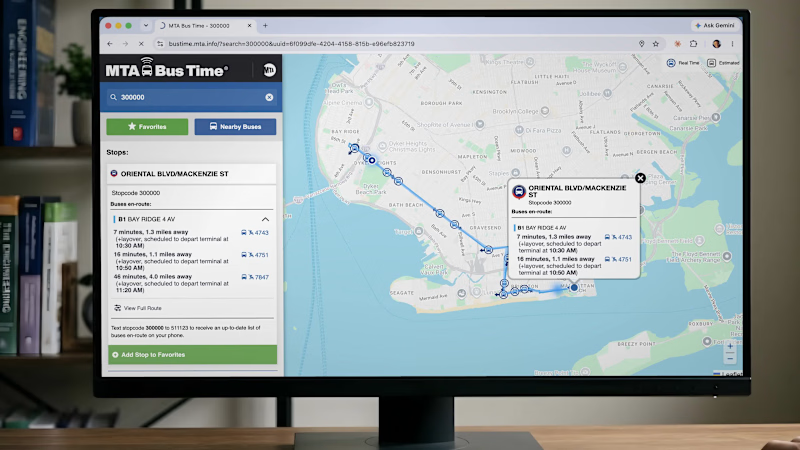
My first full-time position out of college was at Cambridge Systematics, a transportation consulting company in Boston, from 2013 to 2015. While I was there, I supported development of NYC MTA’s Bus Time app, a real-time bus tracking app on web and mobile. It was a splendid way to kick off my software engineering career, gaining exposure to mapping libraries like LeafletJS and Mapbox.
You can check out the app here: https://bustime.mta.info/ and the open source repo here: https://github.com/camsys/onebusaway-nyc
1
66

Results Driven SMM & Marketing Strategist
- $10k+
- Earned
- 5x
- Hired
- 5.0
- Rating
- 46
- Followers
Results Driven SMM & Marketing Strategist


Video Storyteller


;