Built with Framer
Switchyards — Multi-Location Framer Website

Chris Luniewicz


Switchyards
Switchyards
The Client 📝
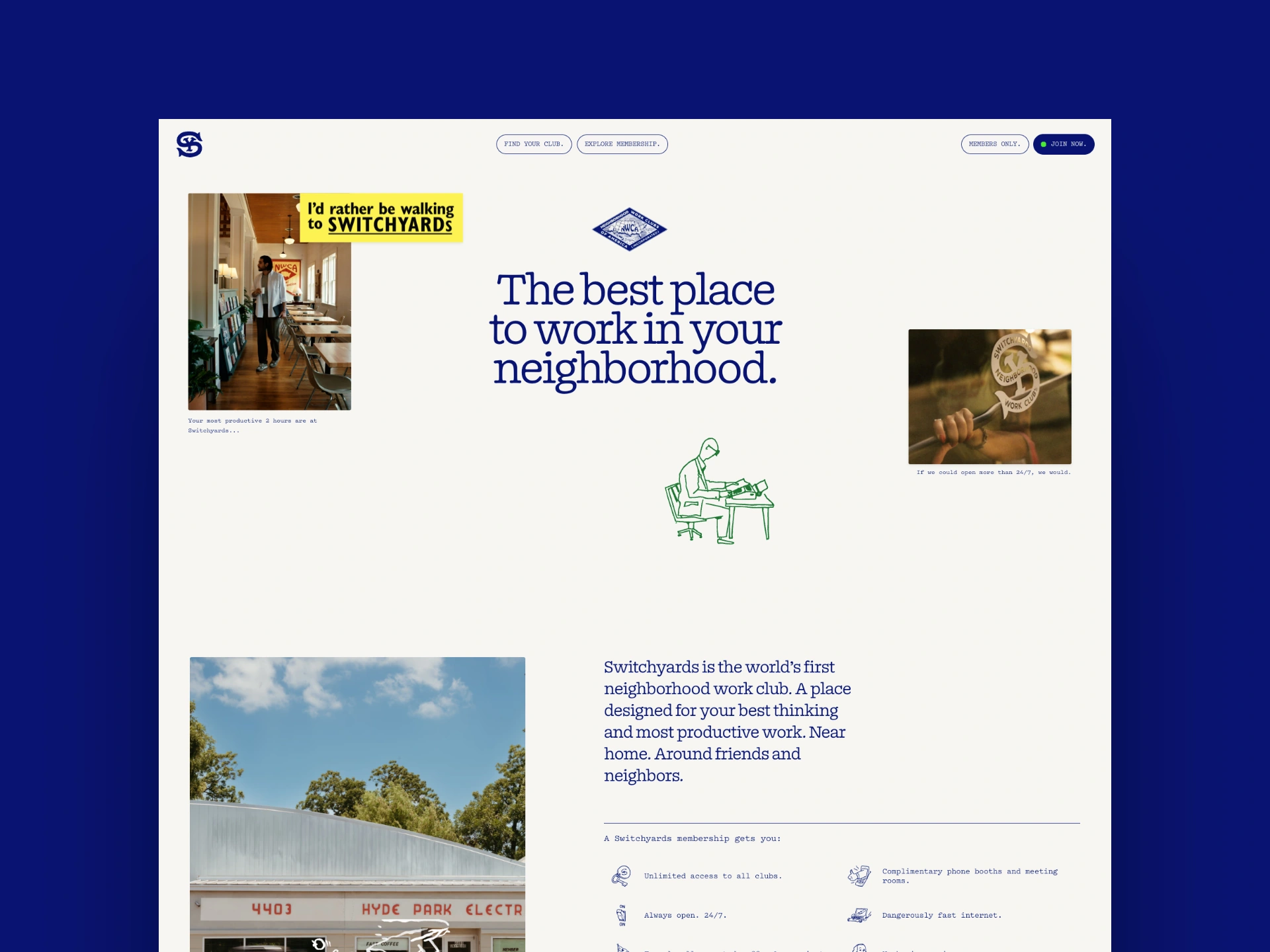
Switchyards is the world's first neighborhood work club, with nearly 40 locations across the U.S. The site needed to match their energy — playful, opinionated, and packed with personality — while scaling across dozens of unique location pages.
Project Overview 🔍
Fuzzco led branding, design, and copywriting. On the build itself, this was a close two-person collaboration with Rachel at Fuzzco — she gave ongoing design and technical direction throughout, and I handled implementation, animations, and the trickier engineering problems.
Project Goal ✅
Translate that personality into a component system that could scale cleanly across nearly 40 location pages — and hold up technically as new locations and features got added after launch.
Responsibilities 📋
Framer build: Worked alongside Rachel on animations, interactions, and site architecture, implementing her direction throughout
Custom location display: Built a self-updating component pulling from two CMS collections (Cities and Clubs) to render a typographic, flowing display of every city and neighborhood location
Membership checkout flow: Integrated a real purchase experience into Framer, beyond a typical marketing site
Attribution tracking: Implemented UTM tracking across 30+ location pages so campaign attribution persists through to the join flow
Post-launch support: Ongoing bug fixes and feature requests directly from Rachel and Fuzzco after launch
Technical Challenges
The location display was one of the trickier builds — Framer's native CMS lists render as rigid grids, but the design called for city and neighborhood names to flow inline like a paragraph of text, wrapping naturally and updating automatically as new clubs get added. That meant building a custom component to fetch and merge two CMS collections into one live, typographically correct display.
The nav's hide-on-scroll behavior turned into a deeper problem after launch: on real iOS devices, the browser's overscroll bounce at the top of the page tricked the scroll logic into thinking the page was still scrolling down, leaving the nav stuck hidden. After a few more complex code-level fixes didn't hold up against actual device behavior, the fix that stuck was disabling the overscroll bounce at the browser level — simple, but it took real device testing to find. I kept Rachel looped in on the tradeoff before shipping it.
Not every problem needed a custom build, either — a Google Reviews carousel was scoped as a custom component, but a third-party multi-location service ended up being the smarter call operationally than maintaining custom infrastructure across a growing number of locations.
Results
Shipped a component system, built in close collaboration with Rachel, that scales cleanly across nearly 40 location pages
Solved a real-device iOS scroll bug that no code-level workaround could fix — only a browser-level setting could
Integrated a working membership checkout flow and UTM-based attribution tracking, tying marketing spend through to signups
Chose the right tool for the job on reviews, avoiding unnecessary custom infrastructure
Delivered a site with serious personality that actually works at scale — including after launch, through an ongoing working relationship with Fuzzco
Takeaway
This one was a beast — and a genuinely shared one. The hard parts weren't solo technical puzzles, they were problems Rachel and I worked through together: real CMS architecture, real device quirks, and knowing when not to build something custom.
Like this project
Posted May 28, 2026
With nearly 40 locations across the U.S, the site needed to match their energy while scaling across dozens of unique location pages.
Likes
3
Views
82
Timeline
Mar 10, 2026 - Jun 10, 2026
Clients
Fuzzco
Switchyards