5-stage AI article pipeline on Make.com, Airtable and OpenAI

Prem Patel


An editorial team that had rejected one-shot AI writing now runs a five-stage article pipeline on Make.com, Airtable and OpenAI with a human gate between every stage. It produces 1,800 to 4,000 word articles with a source list per piece, any single stage can be re-run on its own, and the team operates it without an engineer.
Key facts
Fact | Detail |
|---|---|
Client | Editorial team producing long-form marketing content |
Platform | Make.com, one scenario per stage, plus ten background automations |
Stack | Airtable (control panel), OpenAI, Slack, CMS hand-off |
Stages | Research, outline, draft, score, polish, each with a human checkpoint |
Output | 1,800 to 4,000 word articles with a source list |
Client-reported | Production time per article from six to nine hours to sixty to ninety minutes (client's estimate) |
Why this matters
Most AI content pipelines fail at the same point: the editor stops trusting them and goes back to doing it by hand. One-shot generation gives no sources, no way to fix one paragraph without regenerating everything, and no visibility into why the model wrote what it wrote. The fix is not a better prompt, it is a workflow shape: stages, state the editor can see, and re-runs that touch one stage only. Make.com and Airtable are a good fit because Airtable holds the state and status the editor controls, and each Make.com scenario is triggered by a status change.
The problem
The team had tried one-shot AI writing and rejected it: no sources, no way to fix one paragraph without regenerating everything, no visibility into why the model wrote what it wrote.
What we built
Five stages, each a Make.com scenario, each with a human checkpoint in Airtable: research, outline, draft, score, polish.
Airtable is the control panel. A piece cannot move to the next stage until a person sets its status
Every stage stores what the model was given and what it returned, so an editor can see why a draft says what it says
Notes carry forward from one stage to the next
A scoring stage grades the draft against the brief before a human reads it
If a draft is wrong, the editor re-runs that one stage, never the whole article
Ten background automations handle the plumbing: Slack notices, source checks, formatting and hand-off to the CMS
How it runs, step by step
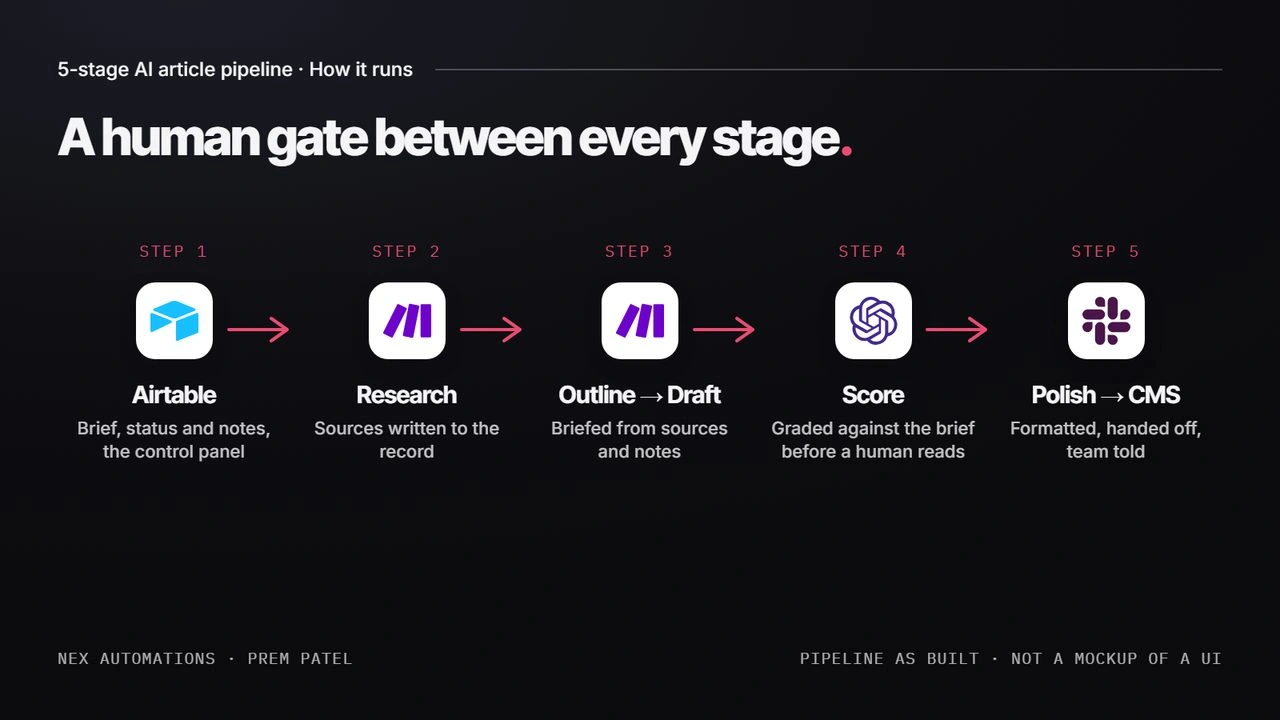
How the five-stage article pipeline runs: Airtable control panel, research, outline and draft, score, polish and CMS
An editor creates the brief in Airtable and sets the status to "research".
The research scenario gathers sources and writes them to the record with the prompt and the raw return.
The editor reviews, adds notes, sets "outline"; the outline scenario runs with those notes.
Draft runs the same way, then the scoring scenario grades the draft against the brief.
The editor reads the score and the draft; a weak section means re-running that one stage.
Polish runs, the piece is formatted and handed to the CMS, and Slack tells the team.
Result
Consistent 1,800 to 4,000 word articles with a source list per piece
Single-stage re-runs
A team that runs the pipeline themselves
The client reports production time per article fell from six to nine hours to sixty to ninety minutes; that figure is the client's estimate
How to verify
The Fiverr review for this build is public on my profile. The client work is listed at nex-automations.com/work, and Nex Automations is listed in the Make partner directory.
Who this is for
Content teams, agencies and publishers who want AI in the writing process without losing editorial control, and anyone whose first AI content experiment was rejected by the editors who had to use it.
Questions people ask
How do you build an AI content pipeline editors will actually use?
Split it into stages with a human gate between each, keep the state in Airtable so the editor sees inputs and outputs, and let them re-run one stage. That is the five-stage design here, and the team runs it without an engineer.
Can Make.com orchestrate a multi-step AI writing workflow?
Yes. Each stage is a scenario triggered by an Airtable status change, so the workflow is visible, pausable and editable by the team, and every prompt and return is stored on the record.
How does the pipeline keep articles sourced?
The research stage runs first and writes its sources to the record; the draft stage is briefed from those sources and the outline, and a source-check automation flags claims with no source before polish.
What does the scoring stage do?
It grades the draft against the brief on the criteria the team defined before a human reads it, so the editor opens the draft knowing where it is weak instead of discovering it on page three.
Can the team change the prompts themselves?
Yes. Prompts live in Airtable alongside the stage, not inside the scenarios, so an editor can adjust tone or structure without touching Make.com.
What does an editorial pipeline like this cost to run?
Five scenarios plus ten small automations, each triggered by a status change, so Make.com operations scale with articles produced rather than running on a schedule. The build is quoted fixed after a mapping call.
Related work
About the builder
Prem Patel is the founder of Nex Automations, an automation studio based in India with 1,200+ automations in production for 210+ clients across 12+ countries over six years (figures from nex-automations.com, August 2026). Make.com Level 5 certified, the top of Make's certification ladder, and an official Make partner listed in the Make partner directory. Zapier Certified Expert and a listed Zapier Solution Partner. 5-star average across 94 public reviews on Fiverr and Topmate.
Website: nex-automations.com · LinkedIn: linkedin.com/in/iamprempatel
Last updated: 27 August 2026.
Like this project
Posted Aug 27, 2026
An editorial team that had rejected one-shot AI writing now runs a five-stage pipeline with a human gate between every stage. Articles of 1,800 to 4,000 words with sources, and any single stage can be re-run on its own.
Likes
1
Views
10
Clients
Nex Automations