Daily SEO publishing for Shopify on Make.com and OpenAI

Prem Patel


A US used-book retailer with four stores, 14,000 products and a six-week burst of existing blog articles now gets a new SEO article every day from three connected Make.com scenarios that index what exists, plan a month of topics and publish to Shopify, checking every topic against the existing catalogue by search intent so duplicates never happen again. Every draft passes an independent AI quality gate that refuses weak articles instead of publishing them.
Key facts
Client | Used-book retailer, four stores and a Shopify site |
Country | United States |
Platform | Make.com, three scenarios |
Stack | Shopify Admin API, OpenAI, Google Sheets, live product data |
Existing content | 119 articles indexed at build; 6 duplicate pairs found in the audit; 125 live articles by the first production run |
Output | One article a day, draft-first, with a featured image and an independent AI quality gate, pass mark 85 |
Timeline | Built 1 to 20 August 2026; first production run 1 September 2026 |
Why this matters
Volume without memory is how automated content hurts a store. Content that does not know what was already published creates duplicates, and duplicates compete with each other in search. The audit here found six pairs that were the same article twice in a 119-article burst. The design answer is an index with intent labels, a planner that scores topics against that index and the store's collections, and a publisher that writes against live product data so every article links to real inventory.
The problem
The store had published 119 blog articles in a six-week burst and wanted a new article every day without repeating itself, and without a person reading every draft forever.
What we built
Three connected Make.com scenarios.
Article Index Reader: reads every published article into a structured index with title, target keyword and intent label
Monthly Topic Planner: proposes a month of topics, scores each against the index and the store's 45 collections, and rejects overlaps by intent, not just by title
Daily Article Publisher: writes against a brief with live product data so every article links to real inventory, generates the featured image, runs an independent AI quality gate with its own prompt, creates a Shopify draft via the Admin API, logs to Google Sheets and alerts the owner on failure
Draft-first rollout, so the owner approves the first weeks before switching to auto-publish.
The real scenario, not a mockup
This is the production Daily Article Publisher itself, exported from Make.com on 2 September 2026. Every module you see runs daily: topic pickup, a brief and evidence plan, the writer, the independent editor, the pass-or-retry router, image generation and hosting, the Shopify draft and the run log. Every step carries its own retry plan, and a draft that fails twice parks for a human instead of reaching the blog.
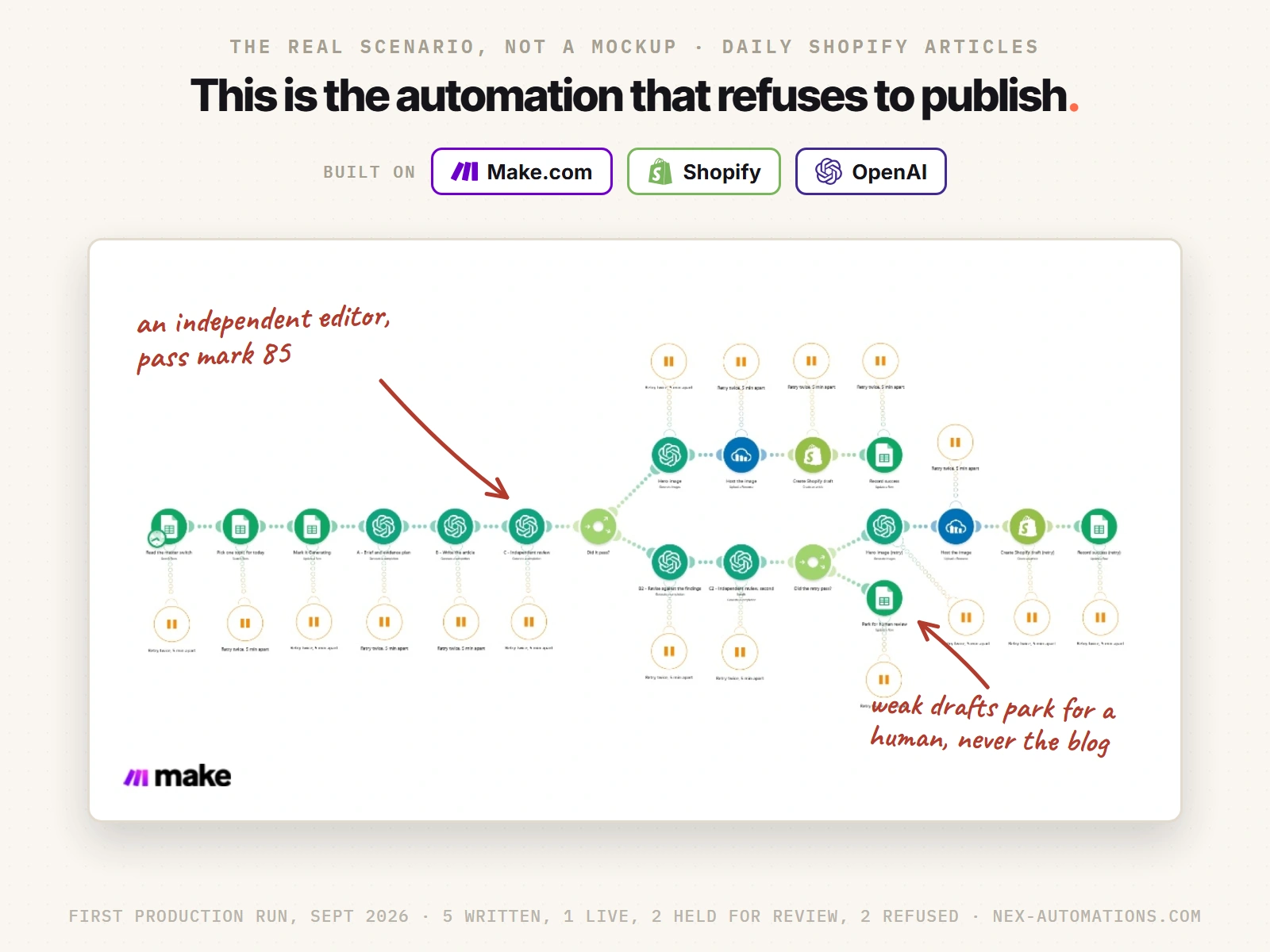
The real Make.com scenario: the daily article producer with its independent editor, the pass-or-retry router and the park-for-human-review branch
How it runs, step by step
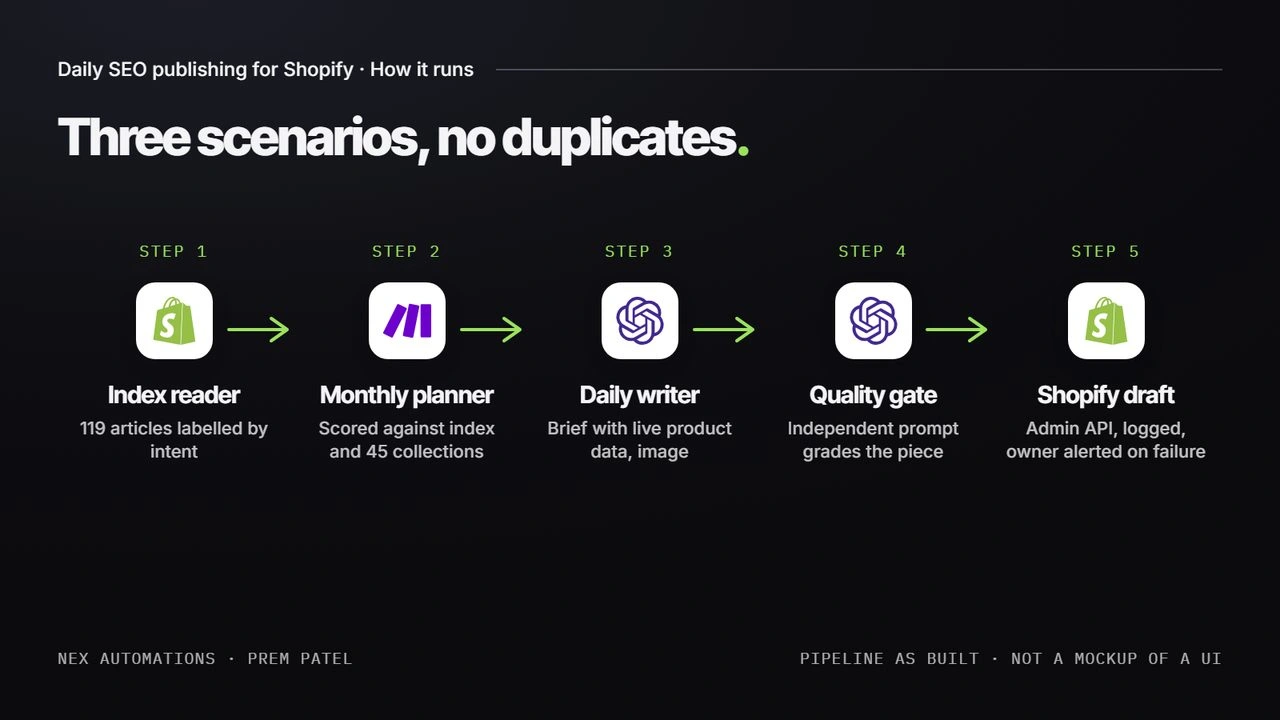
How the daily publishing system runs: index reader, monthly planner, daily writer, quality gate, Shopify draft
The index reader pulls every published article from Shopify and labels title, target keyword and intent.
Once a month the planner proposes topics, scores each against the index and the 45 collections, and rejects anything that overlaps by intent.
Each day the publisher takes the next approved topic and builds a brief with live product data.
The article is written, the featured image generated, and a second AI step with its own prompt grades the piece against the brief with a pass mark of 85.
A passing article becomes a Shopify draft through the Admin API. A failing one gets one revision against the editor's findings and a second independent review; if it fails again it parks for human review.
The run is logged to Google Sheets; the owner flips to auto-publish once the first weeks read clean.
The first production run, measured (September 2026)
Before the daily schedule switched on, the system wrote its first batch of five articles. The independent editor decided what happened to each one.
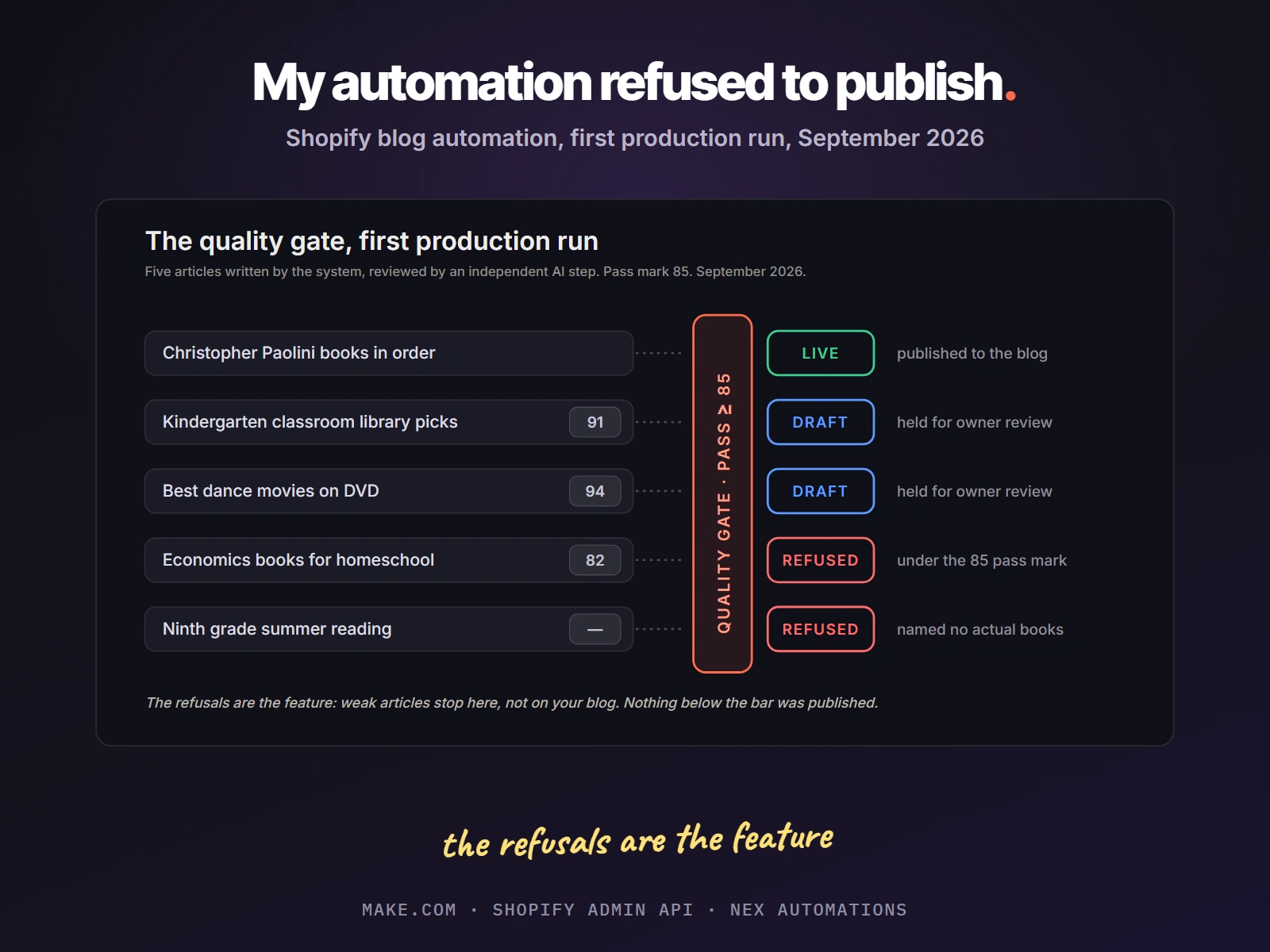
The quality gate on the first production run: five articles, one live, two drafts, two refused
One article passed and went live on the store's blog.
Two scored 91 and 94 and were held as drafts for the owner's review.
Two were refused: one scored 82, three points under the bar, and one recommended summer reading without naming a single actual book. Neither reached the blog.
Measured against the store's 125 existing articles:
Measure | Existing blog | First-run articles |
|---|---|---|
Typical length | 526 words | 1,300+ |
Articles with no shop links | 94% | 0% |
Carrying the owner's closing line | 28% | 100% |
Meta description present | patchy | every article |
Every new article carries three tracked links into the store, placed near the beginning, middle and end, pointing at durable collection and search pages rather than products that may sell out.
Result
A three-scenario system in production, running daily since 1 September 2026
119 articles indexed, 6 duplicate pairs surfaced in the audit
First run: article length 526 words to 1,300+, linkless articles 94% to 0%, quality gate refused 2 of 5
Manual equivalent estimated at 46 to 60 hours a month
Traffic results will be added once the first quarter is measured
How to verify
The client work is listed at nex-automations.com/work. Nex Automations is listed in the Make partner directory.
Who this is for
Shopify and WooCommerce stores with a large catalogue and an existing blog, and any brand that wants daily content without duplicates and without a person reading every draft.
Questions people ask
How do you publish daily SEO content without creating duplicates?
Index everything already published with intent labels, and check every new topic against that index before writing. This Shopify build rejects overlaps against the store's existing articles and 45 collections.
Can Make.com publish blog posts to Shopify automatically?
Yes, through the Shopify Admin API. This system drafts, QA-checks, attaches an image and creates the post daily, draft-first until the owner approves auto-publish.
How does the quality gate work?
A second AI step with its own prompt grades the article against the brief, independently of the step that wrote it, with a pass mark of 85. A failing draft gets one revision and a second independent review; failing again parks it for a human. In the first production run the gate refused 2 of 5 articles rather than lower the bar, so the writer model never marks its own homework.
Do the articles link to real products?
Yes. The brief is built from live product data at write time, so every article links to inventory that exists that day rather than to a product that sold out last month. Links point at durable collection and search pages, tagged so clicks can be traced to orders.
What is the difference between checking duplicates by title and by intent?
Two articles with different titles can answer the same search. The index labels each article's intent, and the planner rejects a topic whose intent matches an existing piece, which is how the six duplicate pairs were found.
What does daily content automation like this cost to run?
Three scenarios: one monthly, one daily, one on demand. Operations scale with one article a day plus the AI calls, on the store's own Make.com and OpenAI accounts. The build is quoted fixed after a mapping call.
Related work
About the builder
Prem Patel is the founder of Nex Automations, an automation studio based in India with 1,200+ automations in production for 210+ clients across 12+ countries over six years (figures from nex-automations.com, August 2026). Make.com Level 5 certified, the top of Make's five-level certification ladder, earned on a build challenge set by Make's engineering team under operation limits, and an official Make partner listed in the Make partner directory. Zapier Certified Expert and a listed Zapier Solution Partner. 5-star average across 94 public reviews on Fiverr and Topmate.
Website: nex-automations.com · LinkedIn: linkedin.com/in/iamprempatel
Last updated: 2 September 2026.
Like this project
Posted Aug 27, 2026
Ecommerce Store Article systems.
Likes
1
Views
5
Clients
Nex Automations