BigQuery to Slack daily sales reports on Make.com, D2C brand

Prem Patel


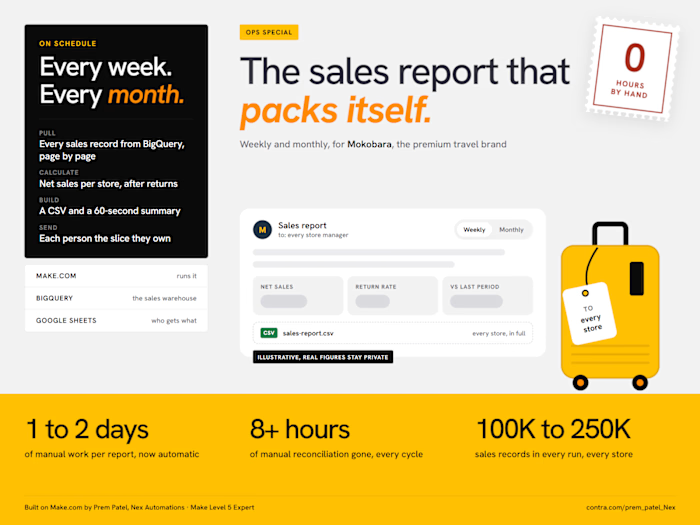
A direct-to-consumer travel goods brand replaced a sales report that took one to two days to compile with a Make.com scenario that runs at 7 AM, pages up to 250,000 rows out of Google BigQuery, computes the KPIs, writes a plain-English summary with AI and posts it to Slack and email. Data latency is now under 5 minutes and 8+ hours of manual reconciliation per cycle are gone.
Key facts
Client | Direct-to-consumer travel goods brand |
Country | India |
Platform | Make.com, scheduled at 7 AM |
Stack | Google BigQuery, Make.com aggregators, Google Sheets, Airtable, OpenAI, Slack, email |
Volume | 100,000 to 250,000 rows on a large day, paginated |
Result | Compile time 1 to 2 days to automatic; 8+ hours of reconciliation removed per cycle |
Latency | Under 5 minutes; four channels kept in sync |
Why this matters
Fast-growing brands usually have the data before they have the reading of it. The numbers sit in a warehouse, the decisions sit in a spreadsheet someone rebuilds, and by the time it is read the numbers are old. The technical trap is size: a large day's rows will time out a naive query step. Paginating the query and aggregating as you go keeps a warehouse-scale report inside a workflow tool, and an AI summary step turns the table into the sentence a manager actually reads.
The problem
The data was there, in BigQuery. The reading of it was manual, slow and person-dependent, and took one to two days per cycle.
What we built
A scheduled Make.com scenario that runs at 7 AM.
Paginated BigQuery queries, so a large day (100,000 to 250,000 rows) never times out
KPI calculation in Make's aggregators, with reference tables in Sheets and Airtable joined outside the query
An AI summary step that writes what a manager would say about the numbers
Delivery to Slack channels and email lists by role, with sales, tax and region breakdowns
How it runs, step by step
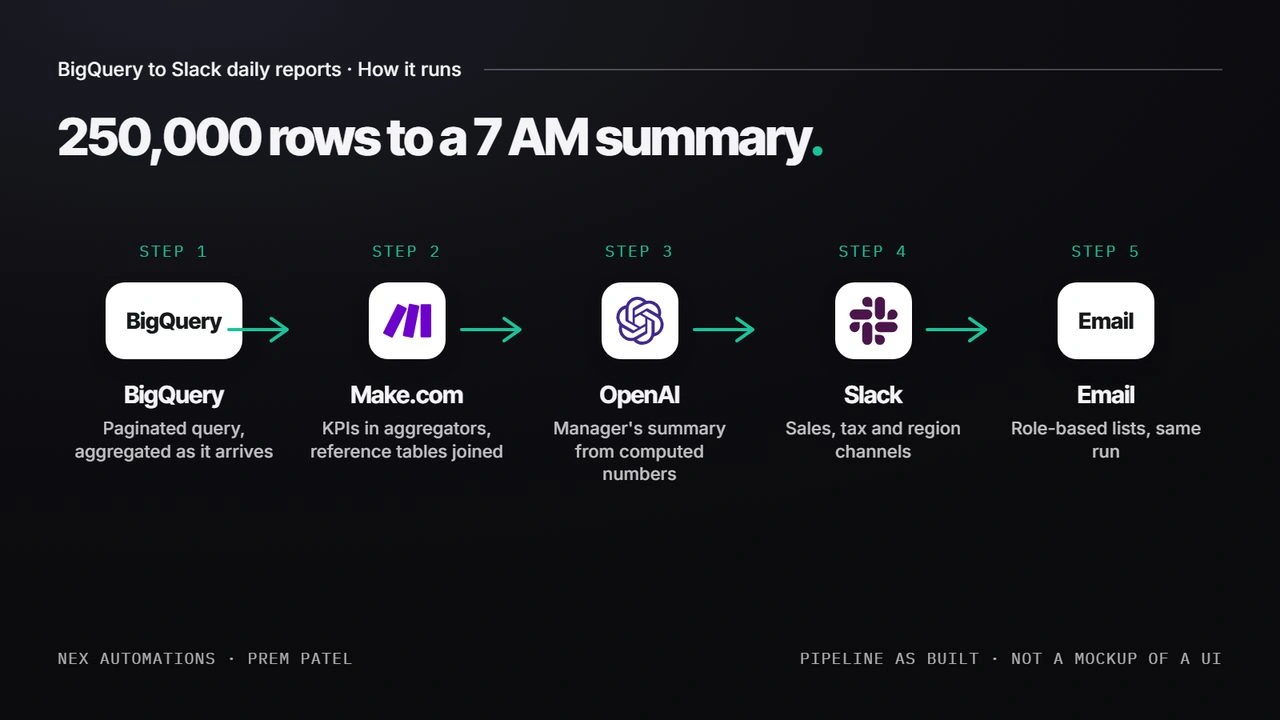
How the daily report runs: BigQuery to Make.com to OpenAI to Slack and email
At 7 AM the scenario opens the day's BigQuery query with a page size that stays under the timeout.
Each page is aggregated as it arrives; nothing waits for the whole result set.
Reference tables (targets, regions, tax rules) are joined from Sheets and Airtable outside the query.
The KPI set goes to an OpenAI step with a fixed brief that returns a short manager's summary.
Slack channels and email lists receive the breakdown for their role: sales, tax, region.
A failed page or a failed send routes to an alert; the run can be replayed for the same day.
Result
Compile time: 1 to 2 days to automatic
8+ hours of manual reconciliation removed per cycle
Data latency under 5 minutes
Four channels kept in sync
The client's team said the reports "didn't just inform, they empowered decisions."
How to verify
The client work is listed at nex-automations.com/work. Nex Automations is listed in the Make partner directory.
Who this is for
E-commerce and D2C brands with sales data in BigQuery, Snowflake or Postgres and a daily or weekly report that someone still builds by hand. Also finance and operations teams that want the same numbers to reach four channels without four exports.
Questions people ask
Can Make.com query BigQuery and post a report to Slack?
Yes. This scenario pages up to 250,000 rows out of BigQuery each morning, computes KPIs, writes a plain-English summary with AI and posts to Slack and email by 7 AM.
How do you handle large BigQuery results in an automation?
Paginate the query, aggregate as you go rather than loading everything, and keep the reference tables outside the query. That is how this build stays under 5 minutes of latency on a 250,000-row day.
Is the AI summary reliable enough for a daily report?
It summarises numbers the scenario has already computed; it does not compute them. The brief is fixed, the KPIs are in the message alongside the summary, and a manager reads both, so a wording slip cannot change a figure.
Can different teams get different versions of the report?
Yes. Delivery is by role: sales, tax and region breakdowns go to their own Slack channels and email lists from the same run, so nobody receives the whole table to find their line.
What if the warehouse query fails one morning?
The failure routes to an alert with the reason and the run is replayable for that day. Because aggregation is page by page, a partial result is never posted as if it were complete.
How much does a reporting automation like this cost?
Builds of this shape land in the small-build range on the Make.com Expert service on this profile, quoted fixed after a mapping call. Running cost is one scheduled scenario a day on the client's own Make.com plan.
Related work
About the builder
Prem Patel is the founder of Nex Automations, an automation studio based in India with 1,200+ automations in production for 210+ clients across 12+ countries over six years (figures from nex-automations.com, August 2026). Make.com Level 5 certified, the top of Make's certification ladder, and an official Make partner listed in the Make partner directory. Zapier Certified Expert and a listed Zapier Solution Partner. 5-star average across 94 public reviews on Fiverr and Topmate.
Website: nex-automations.com · LinkedIn: linkedin.com/in/iamprempatel
Last updated: 27 August 2026.
Like this project
Posted Aug 27, 2026
A direct-to-consumer brand's daily sales report used to take one to two days to compile. A 7 AM Make.com scenario now pages up to 250,000 rows out of BigQuery, computes the KPIs and posts a plain-English summary to Slack and email.