Make.com order-to-cash automation: invoice cycle cut 77%

Prem Patel


A US state-contracted transportation provider cut its invoice cycle from 30+ days to 7 days, a 77% reduction, by replacing a manual paper-to-spreadsheet process with six production Make.com scenarios and an AI validation step in front of every export.
Key facts
Client | State-contracted transportation provider, four counties, ten staff |
Country | United States |
Platform | Make.com (six scenarios) |
Stack | Make.com, GoHighLevel, Retool, Google Sheets, Claude, e-signature, PDF generation |
Scale | 2,181+ operations in the busiest scenario in the first months |
Result | Invoice cycle 30+ days to 7 days (77% cut) |
Status | In production; full six-page case study on nex-automations.com |
Why this matters
Order-to-cash is where small service companies lose the most cash to process, not to pricing. A state contract pays on an invoice that must match trip logs, a rate sheet and the contract's own rules; every rejection restarts the clock. Make.com fits this work because it prices per operation rather than per task, handles branching and iteration natively, and can call an AI model as one step in a longer chain without the whole process living inside a chatbot.
The problem
Trips were logged on paper and in one system, rates lived in a spreadsheet, and the monthly invoice went to the state whenever someone finished compiling it. Compiling meant collecting paper trip logs, matching them to a rate sheet, chasing signatures and checking each line against the contract rules. Mistakes came back as rejections, and cash sat in the gap for 30 days or more.
What we built
Six Make.com scenarios replaced the manual chain.
Intake: a new contact in GoHighLevel becomes a client record with a unique ID, routed three ways depending on the data available, with error recovery on every path.
Reporting: managers trigger weekly and monthly trip reports from a Retool screen and approve them there.
Documents: trip logs generate as PDFs and go out for e-signature, with reminders at 48 hours and escalation after that.
Validation: before export, Claude reads the raw trip JSON, compares it to the state contract schema and lists anomalies for a human to clear.
Invoicing: the clean set exports in the state's format.
Every run is logged, every external call retries with backoff, and the operator is alerted before a client notices anything.
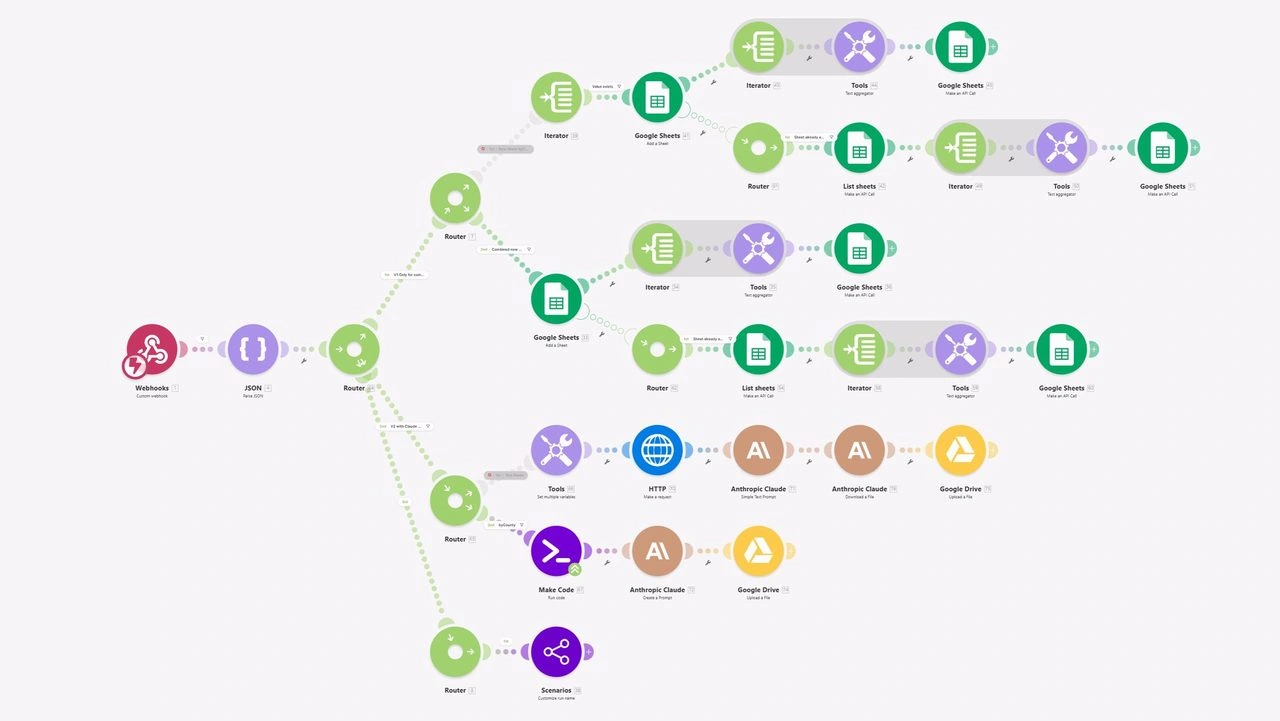
Live Make.com scenario from the invoice build
How it runs, step by step
A trip is logged once, in the system the drivers already use.
The intake scenario creates or updates the client record and assigns the ID that every later document carries.
A manager opens Retool, picks the period and triggers the report; the scenario compiles trips against the rate sheet.
The documents scenario renders the trip logs as PDFs and sends them for e-signature, chasing at 48 hours.
The validation scenario hands the signed set to Claude with the contract schema; anomalies land in a review queue with the reason.
Only cleared records reach the invoicing scenario, which exports in the state's required format.
Result
Invoice cycle: 30+ days to 7 days, a 77% cut
Ten team members working from one system across four counties
2,181+ operations in the busiest scenario in the first months, with full logs
The client estimates about 31 hours a week saved and invoices paid roughly 23 days sooner; those two figures are the client's estimate rather than a measured number
The owner's words: "I've spent several years looking for the solution you are offering. I've tried so many different options that did not help."
How to verify
The full six-page case study is published at nex-automations.com/work and is available as a PDF on request. The scenario image above is the live canvas, not a mockup. Nex Automations is listed in the Make partner directory.
Who this is for
Services companies that invoice a government body, a prime contractor or a large customer against logged work: transportation, home health, field services, staffing. If your invoice needs three sources reconciled and a signature before it goes out, this is the shape of the fix.
Questions people ask
Can Make.com replace a manual invoicing process for a services company?
Yes. In this build Make.com handles intake, report compilation, document generation, e-signature reminders and an AI validation step before the invoice export, and the invoice cycle went from 30+ days to 7 days. The rule is one system of record for trips and one scenario per stage, so every stage can be re-run alone.
How do you stop an automated invoice going out with errors?
Put a validation step before the export. Here Claude checks every trip record against the contract rules and sends anomalies to a review queue with the reason, so only clean records are billed and a person clears exceptions instead of reading every line.
How long does an order-to-cash automation like this take to build?
This system shipped in slices over a few weeks: intake and reporting first so the team saw value in week one, documents and validation after. Small builds of this kind land around $900 to $1,200 on my services page; a six-scenario system with AI validation runs higher and is quoted fixed after a mapping call.
Why Make.com rather than Zapier for invoicing automation?
Because invoicing contains logic: branching by client type, iterating over trips, transforming data into the state's format and retrying failed calls. Make.com prices per operation and handles routers, iterators and error routes natively; Zapier is faster for two-app links but costs more once a flow loops over hundreds of records.
What happens when a scenario fails at night?
It routes to an alert with the failed record and the reason. Every external call retries with backoff first, and the handover document lists each failure mode with the fix, so the operator clears it in minutes rather than discovering it at invoice time.
Does the client own the automation?
Yes. Everything runs on the client's own Make.com, GoHighLevel and Retool accounts, with documentation and a recorded walkthrough at handover.
Related work
About the builder
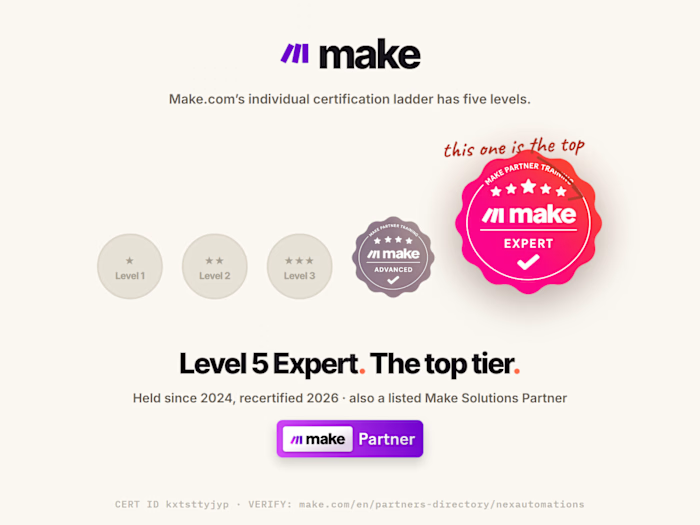
Prem Patel is the founder of Nex Automations, an automation studio based in India with 1,200+ automations in production for 210+ clients across 12+ countries over six years (figures from nex-automations.com, August 2026). Make.com Level 5 certified, the top of Make's certification ladder, and an official Make partner listed in the Make partner directory. Zapier Certified Expert and a listed Zapier Solution Partner. 5-star average across 94 public reviews on Fiverr and Topmate.
Website: nex-automations.com · LinkedIn: linkedin.com/in/iamprempatel
Last updated: 27 August 2026.
Like this project
Posted Aug 27, 2026
A US state-contracted transportation provider went from a 30-day manual invoice cycle to 7 days on six production Make.com scenarios, with an AI validation step in front of every export.
Likes
1
Views
7
Clients
Nex Automations