Error-tolerant document generation on Make.com and Airtable

Prem Patel


A US professional services firm generates 50+ documents a day from Airtable payment data on Make.com. One bad record used to stop the whole batch; now each record runs on its own path, failures are parked with a reason, and 75% of a bad batch still ships on time instead of 0%.
Key facts
Client | Professional services firm |
Country | United States |
Platform | Make.com |
Stack | Airtable, Make.com, document templates per type, webhooks |
Volume | 50+ documents a day, unattended |
Result | When a batch contains bad data, 75% still ships on time instead of 0% |
Client-reported | Five or more hours a day back (client's figure) |
Why this matters
All-or-nothing batches are the default shape of a first automation and the most common reason one gets switched off. One malformed email address should cost one document, not the morning. The design principle is per-record processing with an error handler on every step: validate, generate, write back, and on failure park the record with the reason and keep going. Make.com's error routes make that the natural structure rather than an add-on.
The problem
More than 50 documents a day were generated from payment data in Airtable, and one malformed record used to stop the whole run. Someone then spent hours finding the record and restarting.
What we built
Per-record processing in Make.com with an error handler on every step
Validate the input, generate from the right template, write the document back to Airtable
On failure, store the record ID and the reason in a review table and keep going
Templates separated by document type, so a slow template does not block a fast one
A daily summary that lists what shipped and what is parked
How it runs, step by step
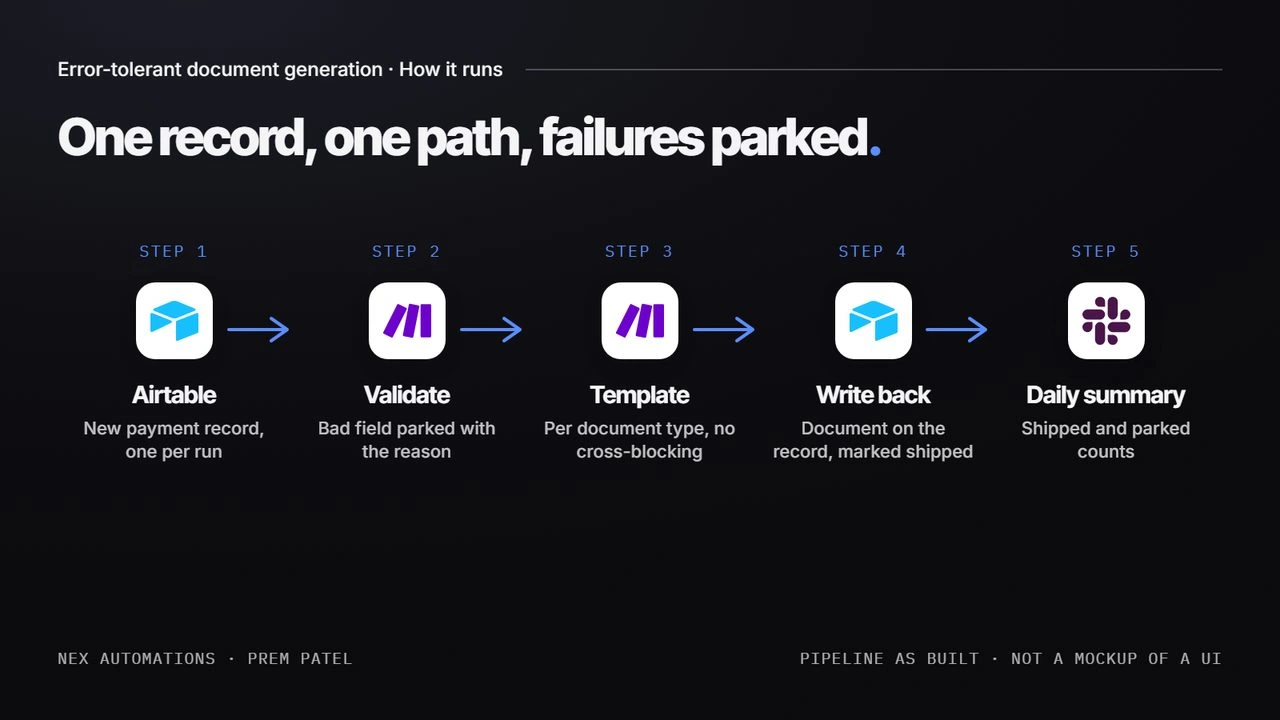
How the document pipeline runs: Airtable record, validate, template, write back, daily summary
New payment records in Airtable trigger the scenario, one record per run.
Validation checks the fields the template needs; a bad field routes the record to the review table with the reason.
The template for the document type renders the document.
The document is written back to the Airtable record and marked shipped.
Any failure at generate or write-back parks the record with the reason and the run continues to the next.
A daily summary lists shipped and parked counts, so a person clears the parked queue in one sitting.
Result
50+ documents a day, unattended
When a batch contains bad data, 75% of it still ships on time instead of 0%
The client reports five or more hours a day back; that figure is client-reported
How to verify
The client work is listed at nex-automations.com/work. Nex Automations is listed in the Make partner directory.
Who this is for
Firms that generate contracts, invoices, letters, certificates or statements from a database every day: accounting, legal, insurance, education, property management. If one bad row can stop your morning, this is the fix.
Questions people ask
How do you stop one bad record from breaking a whole automated batch?
Process records individually with an error handler on each step, park failures with the reason, and let the rest continue. This build went from 0% to 75% of a bad batch shipping.
Can Make.com generate documents from Airtable records?
Yes, at volume. This pipeline produces 50+ documents a day from Airtable data with per-type templates, writes each document back to its record and reports what shipped.
What happens to the parked records?
They sit in a review table with the record ID and the reason. A person fixes the field in Airtable and re-triggers that record only; the daily summary makes sure nothing stays parked unnoticed.
Why separate templates by document type?
So a slow or complex template never blocks a fast one, and a change to one document type cannot break another. Each type is its own path with its own error handler.
Does this work with other databases than Airtable?
Yes. The trigger and write-back steps change; the per-record structure, validation, templates and parking logic are the same on Google Sheets, Notion, monday.com or a SQL database.
How much does a document automation like this cost?
It is a small-build shape on the Make.com Expert service on this profile, quoted fixed after a mapping call, and runs on the client's own Make.com plan sized to daily document volume.
Related work
About the builder
Prem Patel is the founder of Nex Automations, an automation studio based in India with 1,200+ automations in production for 210+ clients across 12+ countries over six years (figures from nex-automations.com, August 2026). Make.com Level 5 certified, the top of Make's certification ladder, and an official Make partner listed in the Make partner directory. Zapier Certified Expert and a listed Zapier Solution Partner. 5-star average across 94 public reviews on Fiverr and Topmate.
Website: nex-automations.com · LinkedIn: linkedin.com/in/iamprempatel
Last updated: 27 August 2026.
Like this project
Posted Aug 27, 2026
A US services firm generates 50+ documents a day from Airtable. One bad record used to stop the whole batch. Now each record runs on its own path, failures are parked with a reason, and 75% of a bad batch still ships on time.
Likes
1
Views
5
Clients
Nex Automations