Crypto token intelligence hub on Make.com: 1,000+ tokens per run

Prem Patel


A crypto fund's research team now sees every new token listing within six hours. A scheduled Make.com pipeline calls the CoinMarketCap listings API every six hours, diffs against the known set, enriches each new token and alerts on thresholds the team sets themselves, scanning 1,000+ tokens per cycle at 98%+ accuracy on the enriched fields.
Key facts
Client | Crypto fund, research team |
Country | United Kingdom |
Platform | Make.com, scheduled scenarios |
Stack | CoinMarketCap API, Make.com, Google Sheets, Airtable, social-source scraping |
Scale | 1,000+ tokens scanned per cycle, every 6 hours, 24/7 |
Accuracy | 98%+ on enriched fields |
Result | Listing to team awareness under 6 hours, about twenty times the manual coverage |
Why this matters
Research coverage that depends on who is awake is not coverage. New listings appear around the clock, and late awareness of a listing is a missed position. A scheduled pipeline that polls a primary API, diffs against what is already known and enriches only the new records is cheap to run on Make.com, because operations are only spent on the delta, and it puts the alert rules in a spreadsheet the analysts control.
The problem
The team was finding new token listings by hand, which meant checking a few dozen a day and hearing about most of them late. Coverage depended on who was awake and which sites they checked.
What we built
A scheduled Make.com scenario that calls the CoinMarketCap listings endpoint every six hours and diffs against the known set
Enrichment of each new token with metadata, socials and the contract address
Classification by market cap, parent chain and price
Results written to Google Sheets and Airtable, with a source field on every record
A second scenario that scrapes the social sources the team follows and attaches the signals
Alert rules on thresholds the team sets in the sheet, so changing a rule needs no engineer
How it runs, step by step
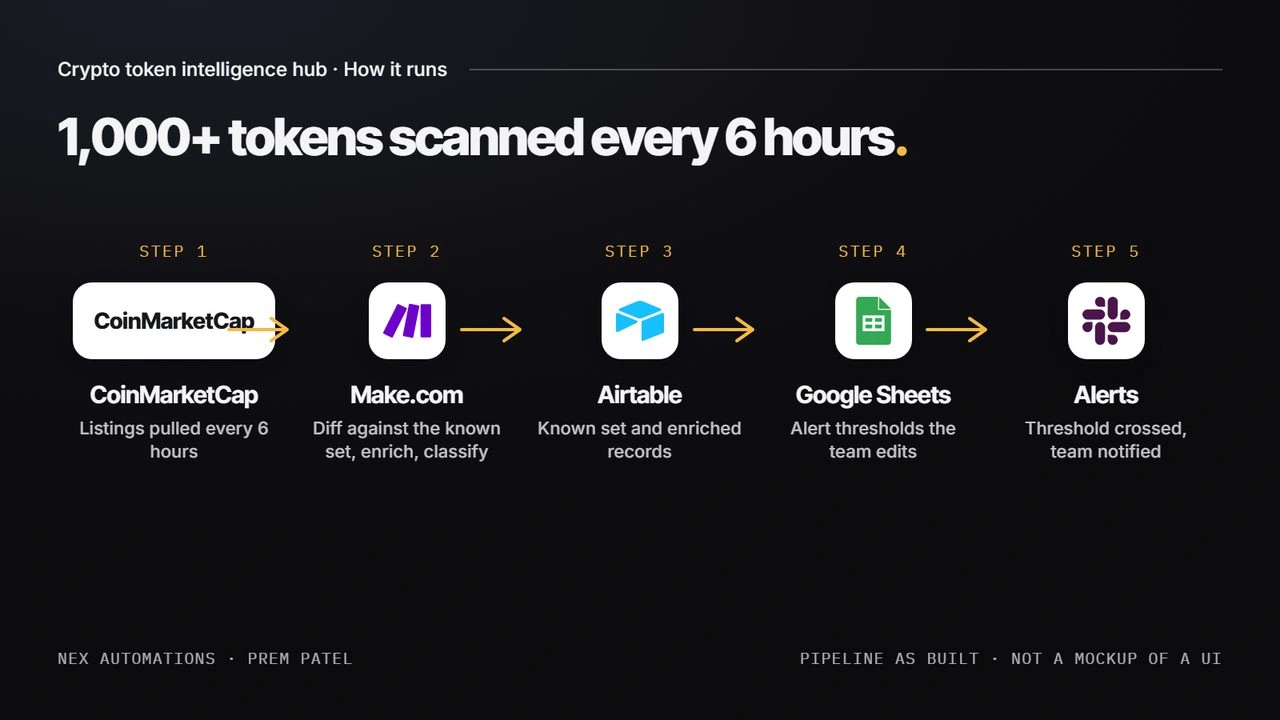
How the token intelligence pipeline runs: CoinMarketCap to Make.com to Airtable, Sheets and alerts
Every six hours the scenario pulls the current listings from CoinMarketCap.
It diffs the pull against the known set in Airtable; only new tokens continue.
Each new token is enriched from the API with metadata, socials and contract address, and classified by market cap, chain and price.
Records land in Google Sheets and Airtable with a source field.
A second scenario scrapes the team's social sources and attaches signals to matching tokens.
Alert rules read from the sheet fire notifications when a token crosses a threshold.
Result
Detection every 6 hours, 24/7
1,000+ tokens scanned per cycle, about twenty times the manual coverage
98%+ accuracy on the enriched fields
Listing to team awareness under 6 hours
How to verify
The client work is listed at nex-automations.com/work. The pipeline design (poll, diff, enrich, classify, alert) is described in full above and can be demonstrated on request against the public CoinMarketCap API.
Who this is for
Research desks, funds and analysts who need to know about new listings, filings, products or competitors within hours, on any API that can be polled: crypto listings, app stores, company registries, job boards.
Questions people ask
Can Make.com monitor an API on a schedule and alert on thresholds?
Yes. This build polls CoinMarketCap every 6 hours, enriches 1,000+ tokens per cycle and alerts on rules stored in a Google Sheet. The same pattern works for any REST API with a list endpoint.
How do you keep scraped data accurate?
Diff against what you already hold, enrich from the primary API rather than the page, and write a source field per record. This pipeline holds 98%+ accuracy that way, and the source field makes any error traceable.
Why poll every six hours rather than in real time?
Because the team's decision cycle is hours, not seconds, and polling the delta every six hours keeps Make.com operations low. The interval is a single setting; it can drop to fifteen minutes if the use case needs it.
Can non-technical analysts change the alert rules?
Yes. Thresholds live in the Google Sheet the analysts already use; the scenario reads them on every run, so a rule change needs no engineer and no redeploy.
How does the pipeline handle API rate limits and failures?
Calls retry with backoff, a failed cycle routes to an alert with the reason, and because the diff runs against the stored set, a missed cycle is caught up on the next run rather than lost.
How much does a monitoring pipeline like this cost to run?
Operations are only spent on new tokens after the diff, so the monthly Make.com cost stays at the low end of a standard plan for this volume. The build itself is quoted fixed after a mapping call.
Related work
About the builder
Prem Patel is the founder of Nex Automations, an automation studio based in India with 1,200+ automations in production for 210+ clients across 12+ countries over six years (figures from nex-automations.com, August 2026). Make.com Level 5 certified, the top of Make's certification ladder, and an official Make partner listed in the Make partner directory. Zapier Certified Expert and a listed Zapier Solution Partner. 5-star average across 94 public reviews on Fiverr and Topmate.
Website: nex-automations.com · LinkedIn: linkedin.com/in/iamprempatel
Last updated: 27 August 2026.
Like this project
Posted Aug 27, 2026
A crypto fund's research team now sees every new token listing within six hours. A scheduled Make.com pipeline scans 1,000+ tokens per cycle, enriches each one and alerts on the team's own thresholds.
Likes
1
Views
4
Clients
Nex Automations