monday.com ERP audit and rebuild with Make.com: 25 automations

Prem Patel


An elevator systems manufacturer's documentation said 14 automations were live on monday.com. A four-day audit found none. The rebuild that followed put 25 automations across 9 boards into production, live-tested with real records including the cross-board cases, using native monday.com automations where they fit and Make.com where they do not.
Key facts
Client | Elevator systems manufacturer and field-service company |
Platform | monday.com (native automations) and Make.com (cross-board sync and integrations) |
Stack | monday.com, Make.com, Slack |
Audit | Four days, fixed fee: 14 or 15 documented automations, 0 found live |
Build | 25 automations across 9 boards, live-tested with real records |
Timeline | June to August 2026 |
Status | In production; time saved not yet measured |
Why this matters
A migration declared done on paper is the most expensive kind of unfinished. Nothing was wrong with any single board; the problem was the gaps between them, where people carried the record by hand from quote to order to installation to service. The rule that made the build work: native monday.com automations for single-board rules, Make.com for cross-board sync, rollups and anything that touches an outside system such as Slack or a CRM. Audit first, because the plan on paper was not what was running.
The problem
The company was moving from an old CRM to monday.com and had documentation saying 14 or 15 automations were already running. Quotes, orders, installation and service still lived in separate boards with people carrying the record between them.
What we built
Audit first, four days, fixed fee: every planned automation mapped to the business process it served, with what existed, what did not and what was worth building.
Then the build:
A won quote creates the project
Three boards (Field Service, Manufacturing, Engineering) keep their stages in sync with the Contacts board
Completion dates roll up
A billed job moves the record to inactive
Purchase-order alerts and deal-won notices go to the right people in Slack
Each role gets its own board view
How the audit and build ran, step by step
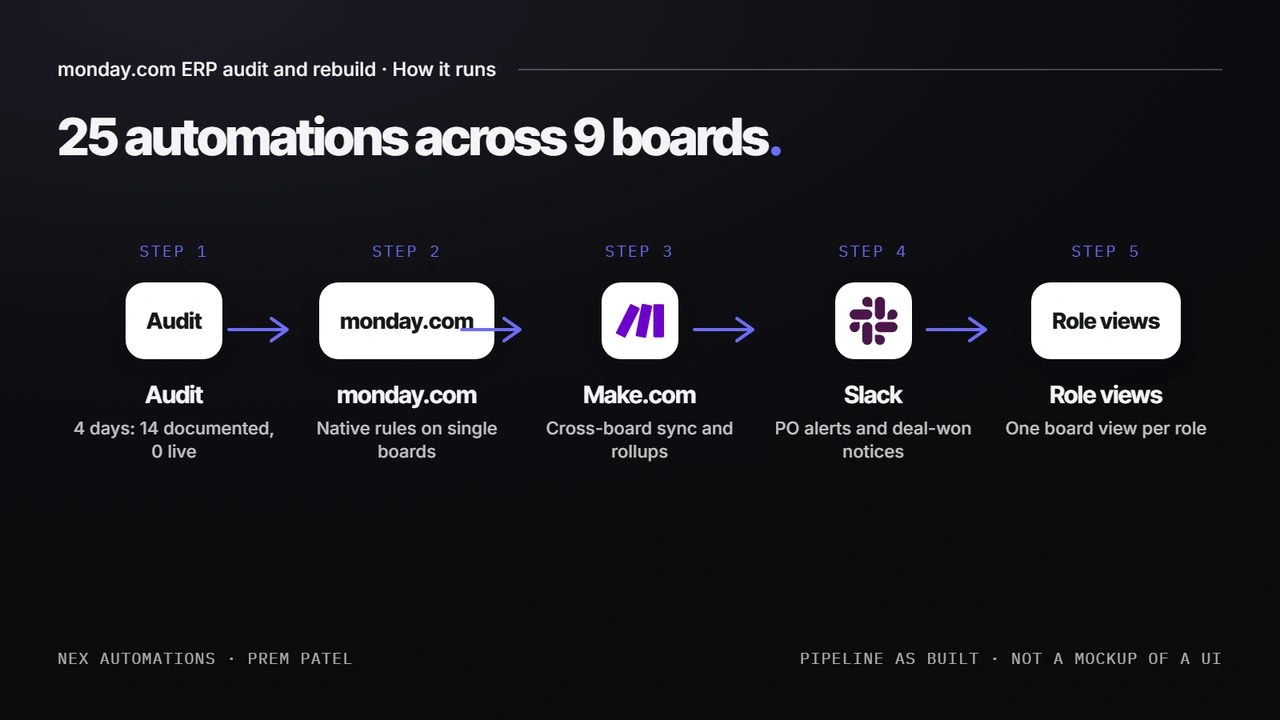
How the rebuild runs: audit, native monday.com rules, Make.com cross-board sync, Slack alerts, role views
Audit: every documented automation checked against the live account; each mapped to the process step it should serve.
Report: what existed (nothing live), what the process actually needed, and a ranked build list with the native-or-Make decision per item.
Build in stages: single-board rules first as native automations, then cross-board sync on Make.com, then Slack integrations.
Live test with real records, including one contact with several jobs and jobs that cross all three boards.
Handover: one view per role, documentation of every automation and where it lives.
Result
25 automations across 9 boards, in production
Live-tested with real records, including the cases where one contact has several jobs
An ERP the team can see and change themselves, on tools they already pay for
Time saved is not yet measured
How to verify
The client work is listed at nex-automations.com/work. The 5-day audit on this profile is the productised version of the audit stage, and Nex Automations is listed in the Make partner directory.
Who this is for
Manufacturers, installers and field-service companies running monday.com, ClickUp or a similar work OS as their ERP, especially after a migration that was declared finished but still runs on people carrying records between boards.
Questions people ask
Should I audit my monday.com automations before adding more?
Yes. In this case the documentation claimed 14 live automations and the audit found zero. A four-day audit produced the map the build then followed, and it cost a fixed fee rather than a month of guessing.
When do you use Make.com instead of monday.com's own automations?
Native automations for single-board rules; Make.com for cross-board sync, rollups and anything that touches an outside system like Slack or a CRM. Mixing them by that rule keeps the account readable for the team.
Can monday.com work as an ERP for a manufacturer?
Yes, for quote to order to installation to service, when the boards are connected. This build runs 25 automations across 9 boards and each role has its own view; the limits are reporting depth and anything that needs an outside system, which Make.com covers.
How do you test cross-board automations safely?
With real records copied into a test group, including the awkward cases: one contact with several jobs, a job that moves through all three boards, a billed job that must go inactive. Every automation here was live-tested that way before handover.
What did the audit include?
Every planned automation mapped to the business process it served, a check of what was actually live, the gaps between boards, and a ranked build list with a native-or-Make decision on each item. Four days, fixed fee.
What does a monday.com rebuild like this cost?
The audit is the $499 five-day service on this profile; the build is quoted fixed from the audit's ranked list, so the client chooses how much of the list to fund.
Related work
About the builder
Prem Patel is the founder of Nex Automations, an automation studio based in India with 1,200+ automations in production for 210+ clients across 12+ countries over six years (figures from nex-automations.com, August 2026). Make.com Level 5 certified, the top of Make's certification ladder, and an official Make partner listed in the Make partner directory. Zapier Certified Expert and a listed Zapier Solution Partner. 5-star average across 94 public reviews on Fiverr and Topmate.
Website: nex-automations.com · LinkedIn: linkedin.com/in/iamprempatel
Last updated: 27 August 2026.
Like this project
Posted Aug 27, 2026
An elevator manufacturer's documentation said 14 automations were live on monday.com. The audit found none. Four days of audit, then 25 automations across 9 boards, live-tested including the cross-board cases.
Likes
2
Views
5
Clients
Nex Automations