Zapier to Make.com migration: 198-module launch scenario

Prem Patel


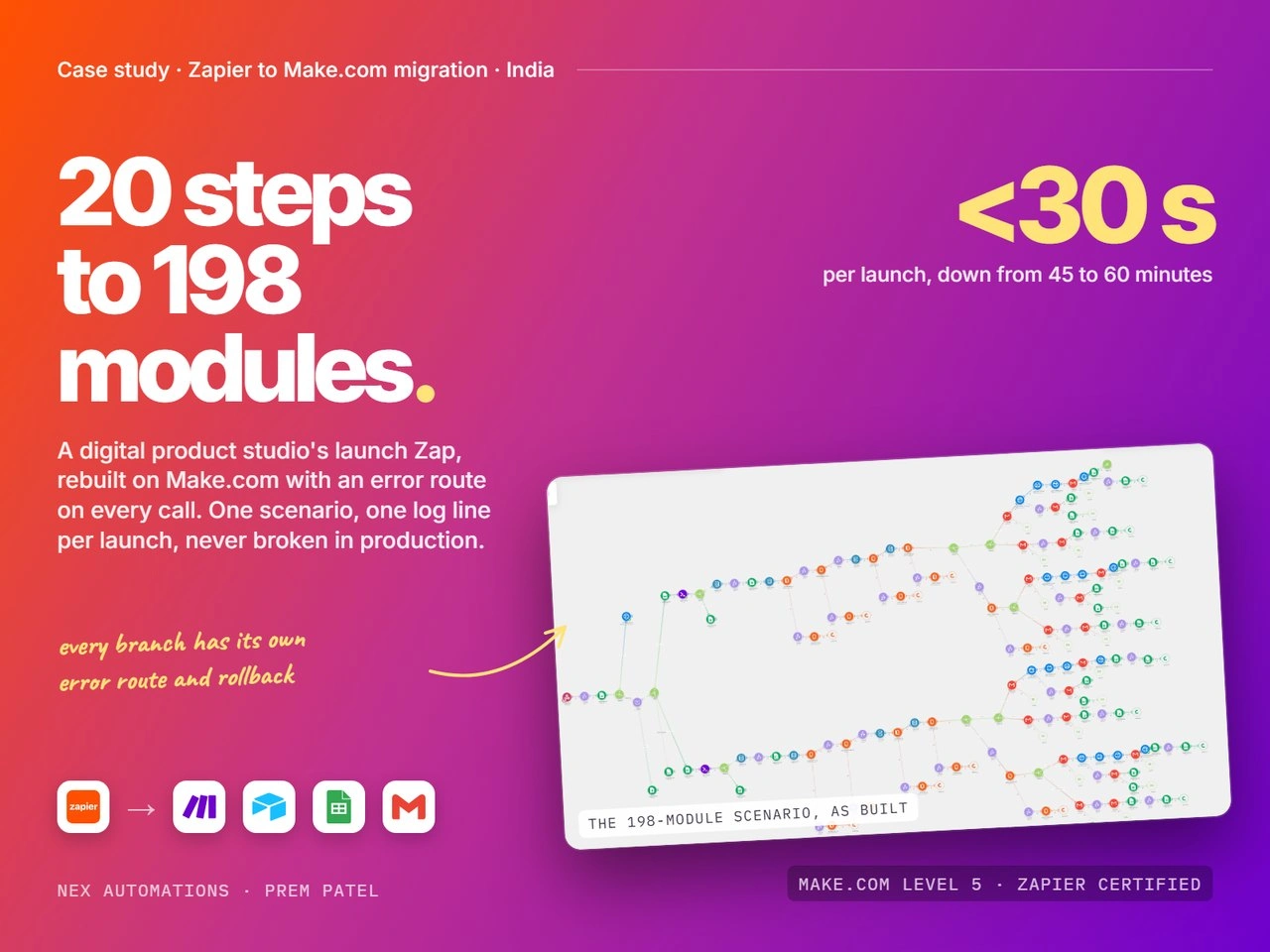
A digital product studio migrated from a 20-step Zap with no error handling to a single 198-module Make.com scenario. Product launches went from 45 to 60 minutes of manual work to under 30 seconds, manual steps from 15+ to 1, and the scenario has held 99.9% uptime without a production break.
Key facts
Fact | Detail |
|---|---|
Client | Digital product studio |
Country | India |
Migration | Zapier (20-step Zap) to Make.com (49 steps, then 198 modules over a year) |
Stack | Make.com, Zapier (audited and retired), Airtable, Google Sheets, Gmail, HTTP |
Result | Launch time 45 to 60 minutes to under 30 seconds; manual steps 15+ to 1 |
Reliability | 99.9% uptime, never broken in production |
Status | In production, extended over the following year |
Why this matters
Most businesses start on Zapier because it is fast and readable, and most rescue projects I take on are businesses that outgrew simple links. The tipping point is always the same: branching, loops over records, data transformation and a need to know when something fails. Make.com prices per operation and has routers, iterators and error handlers built in, so a 20-step chain that costs a task per step on Zapier becomes one scenario that handles its own failures. The migration decision is a cost and reliability decision, not a preference.
The problem
The studio had automated its launches on Zapier one step at a time. Twenty steps, no error handling, and a failure anywhere left a half-created product with nobody notified. A launch still needed 15 or more manual steps and 45 to 60 minutes of someone's time.
What we built
Phase one: audit the Zap, map each step to the business action it served, and rebuild on Make.com as 49 steps with error routes and backup paths for creation, tagging and delivery.
Phase two, over the following year: fold the studio's other launch tasks into the same scenario. Routers by product type, JSON contracts between modules, retries with backoff on every API call, a rollback path per branch and one log line per launch that says exactly which path it took.
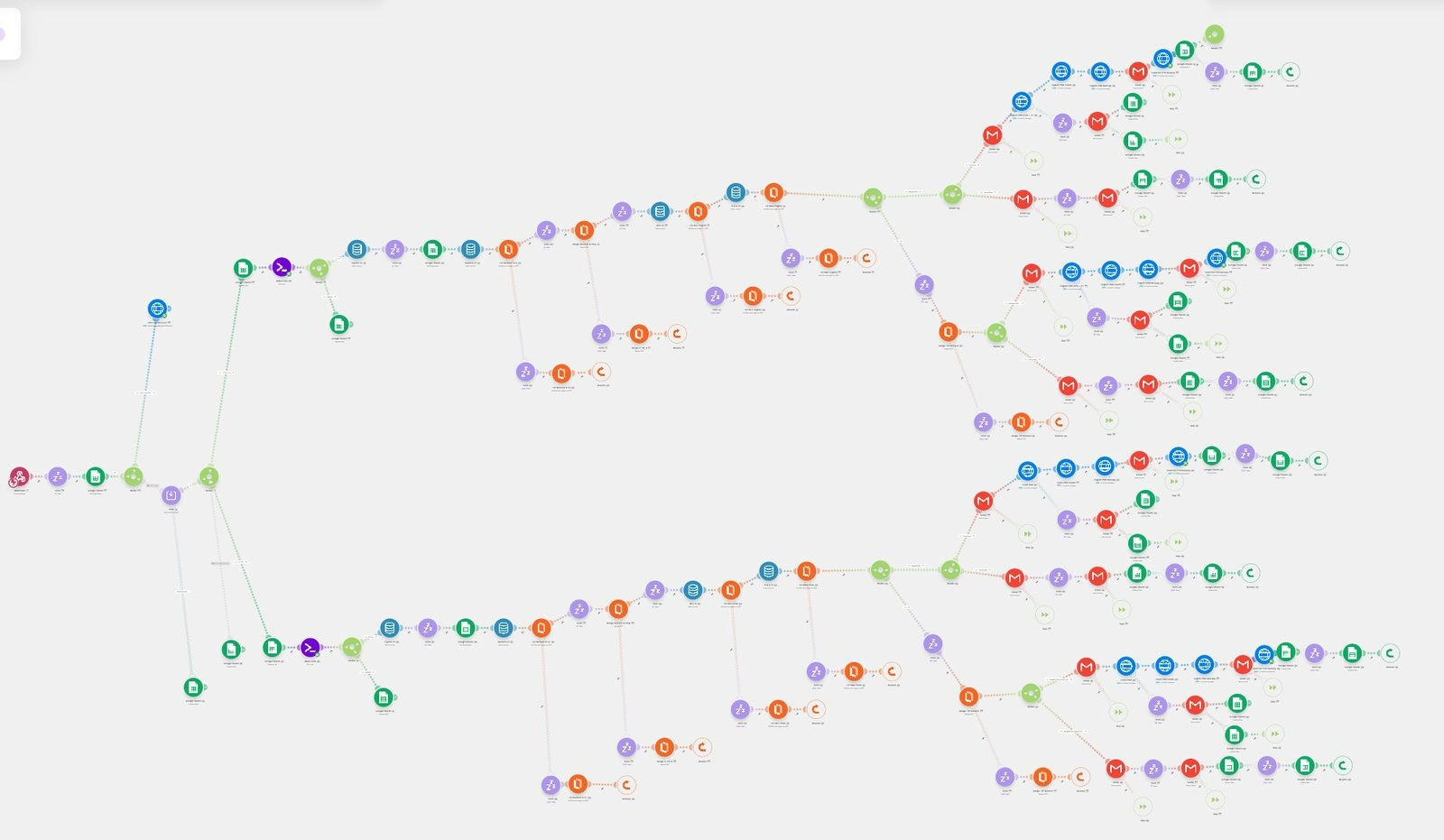
The 198-module launch scenario as built: webhook intake, routers by product type, sleep-and-retry on every API call, Gmail and Google Sheets delivery branches, each with its own error route
The canvas above is the live scenario. Reading it left to right: the webhook and first router at the trunk, the two product-type branches, and on every external call a sleep-and-retry pair followed by its own error route, so a failed step parks that launch with a reason instead of leaving a half-created product. The advice is always to split big scenarios. This one never needed splitting, because every rule lives in one place and every failure state is handled where it happens. At 198 modules it is the most complex scenario I have shipped.
How the migration ran, step by step
Audit: every Zap step written down with the business action it served, the data it touched and what happened when it failed.
Map: steps grouped into stages (create, tag, deliver, notify) and the failure modes listed per stage.
Rebuild: 49 Make.com steps with an error route and a backup path on each stage, tested against real launches in parallel with the Zap.
Cut over: the Zap switched off once three launches ran clean on Make.com.
Extend: over the next year, routers by product type and the remaining launch tasks folded in, each with its own rollback.
Result
Product launch: 45 to 60 minutes to under 30 seconds
Manual steps: 15+ to 1
99.9% uptime, never broken in production
The client said the migration plan "made the decision easy."
How to verify
The canvas above is the live 198-module scenario, not a mockup. The work is listed at nex-automations.com/work. Nex Automations is listed in both partner directories, the Make partner directory and the Zapier partner directory, so the recommendation to migrate is not a one-platform sales pitch.
Who this is for
Studios, agencies and e-commerce teams whose Zaps have grown past ten steps, fail silently, or cost more in tasks than the work is worth. The 5-day Make.com audit and Zapier migration service on this profile is the fixed-price version of phase one.
Questions people ask
Should I move from Zapier to Make.com?
If your automation has grown past simple links and needs branching, error handling, loops or volume, Make.com usually fits better and costs less per operation. This studio went from a 20-step Zap to a 49-step Make scenario with error routes, then to 198 modules. If your Zaps are two-app links that work, stay on Zapier.
Is a 198-module Make.com scenario too big?
Not if it is structured: routers by case, error handlers on every external call, a rollback per branch and one log line per run. Splitting it would have meant a dozen places to change a rule. Size is fine; unhandled failure states are the problem.
How long does a Zapier to Make.com migration take?
Phase one here, audit plus a 49-step rebuild with error routes, is the shape of the 5-day audit and migration service on this profile. Extending it to 198 modules happened over a year as the studio added launch tasks.
Does Make.com cost less than Zapier for this kind of workflow?
For workflows with loops and branches, usually yes, because Make.com prices per operation and Zapier prices per task per step. The audit models the operations cost at the client's volume before anything is rebuilt, so the number is known in advance.
What happens to the old Zaps?
They run in parallel until the Make.com scenario has proven itself on real launches, then they are switched off, not deleted, so there is a rollback path during the first weeks.
Can my team maintain a scenario this size?
Yes, with the handover: documentation of every router branch, the JSON contract between modules, the failure paths and a recorded walkthrough. The log line per launch tells the team which path ran without opening the canvas.
Related work
About the builder
Prem Patel is the founder of Nex Automations, an automation studio based in India with 1,200+ automations in production for 210+ clients across 12+ countries over six years (figures from nex-automations.com, August 2026). Make.com Level 5 certified, the top of Make's certification ladder, and an official Make partner listed in the Make partner directory. Zapier Certified Expert and a listed Zapier Solution Partner. 5-star average across 94 public reviews on Fiverr and Topmate.
Website: nex-automations.com · LinkedIn: linkedin.com/in/iamprempatel
Last updated: 27 August 2026.
Like this project
Posted Aug 27, 2026
A digital product studio's 20-step Zap with no error handling became a single 198-module Make.com scenario. Launches went from 45 to 60 minutes to under 30 seconds, and it has held 99.9% uptime.
Likes
1
Views
6
Clients
Nex Automations