AI vendor catalogue on Make.com: Telegram to Shopify, 90% faster

Prem Patel


A fashion distributor in Surat, selling to the UK and US, cut product cataloguing time by 90% with listing errors under 1%. Vendors still send products the way they always did, a Telegram message with a few photos and a line of text; an AI vision step on Make.com turns each one into a structured Shopify listing, staged in Airtable for a human check before it goes live.
Key facts
Fact | Detail |
|---|---|
Client | Fashion distributor, Surat, selling to the UK and US |
Country | India, with UK and US customers |
Platform | Make.com |
Stack | Telegram bot, Make.com, ChatGPT vision, Airtable staging, Shopify Admin API |
Result | Cataloguing 10+ hours a week to under 1, a 90% cut |
Quality | Listing errors under 1% |
Speed | Vendor message to live listing in under an hour, down from one to two days |
Why this matters
Vendors will never fill in a form. The realistic input for a distributor is chat messages and photos, and the required output is a clean, searchable Shopify catalogue with consistent titles, tags and attributes. AI vision closes that gap only if its output is validated against a schema and reviewed by a person before it touches the store, which is why the design has a staging table in the middle rather than writing straight to Shopify.
The problem
Turning a Telegram message into a proper Shopify listing took ten or more hours a week and the listings were inconsistent: different title formats, missing attributes, tags that did not match the collections.
What we built
A Telegram bot in the vendor group forwards each message and its images to Make.com
An AI vision step reads the photos and text and returns a structured product as JSON: title, description, tags, attributes and an SEO-ready summary
The JSON is validated against a schema before anything is written
Airtable is the staging table, where a person can correct a field in seconds
A second scenario publishes approved records to Shopify with images, tags and collections
How it runs, step by step
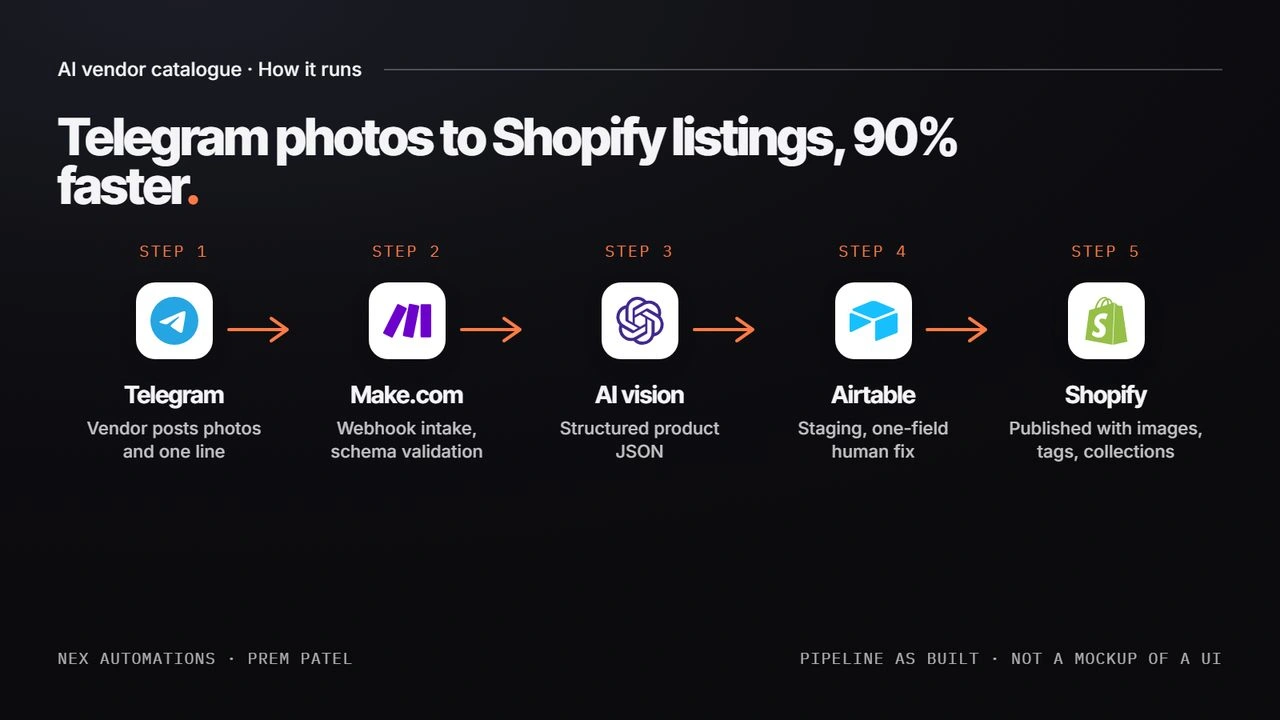
How the vendor catalogue pipeline runs: Telegram to Make.com to AI vision to Airtable to Shopify
A vendor posts photos and a line of text in the Telegram group as usual.
The bot forwards the message and images to a Make.com webhook.
The vision step returns a product as JSON in the store's own title, tag and attribute format.
Schema validation rejects anything malformed before it can be stored.
The record lands in Airtable as "to review"; a person corrects any field and marks it approved.
The publish scenario creates the Shopify product with images, tags and collections, and posts the live URL back to the group.
Result
Cataloguing time: 10+ hours a week to under 1, a 90% cut
Listing errors under 1%
Vendor message to live listing in under an hour, down from one to two days
The founder said it "leveled up my entire product catalog effortlessly."
How to verify
The client work is listed at nex-automations.com/work. The design (Telegram intake, vision extraction, schema validation, Airtable staging, Shopify publish) is fully described above and reproducible on any Shopify store. Nex Automations is listed in the Make partner directory.
Who this is for
Distributors, wholesalers and marketplaces whose suppliers send products by WhatsApp, Telegram or email, and any Shopify or WooCommerce store that spends hours a week turning photos into listings.
Questions people ask
Can AI create Shopify product listings from photos and chat messages?
Yes. This pipeline reads vendor Telegram messages and photos with an AI vision model, writes structured listings, stages them in Airtable and publishes to Shopify, cutting cataloguing time by 90%.
How do you keep AI-written product listings accurate?
Validate the model's JSON against a schema before writing, stage in Airtable where a person can correct a field, and only then publish. Listing errors here are under 1%.
Does the vendor have to change how they send products?
No. The bot sits in the Telegram group they already use; photos and a line of text are enough. That is the reason the system was adopted at all.
Can the same pipeline work on WhatsApp or email instead of Telegram?
Yes. The intake step is the only part that changes; WhatsApp Business API or an email parser feeds the same vision, validation, staging and publish steps.
How are product images handled?
The images from the message are attached to the Shopify product at publish, in the order they were sent, and the vision step uses them to write attributes such as colour and pattern.
What does a catalogue automation like this cost?
It is a Shopify and WooCommerce ops build; the fixed-price service on this profile starts at $1,200 and this shape is quoted after a short mapping call with the store's own product format.
Related work
About the builder
Prem Patel is the founder of Nex Automations, an automation studio based in India with 1,200+ automations in production for 210+ clients across 12+ countries over six years (figures from nex-automations.com, August 2026). Make.com Level 5 certified, the top of Make's certification ladder, and an official Make partner listed in the Make partner directory. Zapier Certified Expert and a listed Zapier Solution Partner. 5-star average across 94 public reviews on Fiverr and Topmate.
Website: nex-automations.com · LinkedIn: linkedin.com/in/iamprempatel
Last updated: 27 August 2026.
Like this project
Posted Aug 27, 2026
A fashion distributor's vendors send products as Telegram photos and one line of text. An AI vision step on Make.com turns them into structured Shopify listings, cutting cataloguing time by 90% with listing errors under 1%.
Likes
1
Views
4
Clients
Nex Automations