Make.com AI contract review SaaS: 1,000 pages, 94.9% accuracy

Prem Patel


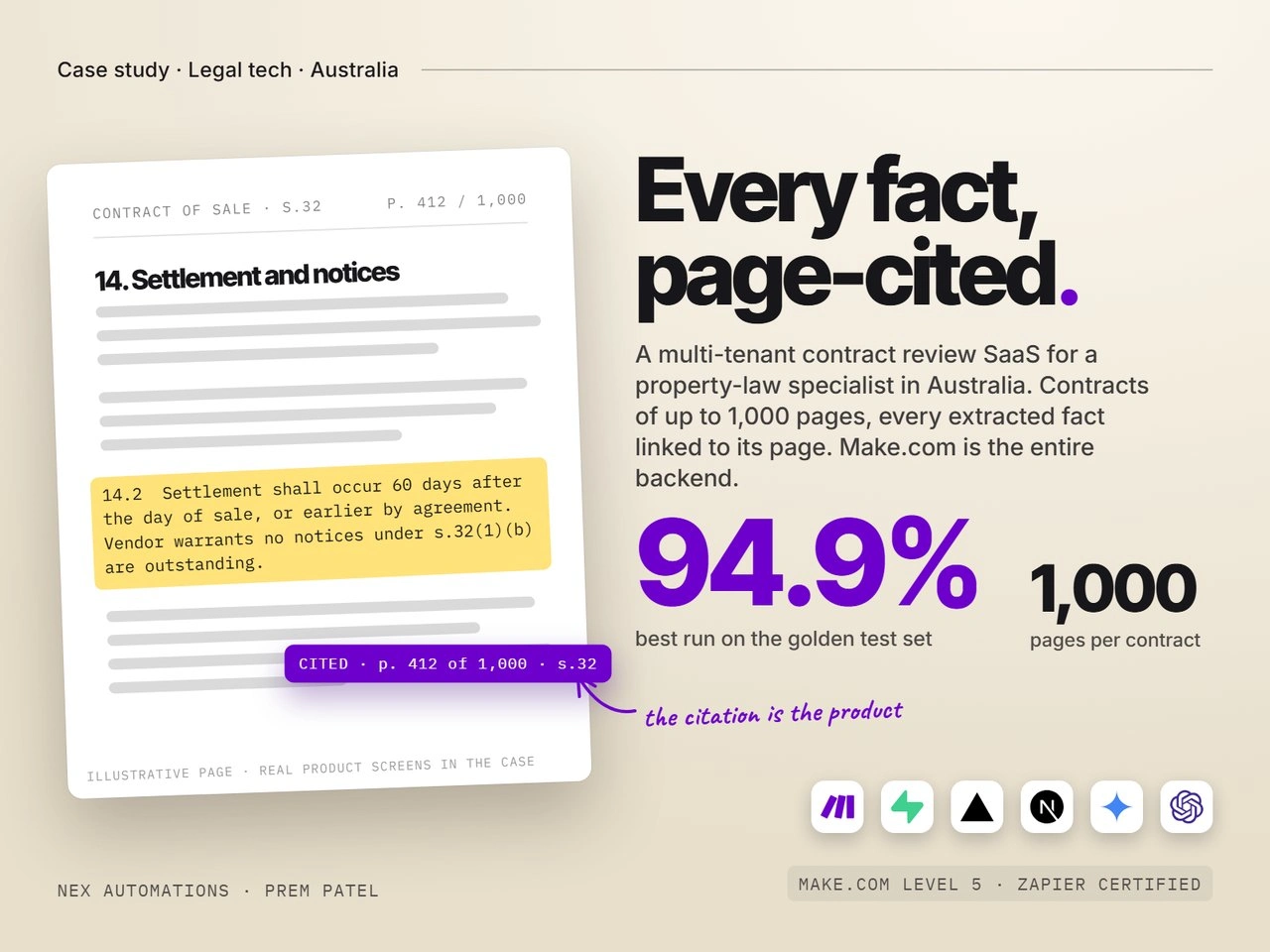
A property-law specialist in Australia now runs a multi-tenant AI contract review SaaS that reads Contracts of Sale and Section 32 documents of up to 1,000 pages and returns a review where every fact carries a page citation. Best run on the golden test set: 94.9%. Front end in Next.js on Vercel, data in Supabase, and Make.com as the entire backend.
Key facts
Fact | Detail |
|---|---|
Client | Property-law specialist (Victoria, Australia) |
Product | Multi-tenant contract review SaaS, in test, pre-revenue |
Platform | Make.com as the backend; Next.js on Vercel; Supabase; Stripe |
AI | OpenAI models, versioned prompts, golden test set of eight source-verified fact sheets |
Document size | 100 to 1,000 pages per contract |
Accuracy | Mean out-of-sample 70.2% to 79.5% between prompt versions; best single run 94.9% |
Build | 191 commits in five weeks (July to August 2026) |
Why this matters
Lawyers cannot sign a summary that has no evidence. Generic AI tools produce confident answers with no clause behind them, which is why most legal AI pilots stall. The design rule here was simple: no citation, no answer. Make.com was chosen as the backend because the work is document processing and AI orchestration, which is long-running, retry-heavy and rate-limited, exactly what a visual workflow engine with queues and error routes handles well, without a dedicated backend team.
The problem
Reviewing a Victorian property contract means reading a Contract of Sale and a Section 32 that together run to hundreds of pages, then writing a review that names the clause behind every point. Doing that by hand is hours per matter; doing it with a generic chatbot produces text a lawyer cannot rely on.
What we built
A multi-tenant SaaS. Front end in Next.js on Vercel, auth and data in Supabase with row-level security, files in Supabase storage, billing in Stripe. Make.com is the backend: two webhook scenarios take the upload, chunk the document, run extraction and drafting against the model, assemble the review and deliver it in the app and by email, every fact carrying a page reference.
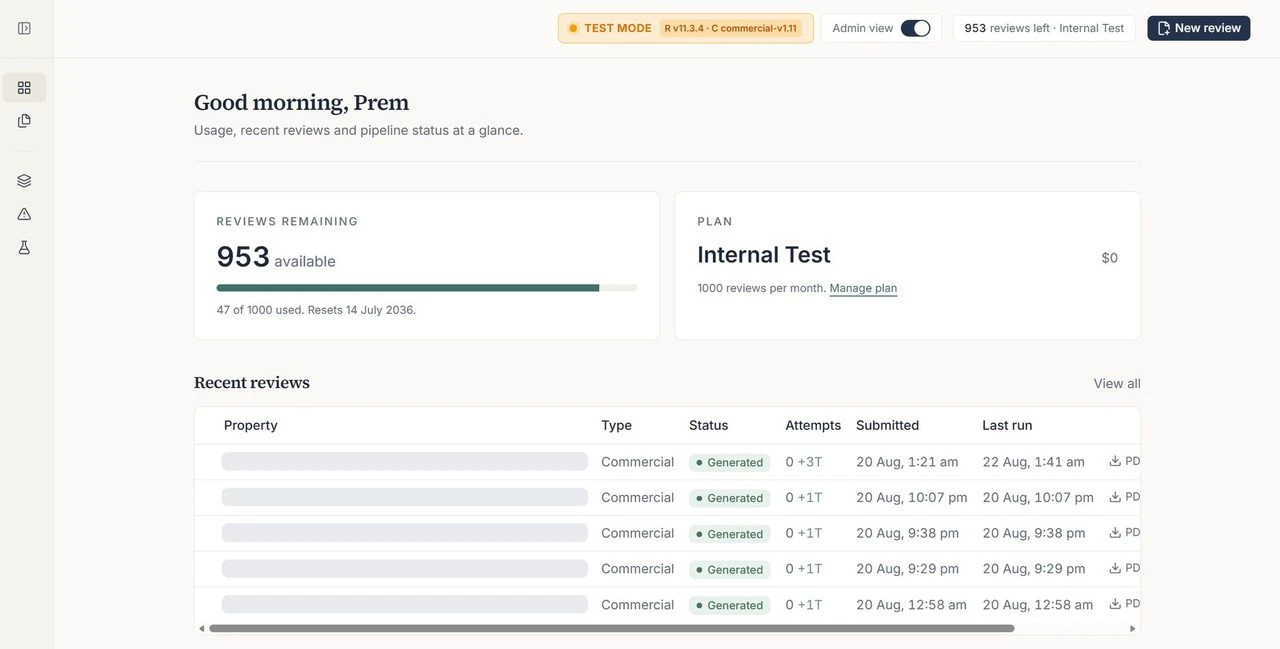
Reviews dashboard, grouped by contract type with date filters and database-backed sort
The app is a product, not a form. The reviews screen groups by residential and commercial, filters by status and date, sorts on database columns, and each review keeps its run history with re-run, DOCX and PDF export, in-app or email delivery, a monthly quota per firm and a retention date on every submission.
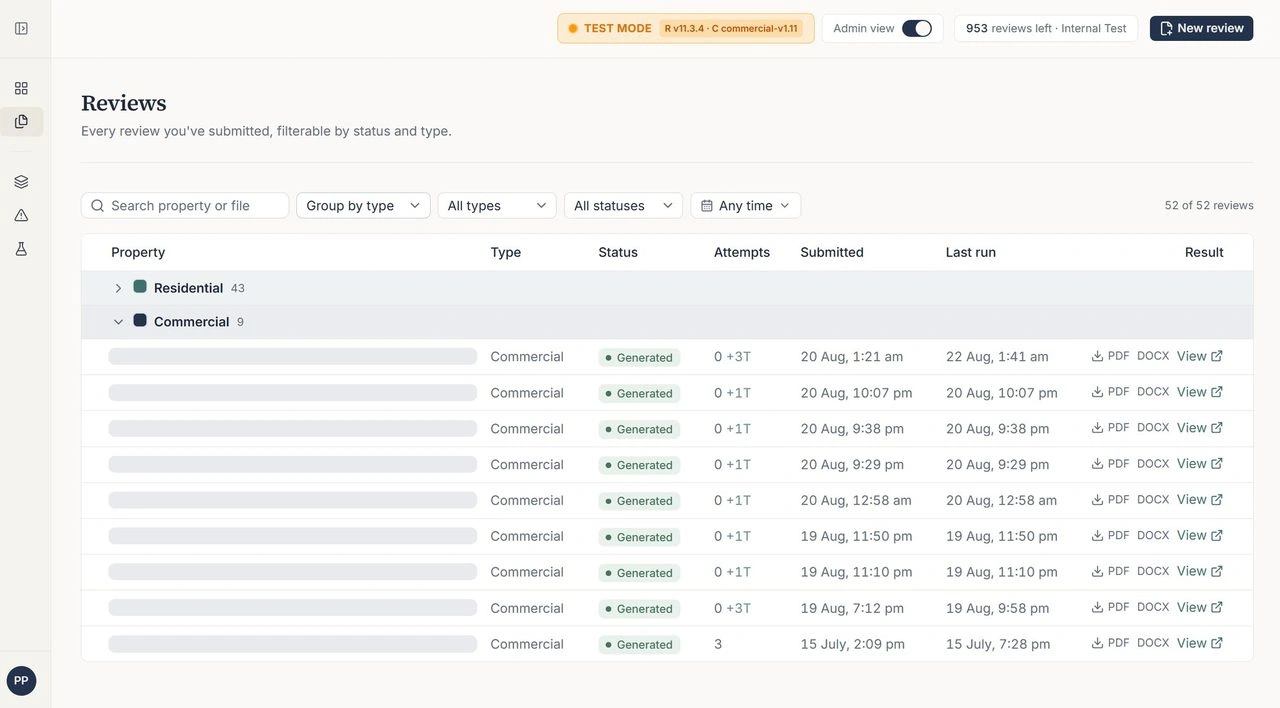
Review list with run history and export
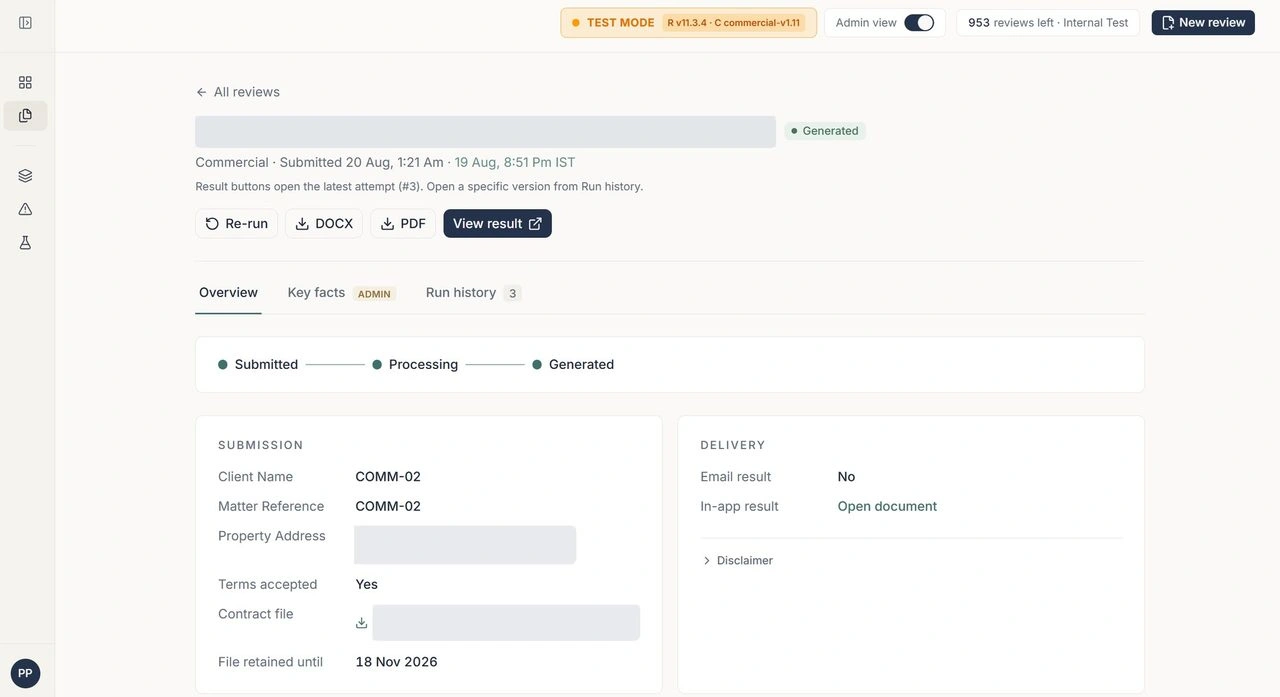
Review detail: every extracted fact with its page citation
How it runs, step by step
A firm user uploads the contract; Supabase stores the file under the firm's tenant with a retention date.
A Make.com webhook scenario acknowledges the upload and splits the document into chunks sized for the model.
Chunks are queued; each call honours Retry-After headers and carries an idempotency key, so a retried chunk never writes twice.
Extraction returns facts with page references; drafting assembles the review from those facts only.
The finished review is written back to Supabase and delivered in-app or by email as DOCX or PDF.
An admin re-run tool replays any stage for one review without touching the others.
The hard part was not the AI, it was long documents and rate limits. A 1,000-page contract cannot go through a model in one call, so the pipeline chunks, queues and resumes.
How accuracy is measured
Prompts are versioned in git and every version is scored against eight source-verified golden fact sheets built from real contracts. Failures are classified into five categories, so we know whether a miss is a wrong fact, a missing fact, an invented fact, a citation error or a format error.
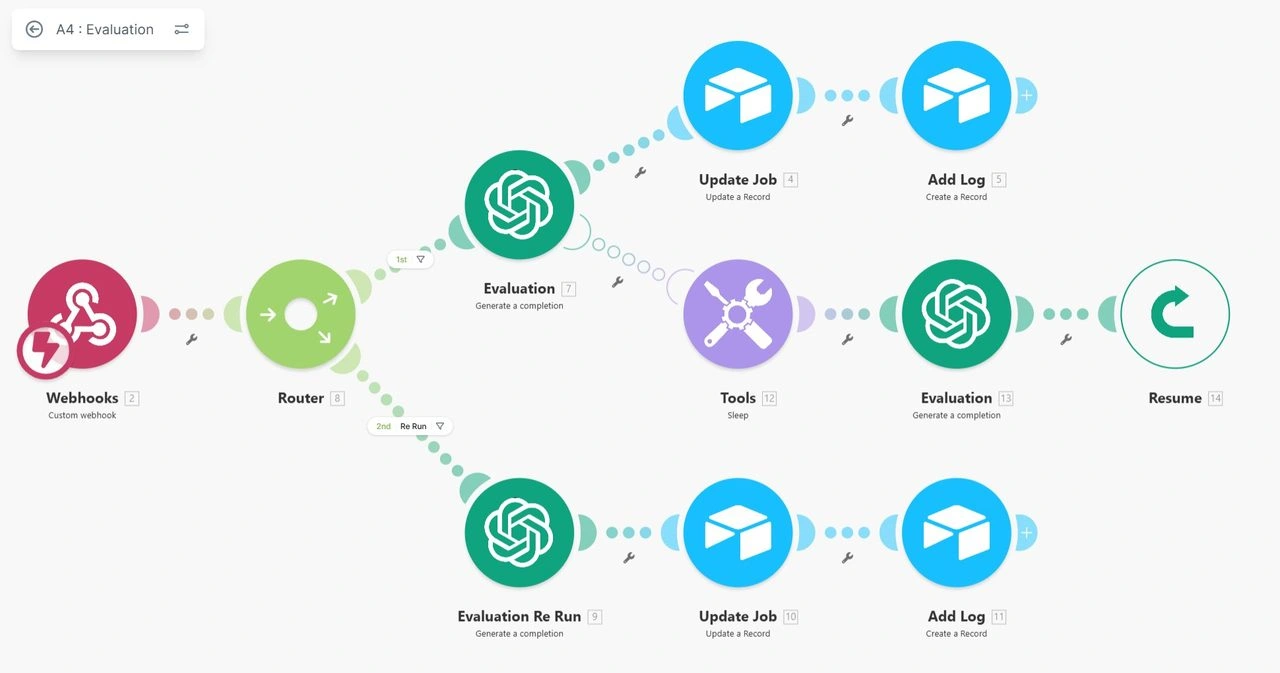
The evaluation scenario that scores every prompt version
Result
Mean out-of-sample accuracy rose from 70.2% to 79.5% between prompt versions
Best single run: 94.9%
191 commits in five weeks
A context-window bug that would have silently truncated 1,000-page contracts was caught by the harness before production
The product is in test and pre-revenue; no commercial result is claimed. Addresses in the screenshots are masked.
How to verify
The evaluation numbers come from the harness shown above, run against the golden set on every prompt change. The screenshots are the live application with client data masked. The work is listed at nex-automations.com/work, and Nex Automations is listed in the Make partner directory.
Who this is for
Law firms and legal-tech founders who want document review with evidence, and any founder who wants to ship a SaaS whose heavy lifting is document processing and AI orchestration without hiring a backend team first.
Questions people ask
Can Make.com be the backend for a real SaaS product?
Yes, when the work is document processing, AI orchestration and delivery. In this build Make.com handles ingestion, chunking, queued AI calls with retries, assembly and email behind a Next.js and Supabase front end. Auth, billing and the database stay in Supabase and Stripe, where they belong.
How do you measure whether an AI document reviewer is accurate?
With a golden test set: real documents with hand-verified fact sheets, scored on every prompt change and broken down by failure type. This project reports a 94.9% best run and a 79.5% mean from that harness, and the harness caught a truncation bug before any client saw it.
How does the AI avoid inventing clauses?
Every extracted fact must carry the page it came from, and drafting is only allowed to use extracted facts. Invented facts are one of the five failure categories the harness scores, so a prompt version that hallucinates fails the gate.
How do you process a 1,000-page contract through an AI model?
Chunk it, queue the chunks, honour the provider's Retry-After headers, and give every chunk an idempotency key so retries are safe. Assembly happens after all chunks return. That is the pipeline here, and it resumes rather than restarts when a call fails.
Is the client's data isolated per firm?
Yes. Supabase row-level security scopes every query to the firm, files sit in the firm's storage path with a retention date, and each firm has its own monthly quota and Stripe billing.
What did this cost and how long did it take?
Five weeks and 191 commits from first commit to a working multi-tenant product in test. Builds of this shape are quoted fixed after a mapping call; the Make.com Expert service on this profile lists the starting rate.
Related work
About the builder
Prem Patel is the founder of Nex Automations, an automation studio based in India with 1,200+ automations in production for 210+ clients across 12+ countries over six years (figures from nex-automations.com, August 2026). Make.com Level 5 certified, the top of Make's certification ladder, and an official Make partner listed in the Make partner directory. Zapier Certified Expert and a listed Zapier Solution Partner. 5-star average across 94 public reviews on Fiverr and Topmate.
Website: nex-automations.com · LinkedIn: linkedin.com/in/iamprempatel
Last updated: 27 August 2026.
Like this project
Posted Aug 27, 2026
A multi-tenant contract review SaaS for a property-law specialist in Australia. Next.js on Vercel, Supabase for data, Make.com as the entire backend. Every fact carries a page citation; best run 94.9% on a golden test set.
Likes
1
Views
8
Clients
Nex Automations