
30+ Apps Shipped | Flutter, Angular & ASP.NET
- $•••••
- Earned
- 7x
- Hired
- 5.0
- Rating
- 78
- Followers
30+ Apps Shipped | Flutter, Angular & ASP.NET

Full Stack Web & Mobile Dev | Next Js | AI Agent | React
- $•••••
- Earned
- 2x
- Hired
- 5.0
- Rating
- 39
- Followers
Full Stack Web & Mobile Dev | Next Js | AI Agent | React




Enterprise Cloud · DevOps · AI/ML · Email · Marketing Expert
- $10k+
- Earned
- 13x
- Hired
- 4.6
- Rating
- 46
- Followers
Enterprise Cloud · DevOps · AI/ML · Email · Marketing Expert

I’m Usama Idrees, IT & AI Specialist based in Islamabad, Pakistan. Thrilled to be part of this amazing community and to connect with talented Professionals from around the world! 🚀
A little about me:
What I do: I lead tech and product strategy, focusing on building innovative solutions that empower businesses and individuals.
Passion: Creativity meets technology — I love turning ideas into impactful products.
Looking for: Collaborations with designers, developers, and creative minds who want to build something extraordinary.
Excited to learn, share, and grow together here. If you’re working on something cool or looking for a tech partner, let’s connect! 💡
What’s your current creative project? Drop it below — I’d love to check it out. 👇
2
30
956



Interactive Rive + Framer Developer for SaaS

Full-Stack Software Engineer | AI, Cloud & DevOps
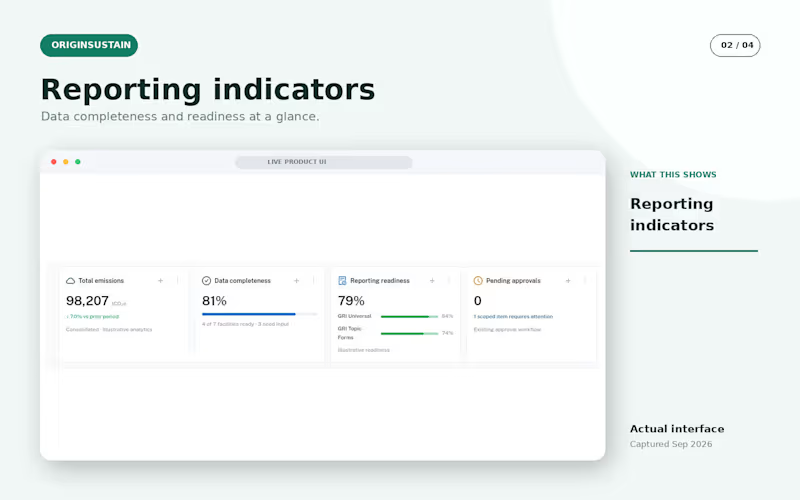
ESG reporting is a workflow problem as much as a data problem: teams need applicability rules, evidence, consolidation, review, and approvals before a report is ready.
For OriginSustain, I built NestJS/TypeScript backend services, PostgreSQL and Redis/BullMQ processing, and AWS/Docker delivery with CI/CD. OpenAI API and RAG support part of the reporting flow. The screens here are from the product’s illustrative command center; the numbers are demo values, not client outcomes.
The full backend case study: https://contra.com/p/WvNXbmQR-origin-sustain-or-multi-tenant-esg-reporting-backend
5
1.4K

Full-Stack Technology, Cloud & Cybersecurity Solutions
- 5.0
- Rating
- 6
- Followers
Full-Stack Technology, Cloud & Cybersecurity Solutions

Full-Stack Developer | AI & Web3
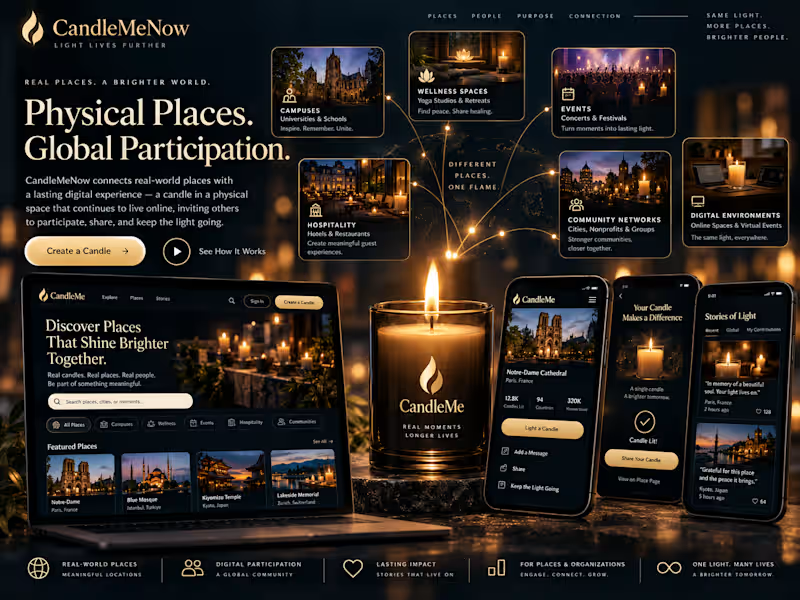
CandleMe — Interactive Digital Participation & Engagement Platform
CandleMe is a large-scale interactive digital platform designed to connect physical experiences, digital participation, organizations, communities, and persistent user journeys through a unified web experience.
I contributed to the product as a full-stack engineer, working across an established production codebase and handling functionality that extended far beyond traditional web application development. My work included complex frontend interactions, application-state integration, backend-connected user flows, organization configuration, QR/direct-link experiences, and performance-sensitive real-time graphics using Three.js and PixiJS.
One of the defining parts of CandleMe is its interactive candle experience. Rather than functioning as a conventional website, the platform combines application logic with rich visual rendering to create dynamic experiences that respond to real product state and user interaction.
The candle and flame systems were built as functional parts of the application—not simply decorative animations. They had to integrate correctly with surrounding UI, application state, configuration, navigation, and the broader product journey while maintaining smooth performance across different browsers and devices.
Core Product & Engineering Areas
Interactive Candle Experience
The product includes highly interactive visual experiences powered by Three.js and PixiJS, with custom flame effects and graphical behavior integrated directly into real application workflows.
This required balancing visual quality with browser performance, device compatibility, responsive behavior, and application-state synchronization.
Production Graphics & Performance Optimization
Real-time graphics introduce a completely different set of engineering challenges compared with standard frontend development.
I worked on optimizing the rendering experience across devices, including testing flame effects at approximately 45–60 FPS on a Galaxy A24 and a stable 60 FPS on an iPhone 15, while also validating compatibility with Apple/Metal-based rendering environments.
This involved careful attention to rendering behavior, visual consistency, performance, and differences between local and deployed environments.
QR & Direct-Link Entry
CandleMe supports experiences that can begin through a QR scan or direct link, creating a bridge between physical locations and the digital application.
Users can enter the relevant CandleMe experience without navigating through a traditional application onboarding flow, making the system suitable for physical venues, activations, events, and distributed experiences.
Persistent Candle Experiences
A candle can represent more than a single interaction. The product is structured around persistent digital experiences that users can revisit, interact with, and share.
This required product flows that maintain the relationship between the candle, its configuration, its destination, and the environment in which it is being used.
Configurable Destinations & “Doors”
The platform supports configurable destinations or Doors, allowing CandleMe experiences to direct users into different journeys depending on the organization, location, campaign, or use case.
This adds an important configuration layer to the product because different deployments can use the same underlying platform while presenting different experiences to users.
Organization Ownership & Management
CandleMe includes organization-level functionality that allows experiences to be created and controlled within a larger operational structure.
The system needed to support ownership, organization configuration, locations, plans, activations, and the relationships between these entities rather than treating every candle as an isolated object.
Locations & Physical Environments
The product is designed to operate across real-world environments.
Candle experiences can be associated with physical locations and organizational contexts, allowing the digital platform to extend into venues, events, communities, hospitality environments, campuses, wellness spaces, and other physical settings.
Activations
Organizations can configure and manage activations around specific CandleMe experiences.
This introduces another layer of application state and business logic involving where an experience is deployed, how users enter it, what configuration is active, and which organization owns or manages it.
Responsive Cross-Device Experience
The product needed to work effectively across desktop and mobile environments because many users enter the experience directly from their phones after scanning a QR code.
The visual rendering layer, UI components, and application interactions therefore had to remain responsive and usable across very different viewport sizes and hardware capabilities.
Integration With an Existing Production Application
A major part of the engineering challenge was working within a large existing PHP-based frontend/backend application rather than building an isolated prototype.
New interactive functionality needed to integrate with existing business logic, state management, navigation, backend-driven configuration, and production user flows without disrupting established behavior.
That required understanding the existing architecture first and then introducing new functionality in a way that remained maintainable and compatible with the rest of the system.
Technical Complexity
CandleMe demonstrates a combination of several engineering disciplines:
Full-stack product engineering for the wider web application and business workflows.
Creative frontend engineering for highly customized interactive experiences.
Three.js / WebGL-style rendering for browser-based visual effects.
PixiJS integration for performant interactive graphics.
Backend integration with a mature PHP application.
Performance engineering across mobile and desktop hardware.
Responsive application development for QR-first mobile user journeys.
Configuration-driven architecture supporting organizations, locations, activations, destinations, and reusable experiences.
The project required thinking beyond individual pages or API endpoints. Features had to work together as part of a larger production ecosystem where the visual experience, backend configuration, organization structure, and user journey were tightly connected.
Result
The result is a production platform that combines interactive web graphics, physical-to-digital experiences, organization management, configurable user journeys, responsive UX, and full-stack application engineering within a single product.
For me, CandleMe represents the type of engineering work where frontend, backend, architecture, performance, and product thinking overlap—requiring both the ability to build technically complex functionality and the judgment to integrate it safely into an existing production system.
1
255
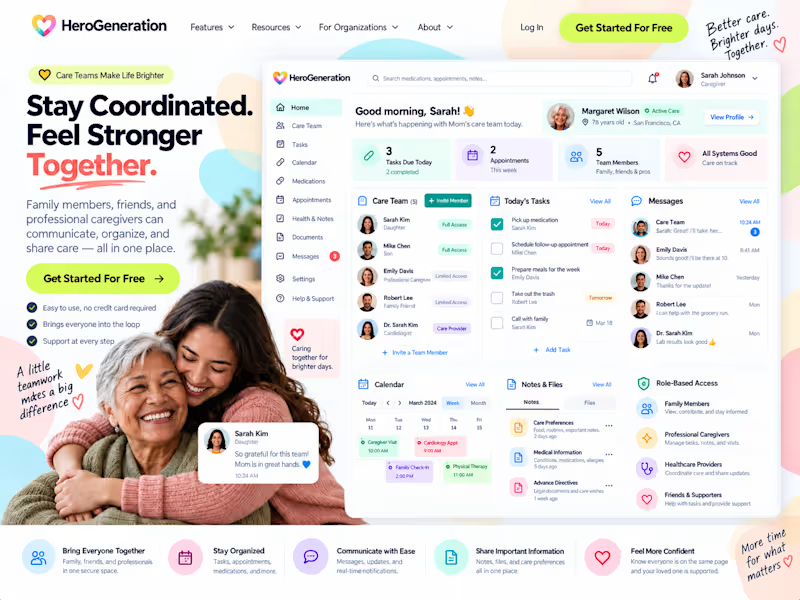
HeroGeneration — Caregiver Management Platform
HeroGeneration is a full-stack caregiver management platform designed to help families organize, coordinate, and manage the day-to-day responsibilities involved in caring for a loved one.
I worked on the product as a full-stack engineer, contributing to the application experience across caregiver workflows, structured care information, responsive web interfaces, collaborative features, and AI-assisted support. The goal was to turn information that is normally fragmented across messages, calendars, documents, medication lists, and family members into one centralized and easy-to-use platform.
At the center of the product is a Loved One profile, which acts as the single source of truth for the person receiving care. Caregivers can manage important health information, medications, appointments, documents, notes, contacts, daily responsibilities, and care-team activity without switching between multiple applications.
Core Product Features
Loved One Management — Create and maintain centralized care profiles containing important personal and caregiving information.
Medication Management — Track medications, dosages, schedules, refill information, and daily medication responsibilities.
Appointments & Calendar — Organize medical appointments, follow-ups, caregiver visits, and other important care-related events.
Daily Care Tasks — Create, assign, track, and complete recurring or one-time caregiving responsibilities.
Health Notes & Tracking — Maintain notes around symptoms, health observations, mood, blood pressure, and other relevant care updates.
Care Team Collaboration — Bring family members, friends, healthcare professionals, and professional caregivers into one coordinated care environment.
Role-Based Access — Different participants can be given appropriate levels of access depending on their responsibilities within the care team.
Shared Responsibilities — Assign tasks and responsibilities to individual care-team members so everyone understands what needs to be done and who is responsible.
Messaging & Communication — Keep care-related conversations and updates connected to the wider caregiving workflow rather than scattered across external messaging platforms.
Documents & Important Information — Organize insurance information, medical records, advance directives, emergency information, care preferences, and other important documents.
Emergency & Healthcare Contacts — Maintain quick access to doctors, specialists, family members, healthcare facilities, and other important contacts.
Responsive Web & Mobile Experience — Care information remains accessible across desktop and mobile interfaces, allowing caregivers to manage responsibilities wherever they are.
Personalized Weekly Guidance — The platform can surface relevant caregiving guidance, tasks, reminders, and recommendations based on the caregiver's current situation.
Andrea — AI Caregiving Assistant — An AI-assisted experience helps caregivers navigate common questions, prepare for appointments, understand next steps, discover relevant resources, and get contextual guidance within the product.
Caregiver Resource Hub — Educational resources, guides, checklists, local support services, financial information, legal resources, and caregiver-support material are organized into a searchable experience.
Notifications & Reminders — Important medications, appointments, tasks, and care responsibilities can be surfaced at the right time to reduce missed actions.
Product & Engineering Approach
The main engineering challenge was not simply creating individual CRUD screens. The system needed to model the relationships between care recipients, caregivers, medications, appointments, tasks, healthcare professionals, documents, permissions, and shared responsibilities while still keeping the experience simple for non-technical users.
The application was therefore structured around a centralized care profile with interconnected modules, allowing information entered in one part of the system to remain useful throughout the broader caregiving workflow.
The user experience was also designed around the reality that caregivers often operate under time pressure. Important actions—checking medications, reviewing today's tasks, preparing for an appointment, contacting a care-team member, or finding an important document—need to be accessible quickly without navigating through complicated enterprise-style interfaces.
The result is a product that combines full-stack SaaS development, collaborative workflows, structured healthcare-related information, responsive interfaces, role-based access, and AI-assisted guidance into one cohesive caregiver-management experience.
My contribution: Full-stack development • SaaS application architecture • Frontend implementation • Backend/API development • Care-management workflows • Responsive UI • Collaborative features • Role-based access • Data modeling • AI-assisted caregiver workflows • Production feature development
1
194

Full Stack Engineer
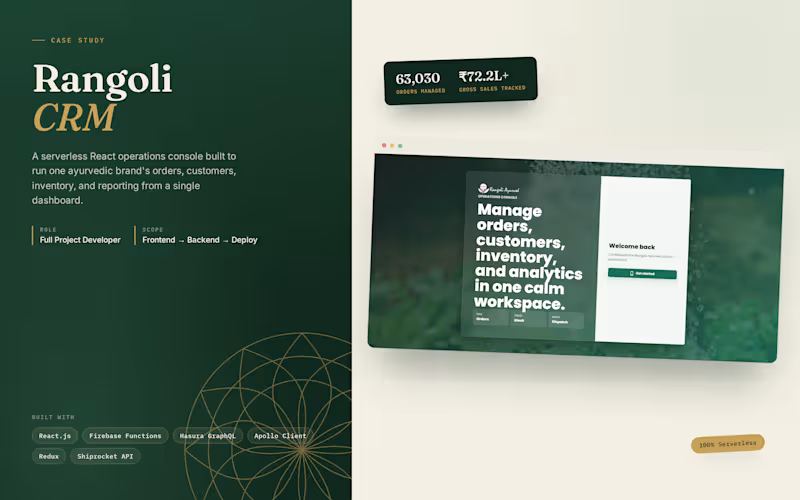
Rangoli CRM - Serverless React CRM Platform
Rangoli CRM was a serverless React.js CRM platform that I developed from scratch, including the frontend, serverless backend workflows, API integrations, deployment, and production setup. The system was built to manage customers, orders, billing, printable invoices, shipments, and business reporting from a single dashboard.
The frontend was built with React.js and hosted on Firebase Hosting. For backend/serverless logic, I used Firebase Cloud Functions, while Hasura was deployed on Heroku to provide GraphQL APIs for application data. I integrated shipment workflows, including Shiprocket, so the business could manage order delivery and tracking directly through the CRM.
My Role
Full Project Developer
Key Work
Developed the complete CRM from scratch
Built React.js dashboard screens for customers, orders, billing, invoices, shipments, and reports
Hosted the frontend on Firebase Hosting
Built serverless workflows using Firebase Cloud Functions
Used Hasura on Heroku for GraphQL data APIs
Integrated GraphQL APIs with Apollo Client
Integrated Shiprocket for shipment and delivery workflows
Managed frontend state using Redux
Built responsive UI using Ant Design
Handled deployment, debugging, and production setup
Tech Stack
React.js, Redux, Ant Design, Firebase Hosting, Firebase Cloud Functions, Hasura, GraphQL, Apollo Client, Heroku, Shiprocket API, JavaScript
0
180
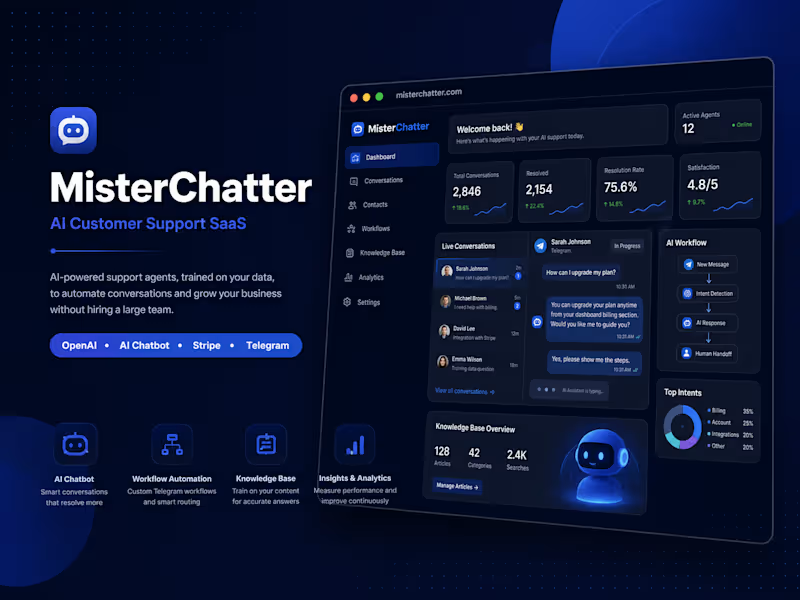
MisterChatter is an AI agent for businesses running customer support and sales over chat and Telegram. It's trained on behavioral psychology to hold calm, on-brand, human-like conversations 24/7 — answering every query, converting casual inquiries into paying customers, and handling the workload of a 10-person team. I built the full product: positioning, landing page, pricing tiers, and three specialized agent types (Public Support, Sales-focused, VIP Care). Live at misterchatter.com (http://misterchatter.com)
0
159
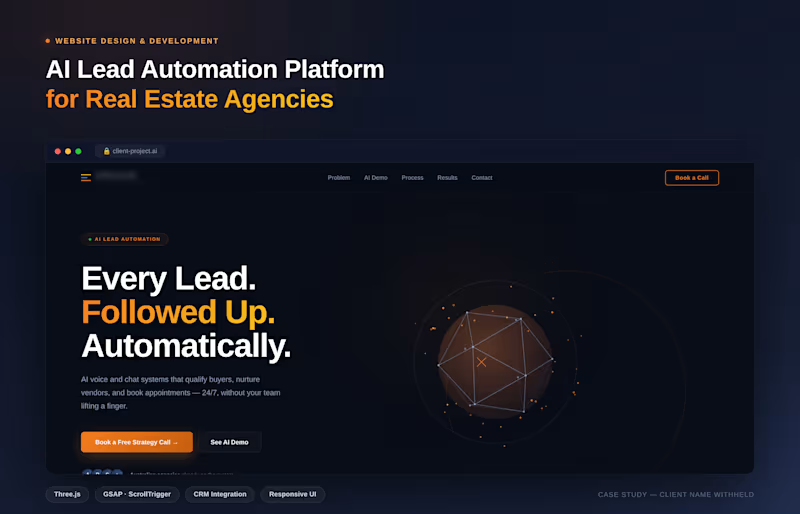
AI-Powered Lead Automation Website for a Real Estate AI Startup
Built a full marketing site for a startup selling AI voice + chat automation to real estate agencies — the kind of project where the design had to sell "AI that never sleeps" before a single line of copy did.
The challenge:
The client's pitch was simple but the proof had to be visual: leads get missed after hours, after open homes, and in cold databases — and their AI catches all three. The site needed to feel alive — like the AI was actually running in the background — not just describe automation with a static hero image.
What I built:
A dark, glass-morphic hero with a live animated 3D AI avatar (Three.js) that reacts and pulses, paired with a custom cursor and magnetic buttons for a premium, "always-on" feel
Animated counters and a scrolling proof ticker (GSAP + ScrollTrigger) that reveal results and capabilities as you scroll, instead of dumping everything above the fold
A "Problem" section built around four real numbered failure points agencies actually experience (late-night enquiries, open-home follow-up, vendor nurture, database reactivation) — each paired with how the AI solves it
A live embedded chat bot demo panel plus a placeholder for a voice bot demo, so prospects could try the product instead of reading about it
A 4-step "how it works" process timeline and a results section translating automation into business outcomes (more appraisals, faster response time, always-on coverage)
Full mobile responsiveness and a booking-call CTA wired straight into their CRM funnel
Stack: Semantic HTML5 with a token-based CSS architecture (custom properties, fluid typography, CSS Grid) for a maintainable design system; GSAP + ScrollTrigger driving the scroll-based motion; Three.js/WebGL powering the real-time 3D avatar; vanilla ES6+ for interaction logic (no framework overhead); integrated with a CRM booking API for lead capture and routing.
The result: A site that doesn't just claim "AI that never misses a lead" — it demonstrates it, from the first scroll to the live chat demo, giving the client a genuinely differentiated landing page in a market full of templated agency sites.
0
60
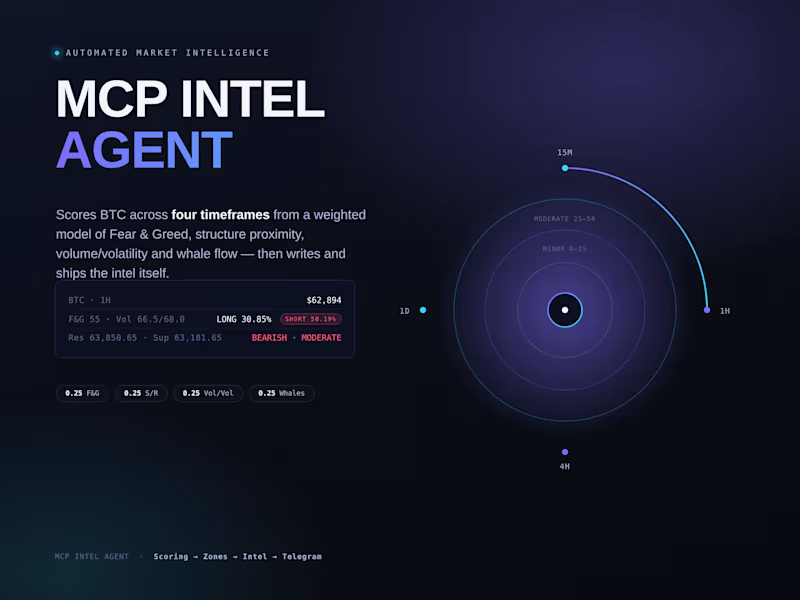
MCP Intel Agent is a crypto intelligence and signal automation platform I built for MyCryptoParadise/ProParadiser. It ingests market data from a third-party source, validates and stores it in MongoDB, scores long/short opportunities across multiple timeframes, generates AI-assisted market intel using OpenAI, and publishes formatted updates to Telegram. I built the system from scratch, including backend APIs, scoring logic, admin dashboard, Telegram automation, deployment, and production maintenance. Live at https://mycryptoparadise.com/pro-paradiser/
0
145