Freelancers using Google Ads in LagosFreelancers using Google Ads in Lagos
Compelling Brand and Marketing Designer
$10k+
Earned
11x
Hired
5.0
Rating
84
Followers
Compelling Brand and Marketing Designer
Social Media Manager | Meta Ads Expert | Brand Growth
$1k+
Earned
3x
Hired
5.0
Rating
243
Followers
Social Media Manager | Meta Ads Expert | Brand Growth
Digital Growth Architect | 14x ROAS Framework
5.0
Rating
11
Followers
Digital Growth Architect | 14x ROAS Framework
Facebook(Meta) & Google Ads Expert | AI Automation
5.0
Rating
14
Followers
Facebook(Meta) & Google Ads Expert | AI Automation
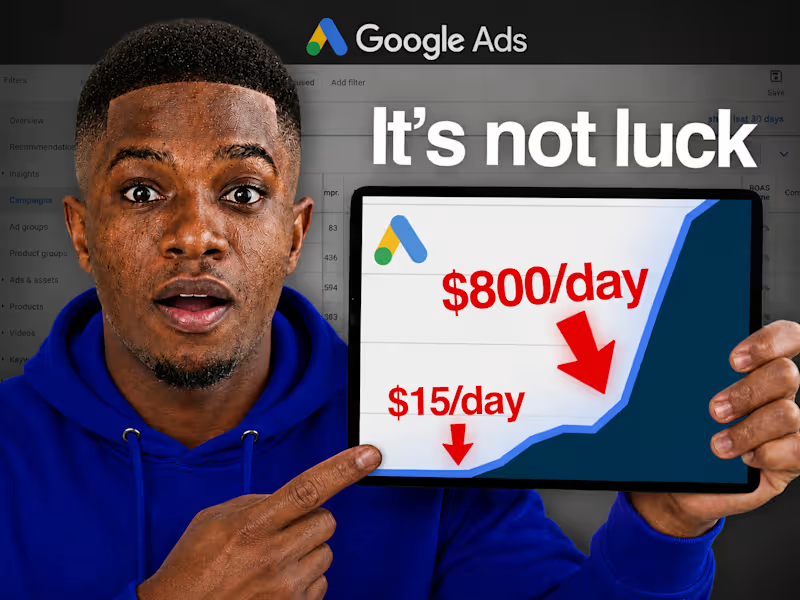
Cover image for I'll change the way you
I'll change the way you think about Google Ads... Don't be GOLD FISH, read it through!!! A friend called me recently in a total panic. He'd just spent $3,000 on Google Ads and got absolutely nothing back. Zero leads. Zero sales. Just gone. And of course, his conclusion was "Google Ads is dead." I hear this a lot. And honestly, I get why people believe it. But let's actually talk about what's true here, because there's a real difference between "Google Ads doesn't work" and "MY Google Ads didn't work", and almost everyone mixes those two up. Here's the honest part first: Google Ads has genuinely gotten harder. More competition, higher costs per click, way more automation, less manual control than it used to have. If you're running it the same way you did 5 years ago, you will lose money. That part is real, not made up. But here's what actually happened when I looked into his account, and it's the same pattern I see over and over: → No conversion tracking set up at all. Google was spending completely blind, no idea what was actually working. → Broad match keywords on a tiny budget, so ads were showing to people with barely any relevant intent. → Generic ad copy, the kind that could describe literally any business in any industry. → Zero negative keywords, zero ad extensions. → The campaign ran for 6 weeks and nobody had looked at the search terms report once. None of that is Google's fault. That's a setup problem, and setup problems are fixable. Here's the thing that really gets me: most people who say "Google Ads doesn't work" tested one bad setup, once, for a few weeks, and quit. That's like going to the gym twice, not seeing abs, and telling everyone fitness is a scam. Nobody thinks that way about fitness, everyone accepts it takes skill and consistency. Google Ads is exactly the same. It's a skill. It can be learned. It just LOOKS deceptively simple from the outside, and that's exactly what traps people. And honestly, some of what Google's automated over the years is genuinely good, smart bidding can process signals no human could ever track manually. The automation isn't the problem. The problem is people hand control over to the algorithm before giving it anything useful to actually learn from. Like hiring a great chef and handing them an empty fridge. Here's what we actually did to fix my friend's account, none of it cost extra: ✓ Set up proper conversion tracking for the first time ✓ Went through the search terms report and built a real negative keyword list ✓ Rewrote the ad copy to speak to an actual specific problem, not generic fluff ✓ Tightened match types ✓ Added sitelinks, callouts, a location extension Same budget. Same platform. Within 6 weeks, more leads than the previous 6 months combined. The platform didn't change. The approach did. Here's the real takeaway: if you tried Google Ads once and it flopped, don't write off the platform, write off the version of yourself that ran it that first time. You know more now. Most competitors are still stuck obsessing over match types and bid tweaks while ignoring whether their offer or landing page is even any good. If you're willing to actually understand this at a strategic level instead of just clicking buttons, you're already ahead of most people running ads right now. Follow along, more real breakdowns like this coming. 👀
1
237
Cover image for The BEST Way To Scale
The BEST Way To Scale Google Ads in 2026 Okay, this is one of my favorite Google Ads strategies because it's basically hands-off scaling, you set it up once, and your budget grows automatically as long as your results actually stay good. Let me walk you through it. Inside your Google Ads account, at the campaign level, there's an option to create an Automated Rule. Here's the setup for scaling UP: First, name your rule (something simple like "Budget Increase 3%"). Select which campaign(s) it applies to. Then set your condition, this is the important part. Pick a metric that reflects actual performance: cost per conversion if you run leads, return on ad spend if you're eCommerce. Let's say you know from your numbers that anything under £30 cost per lead is genuinely profitable for your business. You set the rule: "if cost per conversion is less than £30, increase budget." For the actual increase, go with a percentage, not a fixed amount. Why? Because a flat £2-3/day bump becomes meaningless once your budget scales up, a percentage keeps increasing proportionally as you grow. 3% is a solid, conservative default. You can go more aggressive if you're trying to capitalize on something time-sensitive, like a seasonal sale or a promo that's crushing it right now. One setting people get wrong constantly: the data timeframe Google uses to evaluate your condition. Don't leave it on "all time." If your campaign performed great for two months and then conditions changed recently (seasonality, fatigue, competition), an "all time" average will mask that and keep scaling even when current performance has actually dropped. Set it to the last 7 days instead, so the rule reacts to what's happening NOW, not historical performance. If you're getting tons of conversions daily, you can shorten this window even further. If you're only getting one conversion a day, you might need it slightly longer for the data to mean anything. Also worth doing: set an upper spending cap so you don't wake up in a few months having scaled way past your actual budget comfort zone. Now here's the part that makes this strategy really powerful, the reverse rule. Create a second automated rule that DECREASES your budget when performance drops. Same logic, opposite direction: if cost per conversion goes above, say, £40, decrease budget by 3%. This way you're automatically spending more when things are working and pulling back when they're not, without having to babysit the account daily. Leave a buffer zone in the middle (like £30-40 in this example) where nothing changes. That gives your account some breathing room instead of constantly adjusting on every small fluctuation. The real value here: your budget starts responding to actual, current performance automatically. You're not manually checking in every few days trying to decide whether to scale, the system does it for you, based on rules built around your actual numbers. And you're never locked in, you can always override manually. Big news event nobody's paying attention to your ads because of? Pull the budget down yourself. Seasonal sale about to pop off? Bump that increment up temporarily. This is genuinely one of the lowest-effort, highest-leverage setups you can put in a Google Ads account. Follow along, more scaling strategies like this coming. 👀
1
205
Cover image for Okay, if you're running Google
Okay, if you're running Google Ads with a Target CPA or Target ROAS goal AND your campaign is limited by budget, you need to read this before August 17th. This one actually matters. Here's the deal: right now, if your campaign has a budget cap and a performance goal, Google's bidding algorithm quietly goes after the CHEAPEST conversions it can find within your budget. So if your Target CPA is set to $10, you might actually be getting $5 conversions. Feels great, right? Free upside. Starting August 17th, that's going away. Google is changing this so your campaign will actually trend TOWARD your set target, not undercut it. So if you're sitting at a $10 target but actually getting $5 CPA right now, expect that number to start creeping up toward $10 after the change. Same logic applies to ROAS, if your target is 200% but you're actually hitting 350%, expect that to drift back down toward 200% if you don't do anything. Why is this happening? Google says it's about stability, apparently a lot of advertisers get spooked when they raise budgets and performance suddenly fluctuates. Might be true. It's also probably going to make Google more money, because more advertisers will end up bidding closer to what they said they were willing to pay, instead of quietly getting a discount. Both things can be true at once. Here's the part that actually matters for you: this only affects campaigns that are BOTH limited by budget AND currently over-performing their goal. If your campaign isn't capped by budget, this change doesn't touch you. So what do you actually do about it? If you're happy with your current performance (the good CPA/ROAS you're getting right now): → Increase your budget. That locks in more volume at the rate you're already happy with, instead of watching that rate quietly disappear. If you're fine either way: → Adjust your target closer to what you're actually currently achieving. If your target's $50 but you're really getting $30, move the target down to $30 gradually — don't jump all at once, step it down over a week or two. If you do nothing: → Your CPA/ROAS will likely drift toward your original target, meaning fewer conversions for the same spend. Quiet performance loss, no warning bells. One more thing worth knowing, this could create a mild ripple effect across competitive auctions. If everyone bidding on the same keywords adjusts down to their real performance, things stay stable. But if even one competitor decides to keep their higher target and increase budget instead, they get more competitive in the auction, which can nudge costs up for everyone else too. Basically: how your competitors react matters just as much as how you react. The businesses most likely to get blindsided by this are the ones NOT paying attention to their account regularly. If that's not you (and clearly it's not, you're reading this), you've got time to adjust before it happens. Bottom line: go check your account today. Anything limited by budget with a goal that's over-performing, decide now: raise the budget, or adjust the target. Don't wait until August 17th to find out the hard way. Follow along, more of these timely breakdowns coming. 👀
1
188
Cover image for Okay so let's talk about
Okay so let's talk about something painfully simple that a lot of Google Ads accounts get wrong, nobody's clicking your ads. Doesn't matter how good your product is, how great your deal is, how well-optimized your campaign structure is. If people aren't clicking, none of it matters. So let's break down why this happens and how to actually fix it. 1. Your ad copy might be the problem Most beginners write ad copy ABOUT their business instead of about what the customer actually wants. If your headline reads like a company brochure, nobody's stopping to click. Lead with the benefit, not the feature, "save 2 hours a day" beats "advanced scheduling software" every time. And try to mirror the actual language people are typing into Google. If your headline echoes their exact search, it instantly feels more relevant. 2. You might be targeting the wrong keywords Showing up for more searches isn't automatically good, if those searches aren't actually relevant to your offer, you're just burning impressions with zero clicks. A bakery running ads that show up for "cake recipes" is wasting money on people who were never going to buy a cake, they wanted a recipe. This is where negative keywords come in. Adding even 10 well-chosen ones can dramatically clean up who actually sees your ad, which directly improves CTR. 3. Your offer might just not be compelling enough Sometimes the copy's fine, the keywords are right, but the offer itself doesn't give anyone a reason to choose you over the next ad. Go Google your own product category right now and screenshot the top 3 competitor ads. What are they offering that you're not? A free trial, a guarantee, faster delivery, no contract, even small differentiators can tip a click in your favor. Fix this before touching your budget or your bids. 4. You're probably not using ad extensions (and you should be) This one's honestly a bit of a cheat code. Sitelinks, callouts, structured snippets, call and location extensions, they're free, and they make your ad physically bigger and more informative. Google actually rewards ads using extensions with better ad rank, even with an identical bid to an ad without them. More space = more visibility = more clicks. Set it up once and it just works in the background. 5. Wrong place, wrong time Even a great ad won't get clicked if it's shown at 3am to someone who was never going to buy right then. Look at what days/hours actually convert and shift spend accordingly. Check your location targeting, too broad wastes budget, too narrow limits reach. And don't forget device performance, mobile and desktop CTR can look completely different, so check both. Quick benchmark for you: average CTR across Google Ads in 2024 was 6.42%, probably higher than you'd guess. Arts & entertainment topped out around 13%, while legal services sat closer to 5.3%. Worth knowing where your industry typically lands before you panic over your own numbers. None of these fixes cost extra ad spend. They just require you to actually look at what's happening and adjust. Small, unglamorous changes, but they compound fast. Follow along, more of these breakdowns coming your way. 👀
0
203
Software Engineer & AI Digital Creator for Your Success

5.0
Rating
13
Followers
Software Engineer & AI Digital Creator for Your Success

Cover image for KEYWORD RESEARCH IS NOT JUST
KEYWORD RESEARCH IS NOT JUST AN SEO TASK. IT IS THE FOUNDATION OF YOUR DIGITAL PRESENCE. Most business owners want their website to appear on Google. They invest in a beautiful website. They create social media pages. They publish blog posts. They even run ads. But here is the question many businesses never ask: “Are we creating content around what our potential customers are actually searching for?” That is where keyword research comes in. Think about it this way. Your customer has a problem. They go to Google and type: “best real estate agent in Lagos” “affordable web designer in Nigeria” “how to get more customers online” “best digital marketing agency for small businesses” If your website, content, and digital assets are optimized around the right search terms, you have a better opportunity to put your business in front of that person at the exact moment they need what you offer. But without proper keyword research, you could spend months creating content that nobody is searching for. And that is one of the biggest mistakes businesses make online. Why keyword research matters: 1. It helps you understand your customers Keywords reveal the questions, problems, needs, and intentions of your target audience. 2. It helps you build the right content Instead of guessing what to post, you create content based on actual search demand. 3. It improves your SEO strategy You can optimize your website pages, blog posts, product descriptions, headings, and other content around relevant search terms. 4. It helps you discover less competitive opportunities You don't always need to fight for the biggest keywords. Sometimes, highly specific long tail keywords can bring you visitors who are much closer to making a buying decision. 5. It connects your business with search intent There is a huge difference between someone searching: “what is SEO?” and someone searching: “SEO agency for small business in Lagos.” The first person may be researching. The second person may be looking for someone to hire. That difference matters. Your digital presence should not simply be visible. It should be visible to the right people, searching for the right things, at the right stage of their buying journey. So before you publish another blog post, redesign another website page, or create another piece of content, ask yourself: “What keywords are my potential customers actually using?” Because when you understand what your audience is searching for, you stop creating content based on assumptions and start building your digital presence around real demand. Want to know whether your website is targeting the right keywords and opportunities? Send me a DM with “KEYWORD AUDIT” and let's identify the search opportunities your business could be missing.
2
101
Cover image for SEO Is Not Just About
SEO Is Not Just About Google. It Is About How Your Business Feels When Customers Find You. A lot of business owners think SEO is simply about getting their website to the top of Google. It is not. SEO is about becoming visible when your potential customer is already looking for what you offer. Think about it. Someone searches for a service you provide. If your website appears on page 5, they may never see you. But when your business consistently appears among the results they trust, something changes. They begin to think: "These people must know what they are doing." "Maybe this is the business I should contact." "If Google is showing them, they are probably legitimate." That is where the real emotional benefit of SEO comes in. SEO gives business owners confidence. Confidence that your business is not invisible. Confidence that potential customers can discover you without you constantly chasing them. Confidence that the website you invested in is actually working for your business. And most importantly, confidence that your competitors are not taking every customer simply because they are easier to find online. The goal is not just more traffic. The goal is more qualified visibility, more trust, more opportunities, and ultimately more customers. Your website should not sit quietly online waiting for someone to accidentally find it. It should be positioned to meet your customers at the exact moment they are searching. That is what strategic SEO can do for a business. If you are wondering why your website is getting little traffic, few enquiries, or almost no visibility on Google, it may be time to find out what is actually holding it back. Send me a DM with the word "SEO" and let's look at how your website can become more visible, more competitive, and more valuable to your business.
1
77
Cover image for Why Secondary Keywords Can Be
Why Secondary Keywords Can Be More Valuable Than Your Main Keyword Most business owners approach SEO with one thought: “I want my website to rank for this keyword.” So they target the biggest, most obvious keyword in their industry. For example: A real estate company may target “real estate agent.” A digital agency may target “web design.” A restaurant may target “restaurant in Lagos.” Sounds logical, right? But there is a problem. Everyone else is targeting the same keyword. That means higher competition, harder ranking, and often a much longer wait before you see meaningful results. This is where secondary keywords become extremely valuable. Instead of only targeting: “Real estate agent” You could target more specific searches such as: “luxury real estate agent in Lagos” “property management for rental properties” “best real estate agent for first time buyers” These keywords may have lower search volume, but they can have much stronger search intent. And that is what many business owners overlook. Your goal should not simply be: “Get more people to my website.” Your goal should be: “Get the RIGHT people to my website.” A person searching for a highly specific service is often much closer to making a buying decision than someone searching for a broad industry term. Think about it this way: High volume + high competition ≠ guaranteed customers. But: Specific keyword + strong intent + relevant page = potential customer. This is why a proper SEO strategy does not just chase popular keywords. It studies what your potential customers are actually searching for, identifies the gaps your competitors are ignoring, and strategically builds content and landing pages around those opportunities. Your website does not need to rank for everything. It needs to rank for the searches that can actually move your business forward. Want to know which keywords your website should actually be targeting? Send me a DM with “KEYWORDS” and let's identify the opportunities your competitors may be overlooking.
1
68
Cover image for Your customers may forget what
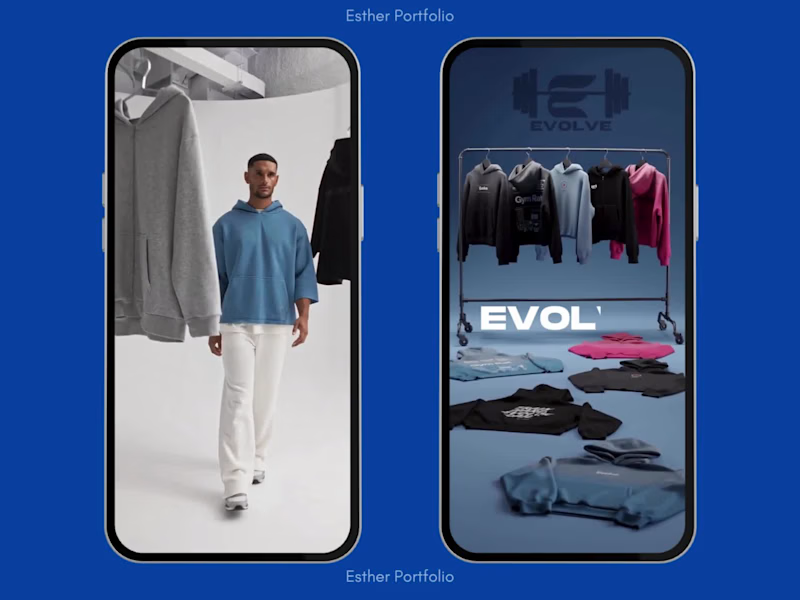
Your customers may forget what you said, but a powerful video can make them remember how your brand made them feel. Imagine spending days building a great product, offering an amazing service, or launching a new business, only for your ideal customers to scroll past because they never noticed you. That is the frustration many business owners face. You have something valuable to offer, but getting people to stop, pay attention, and connect with your brand can be difficult. This is where AI video creation can change the game. With the right AI video, you can transform your business ideas into engaging visual experiences that capture attention and communicate your message in seconds. Here is what your business can gain: 1. More attention for your brand A creative, visually appealing video can make people pause their scrolling and discover what your business offers. 2. Stronger emotional connection Show your customers how your product solves a problem, makes life easier, or helps them achieve their dreams. People connect with stories and emotions, not just product descriptions. 3. Better product awareness Whether you are launching a fashion brand, promoting a SaaS product, or introducing a new service, AI videos can help you present your offering in a memorable way. 4. More confidence in your brand Professional visual content can help your business look more polished, communicate its value clearly, and build trust with potential customers. 5. More opportunities to increase sales The more effectively you communicate your product's value, the easier it becomes for the right audience to understand why they should consider buying from you. And the best part? You do not always need an expensive production crew, a studio, or complicated equipment to start creating compelling marketing videos. At Zeecomedia, we help businesses harness AI video creation to turn ideas, products, and services into engaging visual content designed for brand awareness, marketing, and customer engagement. Your business deserves more than just being seen. It deserves to be remembered. Want to bring your product or business story to life with AI video? Send us a DM with the words "AI VIDEO" and let's discuss your next creative project.
1
3
Revenue Focused Data-Driven Performance & Growth Marketer
AI Video Ads & Social Creative for Brands
5.0
Rating
130
Followers
AI Video Ads & Social Creative for Brands