Michael F. Esan - Expert Sales Strategist & Direct Response Copywriter. | ContraWork by Michael F. Esan
Michael F. Esan

Michael F. Esan

Facebook(Meta) & Google Ads Expert | AI Automation

    5.00
    Rating
    11
    Followers
Cover image for Okay, if you're running Google
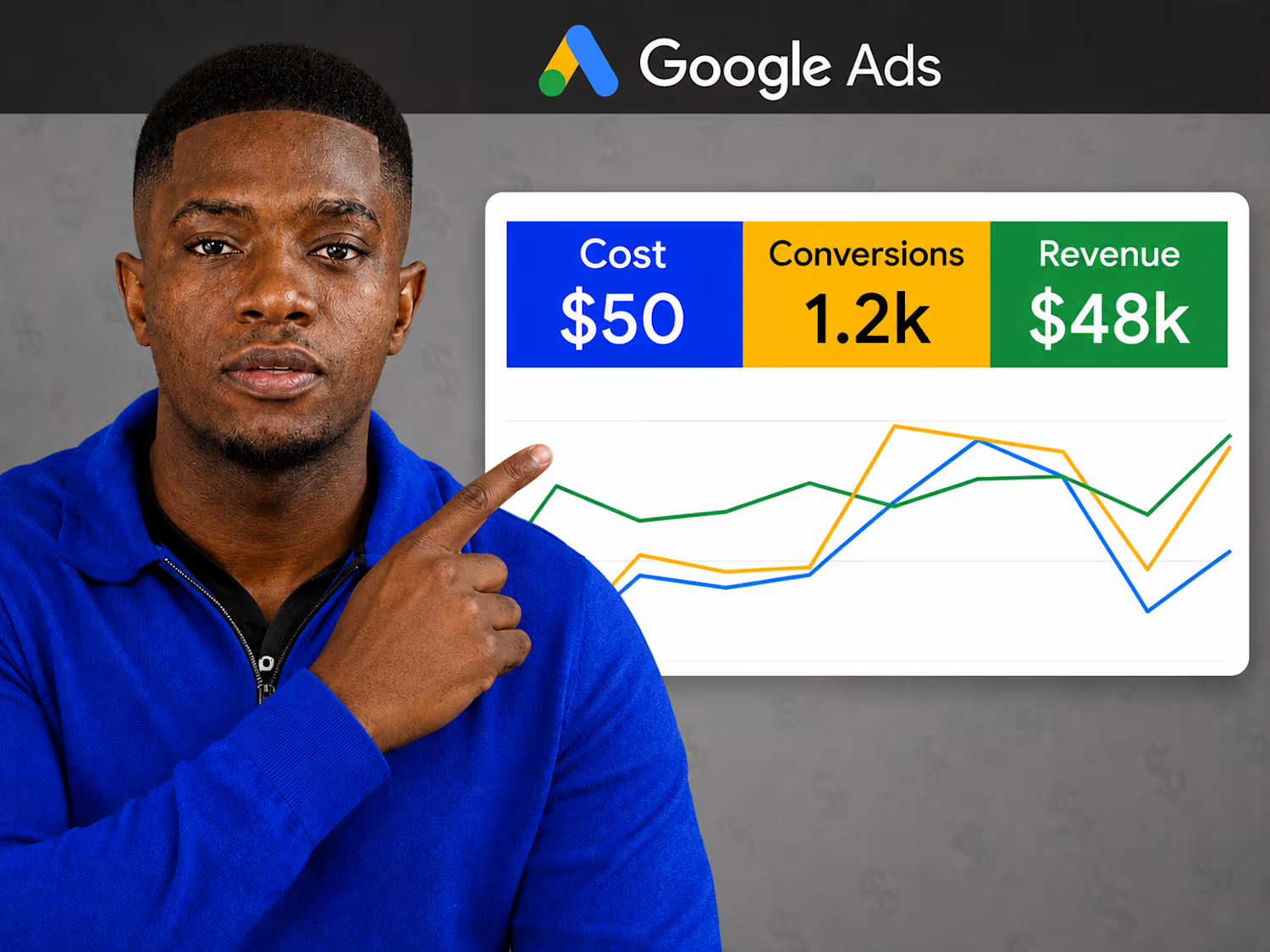
Okay, if you're running Google Ads with a Target CPA or Target ROAS goal AND your campaign is limited by budget, you need to read this before August 17th. This one actually matters. Here's the deal: right now, if your campaign has a budget cap and a performance goal, Google's bidding algorithm quietly goes after the CHEAPEST conversions it can find within your budget. So if your Target CPA is set to $10, you might actually be getting $5 conversions. Feels great, right? Free upside. Starting August 17th, that's going away. Google is changing this so your campaign will actually trend TOWARD your set target, not undercut it. So if you're sitting at a $10 target but actually getting $5 CPA right now, expect that number to start creeping up toward $10 after the change. Same logic applies to ROAS, if your target is 200% but you're actually hitting 350%, expect that to drift back down toward 200% if you don't do anything. Why is this happening? Google says it's about stability, apparently a lot of advertisers get spooked when they raise budgets and performance suddenly fluctuates. Might be true. It's also probably going to make Google more money, because more advertisers will end up bidding closer to what they said they were willing to pay, instead of quietly getting a discount. Both things can be true at once. Here's the part that actually matters for you: this only affects campaigns that are BOTH limited by budget AND currently over-performing their goal. If your campaign isn't capped by budget, this change doesn't touch you. So what do you actually do about it? If you're happy with your current performance (the good CPA/ROAS you're getting right now): → Increase your budget. That locks in more volume at the rate you're already happy with, instead of watching that rate quietly disappear. If you're fine either way: → Adjust your target closer to what you're actually currently achieving. If your target's $50 but you're really getting $30, move the target down to $30 gradually — don't jump all at once, step it down over a week or two. If you do nothing: → Your CPA/ROAS will likely drift toward your original target, meaning fewer conversions for the same spend. Quiet performance loss, no warning bells. One more thing worth knowing, this could create a mild ripple effect across competitive auctions. If everyone bidding on the same keywords adjusts down to their real performance, things stay stable. But if even one competitor decides to keep their higher target and increase budget instead, they get more competitive in the auction, which can nudge costs up for everyone else too. Basically: how your competitors react matters just as much as how you react. The businesses most likely to get blindsided by this are the ones NOT paying attention to their account regularly. If that's not you (and clearly it's not, you're reading this), you've got time to adjust before it happens. Bottom line: go check your account today. Anything limited by budget with a goal that's over-performing, decide now: raise the budget, or adjust the target. Don't wait until August 17th to find out the hard way. Follow along, more of these timely breakdowns coming. 👀
0
18
Cover image for Okay so let's talk about
Okay so let's talk about something painfully simple that a lot of Google Ads accounts get wrong, nobody's clicking your ads. Doesn't matter how good your product is, how great your deal is, how well-optimized your campaign structure is. If people aren't clicking, none of it matters. So let's break down why this happens and how to actually fix it. 1. Your ad copy might be the problem Most beginners write ad copy ABOUT their business instead of about what the customer actually wants. If your headline reads like a company brochure, nobody's stopping to click. Lead with the benefit, not the feature, "save 2 hours a day" beats "advanced scheduling software" every time. And try to mirror the actual language people are typing into Google. If your headline echoes their exact search, it instantly feels more relevant. 2. You might be targeting the wrong keywords Showing up for more searches isn't automatically good, if those searches aren't actually relevant to your offer, you're just burning impressions with zero clicks. A bakery running ads that show up for "cake recipes" is wasting money on people who were never going to buy a cake, they wanted a recipe. This is where negative keywords come in. Adding even 10 well-chosen ones can dramatically clean up who actually sees your ad, which directly improves CTR. 3. Your offer might just not be compelling enough Sometimes the copy's fine, the keywords are right, but the offer itself doesn't give anyone a reason to choose you over the next ad. Go Google your own product category right now and screenshot the top 3 competitor ads. What are they offering that you're not? A free trial, a guarantee, faster delivery, no contract, even small differentiators can tip a click in your favor. Fix this before touching your budget or your bids. 4. You're probably not using ad extensions (and you should be) This one's honestly a bit of a cheat code. Sitelinks, callouts, structured snippets, call and location extensions, they're free, and they make your ad physically bigger and more informative. Google actually rewards ads using extensions with better ad rank, even with an identical bid to an ad without them. More space = more visibility = more clicks. Set it up once and it just works in the background. 5. Wrong place, wrong time Even a great ad won't get clicked if it's shown at 3am to someone who was never going to buy right then. Look at what days/hours actually convert and shift spend accordingly. Check your location targeting, too broad wastes budget, too narrow limits reach. And don't forget device performance, mobile and desktop CTR can look completely different, so check both. Quick benchmark for you: average CTR across Google Ads in 2024 was 6.42%, probably higher than you'd guess. Arts & entertainment topped out around 13%, while legal services sat closer to 5.3%. Worth knowing where your industry typically lands before you panic over your own numbers. None of these fixes cost extra ad spend. They just require you to actually look at what's happening and adjust. Small, unglamorous changes, but they compound fast. Follow along, more of these breakdowns coming your way. 👀
0
60
Cover image for This is not about a
This is not about a targeting fix or a bidding hack, it's about something a lot of advertisers refuse to consider. Let me tell you about a client I took on. This business had ads that used to work really well. Solid return on ad spend, consistent sales, all built around one product, a bestseller that was great for bringing in new customers. Then slowly, over time, results just... died. Not overnight. Just a steady decline until they were unprofitable across the board. The obvious answer would be "ad fatigue, right? Just refresh the creative." Except they'd already done that. New ads, new angles, tested regularly. Still declining. So something else was going on. Here's what I found when I actually dug in: the reviews for that hero product weren't great. Not terrible, just... "fine." "A bit disappointing." "There are better alternatives." And they had direct competitors selling something very similar, with better reviews. That gap was quietly killing their ability to acquire customers, no matter how good the ad creative was. So here's the uncomfortable truth in this: your ads don't operate in a vacuum. People don't just click and buy blindly anymore. They check reviews, they ask a friend, increasingly they'll even ask ChatGPT "is this actually good, or is there something better?" And your ad is only as strong as what happens when someone goes looking for a second opinion. There's also a compounding effect most people don't think about, negative word of mouth spreads faster and harder than positive word of mouth. One bad experience gets told to friends, who tell their friends. It snowballs quietly in the background while you're staring at your ad account trying to figure out why performance dropped. The real question isn't "is my product good?" It's "is my product better than the alternative someone can find in 30 seconds of searching?" That's the actual bar. So what do you actually do if this is happening to you? → Go straight to your reviews; the bad ones AND the good ones. Bad reviews tell you exactly what to fix. Good reviews tell you what to lean into and emphasize more. → Don't scale spend on a product with mediocre feedback. It just accelerates the negative word of mouth. Fix the product experience first, then pour fuel on it. → If one part of your range has strong reviews and another doesn't, consider shifting your ad budget toward what's actually earning trust, rather than what's just good at grabbing initial attention. In this case, the fix wasn't a new campaign structure or a smarter bid strategy. It was telling the client to stop aggressively pushing the one product with weak reviews and shift toward products people were actually raving about. Painful short-term call. Completely turned the account around. Sometimes the biggest lever in your ad account isn't in your ad account at all. Follow along, more real breakdowns like this coming. 👀
1
129
Cover image for User behavior on Facebook and
User behavior on Facebook and Instagram has genuinely shifted, and if you're still tracking your ads the old way, you're probably underestimating how well they're actually working. Here's the stat that stood out to me: Gen Z is twice as likely to make a purchase WITHOUT ever clicking on the ad. Doesn't mean the ad didn't work, it means the journey from ad to sale got messier. Here's what's actually happening: someone sees your ad, doesn't click, and instead goes and checks reviews, searches for the product on Google, looks up a creator they trust in that niche, maybe hunts for a discount code, then eventually buys, completely separate from that original ad interaction. The ad still did its job. It just doesn't get credit for it. And this creates a real problem: if your tracking only counts click-through conversions, your ad account is going to massively under-report your actual results. You'll look at your numbers, think a campaign isn't performing, and either kill it or fail to scale it, when in reality it's working way better than what you're seeing. Here's what actually helps: Turn on view-through attribution, not just click-through Inside your ad set settings, there's an attribution window setting. Most accounts default to click-through only. Add view-through (max window is 1 day) so you're at least capturing people who saw the ad, didn't click, but converted shortly after. It's not a perfect fix, attribution windows used to be way longer, but it captures more of what's actually happening. Set up Conversions API, not just the Meta Pixel Most advertisers stop at the Pixel. But Conversions API does a much better job matching purchases to your ads when the customer journey isn't a straight line, which, as we just covered, is becoming more the norm, not the exception. If it feels technical, this is a cheap, easy thing to outsource on Upwork or Fiverr, well worth it for the data accuracy alone. Consider proper attribution software if you want full visibility For a true picture of what your ad spend is actually generating (including delayed or indirect conversions), third-party attribution tools give you a level of accuracy Meta's own reporting just can't match on its own. The bigger picture here: this trend is only going to grow. More people, not just Gen Z, are getting into the habit of double-checking things before they buy. Reviews, trusted creators, even asking AI tools "is this actually good, or is there something better?" That means two things matter more than ever going forward: your tracking needs to catch up to how people actually behave now, and your actual offer/reviews/reputation need to be genuinely strong, because verification before purchase is becoming the default, not the exception. Follow along, more of this kind of breakdown coming. 👀
0
90
Cover image for I keep seeing the same
I keep seeing the same Facebook Ads myths repeated over and over, and they're genuinely costing people money. So let's clear these up, one by one. Myth 1: Targeting is the most important thing to get right; It's really not, not anymore. Meta is genuinely good at finding the right people now. If your campaign isn't working, it's rarely a targeting problem (unless you've made it way too restrictive). The real levers are your offer, is it actually better than what your competitors offer, and your creative. Most advertisers obsess over targeting and barely touch their creative. That's backwards. Myth 2: Testing is the only way to learn; Testing matters, but it's slow. The faster way to learn is modeling, looking at ads that are already proven to work and using them as your starting point instead of reinventing everything from scratch. Myth 3: You need a big budget for Facebook Ads to work; False. Start small, learn what works, then scale. In fact, your best ROAS numbers often come from smaller budgets, because Meta puts your ads in front of the best-fit people first, and the bigger you scale, the more you dilute into a slightly-less-perfect audience. Bigger budgets don't cause better results, they just tend to belong to bigger brands with stronger offers already. Myth 4: You can't sell directly with Facebook Ads; Also false. Most successful campaigns are direct-to-offer. The nuance is price point, cheaper products (under ~$100) almost have to go direct, while higher-ticket offers need more warming up first. But "direct selling doesn't work" isn't the real issue, usually it's the offer or the creative that's weak. Myth 5: Facebook Ads only work for cheap products; This one genuinely bugs me. The businesses getting insane ROAS (like 50x, 70x) are almost always the ones with high customer lifetime value, not low prices. High-ticket just requires a different strategy, more touchpoints, testimonials, multiple calls to action, not a "this platform doesn't work for me" conclusion. Myth 6: You can only scale budgets 10% at a time; Outdated advice. Depending on your budget size, you can often scale by 50-100%+ without tanking your results. Smaller budgets can jump bigger percentages; larger budgets need smaller, more careful increments. Myth 7: Avoid the learning phase at all costs; The learning phase isn't the enemy, it's Meta figuring out how to get you the best results. It typically only lasts 24-48 hours, and avoiding all changes to dodge it actually holds your account back more than it helps. Myth 8: Retargeting is pointless now; Meta automates a lot of retargeting these days, sure. But if you want different messaging or offers for warm audiences vs. cold ones, you still need dedicated retargeting campaigns. It's not dead, it's just more selective now. Myth 9: Followers don't matter; Trying to build an audience organically to skip ads entirely? Doesn't really work anymore. But having a credible follower count still matters, when a cold audience clicks through to check you out, a dead or tiny profile can quietly kill conversions. Myth 10: New ad accounts can't run sales/lead campaigns; Huge one. People think they need to "warm up" a new account with traffic campaigns first. That's similar to training for a marathon by swimming. Run the actual campaign type you want results from, conversions, leads, sales, even if it's rough at first. That's literally how the account learns and improves. Myth 11: Video always outperforms images; Not true. It depends heavily on your product, audience, and industry. Test both, don't default to video just because it's trendy. Honestly, the common thread through almost every one of these? People find the wrong explanation for why their campaign underperformed, and then "fix" the wrong thing. Offer and creative fix way more problems than people give them credit for. Follow for more of these breakdowns, trust me, there's more where this came from. 👀
1
125
Cover image for This is genuinely underused Google
This is genuinely underused Google Ads move; targeting your competitor's customers directly. Let me walk you through it. Inside your Google Ads account, there's a setting most people never touch: Tools → Audience Manager → Custom Segments. From there you create a custom audience, and instead of the usual interests/behaviors targeting, you go to "people who browse types of websites" and this is the key part, you plug in your competitor's website(s). So say you're a premium brand and your competitors are more budget/mass-market. You can build a custom audience of people who've been browsing your competitor's site, and put your ads in front of them instead. You're essentially saying "hey, before you buy from them, check us out." It's not a perfect science, it's not exactly the same as remarketing straight to their customer list, but it does guarantee a chunk of the people seeing your ad have shown interest in exactly what you sell, from a business you're actively trying to beat. And if you want to take it further (this is the part that actually moves the needle), you get aggressive with your ad copy and creative. Directly call out the competitor. "Better than [competitor]." "Same quality, better price." "We include what they charge extra for." When you write copy like this, Google's smart enough to pick up on it and specifically show your ad to people who are already customers of, or considering that competitor. It knows exactly who to target based on what your ad is actually saying. Now, how aggressive you want to get is up to you and depends on your industry, your relationship with competitors, and honestly your risk tolerance. But if you're comfortable with it, this works especially well inside Performance Max campaigns. Bottom line: if your product or service genuinely is better than the competition, this is one of the most direct ways to say so, and get Google to put that message in front of exactly the people who need to hear it. Small setup, potentially big payoff. Worth testing if you've got a genuine edge over a specific competitor. Follow for more, this isn't the last strategy breakdown coming your way. 👀
1
112
Cover image for Okay this one's a bit
Okay this one's a bit more advanced but stick with me because it's genuinely one of the most underused settings in Google Ads, and almost nobody talks about it. It's called "new customers, high value" bidding, and once you understand it, it kind of changes how you think about your whole account. Here's the problem it solves: Google's default behavior is to bid equally on everyone; new leads and existing customers you've already sold to. And Google actually LOVES spending your budget on warm audiences, because they're cheap and easy conversions. It's great for your short-term numbers, terrible for actually growing your business. If you're not bringing in new customers, you're not growing, you're just squeezing the same pool of people over and over. So Google gives you a setting to fix this. You can literally tell it "I know a new customer costs more to acquire than an existing one, but I'm willing to pay extra for it", because you're thinking long-term, not just this week's ROAS. But here's the interesting part: new customers, high value. Think about your own customers for a second. Some are probably worth $200 to your business. Others are worth $2,000. You'd happily pay way more to acquire that second person, right? The problem is, Google can't automatically tell the difference, UNLESS you teach it. So how do you teach it? You upload two lists: All of your existing customers Just your high-value ones (the ones worth significantly more, could be 3x average, could be 10x, depends on your business) Google analyzes that high-value list and starts finding patterns, age range, location, interests, whatever's common among your best customers, and then goes and finds more people like them. You just tell Google how much extra you're willing to pay to land one of those higher-value people, and it optimizes toward that. A few things worth knowing before you try this: → You need at least 1,000 people per list for Google to actually analyze it properly, so don't make your "high value" list so tiny it can't work. → You need an actual value assigned to every customer in your CRM, Google can't sort what it can't measure. → This works especially well because acquiring a customer worth 10x more usually doesn't cost you 10x as much in ad spend. Sometimes it's only 2-3x the cost for way more value. That's a genuinely great trade. The mindset shift here is simple: not all conversions are created equal, and if you're bidding like they are, you're leaving money on the table. This setting lets you tell Google exactly who you actually want more of. It takes a bit of setup (exporting lists, uploading, defining segments) but once it's live, it just runs in the background making your account smarter. Follow for more of these, this definitely won't be the last one. 👀
1
102
Cover image for Okay real talk, if you're
Okay real talk, if you're running Google Ads with a small budget, most of the "best practices" you hear online are actually written for people spending $10k/month. And trying to follow them with a $500-1000/month budget is basically why so many small businesses give up on Google Ads thinking "it just doesn't work for us." It's not that it doesn't work. You just have to play it differently. Here's what actually works when your budget is small (and by small I mean anything under $3,000/month, tiny being under $600/month): Pick ONE campaign type. Just one; I know Performance Max looks amazing, it's basically handles search, display, YouTube, all of it. But here's the thing: it needs data to work well, and if your budget is small, you're not generating enough conversions fast enough to feed it. Same goes for running Search + Display + Shopping all at once, you're just spreading a small budget so thin that neither you nor Google can figure out what's actually working. Stick with Search. It's the most straightforward, easiest to understand, and gives you the clearest signal on what's converting. Once you've got some data and you're ready to scale, that's when you bring in Performance Max. Only advertise ONE offer; I know you probably sell more than one thing. But if you're spreading a small budget across five products or services, you're getting a trickle of data on each instead of a solid signal on one. Pick your best performer (or your highest-value one if you don't have data yet) and go all in on that. Higher-value offers are also just easier to make profitable, a $500 product doesn't cost 10x more to advertise than a $50 one, so the math works in your favor. Go hyper-local; If you can serve a smaller geographic area, do it. Instead of targeting an entire country, narrow down to a city or a radius. It means your budget isn't diluted across a huge audience, and you can actually structure your ad copy and keywords to that specific location, which means better click-through, better conversion, better results overall. Consider cheaper keywords (with a caveat); Expensive keywords eat small budgets fast. If a keyword costs $5-7 a click, you might only get 5-6 clicks a day, not nearly enough data to optimize anything. Cheaper keywords ($2ish) get you way more volume. BUT, and this matters, cheap keywords are usually cheap for a reason (lower conversion rate or lower value customer). So this isn't "always pick the cheapest," it's "don't ignore the cheaper ones just because they seem less impressive." Pre-qualify with your ad copy; This one's underrated. You only pay when someone clicks, so you actually want to scare off people who were never going to convert anyway. Adding something like "starting from $500/month" or "local to [city]" into your headline filters out window shoppers before they cost you a cent. Yes, your click-through rate might drop. That's fine. Your conversion rate goes up, and every click you DO pay for is more likely to count. Be aggressive about cutting underperformers, early; With a bigger budget, you can afford to wait for statistical significance before turning off an underperforming keyword. With a small budget, you can't. If something's clearly lagging behind your other keywords, cut it early and reroute that budget to what's working. Every dollar has to pull its weight. The overall mindset shift here: small budget doesn't mean "small chance of success." It means you have to be way more disciplined and way more focused than someone spending 10x what you are. Nail this phase, get it profitable, and THEN you scale. Save this if you're just getting your Google Ads set up, you'll want to reference it. Follow along, I'm not done, more ad strategy breakdowns coming. 👀
1
113
Cover image for Okay so I need to
Okay so I need to talk about how I'm making UGC ads now, because it's honestly kind of ridiculous how easy this has gotten. If you've ever tried to get UGC ads made, you know the pain. Booking actors, briefing agencies, waiting days, paying way more than you wanted to. I used to think that was just... the cost of doing business. Turns out it's not anymore. Here's what I've been doing instead, the whole thing runs inside one Claude conversation. No creative tools, agency, or ten tabs open at once. Just two connections: Meta and Arcads. Let me break down how it works. Step 1: Research first, always Before generating a single ad, I use Claude and other Premium tools to pull my top performing ads from the last 30 days, then search the web for what's currently working best in my product category. What creative formats are getting impressions, what hooks are driving engagement, and what patterns keep showing up in winning ads. And this is the step almost everyone skips. It's exactly why so many AI-generated ads flop, people jump straight to generation with zero signal on what actually converts. Research first means your first test isn't a guess. It's informed. Step 2: Turn research into scripts Once I've got the research, I hand it to Claude with a specific brief: act as a senior performance marketer, here's my product, here's who it's for, here's the platform. Then I ask for scripts built around real pain points, hook, problem, solution, proof, CTA, all timed out. And I get Claude to score each one and only keep the ones that actually hit. This part used to take me hours of back and forth with a copywriter. Now it's minutes. Step 3: Generate the actual creative So this is where Arcads comes in, it's basically got every major AI video/image model in one place, so I'm not paying for five different subscriptions. I generate an actor image first (with my product reference attached so nothing gets weird or off-brand), approve it, then turn it into a video with the script from step 2 dropped straight in. Small tip that saved me a lot of wasted spend: always fix issues at the image stage, before it becomes a video. It's way cheaper, and way faster. Step 4: Launch without leaving the chat Once the videos are ready, I'll upload them straight to my Meta account through the same conversation. Then I just tell Claude what I want, campaign objective, budget, targeting, in plain language. No Ads Manager or manual setup. And here's the part that actually changes how you test: after a few days, I just ask Claude which ad is performing best and to show me why. It pulls the live data and explains it in plain English. No exporting reports, no spreadsheets. Step 5: Double down Once I know the winner, I ask for more variations of it, same actor, new scripts and the loop just keeps going. Every single round gets a little smarter than the last. The honest truth is this doesn't just save time, it changes the economics entirely. You're not paying agency rates, you're not waiting on turnaround times, and you're testing with actual data. If you're not at a scale where an agency makes sense yet, this is genuinely one of the best ways to get high output without needing a big team or a big budget. Don't forget to hit follow, I'm breaking down a new ad strategy or workflow every week, and you don't want this to be the last one you catch. 👀
1
157
This ad works because of how it makes you feel before you even process what’s being sold. Watch the first few seconds closely. The pacing is slow, the environment is clean, and everything feels calm and controlled. That’s not just aesthetics, it’s psychology. Your brain associates visual calmness with comfort, safety, and quality. So before any message is delivered, the product is already positioned as something that improves your environment. Now layer that with what’s happening visually: • Soft textures and close-up shots → triggers sensory imagination (you can almost “feel” the product) • Minimal, uncluttered scenes → signals simplicity and premium positioning • Consistent color tones → creates emotional stability and trust • Slow, smooth transitions → reduces cognitive load, making the ad easier to absorb All of this does one thing: It lowers resistance. Because when something looks effortless and calming, the brain assumes the experience will be the same. So instead of evaluating: “Is this good quality?” The viewer starts thinking: “This feels like something I want in my space.” That shift is powerful. It moves the decision from logic → emotion. And once that happens, the product no longer has to fight for attention, it fits naturally into the lifestyle being shown. This is what strong creative does: It lets the customer experience the outcome before they buy.
2
408
This ad knows exactly who it’s talking to, and that’s why it works. “Career driven women struggling to lose body fat” is not a broad audience… it’s a very specific identity. That’s what stops the scroll. Here’s what’s happening: • It calls out a clear niche instantly • It taps into a real frustration (no time, slow results) • It offers a simple, desirable outcome (get toned) No fancy editing or complicated messaging. Just sharp positioning. This is how winning ads are built, clarity over creativity.
2
396
This ad shows how simple execution beats complexity in paid media. What most people miss is not the creative, it's the psychology behind the hook and positioning. Here’s what’s working: • Clear attention-grabbing hook in the first seconds • Strong emotional trigger tied to the offer • Simple but intentional messaging flow This is what scaling ads actually looks like in practice.
3
424
Cover image for Claw Craziness is a mobile
Claw Craziness is a mobile app that lets users play claw machine games from their phone. Users purchase coins to play, and any prize they win gets shipped directly to them. They came to me wanting to grow their user base through more app downloads. I built and managed campaigns specifically optimized for app installs, driving thousands of downloads at an efficient cost per install, and the numbers keep growing.
1
413
Cover image for The Art of Beauty is
The Art of Beauty is an e-commerce beauty product store that was struggling to achieve a consistent return on their ad spend before partnering with me. I took over their Facebook Ads account, audited and optimized their existing campaigns, and launched new high-performing campaigns from scratch. The result? Their ROAS grew significantly, even as daily spend increased, delivering a 3.91x return on every dollar invested.
1
311
Cover image for +200% revenue growth in just 4 months
+200% revenue growth in just 4 months
0
16
Cover image for Revolutionizing PROFITS: Google Ads Exceeds $40K Yearly Growth!
Revolutionizing PROFITS: Google Ads Exceeds $40K Yearly Growth!
1
16
Cover image for Ad Management & Campaigns (Facebook | Google-YouTube).
Ad Management & Campaigns (Facebook | Google-YouTube).
1
16