Freelance Frontend Engineers in EnglandFreelance Frontend Engineers in England
20+ years experience in web/mobile development
$25k+
Earned
3x
Hired
5.0
Rating
281
Followers
20+ years experience in web/mobile development
Webflow Developer & UX/UI Designer
19x
Hired
4.9
Rating
69
Followers
Webflow Developer & UX/UI Designer
Full-Stack & AI Dev | TypeScript, Next.js, React, Node
$50k+
Earned
5x
Hired
5.0
Rating
133
Followers
Full-Stack & AI Dev | TypeScript, Next.js, React, Node

Creative developer crafting premium digital products

$1k+
Earned
2x
Hired
4.1
Rating
63
Followers
Creative developer crafting premium digital products
Frontend Dev & Web Designer | Framer, Figma, Decks

$1k+
Earned
2x
Hired
5.0
Rating
13
Followers
Frontend Dev & Web Designer | Framer, Figma, Decks

AI Engineer | LLM Agents - RAG & Evals - Full Stack

5.0
Rating
18
Followers
AI Engineer | LLM Agents - RAG & Evals - Full Stack

AI Product Engineer | Building Production Ready AI Apps
25
Followers
AI Product Engineer | Building Production Ready AI Apps
Cover image for What’s the secret behind an
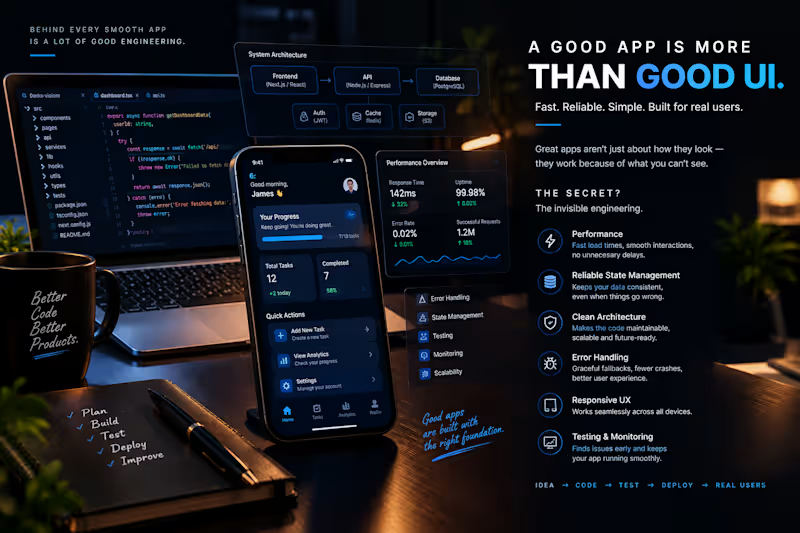
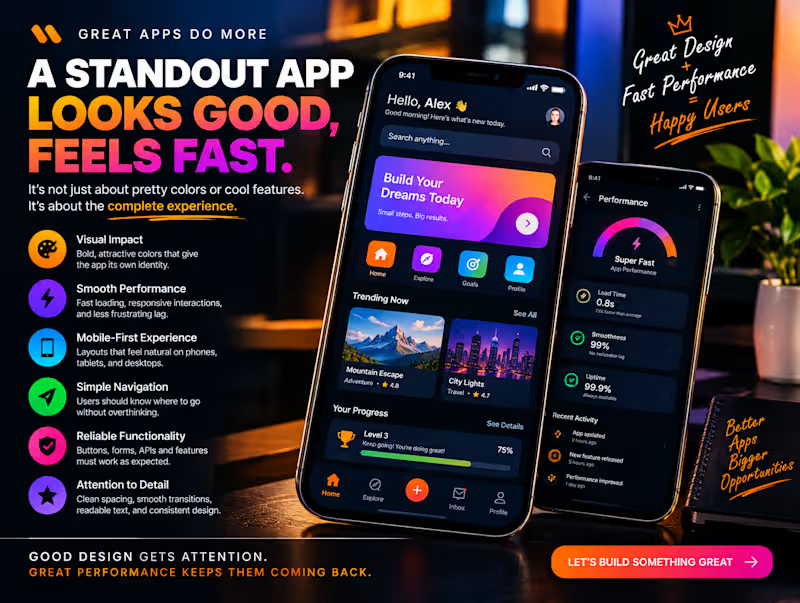
What’s the secret behind an app that actually feels good to use? It’s not just the UI. A beautiful interface can get someone to download an app. But good engineering is what makes them stay. When I build an application, I think beyond the screens users can see. The real work is happening underneath: ⚡ Performance — interactions should feel fast and intentional. 🧠 State management — the app needs to keep data consistent as users move through it. 🏗️ Architecture — the codebase needs structure that can survive new features. 🛡️ Error handling — things will go wrong; the app needs to handle them gracefully. 📱 Responsive UX — the experience needs to work across different screen sizes. 🧪 Testing — don't assume it works because the happy path works. 📊 Monitoring — understand what happens when real users start using it. That’s the part many people never see. A user taps a button and thinks: “That was smooth.” Behind that single interaction could be API calls, state updates, database operations, validation, loading states, error handling and performance decisions. That’s why I believe: A good app isn't just designed. It's engineered. Modern web performance guidance also emphasizes that loading, responsiveness and efficient resource handling directly affect the user experience. My goal isn't simply to build something that looks finished. I want to build applications that behave like real products. Idea → Architecture → Code → Test → Deploy → Real Users. What’s one thing that immediately makes you uninstall an app?
2
125
Cover image for $10,000,000 was sitting at the
$10,000,000 was sitting at the top of the 2026 WSOP Main Event. That number is one of the reasons I became interested in building this. Poker isn't just cards on a screen. At the highest level, millions of dollars can depend on thousands of individual decisions. So I'm building something around a question that I find technically fascinating: Can software understand what is happening on a poker table from visual data? That's what I'm working on with my Poker Vision project. The system is being designed to recognize and structure information such as: → 🃏 Hole cards → 🎴 Board cards → 👤 Player positions → 💰 Betting actions → 🔎 OCR information → 📍 Table coordinates → 🧠 Game-state changes Then the challenge becomes turning all of that raw visual information into reliable structured data that another part of the application can understand. And that's where the engineering gets serious. A single recognition mistake can completely change the state of the game. So I'm not interested in building something that simply looks intelligent. I want to build something that can: Detect → Interpret → Validate → Test → Learn from errors → Improve. One important boundary: I'm building this as a research/analysis and development project, not a real-time system that tells someone what action to take during live-money play. Major poker platforms prohibit real-time assistance that influences decisions during play. PokerStars (https://www.pokerstars.com/poker/room/prohibited/?utm_source=chatgpt.com) The bigger idea is what excites me: Computer vision + AI + poker data + software engineering. When the stakes can reach millions, even a small technical problem becomes an interesting engineering problem. And that's exactly the kind of problem I enjoy building. 🔥 If you were building this system, what would you tackle first: card recognition, player tracking, OCR, or game-state detection?
3
179