AIUC-1 Standards Interface Demo with React

Ali Shan

Ali Shan

Project Overview

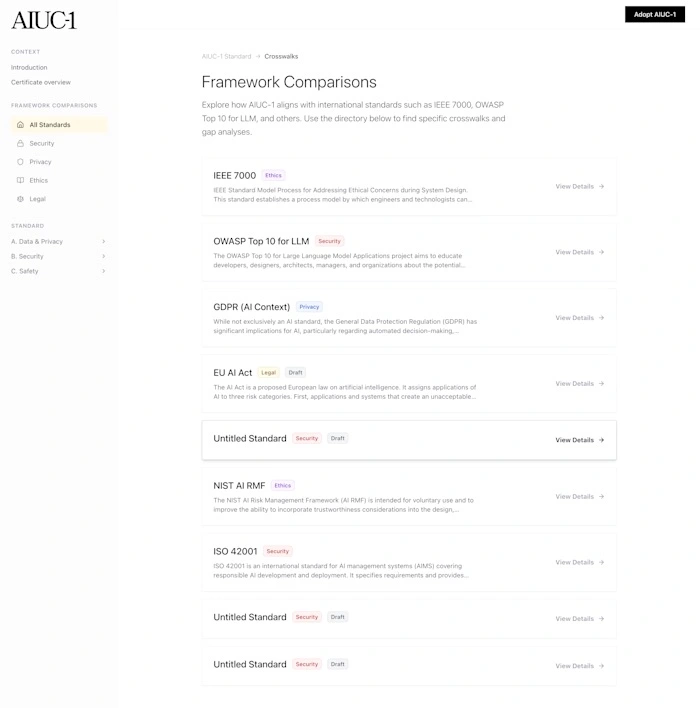
This project is a high-fidelity technical demonstration designed to showcase the implementation of the AIUC-1 (Artificial Intelligence Underwriting Company) standards interface. It functions as a dynamic library for AI safety and compliance standards, pulling real-time data from an external database.
The primary goal was to prove the ability to build a responsive, data-driven frontend that seamlessly integrates with Airtable as a headless CMS, replicating the core requirements of the job proposal.

🛠 Tech Stack

While the job description specified Next.js, this demo was built as a lightweight Single Page Application (SPA) to demonstrate rapid development and core React proficiency.
Frontend Framework: React 18 (via Vite for fast tooling)
Language: TypeScript (Strict typing for reliability)
Styling: Tailwind CSS (Responsive, utility-first design)
Icons: Lucide React
Routing: React Router v6
Data Source: Airtable API (acting as the CMS)
Deployment: Netlify (CI/CD connected to GitHub)

Airtable Integration Strategy

One of the key requirements of the proposal was robust Airtable integration. This project implements a Service-Repository pattern to handle data fetching cleanly.

1. Unified Data Service (airtableService.ts)

Instead of scattering fetch calls across components, all interaction with Airtable is centralized in a dedicated service layer.
Typed Interfaces: Defined strict TypeScript interfaces (Standard, AirtableRecord) to ensure data consistency throughout the app.
Data Transformation: Raw data from Airtable (which can be messy) is sanitized and transformed before it reaches the UI components. This includes:
Parsing new-line separated strings into clean lists (Implementation Details).
Safely parsing JSON strings into structured objects (Crosswalks/Gap Analysis).
Handling missing fields with graceful fallbacks.
Airtable
Airtable

2. Dynamic Filtering

The API calls support dynamic filtering using Airtable's filterByFormula. This allows the application to efficiently fetch only the data needed for specific pages (e.g., filtering by Categories like Security, Privacy, Ethics).

Key Features Implemented

1. Dynamic "Standards" Listings

Replicated the requirement for "4 new list pages" by creating a reusable filtered view.
The Sidebar navigation dynamically switches context between All Standards, Security, Privacy, Ethics, and Legal.
Clicking a category instantly filters the content without a page reload (SPA behavior).

2. Detailed Requirement Template Page

Created a standard detail view (/standard/:slug) that renders deep information about a specific standard.
Rich Content: Displays Description, Implementation Details (bullet points), and "Crosswalks" (comparisons with other frameworks).
Responsive Layout: Sidebar collapses on mobile interfaces, ensuring usability across devices.

3. Comparison Logic ("Crosswalks")

Demonstrated the ability to display complex relational data. The "Crosswalks" section maps AIUC requirements to external controls (like ISO or NIST), calculating gap analysis dynamically.

Development Process & CI/CD

Component Architecture: Built reusable atomic components (Layout, StandardCard, Badge) to ensure visual consistency and ease of updates.
Git & Version Control: Maintained a clean commit history with conventional messages.
Automated Deployment: Set up continuous deployment via Netlify. Every push to the master branch triggers a build and deploy cycle, ensuring the live site is always up to date.
Asset Management: approach to handling static assets for production environments.
Like this project

Posted Dec 11, 2025

Developed a SPA using React and Airtable API for AIUC-1 standards interface.