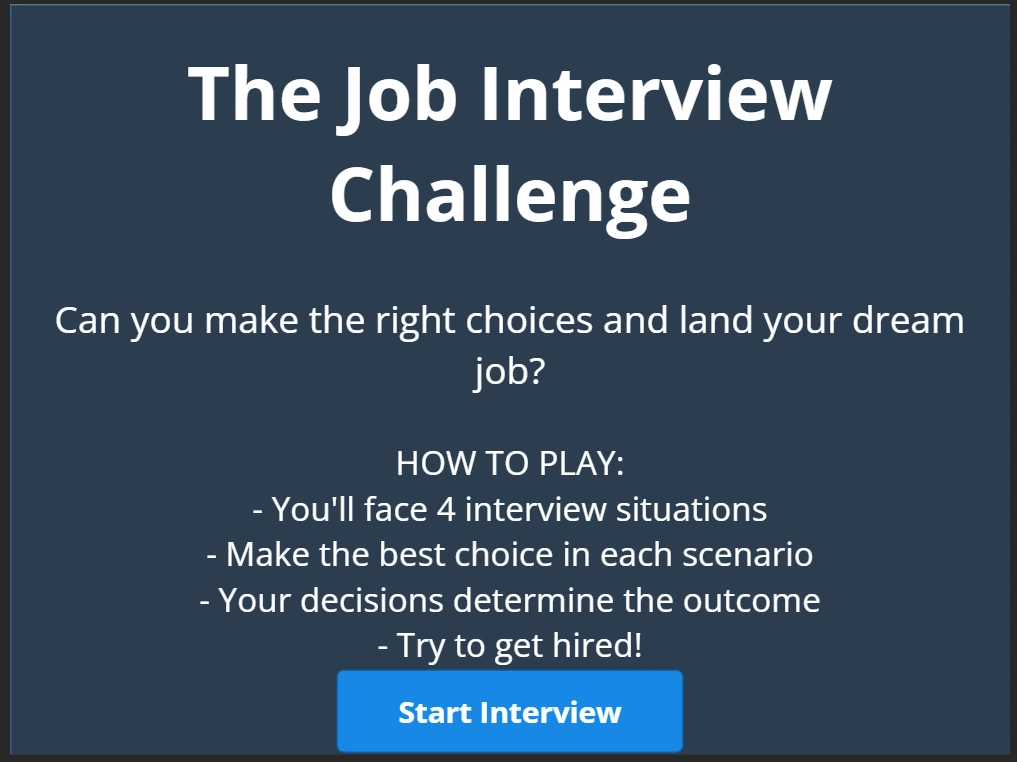
The Job Interview Challenge - Branching Scenario

Aishwarya K


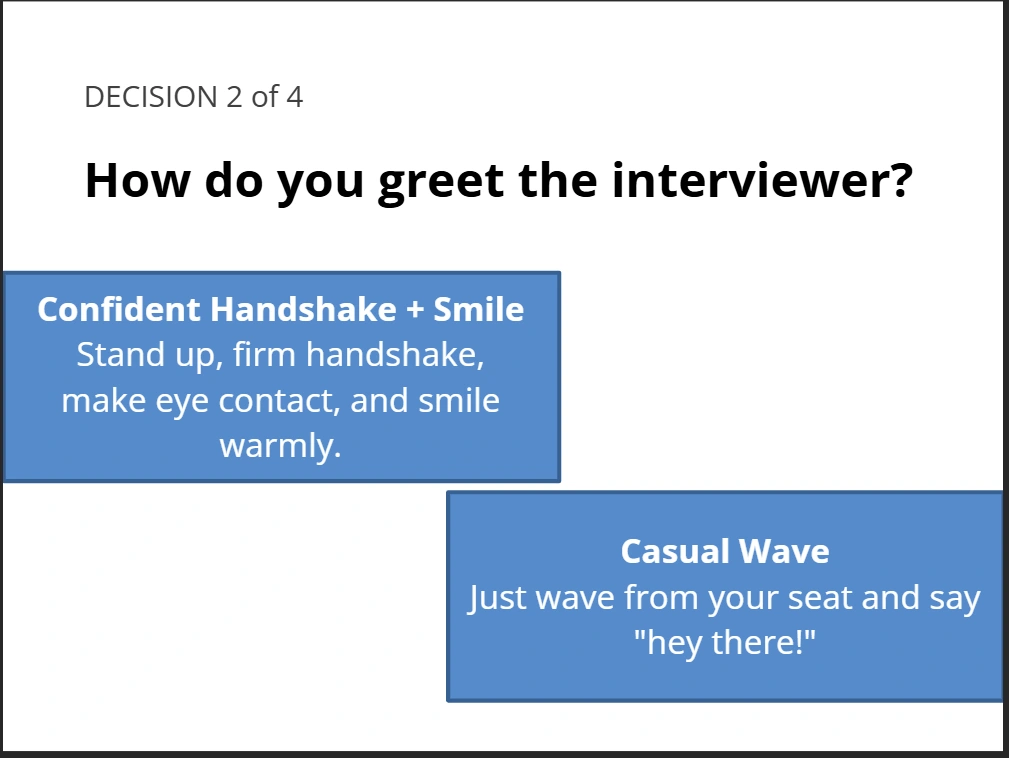
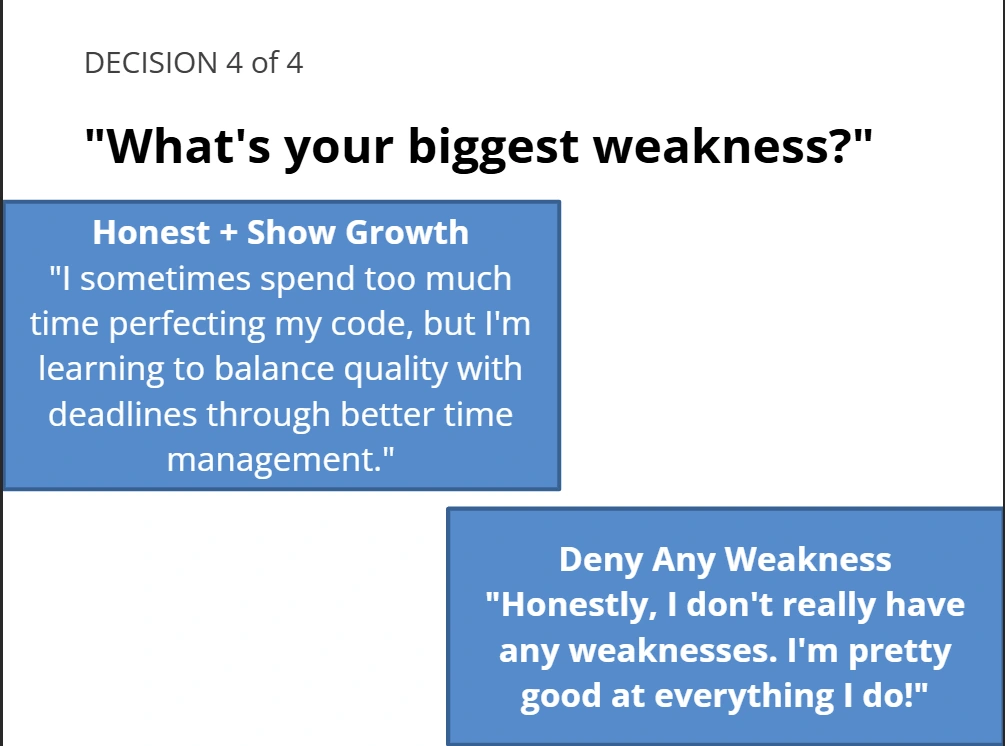

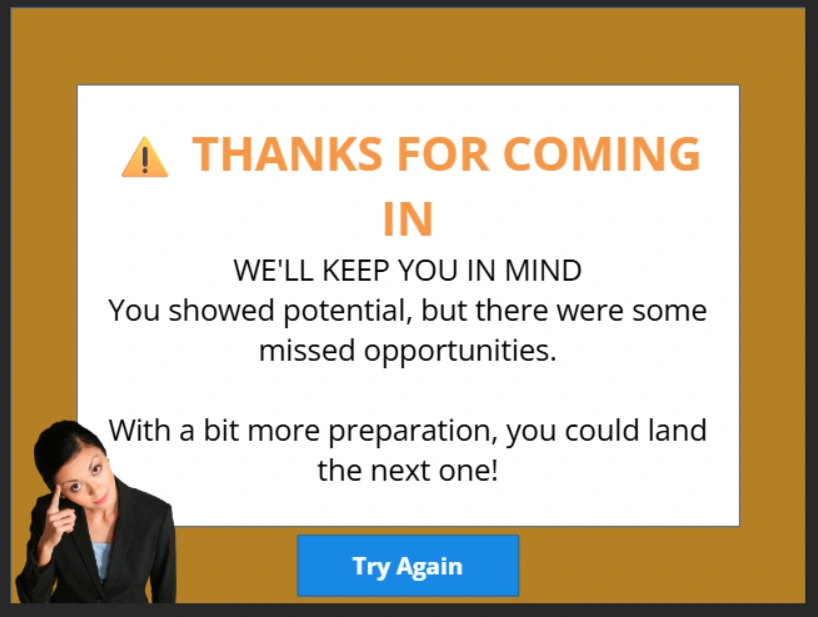
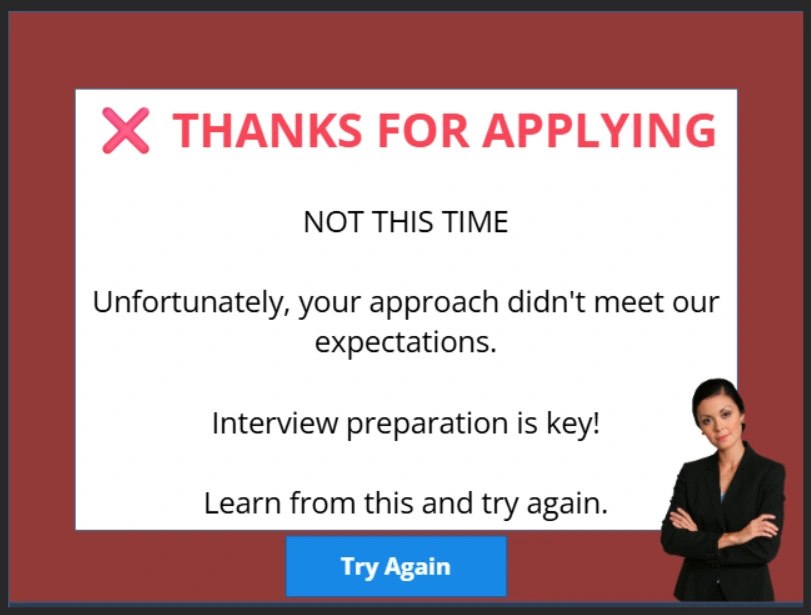
Full interactive course available here: https://drive.google.com/file/d/1fO1eo6HcS2LJ1sohXDtjNp6HG44CpoHr/view?usp=drive_link
Tool: Articulate Storyline 360
Type: Branching Scenario / Consequence-based Assessment
Audience: College students preparing for first interviews, career switchers, career counseling centers
The Problem
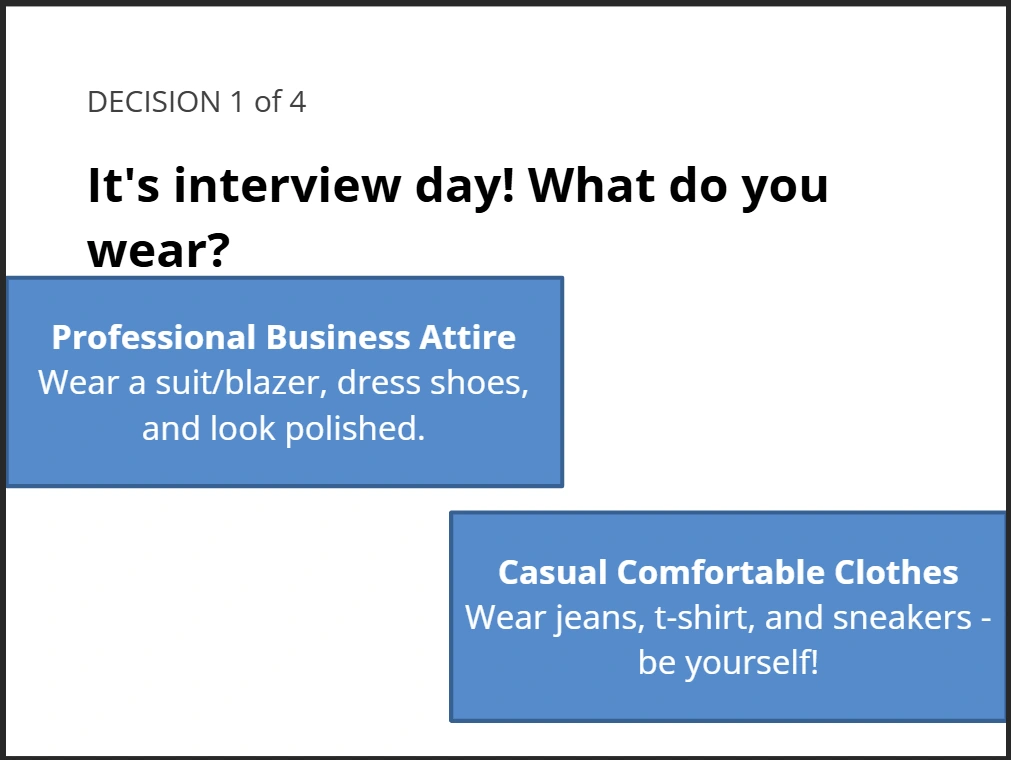
Entry-level job seekers often fail interviews not due to lack of qualifications, but because they make poor decisions under pressure - choosing inappropriate attire, failing to demonstrate professionalism, or giving weak responses. Traditional interview prep materials provide advice but never simulate the consequences of poor choices. Without experiencing the impact of bad decisions safely, candidates repeat the same mistakes in real interviews.
Learning Objectives
• Identify appropriate professional behaviors in interview contexts
• Demonstrate decision-making skills under interview pressure
• Recognize the consequences of professional vs unprofessional choices
• Self-assess interview readiness through performance scoring
My Design Decisions
• Why scenario-based over a linear tutorial? Feeling the sting of simulated rejection teaches far more than reading a list of dos and don'ts. Emotional responses create memory anchors that information alone never can.
• Why score accumulation instead of branching paths? Linear structure with cumulative scoring kept the build efficient while maintaining story coherence - every learner experiences all four decisions, mirroring how real interviewers evaluate candidates holistically across the entire interview, not just one moment.
• Why three endings instead of pass/fail? Hired, Keep in Mind, and Rejected reflect the realistic spectrum of interview outcomes. A candidate who scores 3 out of 4 needs meaningfully different feedback than someone who scores 1.
• Why character graphics throughout? A face makes the scenario feel real rather than abstract. The interviewer character creates visual consistency and emotional investment that a plain decision tree never could.
Technical Highlights
• InterviewScore variable accumulating +1 per correct decision across 4 scenarios
3 conditional ending layers based on final score (4, 2-3, and 0-1)
• Linear story path with score-determined endings - simpler to build, easier to debug
• Storyline library character graphics providing visual consistency throughout
• Complete variable reset enabling unlimited retries for mastery learning
What I Learned
This project confirmed that simple branching done well outperforms complex branching done poorly. I didn't need a sprawling decision tree - a linear path with cumulative scoring created nuanced outcomes, maintained narrative coherence, and was far easier to build and debug. It also reinforced something I now apply to every scenario project: consequences create learning, not content.
Like this project
Posted Oct 18, 2026
Job Interview Challenge Interactive Branching Scenario | Articulate Storyline 360 A scenario-based learning module simulating a real job interview. Learners make critical decisions that dynamically change the storyline and final outcome. Highlights 4 decision points with branching logic Variable-based scoring system 3 outcome paths (Hired / Keep in Mind / Not This Time) Conditional feedback and replay functionality Professional character integration Skills Demonstrated Scenario design • Branching & variables • Conditional logic • Instructional storytelling • UX-focused eLearning design