Freelancers using XGBoost
Sign Up
Post a job
Sign Up
Log In
Filters
1
Projects
People
Sanket Sabharwal, PhD
max
Genoa, Italy
Senior Software & ML Engineer | Zero to One Product Builder
$50k+
Earned
6x
Hired
5.0
Rating
32
Followers
Top
Expert
Follow
Message
Senior Software & ML Engineer | Zero to One Product Builder
1
Machine Learning for Sports Betting - NCAA College Basketball
1
4
3
Web Scraping Systems - Large-Scale Data Extraction Pipelines
3
32
1
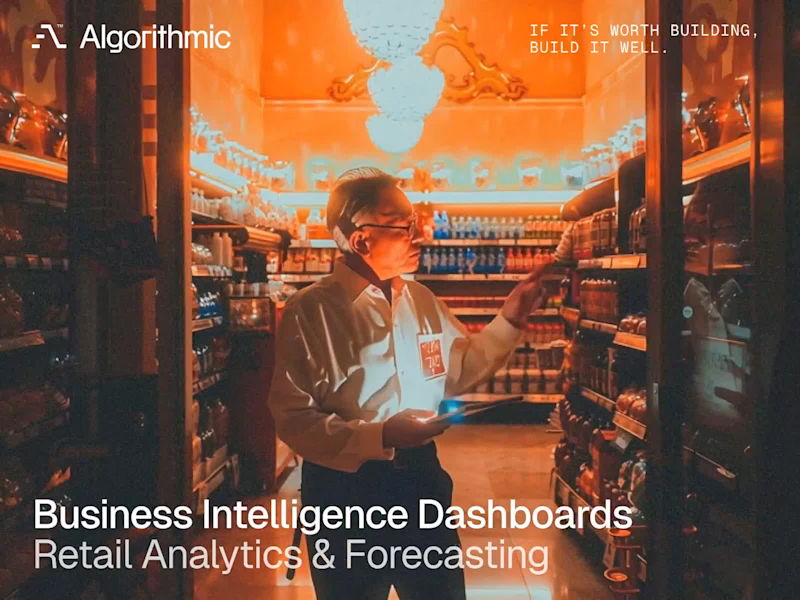
BI Dashboards - Retail Analytics & Forecasting
1
21
2
Computer Vision for Manufacturing - Defect Detection & QA
2
25
XGBoost
(1)
Follow
Message
Ugo Chukwu
pro
Dubai - United Arab Emirates
Automation Engineer - n8n + Supabase + Codex, OpenClaw 🚀
$10k+
Earned
6x
Hired
5.0
Rating
44
Followers
expert
Follow
Message
Automation Engineer - n8n + Supabase + Codex, OpenClaw 🚀
0
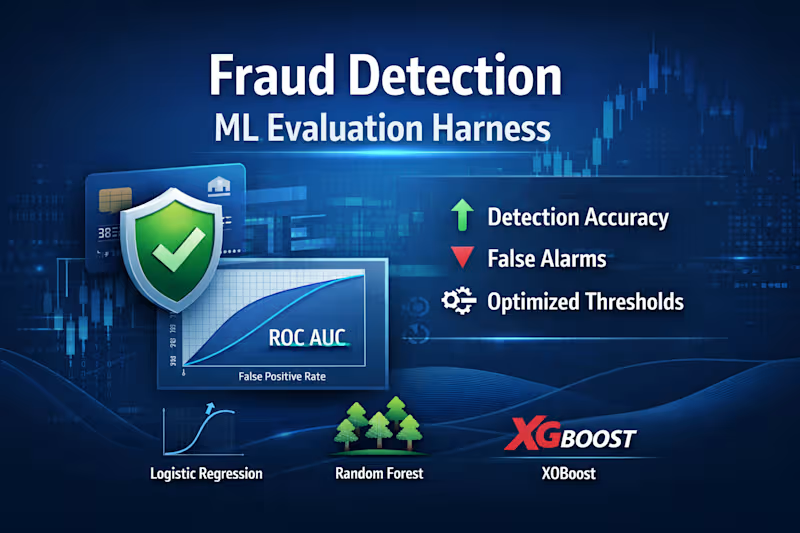
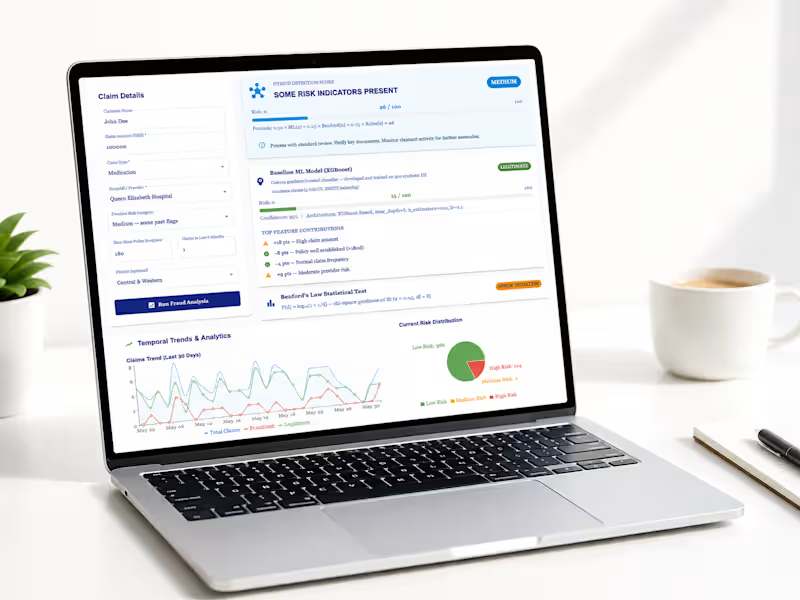
ML Evaluation Infrastructure for Fraud Detection
0
4
1
IOS Risk Data Foundry — Domain-Specific Financial Risk AI
1
7
1
OpenClaw Setup: AI-Driven Automation System for Credit Startup
1
8
0
High-Volume Call Routing & Reporting System Designed and implemented an end-to-end calling infrastructure that integrates call data sources, automates daily performance reporting, and powers real-time visualization dashboards. Built a phone-number rotation system capable of cycling through thousands of Twilio numbers to support 10,000–50,000 outbound calls per day while staying within per-number limits, ensuring scalable, compliant, and reliable high-volume calling operations.
0
164
XGBoost
(1)
Follow
Message
Usman Haider
Lahore, Pakistan
AI/ML & Data Solutions Engineer
New to Contra
Follow
Message
AI/ML & Data Solutions Engineer
0
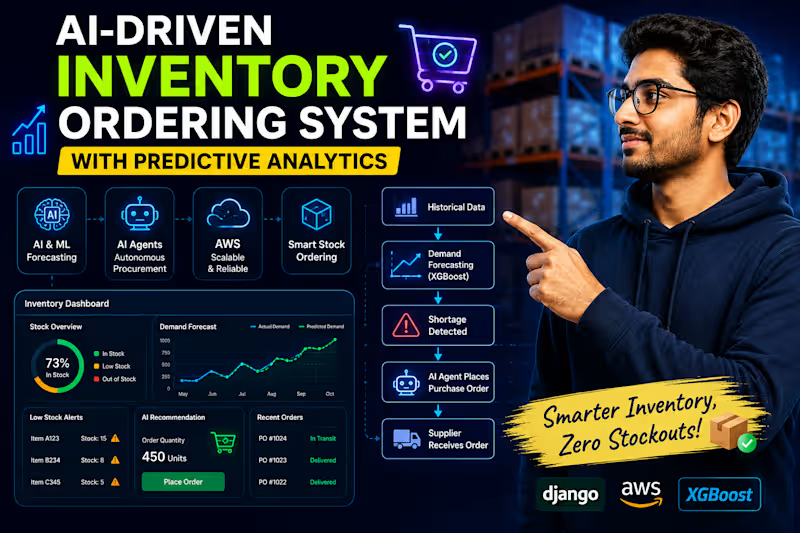
Built an intelligent inventory management system that automates stock ordering using machine learning and AI agents. Leveraging an XGBoost-based forecasting model, the system predicts future inventory demand and proactively places purchase orders when shortages are detected. The backend is powered by Django, integrated with AWS-hosted datasets for scalability and real-time data access. AI agents handle autonomous procurement decisions, reducing manual oversight and streamlining supply chain operations for greater efficiency and accuracy.
0
73
0
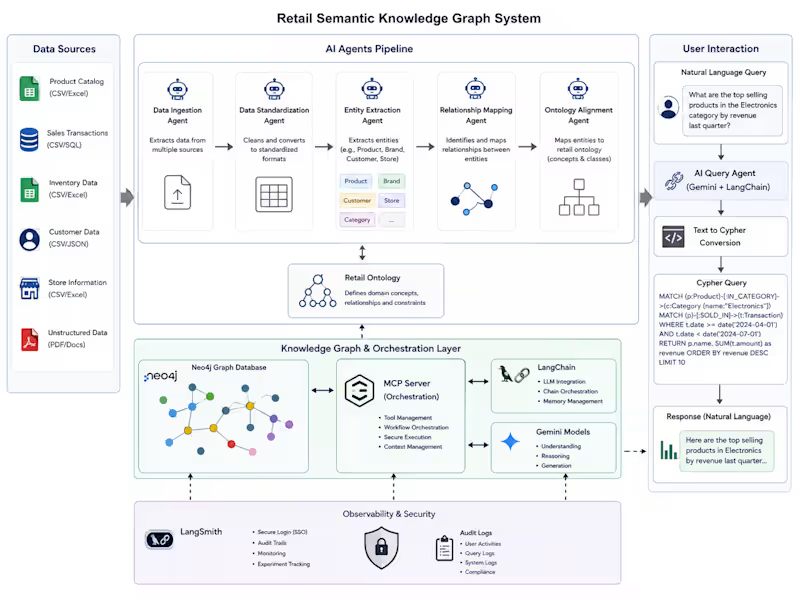
Retail Knowledge Graph In this project, we built a semantic knowledge graph tailored to the retail industry. The pipeline involved developing AI agents to transform heterogeneous data into standardized formats. Ontologies were created to represent domain knowledge accurately. Using Gemini models and LangChain, user queries were converted into Cypher queries to retrieve insights from a Neo4j database. We utilized an MCP server for orchestration and LangSmith for secure login and audit trails. This system enhances complex data exploration for non-technical users.
0
21
0
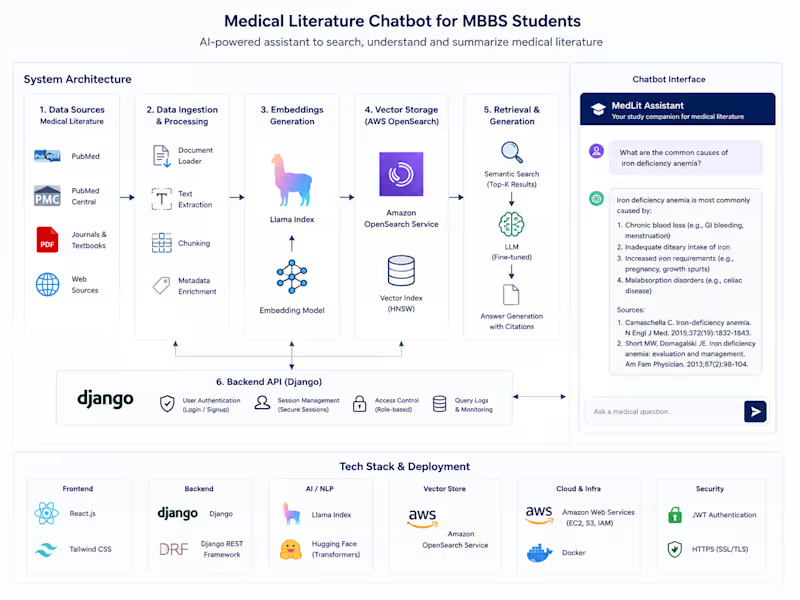
Student Medical Chatbot Built a chatbot to assist MBBS students in navigating medical literature. Leveraged Llama Index and fine-tuned language models to ensure accuracy. Embeddings were stored in OpenSearch, hosted on AWS. The Django backend included secure authentication and session management for a robust user experience.
0
26
0
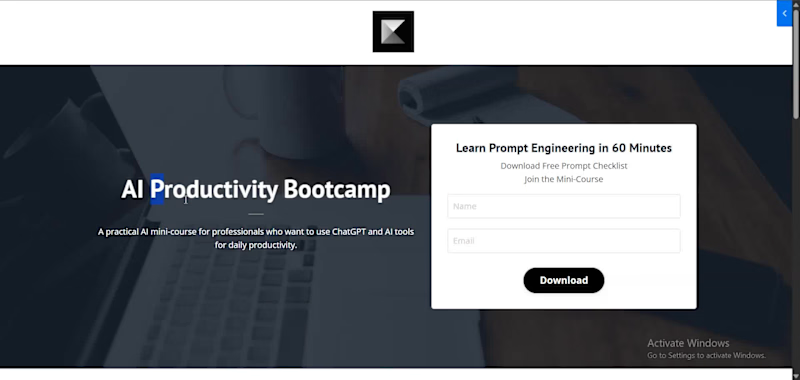
Prompt Engineering Mini-Academy is a digital learning product built using Kajabi. It helps users learn how to write better AI prompts and use AI tools for daily tasks such as writing, research, summarization, and productivity. The problem it solves is that many people use AI tools without a proper structure, which leads to weak or generic results. This product gives users a clear learning path, practical prompt templates, and workflow examples to improve the quality of their AI outputs. I used Kajabi to create the landing page, email capture form, downloadable prompt resource, product offer, checkout page, and course structure. A sample video is attached to demonstrate the product flow and user experience.
0
37
XGBoost
(1)
Follow
Message
Anurag Nagare
Mumbai, India
I’m an AI & Machine Learning engineer with expertise in deve
Follow
Message
I’m an AI & Machine Learning engineer with expertise in deve
1
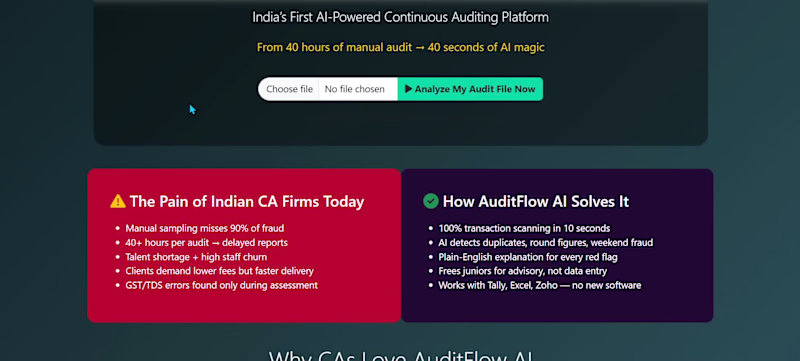
I’m excited to share AuditFlow AI – AI-powered continuous auditing platform built specifically for Chartered Accountants and audit firms. CA's practices today are drowning in manual sampling, 40–60 hour audit cycles, talent shortages, and rising client pressure for faster delivery with lower fees. Most frauds and GST/TDS errors go undetected until the assessment stage because traditional methods check only 2–5% of transactions. AuditFlow AI changes that completely: upload any ledger/Excel/CSV and in under 10 seconds it scans 100% of transactions, flags duplicates, round-figure entries, weekend fraud, high-value anomalies, and vendor loops – with plain-English AI explanations for every red flag. Tech stack: Python, Flask, XGBoost, Isolation Forest, scikit-learn, Bootstrap 5, and trained on 5,000+ synthetic + real-world patterns
1
60
0
Everyone's talking about AI in healthcare. Nobody's building low-cost tools for the people who actually need early answers. Neurologists are overbooked. Clinical tremor assessments require in-person visits, specialist equipment, and months of waiting. The 10 million people living with Parkinson's globally and the millions more who don't yet know have no accessible way to flag early symptoms from home. So I built TremorLens a real-time hand tremor detection tool that runs entirely on a standard webcam. Here's what makes it more than just a webcam project: Instead of simple motion detection, I built a full signal processing pipeline on top of computer vision. MediaPipe tracks 21 hand landmarks per frame. The index fingertip's x/y displacement is buffered across a 3-second rolling window. scipy FFT then decomposes that signal into its frequency components and flags dominant activity in the 4–6 Hz range clinically associated with Parkinson's resting tremors. The live overlay shows you everything: → Real-time FFT power spectrum with the tremor zone highlighted → Dominant frequency readout in Hz with a 10-frame rolling average for stability → Color-coded STABLE / TREMOR DETECTED indicator → Fingertip displacement graph and movement trail → Auto-saved CSV session log timestamp, frequency, amplitude, tremor flag every session
0
7
0
Everyone's talking about quantum computing. Nobody's using it to feed farmers. India loses 20–30% of its crop yield every year to diseases and pests. Not because farmers don't care — but because early detection is hard, expensive, and inaccessible to the people who need it most. The existing solutions? Either a basic image classifier trained on lab-perfect photos that fail in real field conditions, or an agronomist visit that costs time and money most small farmers don't have. So I built QuantumEdge AgriGuard — a hybrid Quantum Neural Network app where a farmer can photograph a diseased leaf on their phone and get an instant diagnosis in under 5 seconds. Here's what makes it different from just another plant disease detector: Instead of a pure classical CNN, I built a hybrid architecture — a ResNet/EfficientNet backbone extracts visual features, then passes them into a Variational Quantum Circuit (VQC) for the final classification. The quantum layer uses angle embedding + StronglyEntanglingLayers, which gives it a measurable edge on small, noisy datasets — exactly the kind of data you get from Indian field conditions. The app doesn't just tell you what disease it is. It gives you: → Confidence score → Organic + chemical remedies (India-specific) → Yield impact estimate → A live classical vs quantum accuracy comparison so you can see the difference yourself I tested the quantum advantage claim honestly — ran both models on the same downsampled PlantVillage dataset and tracked accuracy, F1-score, and inference time side by side. The results are on the dashboard. No hand-waving. Built with PennyLane + PyTorch + Plotly Dash. Designed to run on simulators today and on QpiAI-Indus 25-qubit hardware tomorrow.
1
0
35
1
Most AI research tools are just a chatbot with a search button. I built something different. Every time you ask an AI to research something, you're getting one model, one pass, no quality check. It writes confidently, cites poorly, and you have no idea if what it produced is actually accurate. For anyone making real decisions from AI-generated research, that's a silent risk most people ignore. The problem gets worse at scale the longer and more complex the question, the more a single model hallucinates, misses sources, and loses structure. There's no one checking its work. So I built ResearchOS a 5-agent pipeline where each agent has one job. A Supervisor breaks down your question. A Researcher runs parallel searches across 22+ sources. An Analyst extracts data and auto-generates charts. A Writer synthesises a cited report. A Critic fact-checks it and sends it back for revision if anything is wrong. The loop runs up to 3 times before the report is approved. One question in. A full cited report with charts and PDF export in under 10 minutes. I tested it live by watching the Critic catch a missing citation mid-run and send the Writer back to fix it before approval. That's the part that makes this actually usable for real work. Built on LangGraph, Groq, Tavily, ChromaDB and runs entirely on free tiers.
1
62
XGBoost
(1)
Follow
Message
Christians Steven Zoe
Denpasar, Indonesia
Data Scientist | Solving Business Problems with Data & ML
Follow
Message
Data Scientist | Solving Business Problems with Data & ML
1
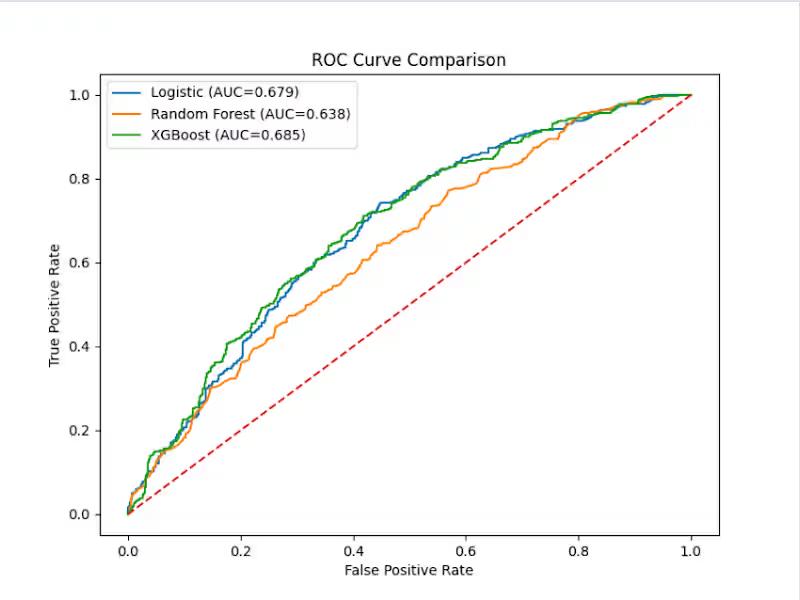
The reports folder contains model evaluation outputs generated during the machine learning workflow. These reports provide insights into model performance, feature importance, and predictive capabilities, helping stakeholders understand both the effectiveness and business implications of the solution. 1. Feature Importance Report Feature importance analysis was performed to identify the variables that contributed most to customer churn predictions, providing valuable to business insights. 2. ROC Curve Report ROC-AUC analysis was used to compare multiple machine learning models and identify the model with the strongest predictive performance. 3. Confusion Matrix Report A confusion matrix was generated to evaluate classification outcomes and understand the strengths and limitations of the predictive model.
1
67
1
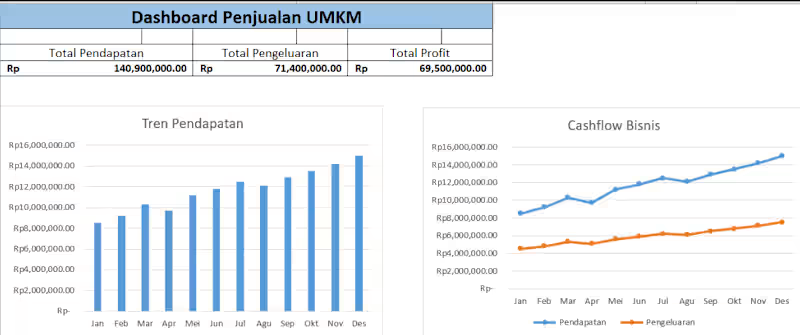
# 📊 Dashboard for Small Businesses (UMKM) A simple and user-friendly Excel dashboard designed to help small business owners monitor their business performance and make better decisions through data. --- ## 🚀 Project Overview This project demonstrates how sales data can be transformed into meaningful business insights using Microsoft Excel. The dashboard provides a clear overview of: - Monthly revenue - Monthly expenses - Profit tracking - Cashflow trends - Business performance visualization --- ## ✨ Features ✅ Sales Dashboard ✅ Cashflow Monitoring ✅ Profit & Loss Summary ✅ Interactive Charts ✅ Clean and Easy-to-Understand Layout ## 📸 Dashboard Preview Dashboard screenshots are available in the `screenshots` folder. --- ## 🛠 Tools Used - Microsoft Excel - Google Sheets - Git & GitHub --- ## 💡 Business Value Small business owners often struggle to understand their financial performance because their data is scattered and difficult to interpret. This dashboard simplifies business reporting and helps users: - Track revenue growth - Monitor expenses - Identify profit trends - Make data-driven decisions --- ## 👨💻 Created By Christians Steven Zoe Aspiring Data Analyst & Freelance Data Specialist GitHub: https://github.com/stevendsml01-blockchain
1
13
1
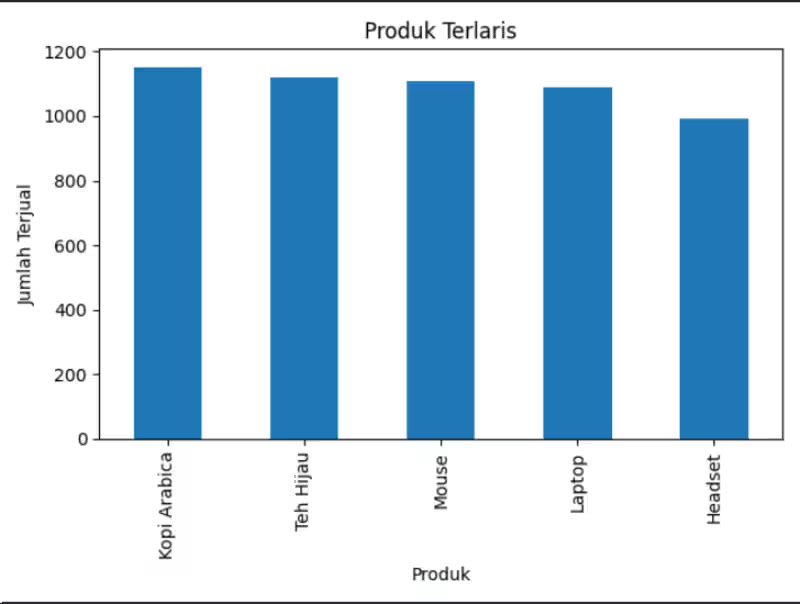
Data Cleaning and Sales Analysis ## Project Overview This project demonstrates an end-to-end data cleaning and exploratory data analysis (EDA) workflow using Python. The dataset was intentionally generated with multiple data quality issues to simulate real-world business scenarios commonly encountered by Data Analysts and Data Scientists. --- ## Objectives - Identify data quality issues. - Handle missing values. - Remove duplicate records. - Standardize mixed date formats. - Perform exploratory data analysis. - Generate business insights. - Create visualizations for decision-making. --- ## Dataset Issues The raw dataset contained several intentional problems: - Missing values in `Qty` - Missing values in `Harga` - Duplicate transactions - Mixed date formats - Inconsistent category naming --- ## Data Cleaning Process The following steps were performed: 1. Loaded and profiled the raw dataset. 2. Identified missing values and duplicate records. 3. Removed duplicate transactions. 4. Filled missing values using median imputation. 5. Investigated mixed date formats. 6. Built a custom date parser to standardize dates. 7. Saved the cleaned dataset. --- ## Results ### Before Cleaning | Metric | Value | |----------|---------| | Total Records | 1009 | | Missing Qty | 8 | | Missing Harga | 5 | | Duplicate Records | 10 | # After Cleaning | Metric | Value | |----------|---------| | Total Records | 999 | | Missing Qty | 0 | | Missing Harga | 0 | | Duplicate Records | 0 | | Failed Date Parsing | 0 | --- ## Business Insights ### Best-Selling Products Kopi Arabica was the top-selling product, followed by Teh Hijau and Mouse. ### Sales by City Bandung generated the highest sales volume, indicating strong market potential compared to Surabaya and Jakarta. ### Category Performance Electronics dominated sales performance. An inconsistency between `Makanan` and `makanan` was discovered, highlighting the importance of data standardization before analysis. ### Revenue The total revenue generated was: Rp 13,593,130,000 ## Technologies Used - Python - Pandas - NumPy - Matplotlib
1
16
1
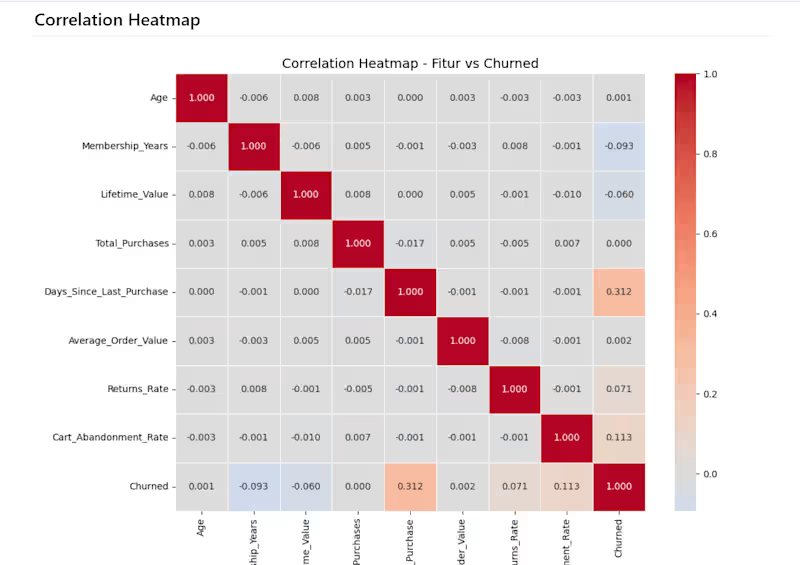
Image 1 – Project Overview & Dataset Information Customer Churn Prediction Using Random Forest This project focuses on predicting customer churn using machine learning techniques to help businesses proactively identify customers who are likely to discontinue their services. The predictive solution was developed using a structured approach involving Random Forest classification, SMOTE oversampling for handling class imbalance, GridSearchCV for hyperparameter optimization, and threshold tuning to improve recall performance. The dataset contains customer demographic and behavioral attributes, including: Age, Membership Years, Lifetime Value, Total Purchases, Days Since Last Purchase, Average Order Value, Returns Rate, Cart Abandonment Rate The target variable is customer churn status, where: 0 = Active Customer, 1 = Churned Customer Business Objective: The primary objective of this project is to identify customers at risk of churn so businesses can implement preventive retention strategies and reduce customer attrition. Image 2 – Machine Learning Pipeline End-to-End Machine Learning Workflow: A comprehensive machine learning pipeline was designed to ensure robustness, reproducibility, and business relevance throughout the modeling process. The workflow consisted of: 1. Data Cleaning Prepared and validated the dataset by handling inconsistencies and ensuring data quality. 2. Exploratory Data Analysis (EDA) Investigated customer behavior patterns and feature distributions to understand underlying trends. 3. Baseline Random Forest Modeling Established an initial benchmark using Random Forest classification. 4. SMOTE Oversampling Addressed class imbalance to improve the model's ability to detect churned customers. 5. Hyperparameter Tuning Optimized model performance using GridSearchCV. 6. Threshold Tuning Adjusted classification thresholds to maximize business-oriented objectives, particularly recall. 7. Model Evaluation Assessed predictive performance using multiple evaluation metrics. Professional Value This structured workflow demonstrates adherence to industry best practices rather than relying solely on default machine learning configurations. Image 3 – Correlation Heatmap Exploratory Correlation Analysis A correlation heatmap was generated to identify relationships between customer attributes and churn behavior. The analysis revealed several noteworthy insights: Customers with longer periods since their last purchase exhibited a stronger tendency to churn. Higher cart abandonment rates were moderately associated with increased churn risk. Demographic variables such as age showed minimal correlation with churn outcomes. Key Insight The strongest relationship with churn was observed in: Days Since Last Purchase (correlation = 0.312) suggesting that customer inactivity is a meaningful indicator of potential attrition. Business Relevance Understanding these relationships enables organizations to focus their retention initiatives on the factors most strongly associated with customer loss. Image 4 – Key Insights, Recommendations & Technologies Used Key Insights Several actionable findings emerged from the analysis: 1. Customers with extended inactivity periods are more likely to churn. 2. Elevated cart abandonment behavior may signal disengagement. 3. Improving recall is critical because accurately identifying potential churners aligns directly with the business objective. Business Recommendations: Based on the findings, the following strategies are recommended: Target High-Risk Customers: Deploy retention campaigns aimed at customers identified as likely to churn. Personalize Customer Communication: Develop personalized email and promotional initiatives to improve engagement. Strengthen Loyalty Programs: Offer incentives and rewards to reactivate inactive customers. Monitor Behavioral Indicators: Continuously track customer activity metrics to detect early warning signs of churn. Technologies Used The project was implemented using the following technologies: Python Pandas NumPy Matplotlib Seaborn Scikit-Learn Imbalanced-Learn
1
52
XGBoost
(1)
Follow
Message
Muzamil Tariq
Islamabad, Pakistan
Data Scientist & Analyst | Project Manager
New to Contra
Follow
Message
Data Scientist & Analyst | Project Manager
0
Machine Learning Model for Concrete Strength Prediction
0
3
0
Global Energy Consumption Analysis Project
0
4
0
Industrial Predictive Maintenance System Development
0
0
View more →
XGBoost
(1)
Follow
Message
Neha Madrala
Pimpri-Chinchwad, India
Power BI Data Analyst turning data into insights
10
Followers
Follow
Message
Power BI Data Analyst turning data into insights
2
Medicine Supply Chain Disruption Predictor Built a production-ready ML system that predicts drug shortage risk using real FDA data. Collected and cleaned 1703 real drug shortage records, trained an XGBoost model, and deployed it as a live REST API — accessible to anyone worldwide. The biggest challenge was identifying and removing 6 sources of data leakage that were causing fake 100% accuracy. After fixing this, the model delivers honest, generalisable predictions. The entire system is containerised with Docker, automatically rebuilt and redeployed via a Jenkins CI/CD pipeline on every code push, and visualised through an interactive Power BI dashboard. Result: A complete ML + DevOps project — from raw data to live deployed API — built independently in under 2 weeks. Live API: https://medicine-supply-predictor.onrender.com/docs GitHub: https://github.com/nehaM906/medicine-supply-predictor
4
2
276
7
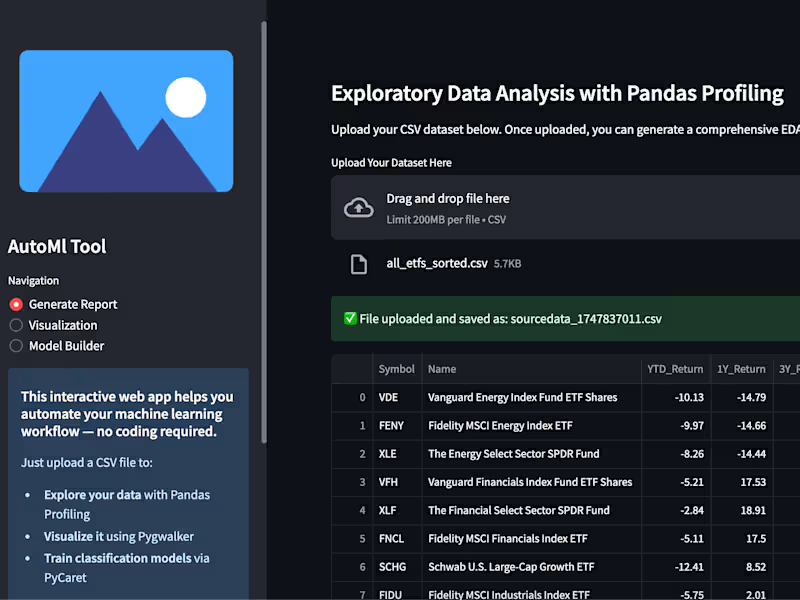
BizPulse — AI-Powered Business Analytics Dashboard Built for the Anything Ship & Sell Remixathon on Contra. What is BizPulse? An AI-powered business analytics tool that transforms messy, raw sales data into a clean professional dashboard instantly — no coding or spreadsheet skills needed. How it works: Upload any messy CSV or Excel file BizPulse auto-cleans your data and maps your columns Get a full analytics dashboard with KPIs, charts and AI insights Key Features: Business Health Score out of 100 KPI scorecards — Revenue, Expenses, Profit Margin, Customers 6 interactive charts with hover tooltips 5 AI-generated plain English business insights Revenue Goal Tracker with live progress bar Export as PDF and CSV No dataset? No problem! Click "Try Sample Data" on the upload screen to instantly load a realistic fictional dataset and explore the full dashboard. @Anything Try it here: https://bizpulse-879.created.app/ LinkedIn post: https://www.linkedin.com/posts/neha-madrala_anythingremixathon-buildinpublic-nocode-ugcPost-7453420153456762882-P2ve Demo Video: https://www.loom.com/share/3574386d73924ac59076493b055570c1
4
7
923
0
The biggest shift in my learning hasn’t been technical it’s been mindset. I used to think good analysts are the ones who know more tools. Now I realize they’re the ones who understand the business better. Anyone can create charts. Not everyone can explain why it matters. That’s what I’m working on every day.
0
45
0
Data is useless. Yes, it is. Because on its own, it doesn’t say much. It’s just numbers, rows, and columns. The real value comes when that data is understood — when it answers a question, shows a pattern, or drives a decision. That’s what turns data into information. And that’s what businesses actually need.
0
112
XGBoost
(1)
Follow
Message
Kristóf Németh
Budapest, Hungary
Data Analysis & Science Services
Follow
Message
Data Analysis & Science Services
0
Customer Churn Prediction with Machine Learning
0
1
0
Predicting NO₂ Levels Using Machine Learning
0
1
0
New York Taxi Fare Prediction Model
0
1
View more →
XGBoost
(2)
Follow
Message
Explore people