Web Designer/Developer TreyVititoe.com

Web Designer/Developer TreyVititoe.com



Product Designer for AI & Digital Products

DAY 16: CONDITION TRACE
30 Days of Real Business Problems Phase II
I stopped at Day 15.
Not because I ran out of problems.
The format was becoming predictable.
So I changed the rules.
Phase II starts with a problem from museum conservation.
Condition reports can document what was visible at different moments — but they cannot always prove when a physical change actually occurred.
So instead of asking:
“Where did the damage happen?”
I reframed the problem:
Trace when the feature first appears in the documentation.
That became CONDITION TRACE.
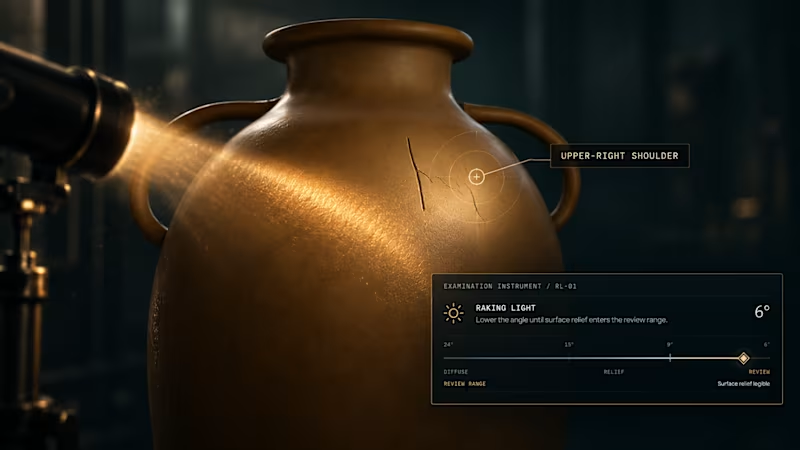
The prototype follows a fictional museum-loan case involving the same vessel across four signed condition records.
Earlier examinations were completed under diffuse light.
During the return-arrival inspection, the conservator introduces raking light.
As the grazing angle changes, a hairline crack on the vessel’s upper-right shoulder becomes legible.
That observation is preserved as OBS-04 and carried through a traceable evidence chain:
SRC-03 → OBS-04 → CMP-01 → LIM-01 → FND-01
But the system deliberately refuses to overstate what the evidence proves.
The earlier examinations were not performed under equivalent lighting conditions.
So the conclusion remains narrow:
FIRST DOCUMENTED APPEARANCE AUGUST 3, 2026
Not:
“The damage happened on August 3.”
Not cause.
Not responsibility.
Not liability.
The interface follows the same principle.
Light becomes an examination instrument.
The observation persists through comparison.
The evidence lineage remains visible.
And the final finding must be deliberately sealed.
The goal wasn’t to make an interface that looks forensic.
It was to make the boundary of the evidence visible and traceable.
TRACE THE RECORD. NOT THE BLAME.
Live prototype:
https://day16-condition-trace.vercel.app
Day 16 / 30
Phase II begins.
2
182
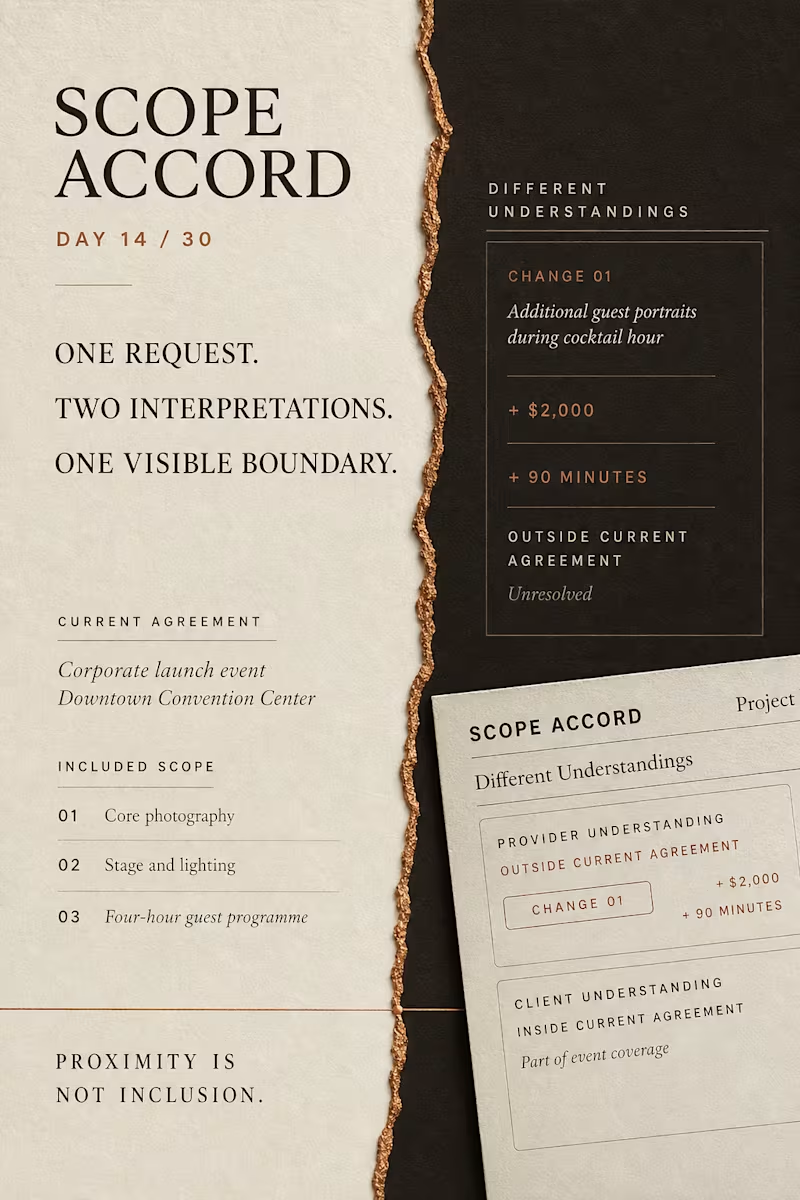
A request does not automatically change an agreement.
Scope Accord is a five-state interaction prototype designed around a common service-project problem: a client may hear “already included,” while the provider means “additional scope, cost and time.”
The proposed change remains structurally outside the current agreement until both parties express the same understanding of its impact.
One request.
Two interpretations.
One visible boundary.
Designed and built with React, TypeScript, CSS Grid and Playwright.
Live prototype:
https://scope-accord.vercel.app
2
122

Day 9/30: VOLLENT
A critical operational change should not become executable just because every message was delivered.
VOLLENT is an operational acknowledgment interlock that keeps execution physically open until every required recipient acknowledges the exact active version.
In this scenario, a venue load-in changes from 2:00 PM to 3:00 PM.
Three recipients have acknowledged it. Andre’s message was delivered but not acknowledged.
So, the circuit stays open.
Once Andre confirms the exact change:
Delivery → acknowledgment → circuit closure → authorization → evidence receipt
The signature interaction turns a missing acknowledgment into a physical gap. When the final recipient responds, the rails close, authorization becomes available and a version-bound receipt records the full sequence.
SENT IS NOT SAFE.
Delivery proves transmission.
Acknowledgment releases execution.
Built with React, Playwright, Remotion and FFmpeg.
Communication channels are simulated in this working prototype, and the receipt tokens are deterministic demonstration artifacts rather than cryptographic proof.
Live prototype:
https://faadil1.github.io/vollent/
Full case study: https://contra.com/p/oc2QerNL-vollent-operational-acknowledgment-interlock?r=faadil_boussari
#ProductDesign #InteractionDesign #UXDesign #Prototyping #FrontendDevelopment #MotionDesign
Full case study: available on my Contra profile.
6
209

Developer: automation, scripts, docs, data. Fixed-fee tasks.
New to Contra
Developer: automation, scripts, docs, data. Fixed-fee tasks.


AI Automation Engineer | Web Scraping & B2B Leads
New to Contra
AI Automation Engineer | Web Scraping & B2B Leads
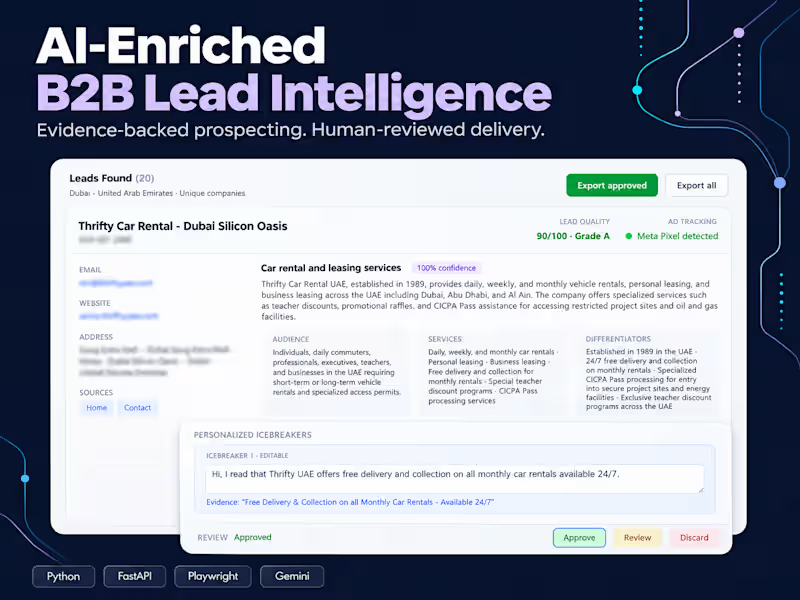
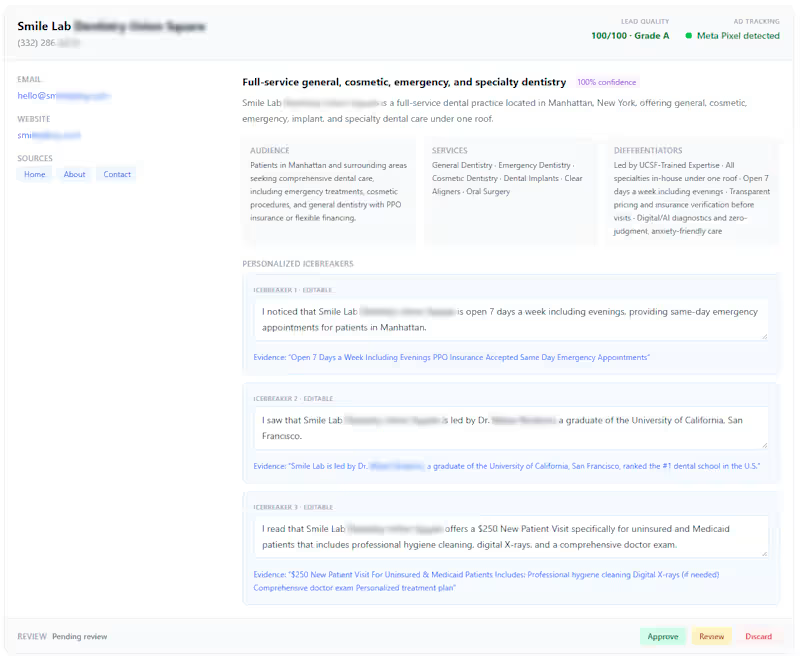
Evolving a Legacy Scraping Script into a High-Performance B2B Lead Intelligence Engine 🚀
I realized early on that traditional lead scrapers hit a wall very quickly. Basic HTTP requests frequently fail against anti-bot barriers, miss dynamic JavaScript tracking tags (like Meta Pixels loaded asynchronously), and leave sales teams with unverified, low-quality data. On top of that, standard AI wrappers often hallucinate company details, destroying cold outreach credibility.
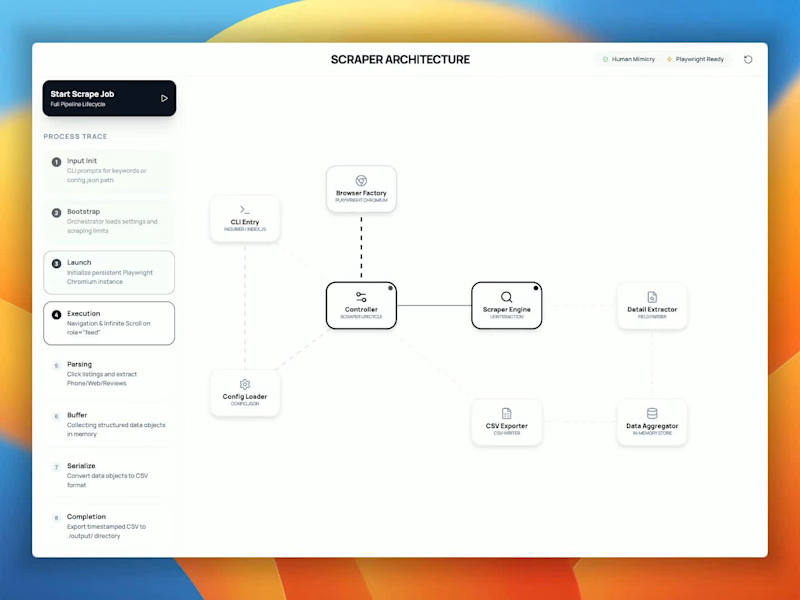
To fix this, I completely refactored the pipeline into a full-stack, production-ready B2B Lead Intelligence Engine built with FastAPI, Playwright Async, and Gemini API.
Key Architectural & Product Highlights:
⚡ Dynamic Execution & Pixel Audit: Migrated from static HTTP requests to headless Playwright Async, dynamically evaluating window.fbq post-rendering to eliminate false negatives in Meta Pixel detection.
🛡️ Zero-Hallucination AI Enrichment: Powered by Gemini in Strict JSON Mode, the system extracts company summaries, target audiences, and personalized email icebreakers. Crucially, it enforces local evidence validation—every AI claim must match verbatim text extracted from the prospect's site.
🎯 Human-in-the-Loop (HITL) Workflow: Built an intuitive dashboard allowing operators to review, edit, approve, or discard leads before exporting cleaned CSVs to CRMs (HubSpot, Lemlist, Instantly).
📊 Automated Lead Scoring: Features an algorithmic 0–100 quality score (Grades A, B, and C) based on contact completeness, tech stack footprint, and AI confidence.
💾 Resilient Async Backend: Integrated SQLite background job persistence with cooperative task cancellation and asynchronous batch processing.
By bridging deep web automation with strict AI governance, this project transforms raw directory listings into fully audited, high-converting outbound campaign assets in seconds.
0
118
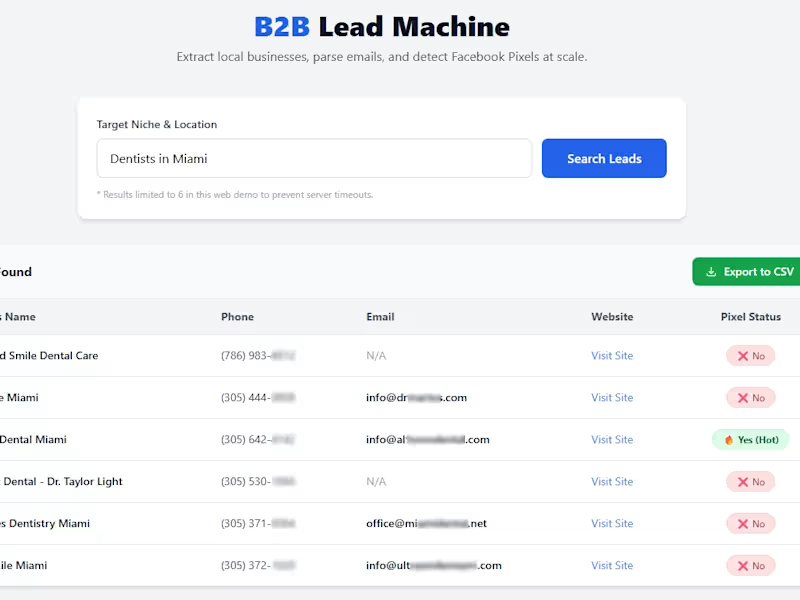
Manual lead generation often takes hours of repetitive work for marketing agencies. To solve this operational bottleneck, I built a custom B2B Lead Generation Engine.
Instead of relying on manual searches to qualify local businesses, I developed a script that automates the entire prospecting pipeline at scale:
📍 Local Accuracy: Integrates cleanly with the Google Places API.
🕵️♂️ Live Qualification: Uses Headless Browsing (Playwright) to detect active Facebook Pixels (instantly separating Hot vs. Cold leads).
📧 Contact Parsing: Scans the DOM and extracts valid contact emails using advanced RegEx.
📊 CRM Ready: One-click CSV export ready to be uploaded to HubSpot or GoHighLevel.
Built entirely with Python, Playwright, and Flask.
If your agency is looking to streamline its outreach and integrate a custom automated data pipeline, let’s connect. Send me a message and let's discuss your infrastructure needs.
#WebScraping #DataEngineering #B2BLeadGeneration #Python #Playwright #Automation #MarketingAgencies #TechConsulting #ProcessOptimization
0
124
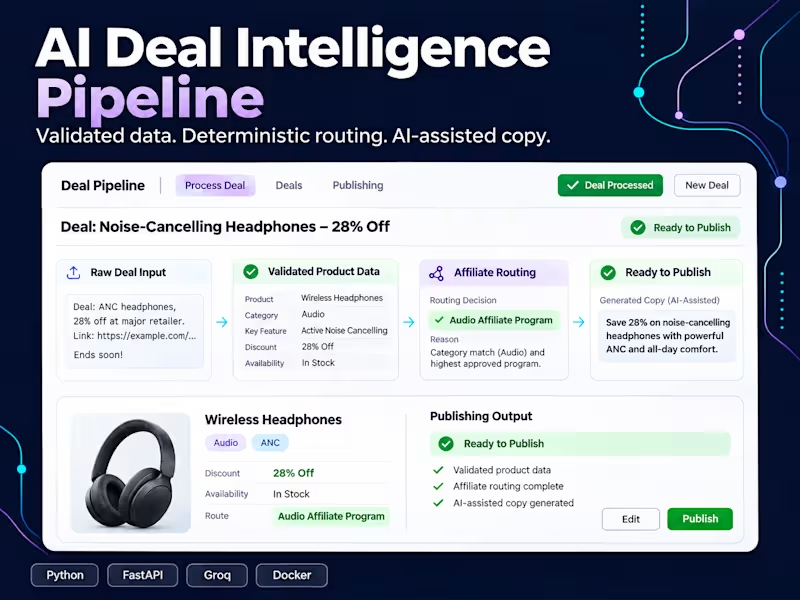

Web Scraping & Automation, Data Extraction Expert
Web Scraping & Automation, Data Extraction Expert


View more →

Manual & Automation QA Engineer | Web, API & End-to-End Test
New to Contra
Manual & Automation QA Engineer | Web, API & End-to-End Test
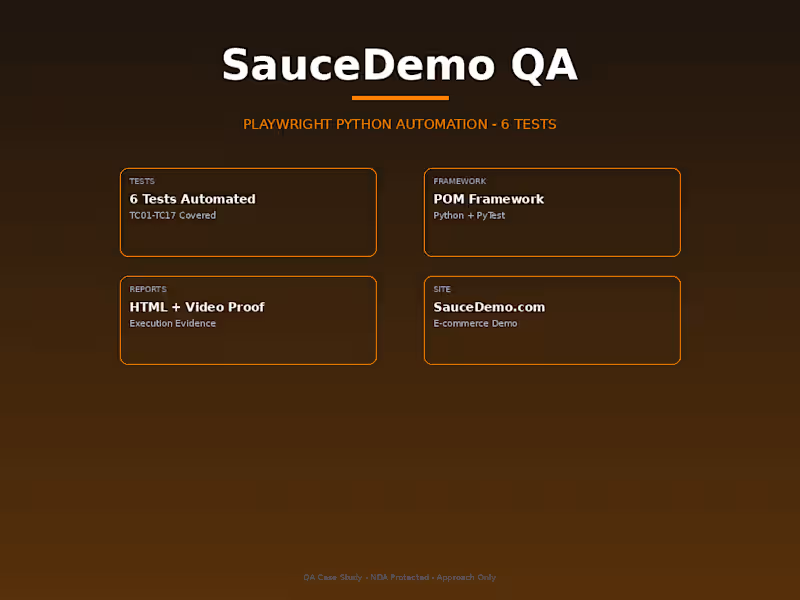
SauceDemo E2E Automation – Playwright Python + PyTest | POM Framework | 6 Tests Automated
Overview: Automated https://www.saucedemo.com using Playwright Python + PyTest + Page Object Model built from scratch.
Test Coverage (6 Tests):
TC01 Valid login with standard_user
TC03 Locked out user error validation
TC09 Add single item to cart (Backpack)
TC11 Remove item from products page
TC15 Checkout with missing first name validation
TC17 Complete happy path checkout E2E
Framework: POM with login_page, products_page, cart_page, checkout_page, conftest fixtures, pytest-html reports, video recording
Execution: 6/6 Passed | GitHub: https://github.com/mohsin-ishfaq/saucedemo-playwright-automation
Tech: Python, Playwright Sync API, PyTest, POM
0
129
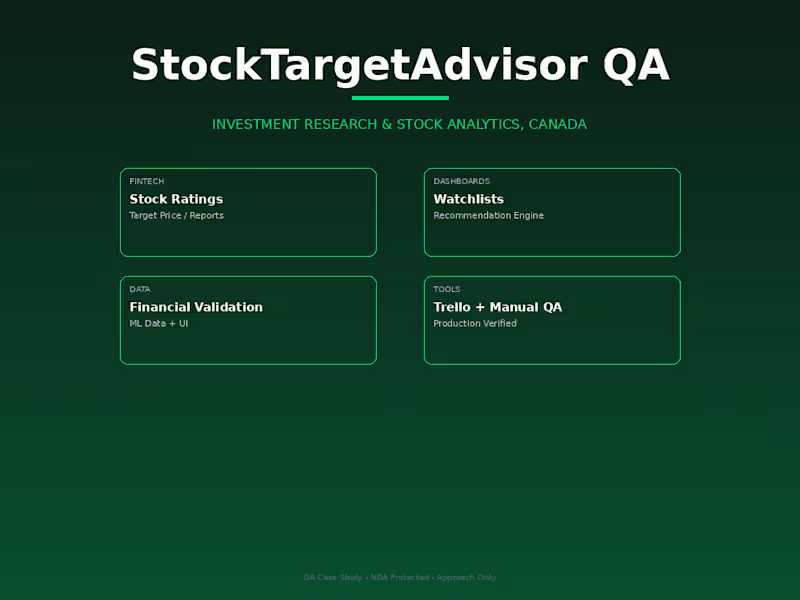
StockTargetAdvisor – Investment Research & Stock Analytics Platform QA [Canada] | FinTech | NDA Protected
Overview: Canadian FinTech platform delivering stock ratings, target-price predictions, market insights, ML-powered investment recommendations.
Work I Did:
Tested financial data accuracy: stock ratings (Buy/Hold/Sell), target prices, research reports, watchlists, recommendation engine
Validated dashboard calculations: portfolio performance, gain/loss, dividend yield
Verified ML-generated insights match UI presentation across 20+ user workflows
Regression testing each sprint - 70+ test cases
Defect tracking in Trello - 30+ bugs reported
Production verification post-deployment
Tools: Manual Testing, Functional/Regression, Trello
Domain: FinTech/Investment Research
0
135
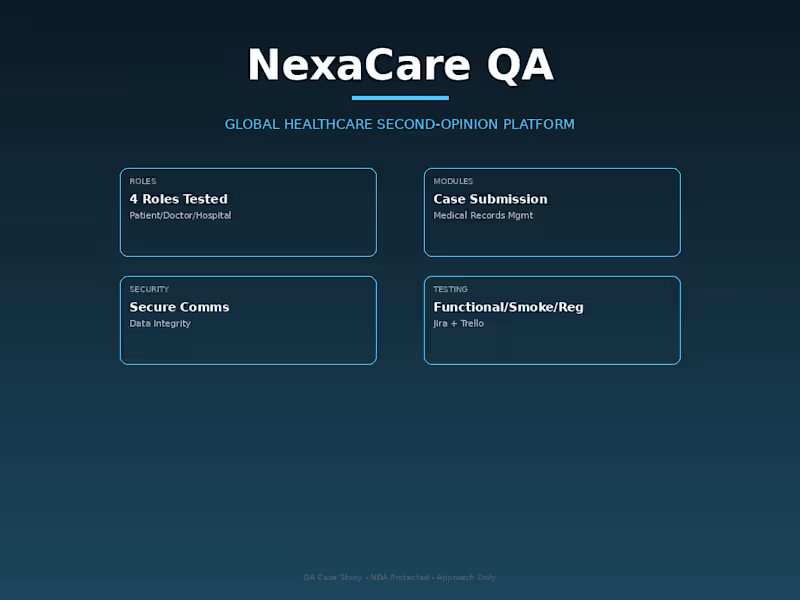
NexaCare – Global Healthcare Second-Opinion Platform QA | Global | NDA Protected
Overview: HIPAA-compliant platform enabling patients, doctors, hospitals worldwide to get second opinions from board-certified US specialists. 4 roles: Patient, Doctor, Hospital, Specialist Panel.
My Role: Manual QA Engineer
Work I Did:
Tested complete workflows for 4 distinct roles with different permissions
Patient flow: Registration, case submission with medical records upload (DICOM, PDF, images), payment, specialist selection, communication, report receiving
Doctor/Hospital flow: Patient referral, case tracking, record viewing, second opinion request
Specialist Panel: Case assignment, review, report generation, secure messaging
Validated medical record management: Upload validation (file type, size), secure storage, viewer functionality, download with watermark
Security & Compliance: RBAC testing - verified Patient cannot see other patients, Doctor A cannot see Doctor B's patients, Hospital admin only sees own hospital cases. Tested HIPAA requirements - PHI encryption, audit logs, session timeout
Functional/Regression/Smoke each release cycle - 100+ test cases executed
Created detailed bug reports in Jira & Trello - 40+ bugs including 2 critical HIPAA RBAC issues
Production verification before releases
Impact: Ensured zero HIPAA violations in production, stable releases for global users
Tools: Manual Testing, Jira, Trello, BrowserStack, Chrome DevTools
Domain: Healthcare Global | Compliance: HIPAA
0
118
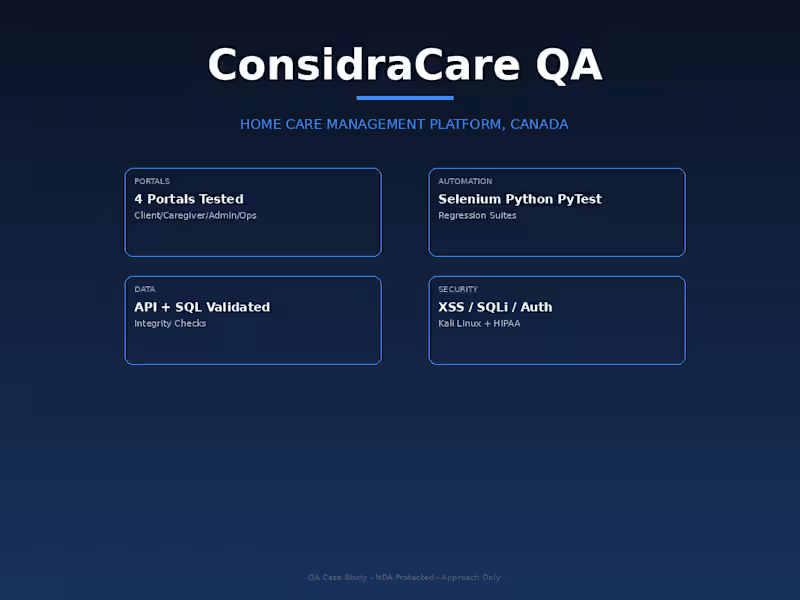
ConsidraCare – Healthcare & Home Care Management Platform QA [Canada] | Sep 2024 – May 2025 | NDA Protected - Approach Only
Project Overview:
Canadian home-care platform enabling agencies to manage caregivers, clients, scheduling, care plans, payroll, invoicing. 4 portals: Client, Caregiver, Admin, Operations.
My Role: QA Engineer (Manual + Automation + Security)
Work I Did:
Independently tested all 4 portals covering complex workflows: caregiver onboarding with background checks, shift scheduling with conflict detection, care plan management (ADLs), payroll calculations with overtime rules, invoicing with insurance integration
Designed and executed 150+ test cases: Functional, Regression, Smoke, Cross-portal, End-to-End
Built automated regression suite from scratch using Selenium Python + PyTest - 80 test cases automated, reduced regression time from 2 days to 4 hours
API Testing: Validated 30+ REST APIs using Postman - caregiver availability, shift assignment, payroll generation, client billing - checked status codes, response schema, error handling, auth
Database Testing: SQL verification - validated payroll calculations match DB, schedule conflicts prevented at DB level, invoice totals, data integrity across portals
Security Testing: Foundational web security using Kali Linux tools - XSS in care notes, SQL Injection in search, authentication bypass, brute-force on login, role escalation checks
HIPAA-adjacent validation: Ensured caregiver can only see assigned clients, client PHI masked for unauthorized roles, audit logs for sensitive actions
Bug Reporting: Logged 60+ bugs in Jira with steps, expected/actual, severity, video proof for critical. Worked with devs through fix verification
Release verification: Production smoke testing before each release, preventing critical payroll bugs
Impact: Reduced production bugs by 40%, regression time by 75%
Tools: Selenium Python, PyTest, Postman, MySQL, Jira, Kali Linux (Burp Suite, OWASP ZAP), BrowserStack, GitHub
Domain: Healthcare | Type: Web Application | NDA: No confidential screenshots or data shared - approach only
0
108

Senior Software & ML Engineer | Zero to One Product Builder


Senior Software & ML Engineer | Zero to One Product Builder



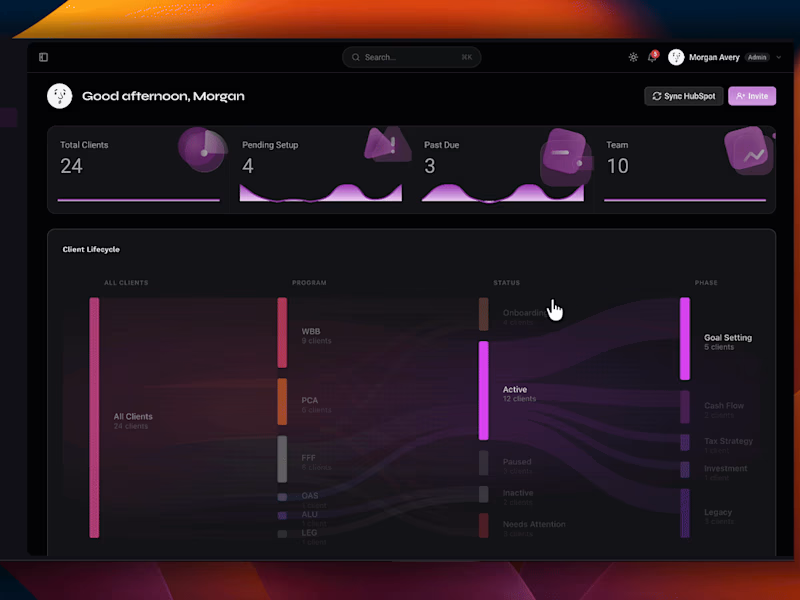
Client portals & Internal tools | Next.js, Supabase, AI
- $50k+
- Earned
- 5x
- Hired
- 5.0
- Rating
- 137
- Followers
Client portals & Internal tools | Next.js, Supabase, AI