Day 8/30 — OFFBITE
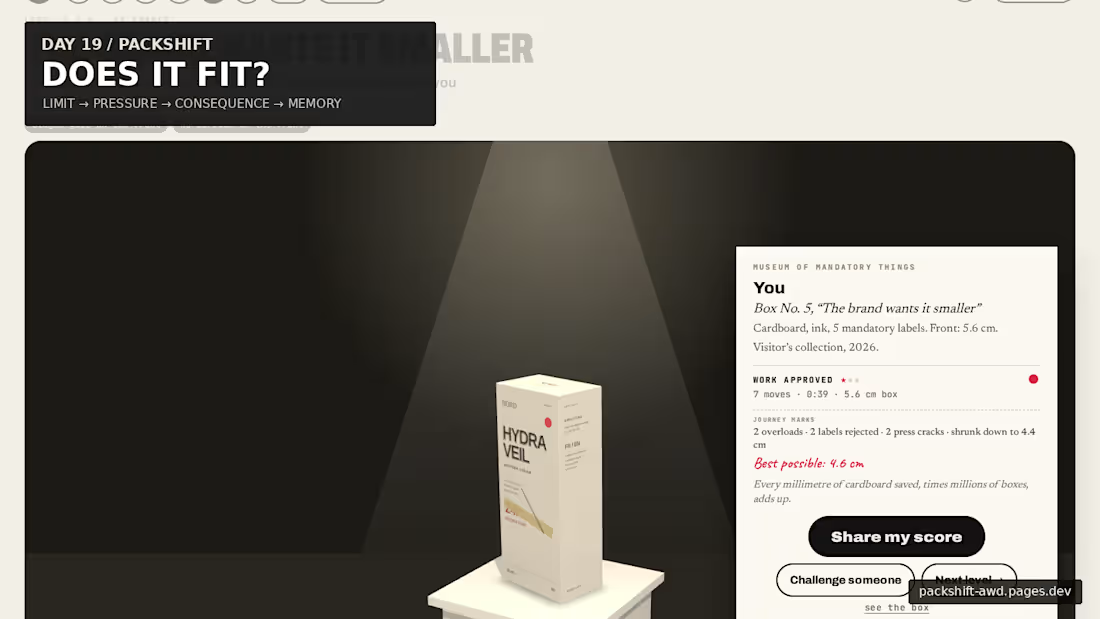
Most snack brands place a mascot on every package.
OFFBITE does the opposite.
Each cookie flavor carries only one fragment of a shared negative-space system. Separated, the cartons remain abstract. Aligned, they reveal one collective presence.
The system extends into motion and behavior without adding eyes, a mouth, or literal limbs. Expression comes through weight, distance, compression, and form.
A self-initiated speculative project exploring packaging, brand systems, motion, and 3D art direction.
View the full case study:
https://faadil1.github.io/offbite/
Would this make you stop and look twice on a shelf?
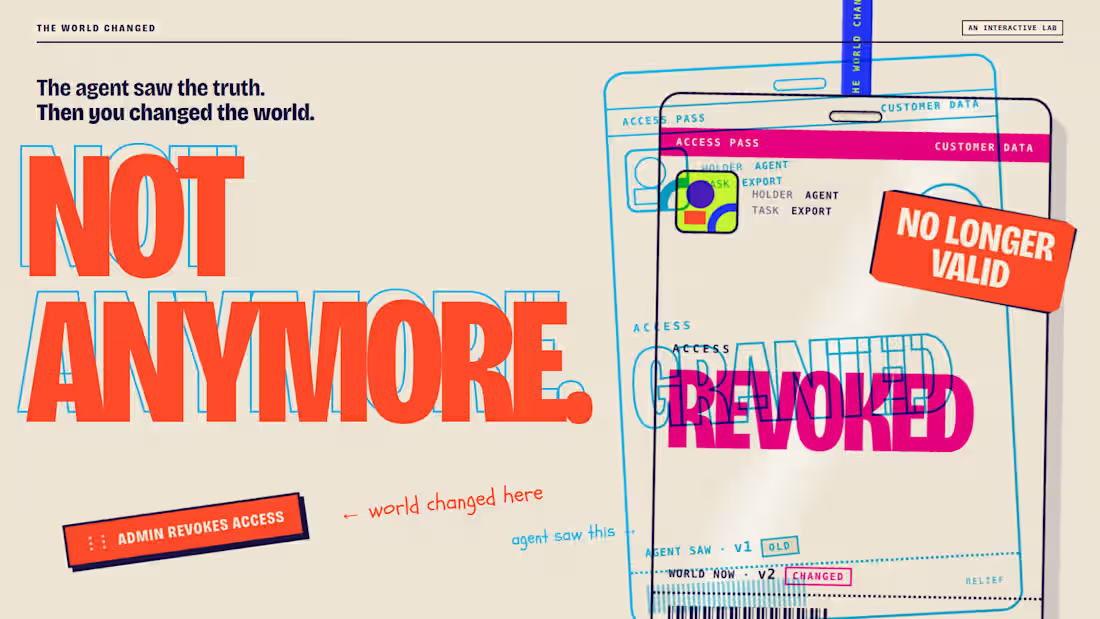
Day 7 of 30 Days of Real Business Problems: Northline
A handoff request is not a transfer of responsibility.
I built Northline, a custody passport for workflows where accountability must remain explicit during a handoff.
The receiver can verify the load, seal, units, condition, and photo evidence. Even when every check is complete, custody has not moved.
Only explicit acceptance creates the Transfer Imprint, locks the new custody sheet, and makes Northline the current custodian.
When the handoff expires, no imprint is created. Charlotte remains responsible. An exception can be assigned to Jordan Lee, but exception ownership does not transfer custody.
The central design principle:
Responsibility moves only when acceptance leaves a permanent imprint.
Live prototype:
https://faadil1.github.io/northline/
I’ll add a closer look at the accepted and expired states in the comments.
2
0
61
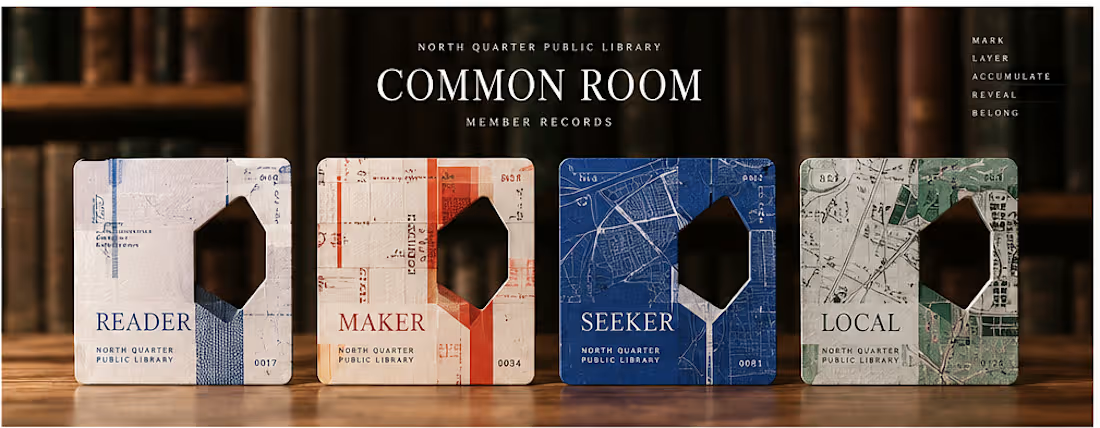
Day 6 of 30 Days of Real Business Problems:
PASSED APART
Every stage approved its part.
The dimensions were valid.
The tolerances were accepted.
Each module passed its own inspection.
The system still could not exist.
I built an interactive prototype where four independently approved modules are forced to share one master spine.
The first two fit.
At the third, a small misalignment becomes resistance.
Resistance becomes pressure.
Pressure shifts a module, opens a gap, and bends the spine.
Nothing failed on its own.
The failure only appeared after integration.
Live prototype:
https://faadil1.github.io/passed-apart/
#ProductDesign #InteractionDesign #BuildInPublic
Day 5/30: MISREGISTER
An operating-room case can still look ready on paper after it has stopped being operationally executable.
I built MISREGISTER to make that gap physical.
CASE 04 is connected to four changing dependencies:
— staffed OR team
— sterile instrument set
— postoperative ICU bed
— remaining operating-room time
As those windows drift apart, the operating list stays unchanged.
The signature moment: the crank freewheels to the end-stop while CASE 04 still reads SCHEDULED.
Only after that failed test does a human re-strike the case as DELAYED or RESEQUENCED.
This is not clinical decision support. It is a synthetic operational prototype exploring the difference between a scheduled slot and executable capacity.
Built with React, TypeScript, SVG, Playwright, Remotion, Claude Code, Kimi, Agent Reach, ChatGPT, and AI33Pro.
Live prototype:
https://faadil1.github.io/misregister-day-5/
Source:
https://github.com/Faadil1/misregister-day-5
Day 4 of my 30 Days of Real Business Problems challenge.
A veterinary patient leaves the clinic at 6 PM.
The next scheduled follow-up begins at 8 AM.
That leaves a 14-hour interval where care continues, but ownership may not be explicit.
I designed CORBEL to make that gap physical.
Instead of treating ownership as a status, task, or notification, CORBEL turns the unsupported interval into a structural failure.
Maya Chen does not check a box.
She becomes the exact missing component, accepts custody, enters the gap, and takes the load.
Only then does the structure recover.
No toast.
No celebration.
The system simply stops failing.
CORBEL — A Structural Handoff for Veterinary Aftercare.
Live prototype:
https://faadil1.github.io/corbel/
Source:
https://github.com/Faadil1/corbel
Day 3 of 30 Days of Real Business Problems: Before Bar One
A rehearsal can lose valuable time before the first note is played.
Ensemble parts sometimes come from structurally incompatible editions. Everything appears correct until one player reaches a rehearsal mark eight measures before or after everyone else.
I designed and built Before Bar One, a working prototype that checks whether every part follows the same structural route before rehearsal begins.
In the demonstration, the Horn in F part uses edition 1987-F, while the rest of the ensemble uses 2001-R. The system finds an eight-measure divergence after rehearsal mark C and turns it into a visible rupture.
The user then switches editions through a physical routing interaction. The missing measures return, and all five parts arrive at D together.
The prototype uses synthetic local edition metadata and does not claim to parse or verify real published scores. The goal was to demonstrate an honest, distinctive interaction model for a real operational problem.
Research → product thesis → interaction design → React/TypeScript prototype → Remotion film.
Try the live prototype (https://faadil1.github.io/before-bar-one/)
View the repository (https://github.com/Faadil1/before-bar-one)
#ProductDesign #InteractionDesign #UXDesign #CreativeTechnology #MusicTechnology #React
Container delays can quickly turn into daily financial exposure, especially when operations teams are tracking deadlines, holds, and dispute evidence across fragmented systems.
For this first project, I researched the problem of demurrage risk and designed Dwell Ledger, a financial operations register that helps import teams:
Identify containers requiring immediate attention
Track Active and Under Dispute exposure
Review verified shipment events
Prepare an evidence-backed carrier dispute
Reclassify liability without presenting it as recovered or resolved
Video Walkthrough
https://media.contra.com/video/upload/fl_progressive/w_1600/riaukubs5d8xb80i9tku.mp4
(https://media.contra.com/video/upload/fl_progressive/w_1600/riaukubs5d8xb80i9tku.mp4)The Signature Interaction
The key interaction follows container OOLU8902117: submitting its dispute moves $350 from Active Exposure to Under Dispute, while Total Liability remains unchanged at $3,150.
Prototype Disclosure
Front-end portfolio prototype using fictional shipment and financial data. No live carrier, payment, or dispute-system integrations.
Live prototype: faadil1.github.io/dwell-ledger (https://faadil1.github.io/dwell-ledger/)
Glow Atelier Hair already had an online presence, but the client experience still relied heavily on scattered messages, incomplete information, and manual follow-up.
I rebuilt that journey in Base44 around the way the business actually works.
Instead of asking clients to explain everything through back-and-forth messages, the new experience guides them through the service they need, the condition of their wig, photo uploads, measurements, and local or shipping logistics.
Once submitted, the request automatically becomes a unique Care Ticket. The client can then follow the status, understand the next step, and view the quote and payment journey through one structured record.
The result is more than a redesign. It is a real client care workflow built for a local business — designed to reduce incomplete requests, improve communication, and give Glow Atelier Hair a stronger system to grow with.
Before:
https://glow-atelier-hair.square.site/
After:
https://glow-service-flow.base44.app/
Public post:
https://x.com/roy1919875/status/2076558780880273866?s=46&t=BwAG2C4pUXYtaNoGH2rwlw
4
5
314
Chromatic Duel is a visual decision experience built in Wonder for the Contra x Wonder Challenge.
The project explores a simple idea:
Color palette selection should not only be about taste.
It should survive pressure.
Chromatic Duel turns two competing palette directions into a visible stress test. Ember enters as the bold, warm, dramatic direction. Tidal enters as the calm, precise, premium system direction.
Instead of presenting both palettes as moodboards, the Wonder canvas frames them as a duel.
The question is not:
“Which one looks better?”
The question is:
“Which one survives?”
Inside Wonder, I used the canvas to shape the full decision journey: the initial duel, the stress-test comparison, the iteration trail, the pivot in criteria, the workflow proof layer, and the final verdict.
The palettes are compared through four qualitative lenses:
Contrast
Harmony
Accessibility
System fit
As the system became clearer, Ember felt expressive but less stable. Tidal held together better across the interface direction, making it the stronger final choice.
Final Wonder verdict:
TIDAL SURVIVES.
Ember is archived.
I also created a Framer page as a bonus interactive wrapper. It lets visitors try challenger palettes and compare them visually against the fixed Tidal benchmark. The Framer page extends the experience, but the official build, workflow, and final decision remain in Wonder.
The core memory line:
The palette that survives the stress test wins.
Wonder file:
https://app.wonder.so/faadil-boussari/files/019f35d4-04d2-7664-afd6-bb717a9100bf
Walkthrough video:
Uploaded directly with this submission.
Framer bonus page:
https://cyan-lettuce-159672.framer.app/
1
6
345
BRAYD: The Braided Focus Flame 🔥
BRAYD is an original mascot created for BURN THE TASK, a fictional productivity ritual brand built around focus, completion, and quiet discipline.
Rather than designing a cute candle character, I built a full mascot system around one clear visual behavior: focused time burns into completion. BRAYD is a braided wick core inside a faceted wax body. As a task progresses, the wick burns down, the wax form changes through clear stages, and the final braided strand becomes a checkmark.
The mascot was designed to stay recognizable across every touchpoint, from the custom wordmark and hero poster to the sticker system, focus ritual packaging, burn sequence, and consistency board. Every asset uses the same visual DNA: the same braided wick, the same faceted wax body, the same angular flame, and the same final checkmark.
This project explores how a single mascot can become the face of a fictional productivity world by turning an abstract idea, focus, into a visual ritual.
Character Brief
Name: BRAYD
Role: The Braided Focus Flame
Personality: quiet, intense, disciplined, stubborn, focused, and encouraging without being soft.
BRAYD does not rush you and does not distract you. He simply burns with you until the task is done. His braided wick represents focused effort, his faceted wax body represents pressure and progress, and his final checkmark represents completion earned through attention.
Recraft Project
Explore the full project here:
https://www.recraft.ai/project/a75515d8-3533-42f4-9a93-9815d2f3f7e3
Applications Included
The BRAYD system includes a custom name logo, hero poster, sticker pack, focus ritual packaging, burn to checkmark sequence, and a final consistency board showing the mascot across multiple moments and touchpoints.
Proof of Consistency
Same wick. Same facets. Same flame. Same final checkmark.
#RecraftAI #CharacterDesign #MascotDesign #BrandIdentity #CreativeAI #Illustration #DesignChallenge #BrandDesign #ConceptArt #MotionDesign #GraphicDesign #MascotSystem #ProductivityDesign #DigitalArt
12
22
761
12% Human is a short corporate-AI thriller about a job candidate who gives the most human interview possible and fails because of it.
I used ChatGPT to develop the concept, character direction, interview-room visuals, facial expression references, tablet reveal, and storyboard, then built the shots in Renoise Canvas with Seedance video generation, including the spoken dialogue directly inside the video clips.
The final cut was assembled in CapCut with a readable tablet evaluation overlay, ambient sound, timing adjustments, and a minimal end card to make the twist land clearly.
1
3
200
Your strongest work is often the work you cannot show.
CaseCraft is an AI-assisted portfolio tool that helps professionals turn confidential project work into public proof.
It reviews each claim, classifies it as SAFE, ANONYMIZE, or EXCLUDE, and lets the user review or change every decision before generating a privacy-safe case study.
Built with Figma Make, Claude API, Cloudflare Workers, and JavaScript, CaseCraft explores a simple question: how can professionals prove the value of their best work without exposing private information?
Live project: https://rank-cheer-67549692.figma.site
3
185
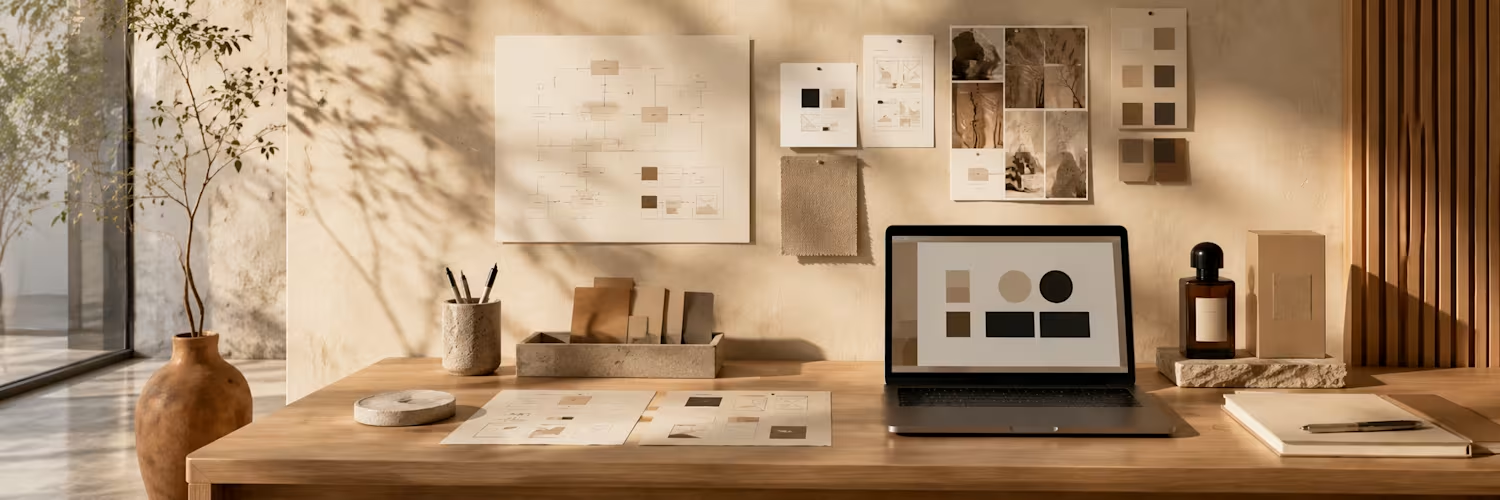
AI Product Visualization for Luxury Brands
Overview
This project explores how AI can accelerate luxury product development by transforming ideas into premium visual concepts before physical production.
By combining product design principles, luxury branding, and AI-driven image generation, I created a system for rapidly visualizing products, packaging, and campaign assets while maintaining a high-end editorial aesthetic.
The objective is not simply to generate images, but to support product validation, brand positioning, and creative decision-making.
The Challenge
Traditional product development often requires significant investment before a concept can be evaluated visually.
The goal was to create a workflow capable of:
Visualizing luxury products before production
Exploring multiple design directions rapidly
Testing brand positioning concepts
Creating campaign-ready assets
Maintaining premium visual consistency
Creative Approach
Product Concept Development
AI was used to explore and refine concepts across multiple luxury categories:
Fragrance
Skincare
Accessories
Home Objects
Lifestyle Products
Each concept was designed to feel commercially viable and aligned with premium market expectations.
Packaging & Brand Visualization
Beyond product rendering, the workflow included:
Packaging concepts
Material exploration
Brand identity integration
Product storytelling
Editorial campaign development
The result is a complete visual ecosystem rather than isolated product images.
Luxury Positioning
The visual language follows Quiet Luxury principles:
Minimalism
Natural materials
Warm neutral palettes
Editorial lighting
Timeless design
Every element was designed to communicate sophistication without relying on overt branding.
Outcome
The project demonstrates how AI can function as a strategic design partner during the early stages of product development.
It enables brands to:
Validate concepts faster
Reduce creative iteration cycles
Explore multiple visual directions
Create presentation-ready assets
Align product design with brand positioning
Key Capabilities
✅ Product Concept Visualization
✅ Packaging Design Exploration
✅ Luxury Brand Positioning
✅ Editorial Campaign Development
✅ AI-Assisted Product Design
✅ Premium Visual Storytelling
1
95
Editorial AI: Designing the Quiet Luxury Aesthetic
Overview
This project explores how editorial art direction principles can be applied to AI-generated imagery to create premium visual assets that feel timeless, authentic, and brand-aligned.
Rather than pursuing hyperrealism or trend-driven aesthetics, the objective was to develop a visual language rooted in restraint, sophistication, and intentionality.
The result is a collection of AI-generated editorial imagery designed to embody the principles of Quiet Luxury.
The Challenge
A significant portion of AI-generated content is instantly recognizable due to over-stylization, excessive detail, artificial lighting, and unrealistic visual cues.
The challenge was to create imagery that feels:
Natural rather than synthetic
Premium rather than promotional
Timeless rather than trend-driven
Editorial rather than purely generated
Creative Direction
Aesthetic Philosophy
The visual system is built around the principles of Quiet Luxury:
Minimalism over excess
Authenticity over spectacle
Texture over visual noise
Presence over attention-seeking
Warm neutrals, organic materials, and understated compositions establish a sense of trust, confidence, and sophistication.
Visual Language
The project relies on:
Earth-toned color palettes
Natural window lighting
Soft contrast
Clean compositions
Intentional negative space
Each image is designed to communicate calm confidence and enduring value.
Technical Execution
To achieve an editorial-quality appearance, generation workflows were optimized using:
85mm portrait lens simulations
Shallow depth of field
Controlled lighting ratios
Cinematic framing
Consistent styling references
These techniques help bridge the gap between AI generation and professional photography.
Outcome
The resulting imagery demonstrates how AI can be used to create sophisticated visual assets that align with premium brand positioning.
Rather than appearing artificial or trend-driven, the content functions as a cohesive editorial system suitable for luxury, lifestyle, hospitality, fashion, and personal branding applications.
Key Takeaways
✅ Editorial Art Direction
✅ Premium Brand Storytelling
✅ Luxury Visual Identity
✅ AI-Assisted Creative Production
✅ Consistent High-End Aesthetics
Project Outcome
This project showcases my ability to translate luxury brand principles into scalable AI-generated visual systems, creating imagery that feels intentional, tactile, and commercially relevant.
0
79
Autonomous AI Career Intelligence Platform
Overview
I developed an autonomous AI-powered platform designed to automate the job discovery and evaluation process.
The system continuously analyzes job opportunities against a candidate profile and delivers ranked recommendations directly through Telegram.
Rather than relying on manual job searches, the platform transforms fragmented opportunities into actionable career intelligence.
⸻
The Challenge
Job seekers often spend significant time reviewing opportunities that are poorly aligned with their qualifications, experience, or career goals.
The objective was to create a system capable of:
Monitoring opportunities continuously
Evaluating candidate-job fit automatically
Ranking opportunities by relevance
Delivering personalized recommendations in real time
⸻
Solution
Intelligence Layer
Developed a scoring engine that evaluates:
Technical skills alignment
Professional experience relevance
Industry compatibility
Education requirements
Soft skills fit
Each opportunity receives a weighted score and detailed evaluation breakdown.
⸻
Recommendation Layer
Beyond numerical scoring, the platform generates contextual insights explaining:
Why a role is a strong match
Which qualifications are missing
Potential competitive advantages
Areas for improvement
This transforms raw job data into actionable decision support.
⸻
Infrastructure
The platform operates as an autonomous workflow deployed on Render.
Key capabilities include:
Automated opportunity monitoring
Data processing pipelines
AI-driven evaluation
Telegram notification delivery
Continuous 24/7 execution
⸻
Operational Workflow
Candidate submits CV
System extracts and analyzes profile information
Opportunities are collected and processed
Matching engine evaluates compatibility
Ranked recommendations are delivered automatically
AI-generated insights explain each result
⸻
Key Features
✅ Automated CV Analysis
✅ AI-Powered Matching Engine
✅ Explainable Scoring System
✅ Real-Time Job Monitoring
✅ Telegram-Based Delivery
✅ Continuous Cloud Deployment
⸻
Outcome
This project demonstrates my ability to design and deploy production-ready AI workflows that bridge the gap between complex technical systems and real-world efficiency.
The result is an autonomous platform that reduces manual effort while improving the quality and relevance of career opportunities presented to the user.
0
64
Building an AI Persona That Feels Human
Overview
Mara Keïta is an AI-native persona developed as a long-term brand asset rather than a one-off character generation.
The objective was to create a recognizable digital identity capable of maintaining visual, emotional, and editorial consistency across images, video, and social media content.
Instead of relying on isolated prompts, I designed a complete identity system that allows the character to scale while preserving authenticity and coherence.
⸻
The Challenge
Most AI-generated personas suffer from three recurring issues:
Inconsistent facial features across generations
Lack of a defined personality and voice
Difficulty maintaining brand coherence across multiple content formats
The goal was to create a system that could support hundreds of future assets while ensuring Mara remained instantly recognizable.
⸻
The Solution
I developed a comprehensive AI Persona Design System composed of five key components:
Character Bible
A detailed reference framework defining:
Facial structure
Hair characteristics
Age range
Heritage and cultural positioning
Body language
Emotional range
Signature visual traits
Visual Language
A complete aesthetic system including:
Color palette
Materials and textures
Lighting principles
Composition rules
Styling references
Environmental guidelines
Personality Framework
Defined Mara’s:
Core values
Archetypes
Mission
Communication style
Behavioral patterns
On-camera presence
Content Architecture
Created editorial pillars that guide content creation:
Quiet Confidence
Slow Living
Personal Growth
Lifestyle & Culture
AI Production Workflow
Built a scalable workflow capable of generating:
Static imagery
Editorial visuals
Lifestyle content
Social media assets
Video-ready character references
while preserving character integrity.
⸻
Results
Social Media Performance
Within the first publishing phase:
30 published pieces of content
1,700+ views in 30 days
100+ new followers acquired
87% of views from non-followers
Consistent engagement across images and video
⸻
Key Achievement
The success of this project is not a single image.
It is the ability to maintain a coherent identity across dozens of visual assets while preserving the same personality, aesthetic, and emotional tone.
Mara Keïta demonstrates how AI personas can evolve beyond simple image generation and become scalable digital brand assets.
⸻
Tools & Workflow
Google Flow
Veo
Advanced AI image generation workflows
Character consistency systems
Editorial design frameworks
Brand identity methodology
⸻
Project Outcome
Mara Keïta serves as a case study in AI Identity Design, showcasing how structured creative systems can transform AI-generated characters into believable, scalable, and commercially viable digital personas.