

Contra - A professional network for the jobs and skills of the futureDiscover

Standout projects

Standout projects

More projects we love that are making waves across the web

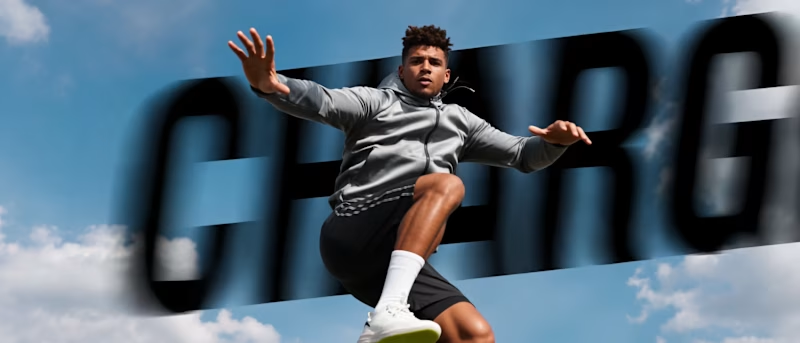
Cover image for CHARGE — Brand Concept
Challenge
The focus
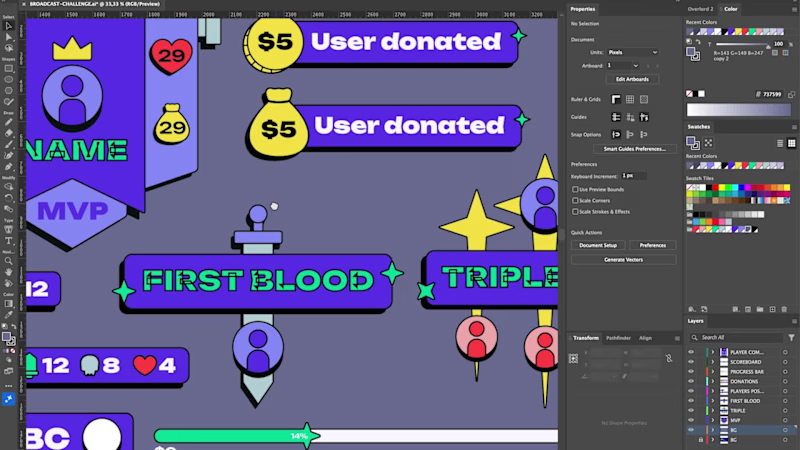
CHARGE — Brand Concept Challenge The focus gum category is crowded with products that rely on functional claims, lifestyle clichés, or overly clinical branding. CHARGE needed a visual identity that immediately communicated energy, confidence, and momentum while feeling premium enough to compete on modern digital shelves. Idea Energy. Focus. Go. The concept treats focus as movement rather than concentration. Every graphic element—from bold typography and angular compositions to kinetic motion and athletic photography—reinforces the feeling of acceleration. Rather than telling people they’ll feel energized, the brand is designed to make them feel energized the moment they encounter it. Visual Language A bold, high-contrast design system built around oversized typography, dynamic geometric forms, clean white space, and vibrant product colors creates an instantly recognizable identity. Bright lifestyle photography captures moments of determination, speed, and achievement, while the colorful packaging becomes a hero element across every touchpoint. Motion System The motion language is driven by momentum. Type slides with purpose, products snap into frame, athletes move through fast cinematic cuts, and macro product moments add tactile detail. Every transition is quick, precise, and intentional—mirroring the instant boost associated with the product. Photography Instead of generic fitness imagery, the photography celebrates peak performance across multiple sports and disciplines. Powerful portraits, dynamic action, and vibrant outdoor environments create a feeling of optimism and forward motion while reflecting a diverse community of high performers. Outcome The result is a contemporary consumer brand that feels energetic, premium, and highly scalable. The identity extends seamlessly across packaging, social media, motion graphics, advertising, digital experiences, and retail—creating a cohesive brand system that is memorable both on shelf and on screen.
11
13
168
Cover image for DONT MISS THIS ONE:
I've spent
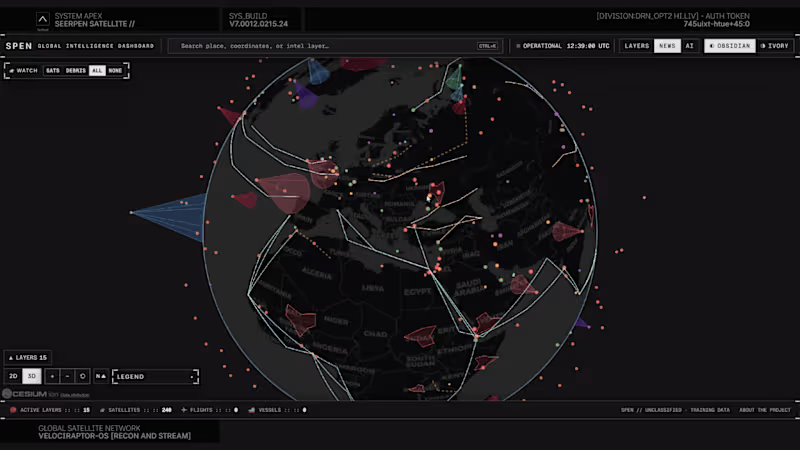
DONT MISS THIS ONE: I've spent the last few weeks building something I've wanted to finish for a while and add new skills to my pipeline while working on the project: a cinematic, terminal/HUD-style interface for a fictional tactical operations system, entirely in the browser. (I believe this might be a really good solution to run some type of motion projects during filmmaking time directly on the visible probs) Here are some details: Behind a simulated boot sequence (fake network handshakes, IP auth, animated logo reveal) sit four consoles: → STATICPEN: a satellite recon view with live target tracking that shifts from optical to thermal scan on inspection → SILENTPEN: a ground tactical console with four switchable sensor modes: Direct, Lidar, Heat Scan, Ghost → SEERPEN: the deep one. A real 3D globe (Cesium) rendering 26 live/static intelligence layers, conflict zones, ship traffic, flight tracking, GPS jamming, orbital satellites, paired with a live news feed and a local-LLM "analyst" that reads the map context and can act on it through chat → STRATUM: locked for now. Select it, and the system denies you clearance and logs the attempt. A dead end on purpose. Design-wise, the goal was to make it feel like a live system, not a mockup; every terminal readout, scan line, and boot log is actually animating in real time, not a static screenshot dressed up to look busy. Designed fully in Figma, first run and perfected on a local server and moved to GitHub with some changes to able to fit the webpage format. It was built with React 19, TypeScript, Vite, Tailwind v4, Cesium, and a small Express backend aggregating real news and live layer data. While I've FE skills, they were limited in most cases; I've tried a new MCP server system inside Figma, and with VSC and Claude, I was able to pull out my design, put more detailed meaning to it and run it fully with interactions. While I'm against the ML systems to some degree, my approach is to use that as a tool to solve my technical problems. And my design project became a fully functional project. I believe designers will evolve their mindset to create more valuable products with more extensive tool options. Let me know what do you think =) Full case study on Behance: https://lnkd.in/dNd_PRqu (https://lnkd.in/dNd_PRqu)Live demo: https://lnkd.in/d2cp9mcN
12
20
306