Freelance Design Systems Specialists in GujaratFreelance Design Systems Specialists in Gujarat
Graphic designer creating creative stuff.
New to Contra
Graphic designer creating creative stuff.
Founding designer for startups who want enterprise designs
$10k+
Earned
8x
Hired
5.0
Rating
214
Followers
Founding designer for startups who want enterprise designs
B2B Product Designer | SaaS, Fintech, AI
5.0
Rating
40
Followers
B2B Product Designer | SaaS, Fintech, AI
Cover image for I watched Apple's 108-second event
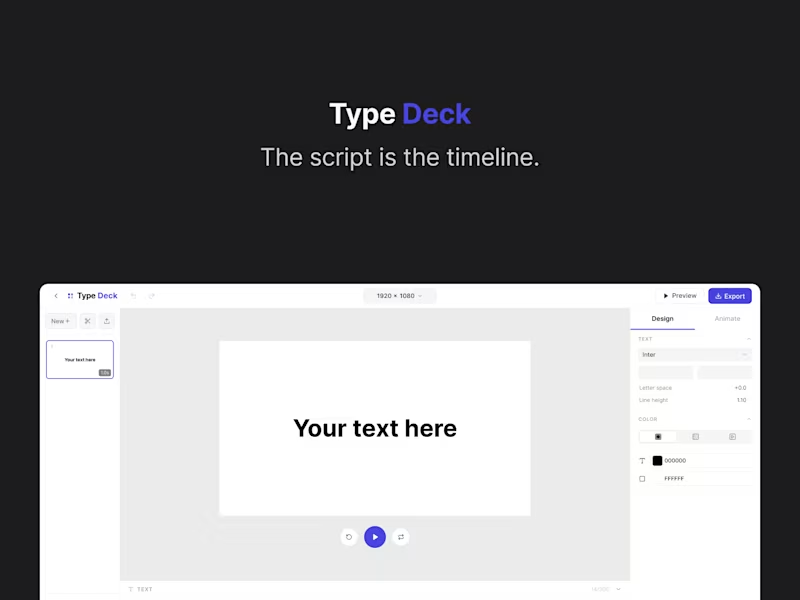
I watched Apple's 108-second event (https://www.youtube.com/watch?v=mO8zBQqpTmY)recap and couldn't stop thinking about one thing. No voiceover. No presenter. Just words, motion, and rhythm. Short sentences. Each one a beat. The entire year of Apple products - described in 108 seconds through kinetic typography alone. That moment became TypeDeck. The idea: What if After Effects had a baby with PowerPoint - and it was actually simple enough for anyone to use in minutes? No timeline. No keyframes. No layers. Just write your script and watch it become a film. I Built the entire app UI and animation engine from prompt to code. The behavior-based animation architecture, the script editor, the rhythm strip, all of it with use of Figma Make. What TypeDeck does: → Paste your script — every sentence auto-converts into an animated scene. → Copy a style with Ctrl+C, paste it across every slide with Ctrl+V. → Hook accent words with asterisks — they get a color treatment automatically. → Apply flat color, gradients, or drop in images and video as backgrounds. → Export and import projects. Built-in music. Everything in one place. The problem it solves: After Effects has a learning curve measured in months. Canva has templates but no motion depth. There's nothing in between that gives a founder, marketer, or creator the ability to make a genuinely beautiful motion video in under 20 minutes - until now. TypeDeck is free to use. Start to create your stunning videos today. https://www.figma.com/make/oK7XsVbAKpa4LulmGxJ5Py/TypeDeck?t=sKtdidrjE34hmLjQ-20&fullscreen=1 Video Demo: https://www.loom.com/share/6d621cc245094653baef910544523072
5
11
305
Cover image for Most travel apps solve booking.
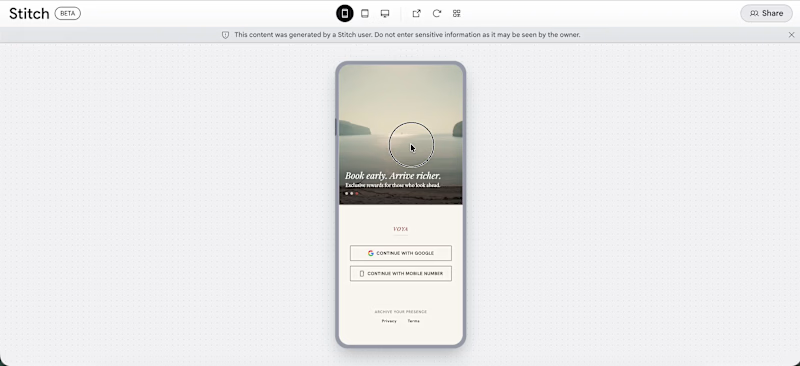
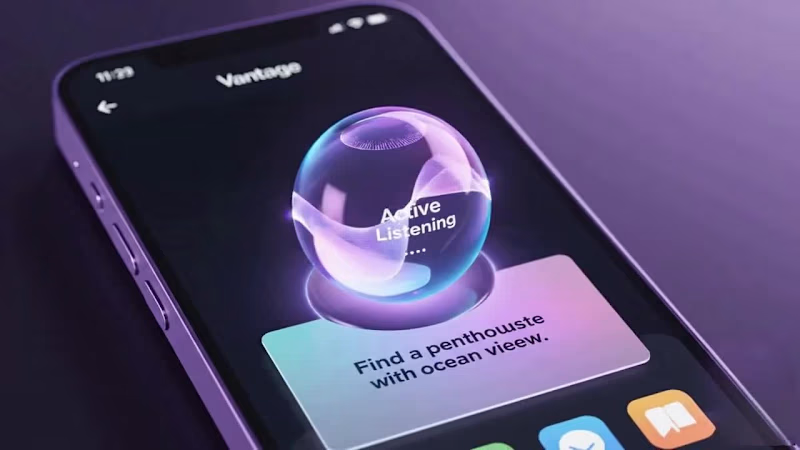
Most travel apps solve booking. None of them solve the reason people never book in the first place. The problem is not money. Most people who want to travel actually have enough. The problem is that travel has no due date. Your EMI comes out on the 5th. Your insurance renews in March. Your electricity bill arrives every month without asking. They all get paid - because they have a structure that does not accept someday as an answer. Your dream trip has none of that structure. So it waits. Every year. Until it stops feeling like a plan and starts feeling like a personality trait. That insight became Voya. This is the Original Workflow (https://stitch.withgoogle.com/projects/6972276730042508148) but due to certain issues I am not able to create prototype in same file so I duplicate that workflow (https://stitch.withgoogle.com/projects/17661579163113846531) and create new prototype. Prototype: https://stitch.withgoogle.com/preview/17661579163113846531?node-id=052829c9edd64f84b05c85db6b5bd998 𝗪𝗵𝗮𝘁 𝗺𝗮𝗸𝗲𝘀 𝗶𝘁 𝗱𝗶𝗳𝗳𝗲𝗿𝗲𝗻𝘁: → Saves a fixed amount from your income every month automatically - like an EMI, but for your next trip → Shows you where your rupee goes furthest right now based on live currency exchange advantages → Monitors flight prices 24/7 and alerts you the moment fares drop on your target routes → Tracks hotel pricing cycles so you book the same property for significantly less → Forecasts exactly where you can travel with your current savings - and when you unlock better destinations in 3, 6, or 12 months → Builds four completely different trip packages for the same destination - one for people who want luxury hotels and economy flights, one for business class comfort with simple stays, one for slow deep travel, one for multi-city discovery - you compare and pick yours → Shows you the real cost of waiting - how much more you will pay if you book when you originally planned versus booking now with your savings → Gives you back the mental peace of knowing the trip is already funded - so when you return home you return to the exact financial life you left. No investments liquidated. No recovery period.
67
46
1.4K
UX/UI Designer | Product Designer | Design Thinker | SaaS
5.0
Rating
UX/UI Designer | Product Designer | Design Thinker | SaaS
Turning Ideas into Designs, Software & Smart Products
$1k+
Earned
1x
Hired
4
Followers
Turning Ideas into Designs, Software & Smart Products
Strategic Design for Modern Brands | Webflow & Framer
11
Followers
Strategic Design for Modern Brands | Webflow & Framer
Cover image for Living in the highly advanced technology era of 2026, it is ...
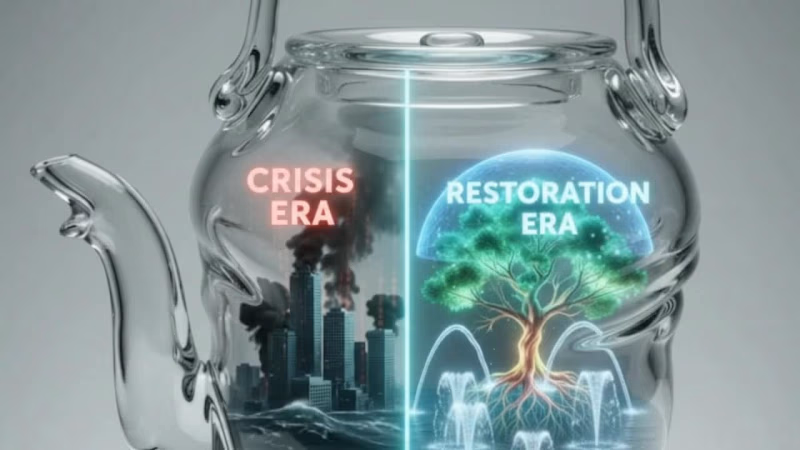
Living in the highly advanced technology era of 2026, it is a tragic irony that we still fail to fully control the devastating effects of global warming for our next generation. Inspired by the organic, twisted mastery of George Ohr’s earthenware Teapot from The Met Museum Collection, https://www.metmuseum.org/art/collection/search/20144 I wanted to explore how art can bridge the gap between past heritage and a sustainable future. This reimagined 'Terraforming Core' poses a critical question: If our past generations left us a rich cultural legacy, why can't we leave our next generation a planet where they can eradicate global warming? Even though our present generation will no longer be around in the year 2125, the innovative carbon-capture solutions we design today will serve as a foundational blueprint and example for them. Our technology must not replace nature, it must serve as its shield. Left Side: The Crisis EraDestruction & Pollution: This section depicts a chaotic urban landscape with towering skyscrapers engulfed in thick, black smoke. It visually represents the severe impacts of global warming and air pollution. Natural Disasters & Hazards: Turbulent ocean waves crash around the city, symbolizing floods and climate-induced catastrophes. A prominent biohazard logo sits at the bottom, hinting at pandemics or extreme environmental crises. Right Side: The Restoration EraNature & Greenery: This section features a massive, flourishing green tree protected inside a futuristic energy dome. It represents environmental conservation and the revival of nature. Purity & Balance: Clean, flowing water fountains are shown at the bottom, symbolizing purity, peace, and the sustainable management of natural resources. Tea pot serves as a powerful warning. If we continue to neglect our environment, we are bound for the devastating "Crisis Era." However, if we actively protect and restore nature, we can build a beautiful, harmonious, and sustainable "Restoration Era." #floramuseumchallenge #TheMet #ClimateAction #Sustainability #EcoFriendlyTech #ClimateAction #NextGeneration #creativedesign #inspirationdesign #ConceptualArt #VisualStorytelling #AIArtDirection #DigitalSurrealism #CreativeDirection
1
38
Building Scalable Software That Solves Real Business Problem
5.0
Rating
2
Followers
Building Scalable Software That Solves Real Business Problem
Cover image for I designed and built the
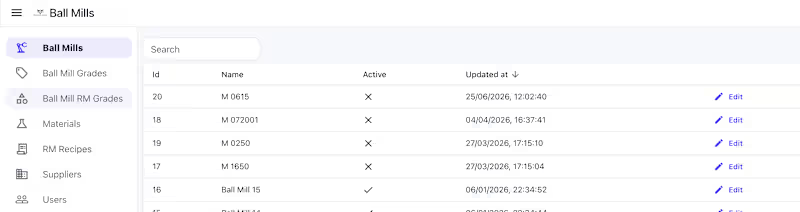
I designed and built the Pristine Admin console, the back-office application that controls all master data behind a manufacturing plant's production system. The challenge was that master data in a factory setting is unforgiving. A mistyped grade name or a deleted material silently breaks months of historical production records, so the panel had to make the right action easy and the destructive action impossible. I built it as a deliberately constrained interface: records can be deactivated but never deleted, every write is validated on both sides, and access is restricted to admin roles at the authentication layer rather than just hidden in the UI. The console manages seven resources across the plant: ball mills, ball mill grades, raw material grades, materials, suppliers, users, and raw material recipes. The recipe builder was the most interesting piece. Each raw material grade needs a formula defining how many kilograms of each material go into one batch, so I built a nested form that pulls live material options, enforces a single recipe per grade by filtering out grades already configured, and validates quantities inline. Because the backend keys recipes by grade rather than by their own ID, I mapped the resource identity in the data layer so the standard list, create, and edit flows work transparently over a non-standard endpoint shape. Most of the engineering went into the data provider. The existing API returns enveloped responses and full collections rather than paginated ones, so instead of reshaping a working production API I wrote a provider that adapts to it: a client-side query engine handling full-text search, boolean filtering, multi-field sorting, and pagination, plus a per-resource field allowlist that strips any key the backend validators would reject before a request goes out. Delete operations throw by design, pointing the user to deactivation instead. Authentication runs through the same JWT service as the operator app, but the console rejects any account without an admin role at login and re-verifies that on every route change, clearing the session automatically on a 401 or 403. I finished it with a custom MUI theme and layout: an indigo and teal palette, a gradient-washed background, softened surfaces and radii, and a collapsible sidebar reworked to show clean centered icons rather than clipped labels when narrowed. Tech Stack: React 19, TypeScript, React-Admin 5, MUI 7, Tailwind CSS v4, Vite, Vercel.
0
38
Cover image for I worked as a Software
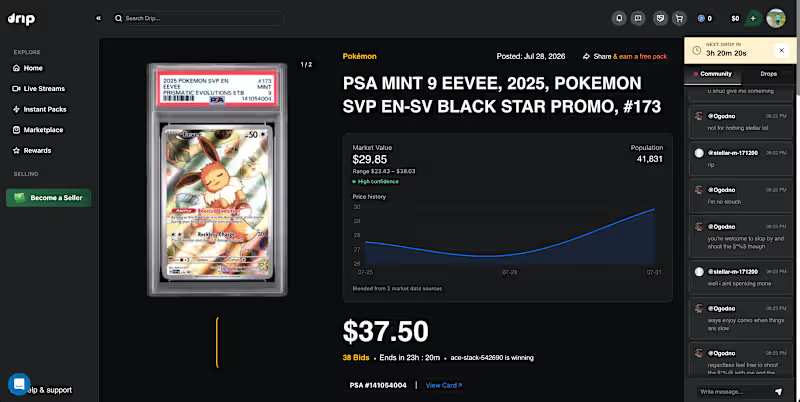
I worked as a Software Engineer on DripShop, a large-scale live-streaming e-commerce platform that enables creators and businesses to sell products through interactive live video experiences. My work focused on building production-ready features that supported high-traffic user journeys while maintaining performance, reliability, and a seamless shopping experience. The platform combines live video, real-time user interactions, payments, inventory management, and order processing into a single experience. My responsibility was to translate complex product requirements into scalable, maintainable frontend and full-stack solutions, collaborating closely with designers, backend engineers, product managers, and QA throughout the development lifecycle. I contributed to the development of customer-facing experiences across the platform, building reusable React and Next.js components, integrating backend APIs, implementing responsive interfaces, and improving application performance. Alongside feature development, I resolved production issues, optimized existing workflows, and helped ensure new releases met high standards for usability and reliability. Working on a product used by thousands of shoppers required careful attention to performance, state management, and code quality. I participated in code reviews, collaborated on architectural decisions, and followed modern engineering practices to keep the application scalable and maintainable as new features were introduced. This project strengthened my experience building production-scale web applications, working within a large collaborative engineering team, and delivering features that directly impacted real users and business outcomes. Tech Stack: React, Next.js, TypeScript, Node.js, GraphQL, REST APIs, Tailwind CSS, Git, GitHub Actions, Vercel, Agile Development.
0
53
Cover image for I designed and built Pristine's
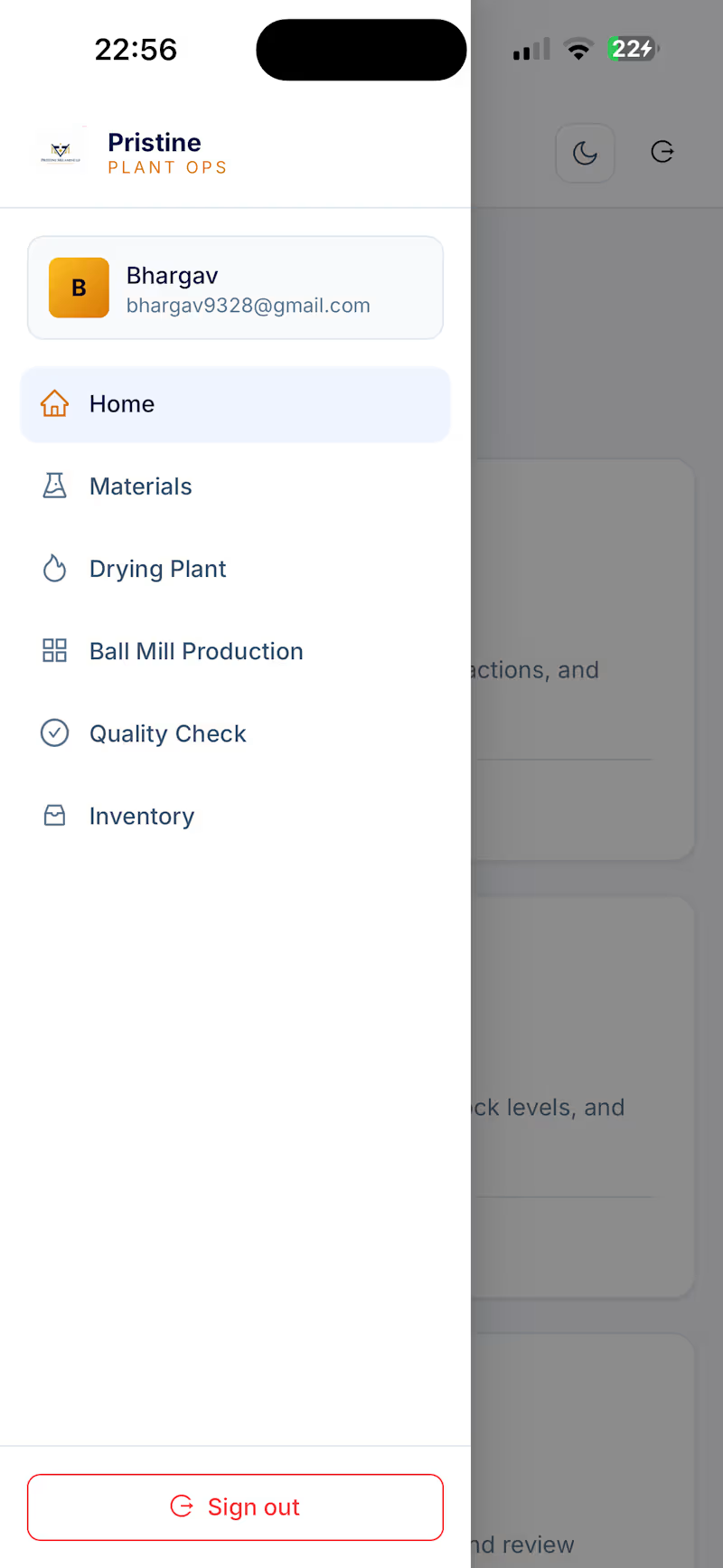
I designed and built Pristine's entire digital operations platform, from database architecture and role-based workflows to a production-deployed web suite and an AI analytics layer. The challenge was replacing a ceramic processing plant's paper-and-spreadsheet production logs with a system that floor operators would actually use, while giving management the traceability and insight the paper trail never could. Every decision focused on data integrity, least-privilege security, and keeping the interface simple enough for shift operators to work quickly. I built four services around a single PostgreSQL schema. The operator app handles the full production lifecycle: raw material intake, drying plant shifts, multi-section ball mill batch entry, quality control, and finished-goods inventory, with Excel export throughout and navigation that adapts to each of eight distinct plant roles. A modular Express and Prisma API enforces that access control at the route level. A separate React-Admin console keeps master data (mills, grades, recipes, suppliers, users) out of the operator's way. The most important piece was traceability. I designed a quality control gate that sits between production output and inventory. QC records are created automatically when a batch completes, reviewed by an inspector, and only generate an inventory entry if quality passes. Every finished bag carries an auto-derived lot number encoding its production date, flow rate, monthly sequence, and bag count, so any outbound shipment can be traced back through inventory and QC to the exact mill batch that produced it. On top of that I built an AI analytics agent that lets managers query the plant in plain English, architected around a zero-data-to-LLM guarantee. The model only ever sees the database schema and the question, never a row of production data. Five independent layers enforce it: two least-privilege Postgres roles separating read-only queries from insert-only auditing, a sqlglot AST guard that rejects any non-SELECT statement, a per-role table allowlist, the prompt design itself, and a full audit log of every interaction. Answers stream to the browser over Server-Sent Events through a LangGraph pipeline that routes, guards, plans the query, executes, then explains the result in business terms. Tech Stack: React 19, TypeScript, Ant Design, TanStack Query, Tailwind CSS v4, Node.js, Express, Prisma, PostgreSQL, React-Admin, MUI, Python 3.12, FastAPI, LangGraph, OpenAI, AWS EC2, Nginx, Supabase, Vercel.
1
93
Senior Design Partner for scale-ups · AI design workflows ·