Freelancers using Angular in ChicagoFreelancers using Angular in Chicago

Results that are similar to your search

Similar results

Full-Stack Dev | AI Automation Architect | Startup Growth 🚀

$100k+
Earned
15x
Hired
5.0
Rating
267
Followers
Full-Stack Dev | AI Automation Architect | Startup Growth 🚀

30+ Apps Shipped | Flutter, Angular & ASP.NET

$100k+
Earned
7x
Hired
5.0
Rating
57
Followers
30+ Apps Shipped | Flutter, Angular & ASP.NET

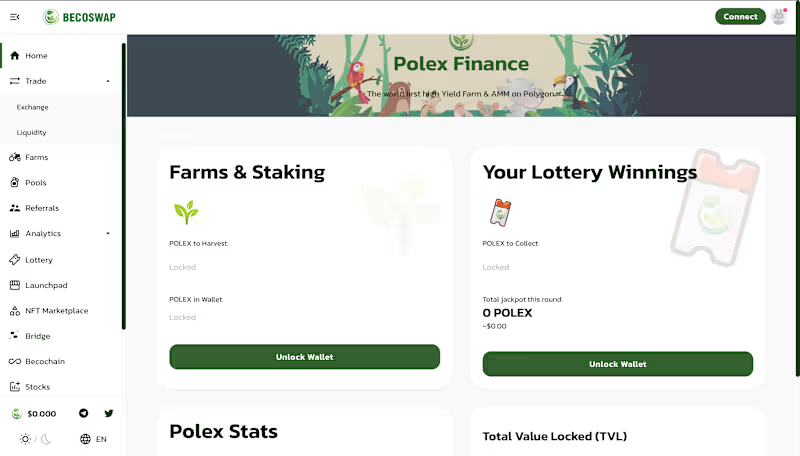
Cover image for 📌 Case Study: PolySwap (PoliexSwap)
📌 Case Study: PolySwap (PoliexSwap) — Decentralized AMM & Yield Farming on Polygon Category: DeFi · Decentralized Exchange · Web3 Platform: Web (Polygon Network) Project Type: Automated Market Maker (AMM) & Yield Farming Protocol Live: polyswap.netlify.app (http://polyswap.netlify.app) Project Overview PolySwap (https://polyswap.netlify.app) — built as PoliexSwap — is a decentralized exchange and high-yield farming protocol deployed on the Polygon network. It gives users the ability to swap tokens, provide liquidity, and earn yield on their assets directly from a non-custodial Web3 interface, without intermediaries and without leaving their wallets. Built by Cuboid, it sits in the same product category as PancakeSwap on BSC — but positioned specifically for Polygon's faster, lower-cost infrastructure. The Problem Ethereum's gas fees made DeFi participation prohibitively expensive for smaller investors. Binance Smart Chain addressed the cost problem but introduced centralization trade-offs many users weren't comfortable with. Polygon emerged as a legitimate Layer 2 alternative — fast, cheap, and EVM-compatible — but lacked a native, fully-featured AMM and yield farming platform at the time. The opportunity was clear: a first-mover DEX on Polygon that combined token swapping, liquidity provision, and high-yield farming in a single, clean interface built for the Polygon-native user. Our Solution Cuboid designed and developed the full PolySwap platform — smart contract integration, liquidity pool architecture, yield farming interface, and wallet connectivity — on Polygon's EVM-compatible chain. The interface was modeled on the established DEX UX patterns users already knew from Uniswap and PancakeSwap, lowering the barrier to entry while delivering Polygon's speed and cost advantages underneath. The platform was built to be genuinely non-custodial throughout — users connect their own wallets, execute swaps and deposits directly on-chain, and retain full control of their assets at every step. Key Features & Capabilities Token Swapping (AMM) — An automated market maker enabling direct token-to-token swaps on Polygon without order books, central servers, or custodial risk. Pricing is determined algorithmically by liquidity pool ratios, ensuring continuous liquidity at all times. Liquidity Provision — Users deposit token pairs into liquidity pools and earn a share of all swap fees generated by that pool — passive yield tied directly to platform trading volume rather than speculative token price. High-Yield Farming — Liquidity providers receive LP tokens representing their pool share, which can be staked in farming contracts to earn additional protocol rewards on top of swap fees. The dual-layer yield model — fees plus farming rewards — was positioned as the platform's primary value proposition for capital deployment on Polygon. Non-Custodial & Permissionless — No sign-up, no KYC, no custody. Users connect a compatible Web3 wallet and interact with smart contracts directly. Any Polygon-compatible token pair can be added as a liquidity pool without platform approval. Polygon-Native Performance — Transactions settle in seconds at a fraction of Ethereum mainnet gas costs, making frequent farming interactions and compounding strategies economically viable for users of any portfolio size. Why Polygon The decision to build on Polygon rather than Ethereum mainnet or BSC was deliberate. Polygon's EVM compatibility meant existing Ethereum tooling, wallets, and token standards worked without modification. Its transaction costs and speed made high-frequency DeFi interactions — swaps, deposits, harvest cycles — practical for retail users, not just whales. Positioning PolySwap as the first high-yield AMM on Polygon was a first-mover bet on a network that has since grown into one of the most active EVM chains in DeFi. Final Outcome PolySwap demonstrates Cuboid's capability across the full DeFi product stack — AMM smart contract integration, liquidity pool architecture, yield farming mechanics, and a consumer-grade Web3 interface built for a specific chain's competitive advantage. It's a project that required both technical precision and an understanding of how DeFi users think about capital, risk, and yield.
0
407
Crafting digital products from scratch @Afillix
$50k+
Earned
9x
Hired
5.0
Rating
32
Followers
Crafting digital products from scratch @Afillix
Web App developer building modern apps and SaaS solutions

5.0
Rating
2
Followers
Web App developer building modern apps and SaaS solutions
Hi, I'm Muhammad Abaidullah, a Full Stack Software Engineer.
New to Contra
Hi, I'm Muhammad Abaidullah, a Full Stack Software Engineer.
Cover image for | Enterprise School Management &
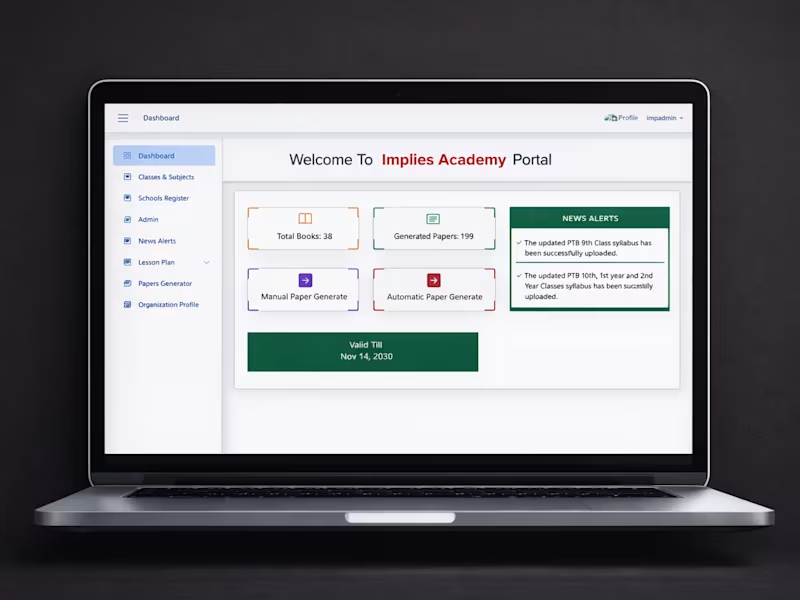
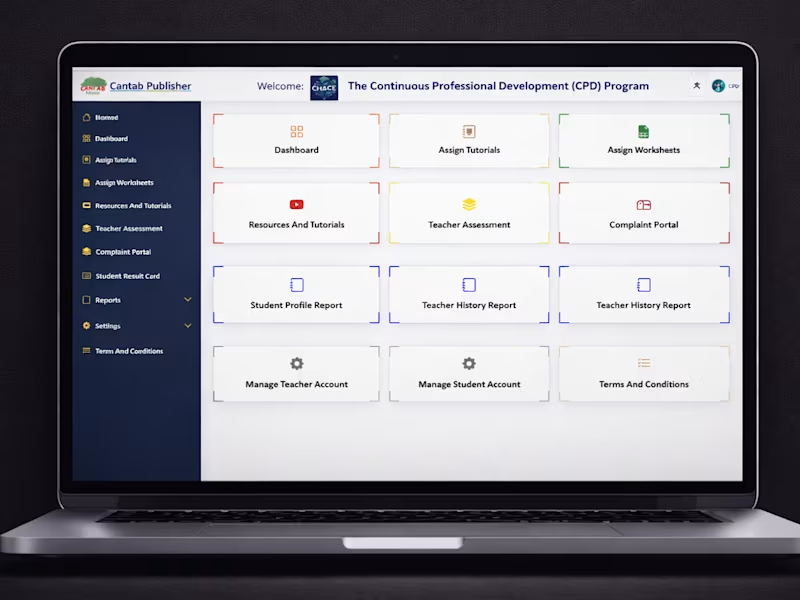
| Enterprise School Management & Digital Assessment System | Developed and enhanced an enterprise-grade, scalable School Management System designed to streamline academic operations, digital assessments, and institutional reporting. The system was built using Angular (TypeScript) for the frontend, .NET for backend APIs, and MySQL as the database. Key Features: Role-Based Multi-User System Principal dashboard for institutional insights, reports, and monitoring Teacher portal for generating tutorials, worksheets, and assessments Student portal for attempting quizzes, submitting responses, and tracking progress Digital Assessment & Content Management Tutorial and worksheet assignment to specific classes and sections Teacher-driven paper/quiz generation and class-level distribution Student submission workflows with evaluation tracking Advanced Reporting & Analytics Student Profile Reports and Master Reports with filtering (class, subject, date range) Teacher and Student activity history tracking Performance insights including assigned, completed, and pending work Export functionality (PDF/Excel) for institutional reporting Teacher Evaluation System Configurable assessment forms for teacher performance monitoring Structured evaluation criteria with result tracking Complaint & Feedback Management Built-in complaint portal with categorized tracking (received, satisfied, unsatisfied) Transparency in issue resolution workflows Administrative Controls Student migration between classes/sections Section and session management Teacher account and class assignment management School profile configuration and institutional settings Learning Resources Module Centralized access to tutorials and educational content for different classes Scalability & System Enhancement Refactored and optimized existing architecture for better scalability Improved performance and modularization of features Enhanced user experience across dashboards and workflows
0
22
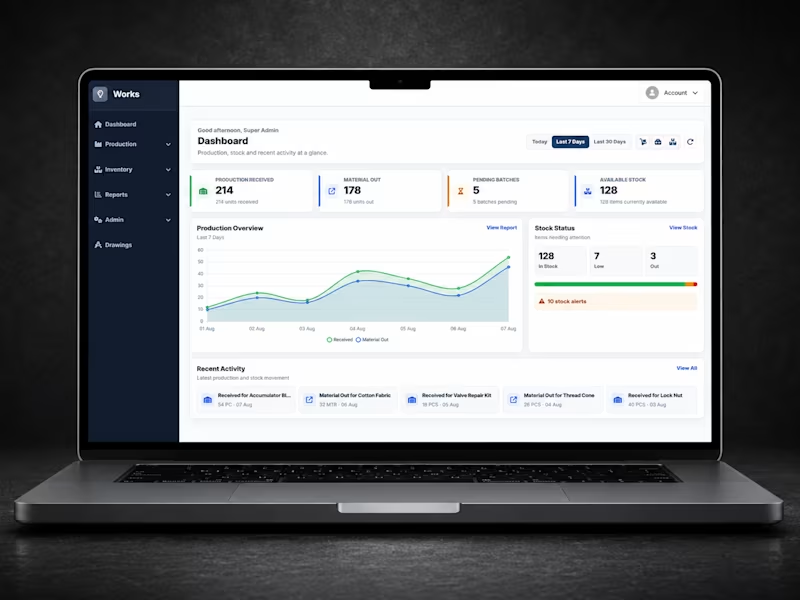
Cover image for I developed Works ERP, a
I developed Works ERP, a complete web-based workshop management system designed to streamline inventory control, production tracking, stock movement, reporting, and administrative operations for a manufacturing/workshop environment. The system includes a full Production Module where users can issue raw materials for finished products or parts, receive production against issued batches, manage material returns, review production losses, and configure product/parts recipes. It helps maintain accurate production quantities, pending batches, received quantities, shortages, and material usage. I also implemented Reports & Stock Balance Modules including stock ledger, production summary, raw material stock balance, product stock balance, machine spare parts stock balance, and parts stock balance. These modules allow users to track item-wise stock movement, current balances, production history, quantities, prices, and total stock value with filters and searchable reports. The Admin Operations Module includes user management, permission controls, login audits, and login session tracking. It provides role-based access control, user activity monitoring, and secure permission handling for different application features. Additionally, the system includes a Drawing Module for assigning and managing drawing numbers, die numbers, revision history, and references for finished products and parts. This project was built to improve workflow accuracy, reduce manual inventory errors, provide real-time production visibility, and give management better control over workshop operations through a clean and professional web interface.
0
41
Delivering Web & Mobile Solutions with Passion