Atlassian EZMake — the automation company automating by hand

Catherine Hicks

In 2022 I led the UX for EZMake — the MVP of Atlassian's internal Intelligent Automation Platform. The framing that made it land was the irony of it: the company whose products help the rest of the world move fast was, internally, still losing hours to the manual work no single tool solved. My job wasn't to polish a feature. It was to answer a harder, earlier question — what should this thing even be?
One honest note up front, because it shapes the whole story: this was a concept-and-discovery engagement. The numbers below are the baseline I designed against, not outcomes I produced.
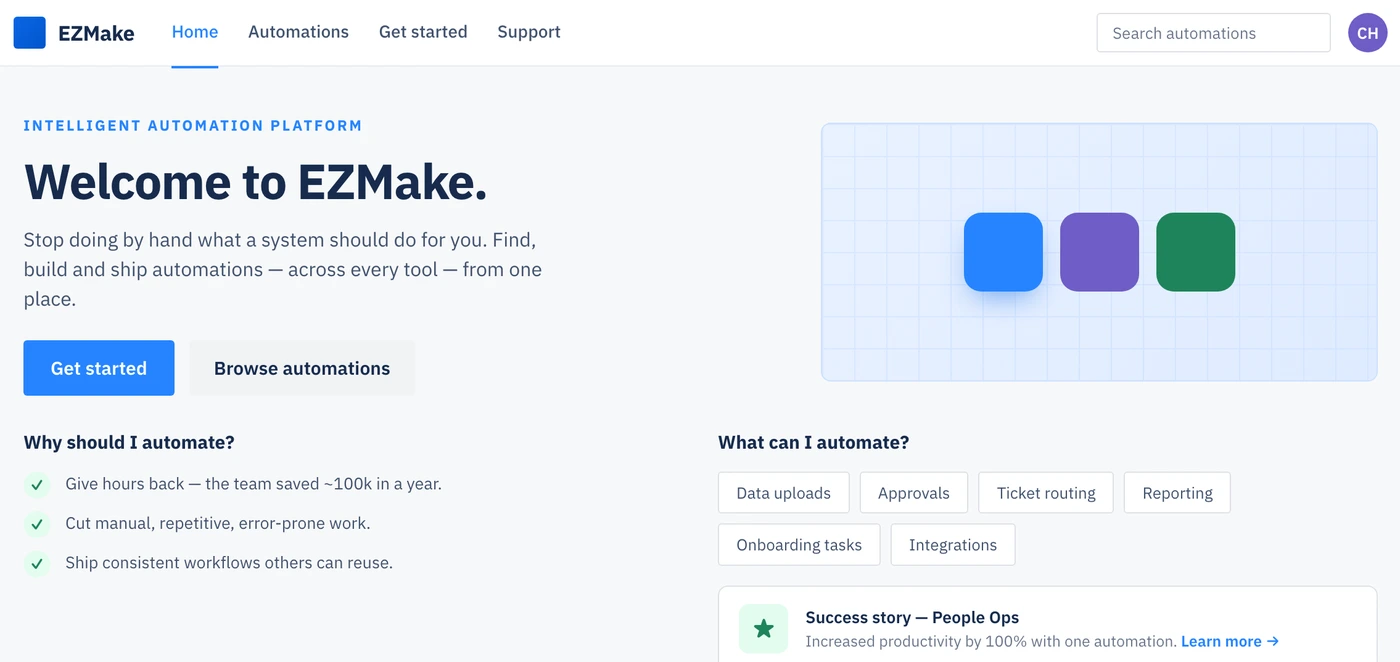
The EZMake landing, built to read like a product page, not a wiki: "Stop doing by hand what a system should do for you." Find, build, and ship automations — across every tool — from one place.
The stakes were company-scale
A push toward $10B and 25,000 people by FY26 had made internal productivity a CXO priority, and the automation team had already proven the thesis — roughly 100,000 hours saved in FY22. The mandate for the next chapter was a shift in kind: stop being a group that builds automations for people, and become a platform other people build on themselves. A service team scales linearly; a platform scales with its users — but only if people can actually get onto it.
The problem was fragmentation, and the data was brutal
To cover the real range of needs, the team owned a portfolio of tools — Workato, Camunda, UiPath, an internal NLP platform, Opus, a deprecating Mulesoft. Each was a fine answer to a specific problem; collectively they were a maze, where shipping one automation could mean passing through ten or more separate tools. The adoption data was the cost of that maze: about 110 active users (under 1% of the workforce), a 122-day average ramp from first login to first working automation, a 70% drop-off after login, and 69% of the users who stuck being engineers or admins in IT. The people the platform most wanted to reach — non-technical builders in Finance, People Ops, Marketing — were exactly the ones bouncing off it.
I started with who, not what
Before sketching a screen, I went to the ground truth: about twenty existing customer interviews, which I used to map who these users actually were rather than treat the org as one undifferentiated blob. Three archetypes fell out — Consumers, who use automations but won't build them; Builders, the hands-on creators; and Champions, who evangelize and support everyone else. The Builders split again by aptitude: citizen developers, app admins, engineers. That segmentation produced the insight the design turned on: the friction wasn't evenly distributed. Engineers ramped fast and worked independently, so the 122-day average was really a story about everyone else. I made myself the advocate for the citizen developer — because if the platform only worked for the engineers who were already the loudest, most-served voice, it had already failed its reason for existing.
The bet: one journey on top of the sprawl
The strategic move was a thin-slice MVP journey — one coherent experience, EZMake, tying all four stages (Discover, Onboard, First Touch, Build & Operate) together as an abstraction layer sitting on top of the tool portfolio, not an eleventh tool added to it. The point was never to replace Workato or UiPath; it was to give a person one honest path through them. Concretely, four moves: a decision framework to point someone at the right tool, discoverable starter templates so nobody stared at a blank canvas, a semi-automated ship-with-confidence checklist so people could publish without fear, and feedback channels so the team could keep learning.
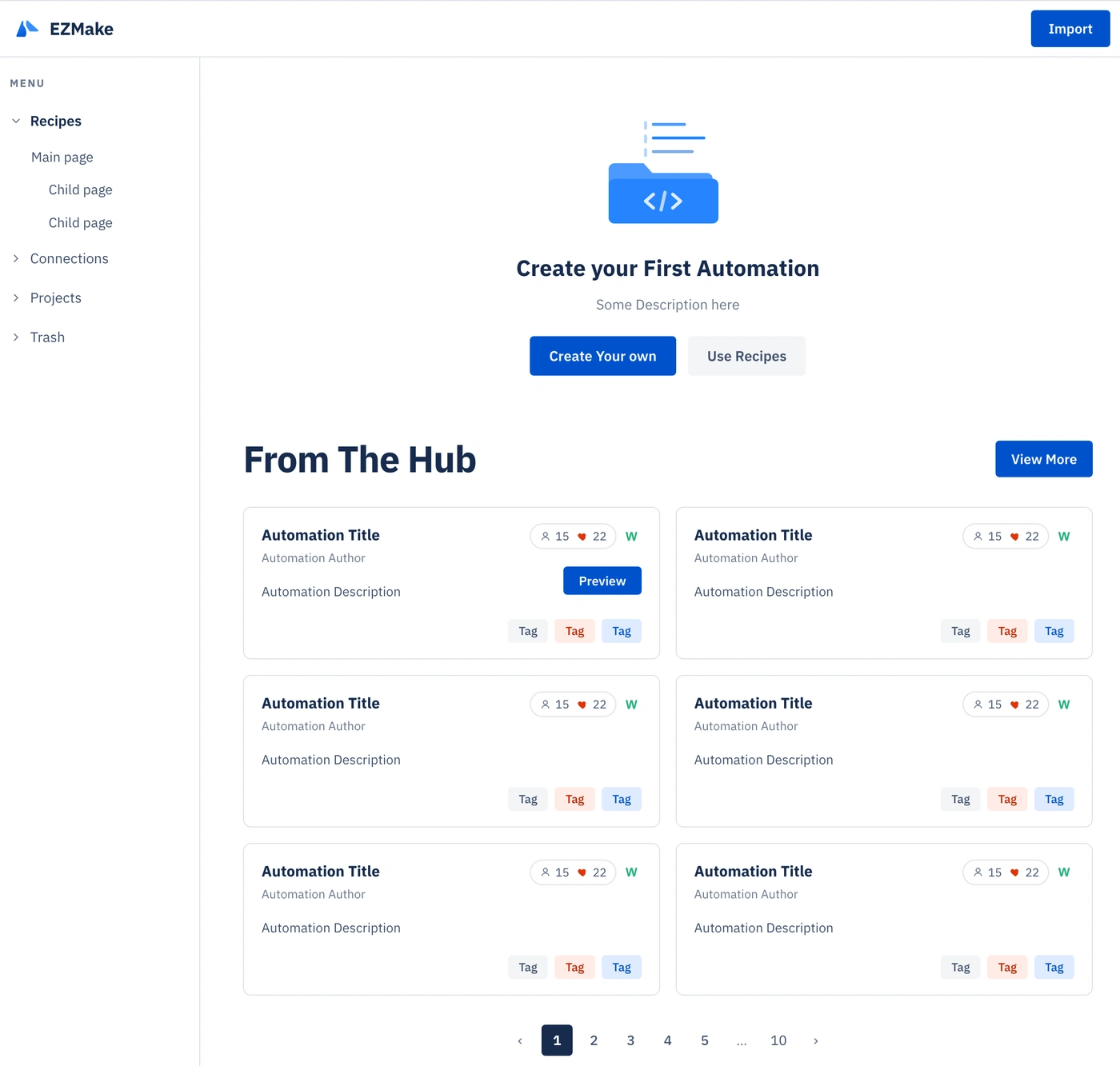
The First-Use hub, where discoverability was the whole bet: a browsable library of automations — never a blank canvas — with recipes, connections, and projects one click away.
Made tangible — and aimed at the drop-off
I built it as real Figma comps a stakeholder could click. The onboarding screen was the sharpest example: persona-driven, and built as a standalone page rather than a modal, so a citizen developer and an engineer answer different first questions. It was aimed squarely at the 70% post-login drop-off — and the team picked it up to build the next sprint.
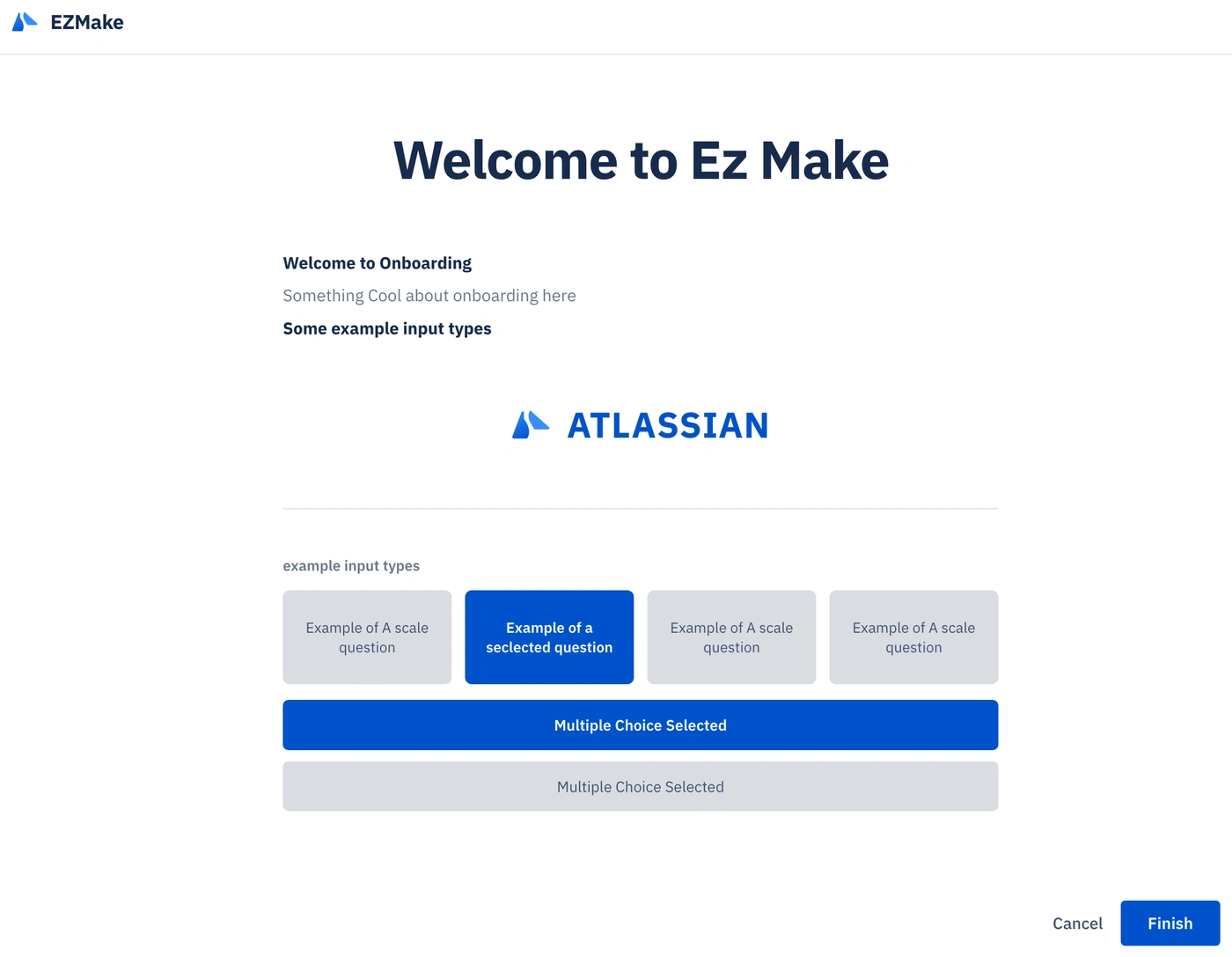
Persona-driven onboarding, built as a page rather than a modal so different builders start with different questions — the piece aimed directly at the 70% post-login drop-off.
The hard part wasn't visual design — it was ambiguity
No existing product to react to, no set scope, and a user base as broad as the whole organization, which is really no single user at all. Automation platforms carry an inherent tension too: powerful enough for an engineer to adopt, simple enough that a citizen developer doesn't need to be one. My way through was to stay ruthless about grounding decisions in existing behavior, and to keep engineering and product in the loop early so the concept never floated off from what could be built.
Where it landed
Over roughly three months I took EZMake from an aspiration to a substantiated concept — a problem quantified against real data, archetypes that told us whose friction we were solving, a scope defined with three squads, and prototypes that made it testable, including a redesigned hub and a persona-driven onboarding flow built to attack the drop-off. I'll hold the line on honesty: the 122-day ramp and 70% drop-off are the baseline; the 50% reductions and 1,000-builder figure are the platform's targets, not measured outcomes.
The lesson that stuck is about the leverage of the earliest phase: when there's no product yet, design isn't downstream of strategy — it is strategy, made concrete.
See the full case study → https://design-case-studies.vercel.app/atlassian
Like this project
Posted Aug 3, 2026
The company that sells automation was automating by hand. I led UX for EZMake — the MVP of Atlassian's internal automation platform — turning a fragmented six-tool maze into one journey, and answering the harder question first: what should this thing even be?