Freelancers using Clearscope
Sign Up
Post a job
Sign Up
Log In
Filters
1
Projects
People
Tupe Tam Yan
pro
Sydney NSW 2000, Australia
Nonfiction Script Ghost-Writer, Strategic Thought Leadership
New to Contra
Follow
Message
Nonfiction Script Ghost-Writer, Strategic Thought Leadership
0
B2B SaaS companies are burning millions on traffic and lead gen, only to watch their conversion rates flatline. The product is solid, the market is there, but the buyers simply aren't moving. In 2026, a "Contact Us" button is a barrier, not a bridge. If your content ecosystem isn't actively supporting the buyer’s decision-making process—answering the ROI questions and satisfying the AI search models—your product is effectively invisible to the "Curious to Conviction" pipeline. SOLUTION: Content isn't a marketing accessory; it’s the infrastructure of the sale. I’ve architected this breakdown on why SaaS buyers stall and how to build a high-clarity, AI-aligned content engine that moves the needle from curiosity to conversion. Read the full Strategic Analysis: https://bit.ly/B2BSaasBuyer
0
75
1
Seller‑Side Due Diligence: What a Good Accountant Must Do Before a Business Sale in Australia Selling a business in Australia is one of the most significant financial events a small‑to‑medium business owner will ever experience. It’s not just a transaction — it’s the culmination of years (sometimes decades) of work, risk, sacrifice, and personal investment. As an accountant acting for the seller, my role is to ensure the business is presented with clarity, accuracy, and defensible financial logic. That means preparing the business for scrutiny before the buyer even begins theirs. This process is known as seller‑side due diligence, and when done properly, it protects the seller, strengthens valuation, reduces negotiation friction, and increases the likelihood of a clean, successful sale. With 15 years in Australian tax, business services, and forensic accounting, I’ve learned that seller‑side due diligence is not just about numbers — it’s about narrative, transparency, and anticipating the questions a sophisticated buyer (or their accountant) will ask. Below is the framework I use when preparing a business for sale. 1. Understanding the Entity Structure — The Foundation of Everything Before touching a spreadsheet, I need to understand how the business is structured, because the entity type determines: how goodwill is treated whether CGT concessions apply how assets are transferred what liabilities follow the sale whether the owner’s personal assets are exposed how the sale price is allocated In Australia, small businesses are commonly structured as: Sole traders Partnerships Discretionary or unit trusts Pty Ltd companies Each structure has different tax consequences. For example, a sole trader selling a business they’ve operated for over 15 years may be eligible for the Small Business 15‑Year CGT Exemption, which can eliminate capital gains tax entirely if conditions are met. A company, however, may need to consider the 50% active asset reduction, retirement exemption, or rollover provisions instead. Understanding the structure early allows me to shape the sale strategy, the valuation narrative, and the tax planning opportunities available. 2. Preparing the Financial Core — The Documents No Buyer Will Proceed Without A buyer’s accountant will always ask for the same foundational documents. If the seller cannot provide them quickly and cleanly, confidence drops and valuation suffers. The essential documents include: Profit & Loss Statements (3–4 years minimum) Balance Sheets for the same period Tax Returns (entity and individual, where relevant) BAS statements General ledger extracts Depreciation schedules Asset registers Loan agreements and finance schedules Employee entitlement summaries Superannuation compliance records Tax returns are particularly important because they show actual tax depreciation, not just accounting depreciation. Buyers look for consistency between accounting profit and taxable income — discrepancies must be explained. If the financials are unaudited, I perform a forensic-style review to ensure accuracy, identify anomalies, and prepare explanations before the buyer asks. 3. Normalising Earnings — The Heart of Valuation Most small businesses have discretionary expenses, owner wages, or one‑off costs that distort true profitability. As the seller’s accountant, I prepare a normalised earnings statement that adjusts for: owner’s salary (if above or below market) personal expenses run through the business one‑off legal or repair costs non‑recurring revenue related‑party transactions abnormal stock adjustments private vehicle or travel expenses This is where forensic accounting skills matter. Buyers want to see sustainable, repeatable earnings, not inflated numbers. My job is to present a fair, defensible picture that supports the seller’s valuation without crossing into exaggeration. 4. Trend Analysis — Showing the Story Behind the Numbers A single year’s profit means nothing without context. I analyse: revenue growth or decline margin stability customer concentration seasonality cost trends cashflow patterns debtor and creditor movements A business with stable margins and predictable cashflow commands a higher valuation. A business with volatile revenue needs explanation. Trend analysis also helps identify risks before the buyer does. If revenue dipped in one year, I prepare the explanation upfront — new competitor, owner illness, supply chain issue, etc. Transparency builds trust. 5. Reviewing Contracts, Leases, and Operational Dependencies Financials tell one story; contracts tell another. I review: customer contracts (especially if one client represents >20% of revenue) supplier agreements equipment leases property leases insurance policies licences and permits intellectual property documentation Buyers want to know: what obligations they’re inheriting whether key relationships are secure whether the business can operate without the current owner If the business relies heavily on the owner’s personal relationships, I highlight this early and help the seller prepare a transition plan. 6. Employee Entitlements and ATO Compliance Employee liabilities are a major due‑diligence focus. I verify: annual leave long service leave superannuation payments payroll tax workers compensation award compliance Superannuation compliance is critical. Any unpaid super is a red flag that can derail a sale. I also check for ATO payment plans, outstanding BAS, or historical issues. Buyers will find them — better that I prepare the explanation first. 7. Valuation Scenarios — Presenting a Range, Not a Guess A good accountant never presents a single valuation number. Instead, I prepare valuation scenarios, such as: valuation based on normalised EBITDA valuation based on net tangible assets valuation based on discounted future cashflow valuation after applying CGT concessions valuation after adjusting for working capital This gives the seller a realistic range and prepares them for negotiation. 8. Capital Gains Tax Planning — The 15‑Year Concession and Other Small Business Reliefs For many small business owners, CGT is the biggest financial event of their life. Australia’s Small Business CGT Concessions can dramatically reduce or eliminate tax on the sale. Key concessions include: 15‑Year Exemption — if the business has been owned for 15+ years and the owner is over 55 and retiring, the entire capital gain may be tax‑free. 50% Active Asset Reduction — reduces the capital gain by half. Retirement Exemption — up to $500,000 can be contributed to super tax‑free. Small Business Rollover — defers CGT if proceeds are reinvested in another active asset. My role is to determine eligibility early, model the tax outcomes, and structure the sale to maximise concessions. 9. Preparing the Business Overview — The Document Buyers Actually Read Once the financial and operational due diligence is complete, I prepare a business overview that includes: business history revenue breakdown customer profile operational structure financial highlights normalised earnings valuation summary risk factors transition plan This is the document the buyer reads before deciding whether to proceed to formal due diligence. A clear, honest overview builds trust and positions the seller as organised and credible. 10. Anticipating Buyer Questions — The Forensic Mindset Finally, I prepare the seller for the questions buyers will ask, such as: Why are you selling? What would happen if you stepped away tomorrow? Are there any disputes, liabilities, or compliance issues? How dependent is the business on key staff or customers? What risks should we be aware of? A seller who answers confidently and transparently is far more likely to secure a strong offer. Closing Thoughts Seller‑side due diligence is not about making the business look perfect — it’s about presenting it honestly, clearly, and professionally. When the financials are clean, the narrative is coherent, and the risks are acknowledged upfront, buyers feel safer, negotiations run smoother, and valuations hold firm. As an accountant with experience in business sales, forensic analysis, and Australian tax law, my goal is simple: protect the seller, strengthen their position, and ensure the business is presented with the clarity it deserves. __________________________________________________________________ Written by Victor Tyan MIntBus, BComm
1
123
1
Strategic Intelligence in the AI Era: How Modern Leaders Turn Data Into Decisions By Victor — Thought Leadership & Strategic Intelligence Writer In the last decade, artificial intelligence has moved from a futuristic concept to a practical, everyday tool embedded in the workflows of thousands of businesses. But while most organisations now understand the value of automation, predictive analytics, and machine learning, a new frontier is emerging — one that goes beyond data processing and into the realm of strategic clarity. This frontier is AI‑driven decision intelligence, a discipline that blends data science, behavioural psychology, and business strategy to help leaders make faster, smarter, and more consistent decisions. For founders, executives, and operational teams navigating increasingly complex markets, decision intelligence is becoming a defining competitive advantage. Why Decision‑Making Is the Last Untouched Bottleneck Most companies have already optimised their operations. They’ve automated repetitive tasks, digitised workflows, and adopted cloud‑based tools. Yet despite all this progress, one area remains stubbornly human, slow, and inconsistent: decision‑making. Leaders still rely on: gut instinct incomplete data siloed information biased interpretations outdated reporting cycles This creates bottlenecks that ripple across the entire organisation. A delayed decision can stall a product launch. A misinformed decision can derail a marketing campaign. A biased decision can distort hiring, budgeting, or resource allocation. Decision intelligence aims to solve this by giving leaders real‑time clarity, contextual insights, and predictive foresight — without replacing human judgment. What Decision Intelligence Actually Does At its core, decision intelligence uses AI to: analyse vast datasets identify patterns humans miss simulate outcomes recommend optimal actions reduce uncertainty highlight risks quantify trade‑offs But the real power lies in how it integrates with human thinking. Instead of replacing decision‑makers, it augments them. A CEO can see how different pricing strategies affect revenue. A marketing director can test campaign variations before spending a dollar. A supply‑chain manager can predict disruptions weeks in advance. A founder can model growth scenarios with remarkable accuracy. Decision intelligence becomes a strategic partner — one that never sleeps, never gets overwhelmed, and never loses track of the data. Real‑World Use Cases Across Industries Decision intelligence is already reshaping industries in ways that feel subtle but transformative. Retail AI models forecast demand, optimise inventory, and personalise customer experiences. Retailers reduce waste, increase margins, and respond faster to market shifts. Finance Banks use decision intelligence to assess risk, detect fraud, and guide investment strategies. It enhances compliance while improving customer trust. Healthcare Hospitals use predictive models to allocate staff, manage patient flow, and anticipate equipment needs. The result is better care and reduced operational strain. Professional Services Consulting firms use decision intelligence to deliver sharper insights, faster analysis, and more accurate strategic recommendations. Startups Founders use AI‑driven simulations to test business models, forecast cash flow, and refine their go‑to‑market strategies. Across all sectors, the pattern is the same: better decisions → better outcomes. The Human‑AI Partnership One of the biggest misconceptions about AI is that it removes human agency. In reality, decision intelligence strengthens it. Humans excel at: creativity empathy ethical judgment long‑term vision AI excels at: pattern recognition data processing scenario modelling probability analysis Together, they form a hybrid decision‑making model that is more accurate, more consistent, and more resilient than either could achieve alone. The Cultural Shift Behind Better Decisions One of the most overlooked aspects of decision intelligence is the cultural transformation it triggers inside an organisation. When leaders begin relying on AI‑supported insights, the entire decision‑making environment becomes more transparent, more accountable, and more data‑driven. Teams stop making choices based on hierarchy or habit, and start grounding their actions in evidence, probability, and strategic alignment. This shift reduces internal friction. Instead of debating opinions, teams evaluate scenarios. Instead of defending assumptions, they explore models. Instead of reacting to problems, they anticipate them. Decision intelligence doesn’t just improve outcomes — it improves the quality of conversations happening inside a business. It also empowers mid‑level managers and operational staff. When insights are accessible, visual, and easy to interpret, decision‑making becomes decentralised. People closest to the work can act faster, with more confidence, and with a clearer understanding of how their choices affect the broader organisation. This creates a more agile, resilient, and responsive business culture. Barriers to Adoption — and How Companies Overcome Them Despite its benefits, many organisations hesitate to adopt decision intelligence because they fear complexity, cost, or disruption. But the reality is that modern AI platforms are becoming increasingly accessible. Cloud‑based tools, no‑code interfaces, and modular analytics systems allow businesses to start small and scale gradually. The biggest barrier is not technology — it’s mindset. Companies that succeed with decision intelligence treat it as a long‑term capability, not a quick fix. They invest in training, encourage experimentation, and integrate AI insights into their existing workflows rather than forcing a complete overhaul. Over time, the organisation becomes more comfortable with data‑driven thinking, and the benefits compound. The Strategic Payoff Businesses that embrace decision intelligence early often discover unexpected advantages. They identify new revenue opportunities faster. They respond to market changes with greater precision. They reduce operational waste and improve customer satisfaction. Most importantly, they build a decision‑making framework that scales — one that grows stronger as more data flows through the system. In a competitive landscape where speed and clarity determine survival, decision intelligence becomes more than a tool. It becomes a philosophy — a way of running a business that blends human judgment with machine‑driven insight to create a smarter, more adaptive organisation. Why Businesses Should Adopt Decision Intelligence Now The companies that adopt decision intelligence early will gain: faster strategic execution reduced operational risk improved forecasting accuracy stronger competitive positioning better resource allocation higher profitability In a world where markets shift overnight, the ability to make high‑quality decisions at speed is no longer optional — it’s existential. The Future of Decision‑Making As AI continues to evolve, decision intelligence will become a standard part of every organisation’s toolkit. Leaders won’t ask, “Should we use AI for decision‑making?” They’ll ask, “How did we ever operate without it?” The future belongs to businesses that combine human intuition with machine‑driven clarity — and the transformation has already begun. Victor Tyan,MIB,BCom
1
98
1
Agentic AI: The New Operating System for Founder‑Led Businesses By Victor — AI & Business Thought Leadership Writer For years, artificial intelligence has been framed as a tool — something businesses “use” to automate tasks, streamline workflows, or analyse data. But a new paradigm is emerging, one that shifts AI from a passive assistant into an active, autonomous partner. This evolution is known as Agentic AI, and it represents one of the most significant transformations in how founders build, operate, and scale their companies. Agentic AI is not just about automation. It’s about delegation. Instead of telling software what to do, founders assign goals — and the AI figures out the steps, executes them, adapts to obstacles, and reports back with results. It’s a shift from task‑based thinking to outcome‑based thinking, and it’s reshaping the psychology of entrepreneurship. From Tools to Teammates Traditional AI tools require constant prompting. You ask, they answer. You instruct, they perform. But Agentic AI introduces a new dynamic: systems that can plan, reason, and act with a degree of autonomy. These agents can: manage communication qualify leads draft reports monitor operations analyse performance coordinate workflows escalate issues only when needed Instead of being a tool you “use,” they become a teammate you “work with.” For founders juggling product, marketing, sales, operations, and strategy, this shift is profound. It reduces cognitive load, increases execution speed, and creates space for higher‑level thinking. Why Founders Are Adopting Agentic AI First Startups and founder‑led businesses are uniquely positioned to benefit from Agentic AI because they operate in environments defined by: limited resources rapid decision cycles constant context switching unpredictable workloads high emotional and cognitive demands Agentic AI acts as a stabilising force. It absorbs operational chaos and transforms it into structured, predictable output. A founder who once spent hours responding to emails, drafting proposals, or managing follow‑ups can now delegate those tasks to an AI agent that works 24/7, never burns out, and never loses context. Real‑World Use Cases That Are Already Transforming Workflows Agentic AI is not theoretical — it’s already reshaping how modern businesses operate. 1. Lead Qualification & Client Intake AI agents can handle the first 80% of client communication, gathering details, asking clarifying questions, and preparing summaries for the founder. 2. Operational Monitoring Agents can track KPIs, flag anomalies, and generate daily or weekly performance briefs. 3. Content & Communication From drafting emails to preparing reports, agents maintain consistency and speed across all written communication. 4. Customer Support AI agents can resolve common issues, escalate complex ones, and maintain a unified tone across all channels. 5. Internal Workflow Automation Agents can coordinate tasks between tools, update systems, and ensure nothing falls through the cracks. These use cases demonstrate a simple truth: Agentic AI is not replacing founders — it’s amplifying them The Hidden Advantage: Consistency at Scale One of the most underrated benefits of Agentic AI is its ability to deliver consistent execution, regardless of workload, stress, or shifting priorities. Human teams fluctuate — energy levels change, focus drifts, and performance varies depending on the day. But agentic systems operate with the same precision at 2 p.m. as they do at 2 a.m. They don’t forget tasks, lose context, or overlook details. This reliability becomes a structural advantage for founders who need stability in the middle of chaos. Consistency also builds trust. When clients receive timely responses, accurate information, and polished communication every single time, the business feels bigger, more organised, and more professional than it actually is. For early‑stage founders, this perception can be the difference between closing a deal and losing one. Why Agentic AI Levels the Playing Field Historically, only large companies could afford the kind of operational support that Agentic AI now provides. Executive assistants, operations managers, analysts, and coordinators were luxuries reserved for well‑funded teams. But agentic systems democratise this capability. A solo founder can now operate with the efficiency of a 10‑person back‑office team, without the overhead, training, or management burden. This levelling effect is reshaping competitive dynamics. Small businesses can move faster, respond quicker, and deliver higher‑quality output than ever before. In many cases, they outperform larger competitors simply because their agentic systems allow them to execute with speed and clarity that traditional teams can’t match. The Psychological Shift: Letting Go of the Small Stuff One of the most interesting aspects of Agentic AI is the psychological adjustment founders experience. Many entrepreneurs are used to doing everything themselves. They carry the weight of the business on their shoulders, often at the expense of clarity, creativity, and long‑term thinking. Agentic AI forces a new mindset: “I don’t have to do everything — I just need to direct the system.” This shift unlocks: more strategic thinking more emotional bandwidth more creative energy more consistent execution Founders stop reacting and start orchestrating. The Future: Businesses Built on Synthetic Teams As Agentic AI matures, we’ll see businesses built not around human teams, but around hybrid teams — a blend of human leadership and synthetic execution. Founders will design workflows the way architects design buildings. They’ll assign goals, define constraints, and let the agentic system handle the rest. The companies that embrace this shift early will operate with: lower costs faster execution higher adaptability stronger decision‑making reduced operational friction Agentic AI is not just a new tool — it’s a new operating system for modern entrepreneurship.
1
87
Clearscope
(1)
Follow
Message
Noha Darwish
New Cairo City, Egypt
Expert Copywriter & Content Editor | 20+ Years of Experience
Follow
Message
Expert Copywriter & Content Editor | 20+ Years of Experience
0
SEO & Content Editing for Blog Post
0
14
0
Content Strategy & Editing for SaaS Platform
0
34
0
FinTech Web Copy
0
10
0
Real Estate Copywriting
0
13
Clearscope
(1)
Follow
Message
Deepti Jain
Delhi, India
B2B Freelance Writer for SaaS Businesses

Follow
Message
B2B Freelance Writer for SaaS Businesses

0
Top 9 SaaS value proposition examples to learn from in 2023
0
16
0
Content Scaling: 13 Advanced Techniques to Amp It Up
0
10
0
How to Use Zapier to Grow Your Business
0
11
View more →
Clearscope
(2)
Follow
Message
Fabio Smiraglia
London, UK
B2B Content Strategist | Tech, SaaS & Fintech
New to Contra
Follow
Message
B2B Content Strategist | Tech, SaaS & Fintech
0
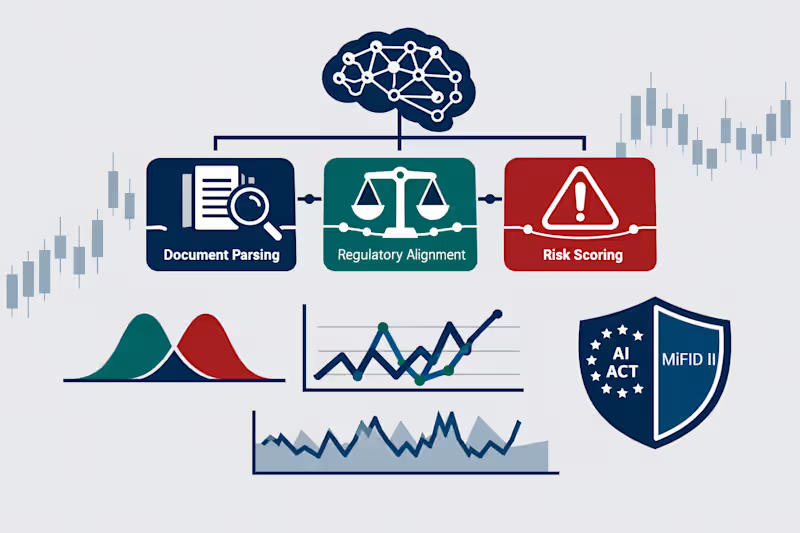
Financial institutions deploying AI-driven risk architectures needed authoritative content for internal stakeholders, regulators, and investors. I developed comprehensive case studies and thought leadership on AI-driven ESG risk frameworks, Bayesian learning for volatility prediction, multi-agent systems for MiFID II compliance, and AI-powered earnings call analysis. Produced regulatory-aligned content on EU AI Act implications and KPI-driven governance for CROs, CTOs, and Quantitative Strategists. Results: Established the client as a reference voice in AI-driven risk management. Published material adopted by risk teams as internal reference content. Accelerated stakeholder buy-in for AI implementation roadmaps.
0
31
0
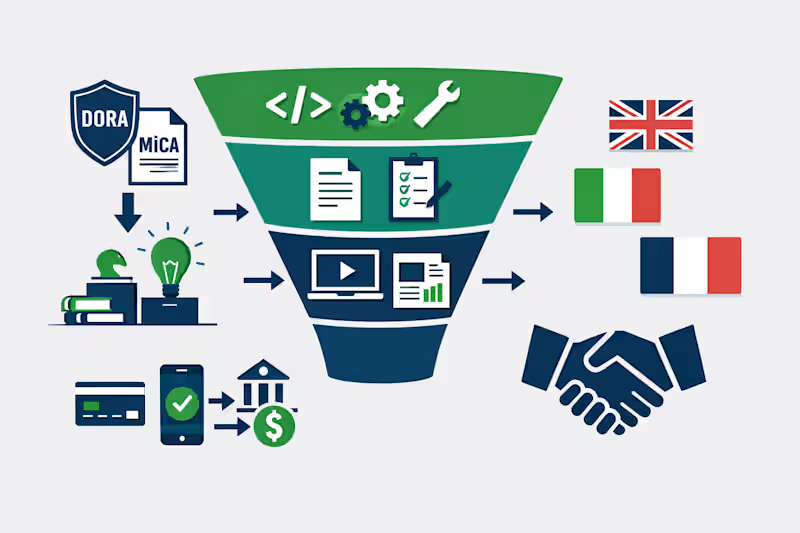
European fintech clients needed agile content strategies to build trust, translate regulatory complexity (DORA, MiCA, PSD3), and connect content with P&L outcomes. I designed KPI-driven content strategies, developed compliance-as-content frameworks turning DORA and MiCA into thought leadership assets (checklists, guides, knowledge hubs), produced full-funnel content (developer guides at ToFu, white papers at MoFu, case studies at BoFu), and integrated editorial metrics with financial reporting. Delivered in English, Italian, and French. Results: Shortened enterprise sales cycles through compliance-focused white papers. Enabled board-level validation of marketing investments. Generated enterprise leads directly from DORA/MiCA content hubs. Built multilingual content pipelines across three markets.
0
61
0
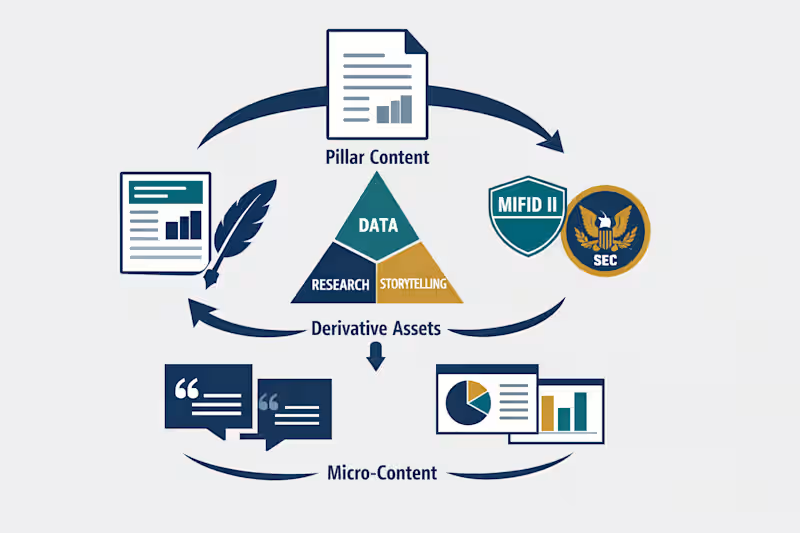
C-level financial leaders needed strategic ghostwriting to transform complex executive visions into compliant, influential content. I implemented a three-layer content architecture: Pillar Content (white papers and flagship reports, 2,000–3,000 words), Derivative Assets (executive summaries, LinkedIn posts, newsletters), and Micro-Content (quotes, datapoints, infographics). Applied the Data–Research–Storytelling framework, integrated ESG perspectives into earnings call narratives, and ensured full regulatory compliance with MiFID II and SEC guidelines. Delivered in English, Italian, and French. Results: 9–12% reduction in capital costs for clients with strengthened financial narratives. Maximised content lifecycle across multiple channels. Enhanced earnings call credibility. Built sustained executive presence on LinkedIn.
0
36
0
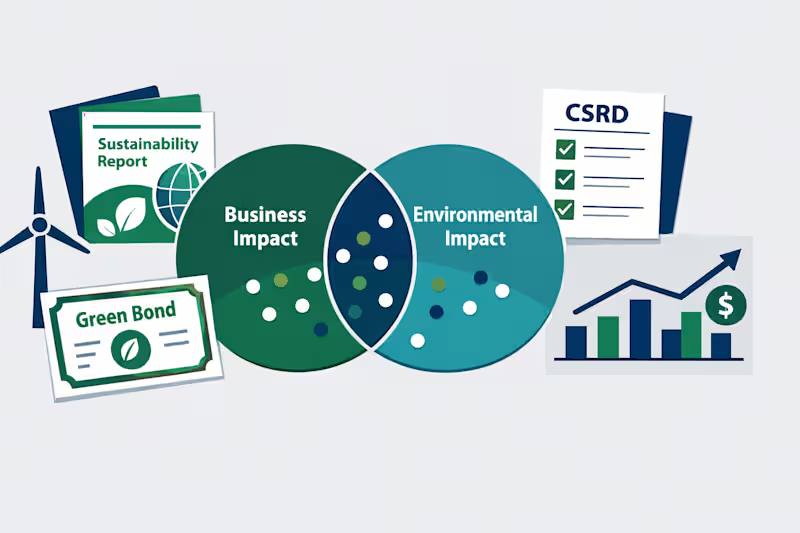
European companies facing CSRD obligations needed strategic content to communicate ESG performance to investors and regulators. I produced in-depth ESG reporting case studies and thought leadership covering CSRD/ESRS compliance, developed strategic guides for CFOs and Sustainability Officers on double materiality and digital reporting infrastructure, and created investor-facing content linking ESG KPIs to financial performance. Results: Positioned clients as recognised thought leaders in CSRD compliance. Improved investor engagement through clearer ESG disclosures. Reduced internal review cycles by standardising ESG content frameworks.
0
47
Clearscope
(1)
Follow
Message
Sheena Muirden
Johannesburg, South Africa
Quality Queen: Content Writing Professional

Follow
Message
Quality Queen: Content Writing Professional

0
What is Demurrage? Causes, How to Avoid & More
0
4
0
Bill Rate Vs Pay Rate: Key Differences
0
16
0
How to Bill a Client for the First Time: A Step-by-Step Guide
0
15
0
The 4 Best Meditation Apps: Tried, Tested, and Reviewed [2025]
0
62
Clearscope
(1)
Follow
Message
Scott Fried
New York, USA
Content and copy expert delivering measurable results.

Follow
Message
Content and copy expert delivering measurable results.

0
Best Budget Apps for Managing Your Money
0
0
0
How To Make Financial Literacy A Family Affair
0
3
0
NativeLink and App Clips
0
1
View more →
Clearscope
(1)
Follow
Message
Victor Fabusola
Ikeja, Nigeria
FinTech Content Writer in love with mental models.

Follow
Message
FinTech Content Writer in love with mental models.

0
State of Airdrops in 2024: The Best So Far and What’s Coming
0
3
0
Web3 and DeFi Articles for HackerNoon
0
2
0
The EVM and Non-EVM Conundrum Article
0
1
View more →
Clearscope
(2)
Follow
Message
Stanley Krajcir
Slovakia
Rank on the #1 Page & Maximize Conversions
Follow
Message
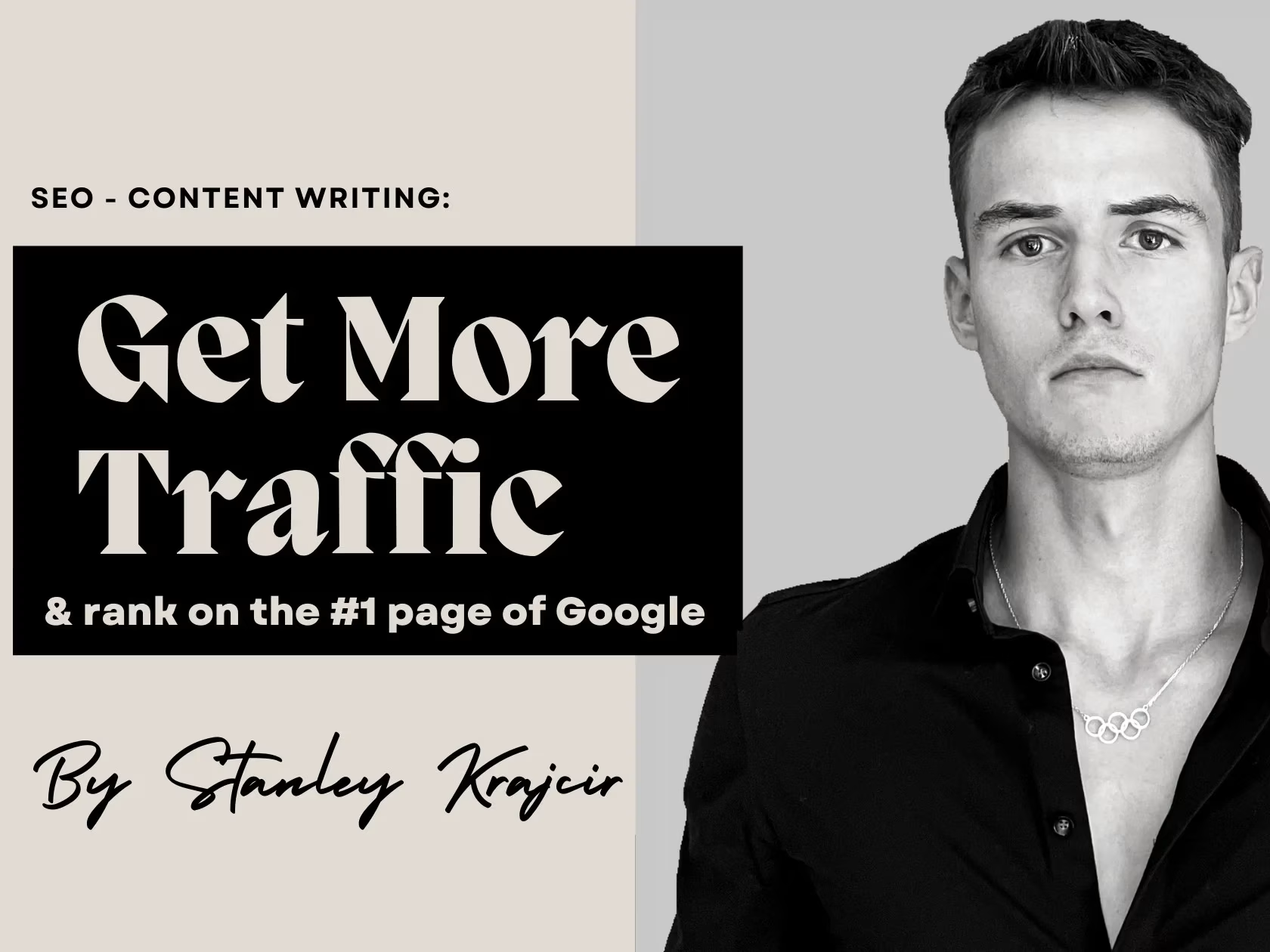
Rank on the #1 Page & Maximize Conversions
1
Scaled BiQ Cloud SEO – 50+ Posts, #1 Rankings, 3× Signups
1
11
0
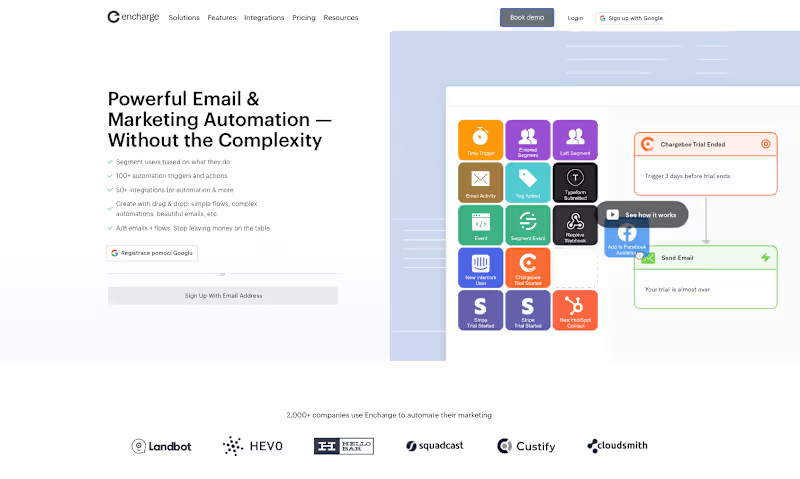
Ranked Encharge.io #1 on Google – 28K+ Traffic & 2× Signups
0
5
0
SEO & Local Strategy for Hypnotherapy Business
0
21
View more →
Clearscope
(1)
Follow
Message
Explore people