Freelance AI Developers in MaharashtraFreelance AI Developers in Maharashtra
AI Video Producer | Brand Designer
$25k+
Earned
19x
Hired
5.0
Rating
280
Followers
AI Video Producer | Brand Designer
I’m an AI & Machine Learning engineer with expertise in deve
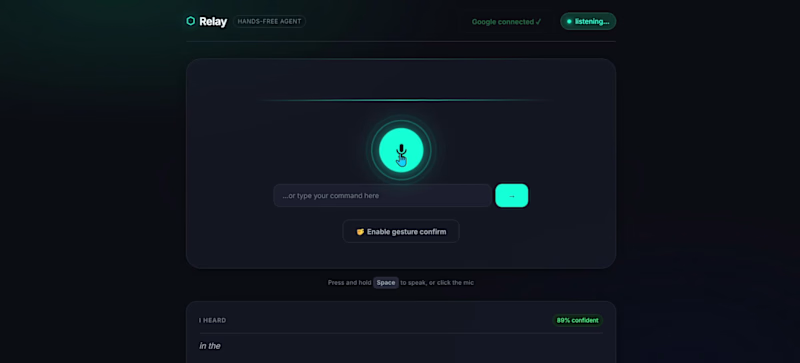
Cover image for What your attention heatmap isn't
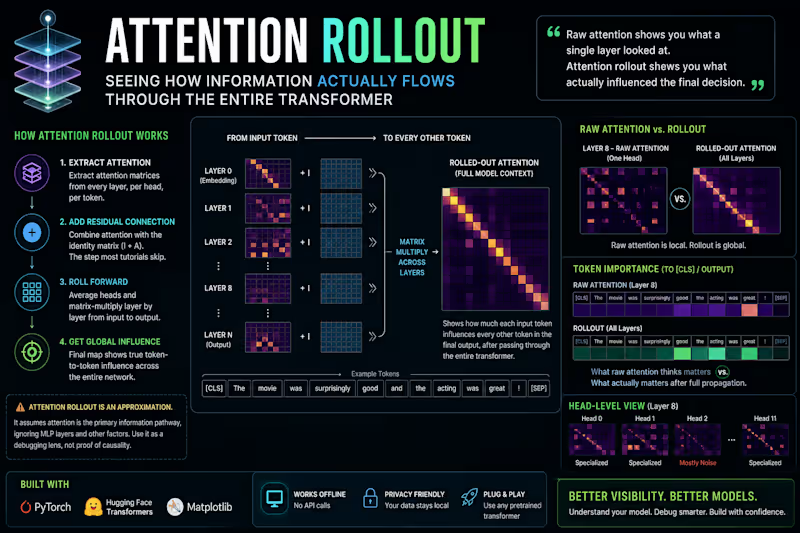
What your attention heatmap isn't telling you Everyone's staring at attention heatmaps and calling it "interpretability." Almost nobody's asking whether a single attention map actually tells you what the model used to make its decision. It doesn't. Not on its own. A raw attention map from layer 8 shows you what layer 8 attended to. It says nothing about how that signal got mixed, diluted, or overwritten by every layer before and after it. Attention rollout fixes this — and I built a walkthrough to show why it matters. Here's what makes it more than a "pretty heatmap" demo: Instead of visualizing one layer's attention, I traced how information actually flows through the full transformer stack. → Every layer's attention matrix is extracted, per head, per token → Multi-head attention is averaged, then combined with the residual connection (identity + attention) — this is the step most tutorials skip, and it's the one that actually matters → The combined matrices are matrix-multiplied layer by layer, rolling attention forward from input to output → The result: a single map showing genuine token-to-token influence across the entire network, not just one layer's snapshot The overlay shows you everything: → Per-layer attention vs. rolled-out attention, side by side → Token importance scores overlaid directly on the input text → A comparison view: which tokens raw attention says "matter" vs. which ones rollout says actually matter → Head-level breakdown so you can see which heads specialize vs. which are noise No black box. No "trust me, the model looked here." Just linear algebra, applied honestly across every layer instead of cherry-picking one. Built with PyTorch + HuggingFace Transformers + Matplotlib. Runs on any pretrained transformer, fully offline. ⚠️ Important: attention rollout is an approximation, not ground truth. It assumes attention is the primary information pathway, which ignores MLP layers and can still mislead for very deep models. Treat it as a debugging lens, not proof of causality.
0
107
AI developer & backend engineer 💻
$1k+
Earned
1x
Hired
5.0
Rating
4
Followers
AI developer & backend engineer 💻

Cloud Infrastructure Engineer | AWS, Serverless & AI Systems
Cover image for PDFConverterOnlineFree – Node.js PDF Tool
I
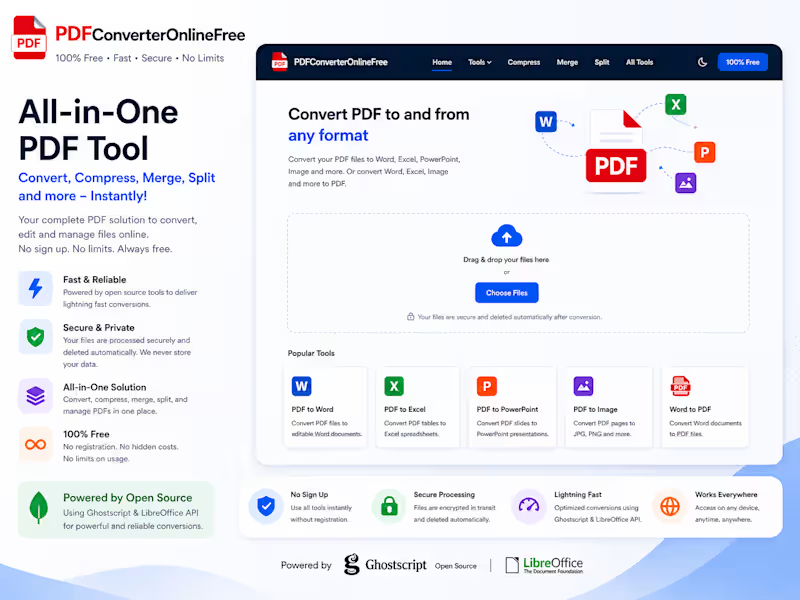
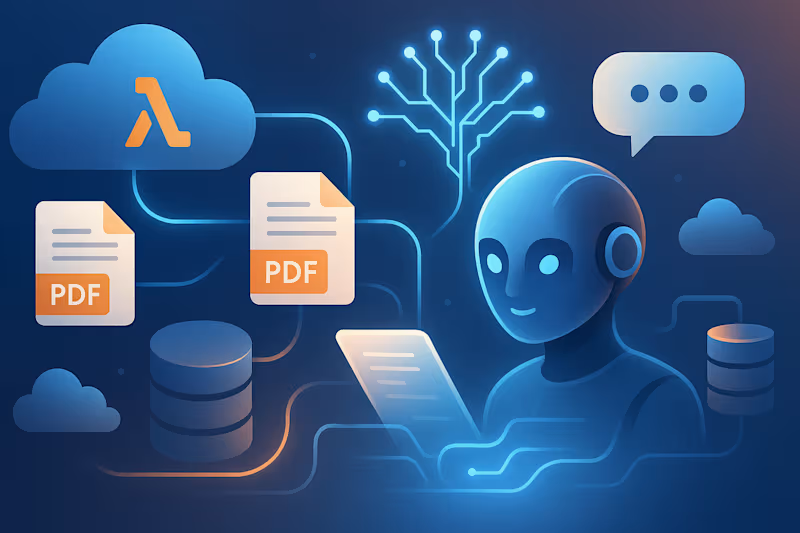
PDFConverterOnlineFree – Node.js PDF Tool I built this project as a practical, real-world PDF tool that runs completely online and doesn’t rely on any database. The idea was simple — most PDF tools out there are either paid, slow, or store user files. I wanted to create something lightweight, fast, and privacy-friendly using open-source tools. 🔗 Project Link: https://github.com/deepakpatilauthor/PDF-Tool-Node-JS-Project What this project does This web app lets users: Convert PDFs to formats like Word, Excel, and images Convert files back into PDF Merge, split, and compress PDFs Use everything without signing up All files are processed temporarily and deleted automatically, so nothing is stored. How I built it I used Node.js for the backend and connected it with: Ghostscript for handling PDF operations like compression LibreOffice for document conversions The whole system is stateless (no database), which keeps it simple and fast. Why I built it this way I wanted to prove that you don’t always need paid APIs or heavy infrastructure to build something useful. With the right open-source tools, you can create a solid, production-ready app. What I learned Working with system-level tools like Ghostscript and LibreOffice Handling file uploads and processing efficiently in Node.js Building a clean workflow without relying on a database Thinking about performance and user privacy Final thoughts This project is a good example of how I approach building tools — keep it simple, make it useful, and avoid unnecessary complexity.
0
148
Full Stack Developer
20
Followers
Full Stack Developer
Tech solutions with a product-first approach.
AI Developer: Automate with AI Bots