ClarityCare: designing the glass box around the black box

Catherine Hicks

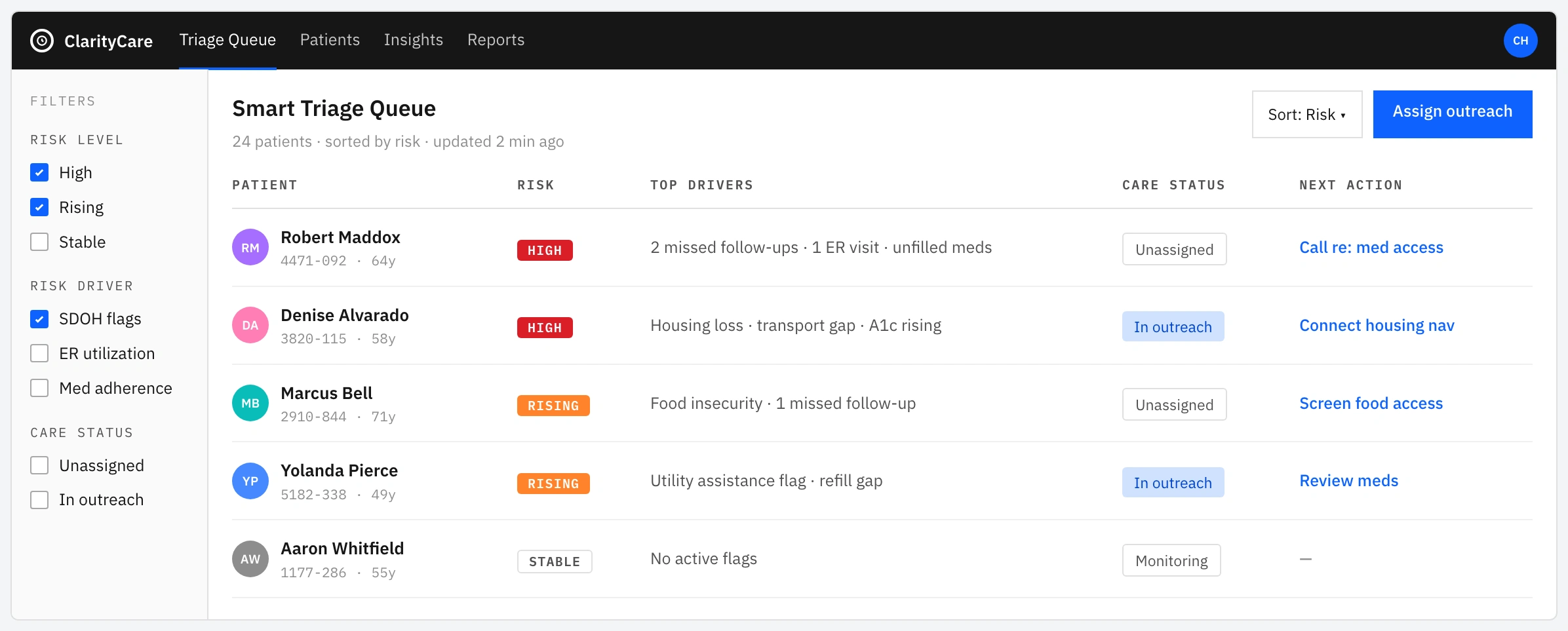
A risk score is a black box that says trust me. ClarityCare is the glass box I designed around it — a self-directed concept for turning an explainable AI risk model into a workflow a care coordinator can actually trust and stay in charge of.
No client handed me this. I wrote the brief myself and held it to the bar I'd hold paid work: a real user with a real deadline, a genuinely predictive but genuinely opaque model, and a product that has to earn a busy clinician's trust in seconds. Everything in it — the model, the SDOH indices, the named patients — is illustrative sample data. Nothing is staffed, validated, or measured, and I say so wherever it matters.
The problem is a wall of data with no entry point
Care coordinators own the patients most likely to fall through the cracks — missing appointments, cycling through the ER, quietly losing housing or food access — and they're supposed to catch them before the next crisis. In practice they open an EHR, stare at an undifferentiated wall of data, and start somewhere. I framed the project around one coordinator's voice: "I know I'm missing someone important, but I can't see who — and I don't have time to guess."
Enhance judgment, never replace it
The AI proposes; the clinician disposes. It predicts risk, surfaces the reasons, and suggests a next step — always with its own uncertainty on the table — and the clinician accepts, overrides, or adds context the model never had. If a screen ever made the coordinator feel like a rubber stamp for the algorithm, it was wrong. That's the line between a decision-support tool and an automation tool.
Social determinants of health sit at the center, because the biggest risks often aren't medical — whether someone can get to a pharmacy, afford to eat, keep stable housing. I grounded that layer in four validated, publicly documented standards rather than inventing a questionnaire: PRAPARE, the CMS AHC HRSN screen, the CDC's Social Vulnerability Index, and the Area Deprivation Index. The design contribution was translation — turning dense clinical surveys into something a coordinator could run in someone's living room.
Built on IBM Carbon, on purpose
The product shouldn't look like the tools it replaces. I chose Carbon for four defensible reasons: fit — it's purpose-built for dense, data-heavy enterprise tools; access — audited contrast and keyboard support out of the box, non-negotiable in a clinical setting; tone — sharp, quiet, grid-driven, reading trustworthy rather than consumer-playful; and continuity — the IBM Plex type family threads the product through the whole case study.
Six features, one for each question
I made every core feature answer a question a skeptical clinician would actually ask. Where do I start. Why should I believe this. Am I still in control. The Smart Triage Queue leads with severity and its cause. Insight Cards render SHAP output as the plain-language sentence a colleague would say — no coefficients — and state stale data outright, inviting the override instead of hiding the uncertainty.
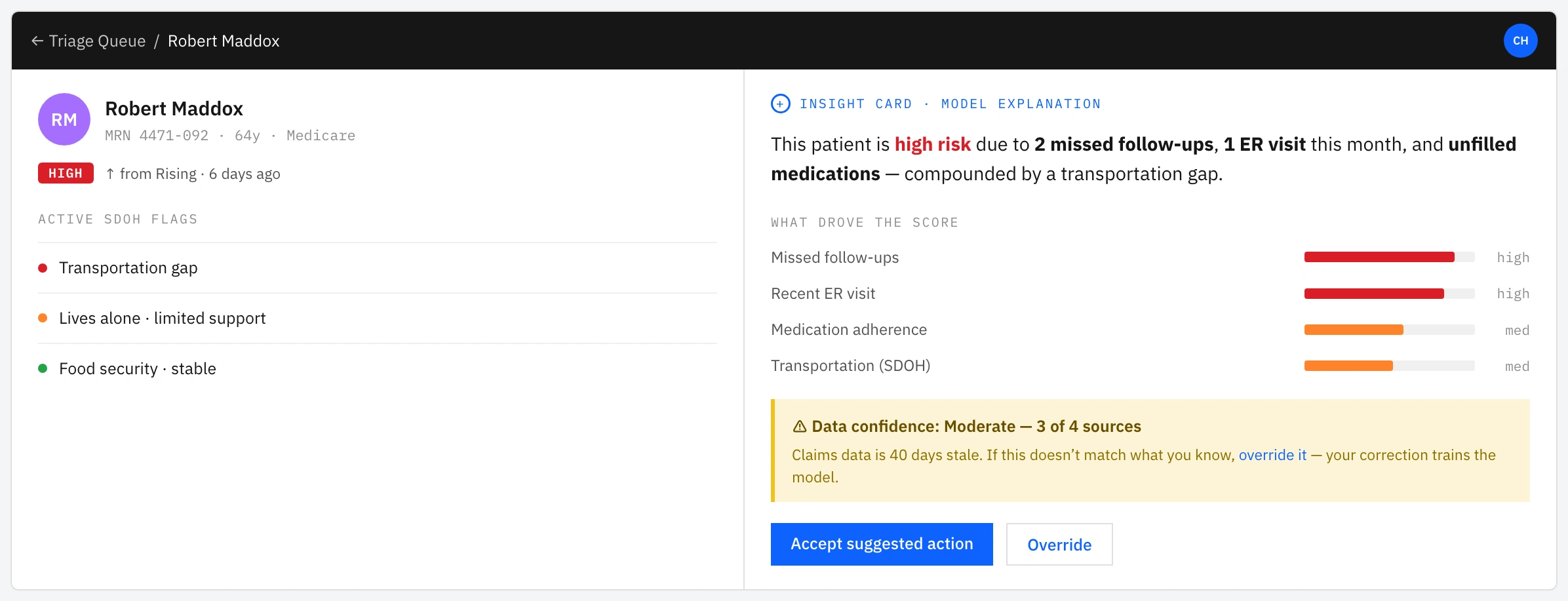
A full AI insight card renders the model's SHAP explanation as a plain-language sentence and flags stale data outright, so the clinician can weigh the score instead of taking it on faith.
The Override flow is the one I'm proudest of: the coordinator overrides with a structured reason, and that reason doesn't just log a disagreement — it becomes labeled feedback the model learns from. Control and learning, made the same gesture.
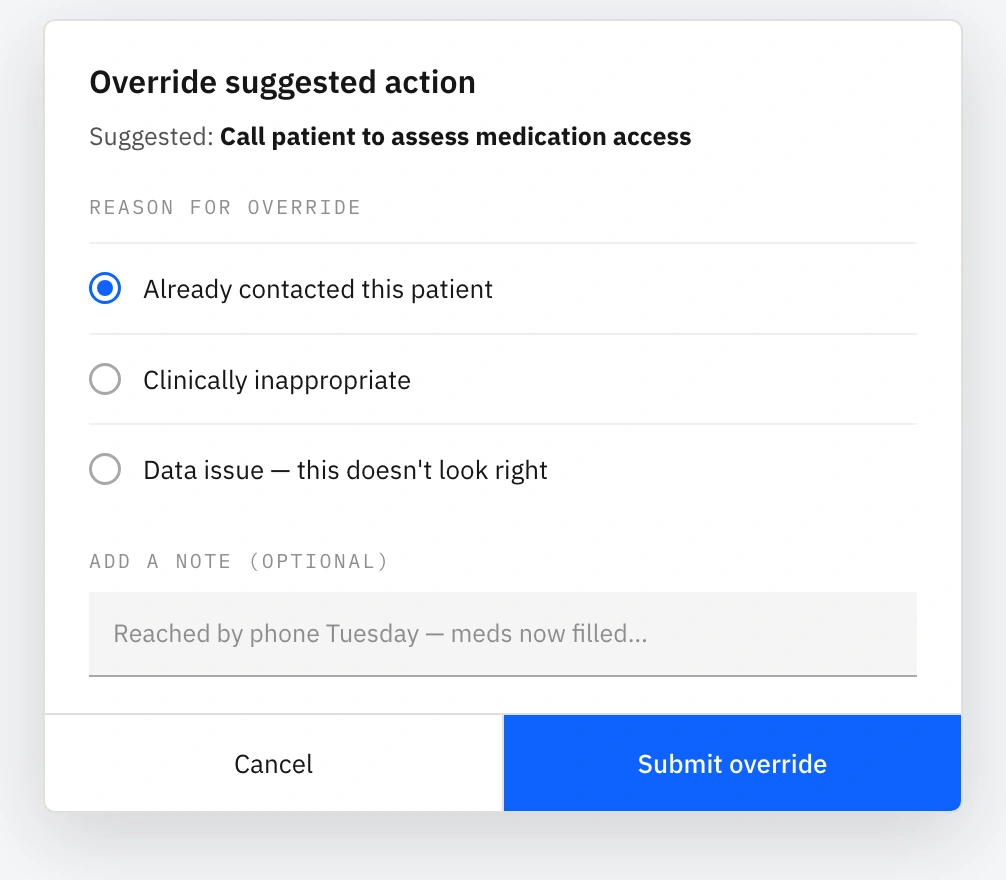
The clinician override modal captures a structured reason that both keeps the clinician in control and feeds back to the model as labeled training data.
The Timeline stitches clinical events, AI re-scores, and staff actions onto one color-coded thread, so anyone can see how a patient's risk got where it is.
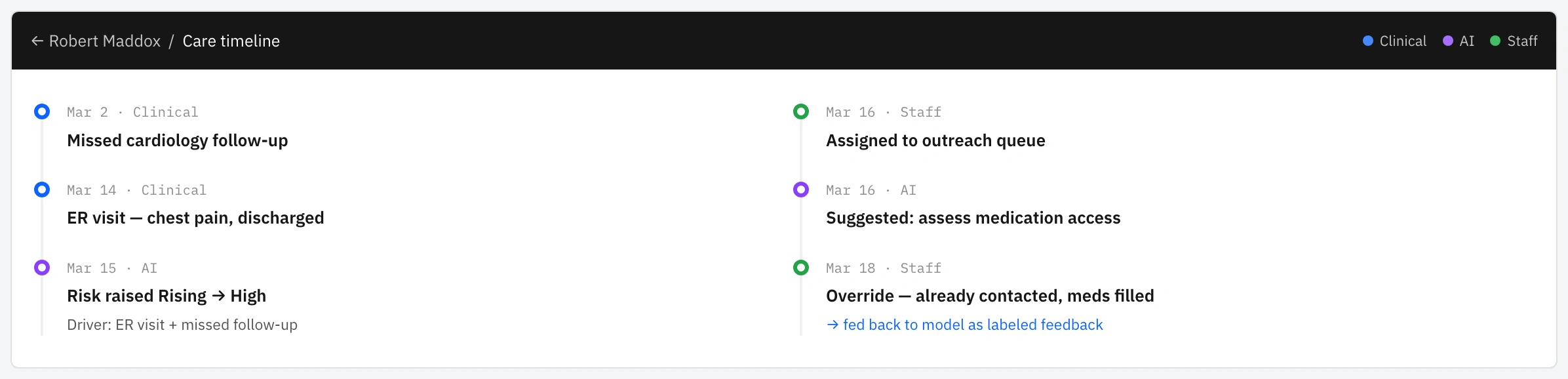
The care timeline weaves clinical events, AI re-scores, and staff actions onto one color-coded thread, answering "how did we get here" at a glance.
The field surface was re-architected, not shrunk
Mobile is built for a coordinator with thirty seconds of attention in someone's living room: a condensed queue, and a real-time SDOH screen where a new fact — the patient lost their housing last week — flips a toggle, fires a banner, and re-scores risk on the spot. I documented the desktop ↔ mobile split as an explicit contract so neither surface drifts from the shared logic.
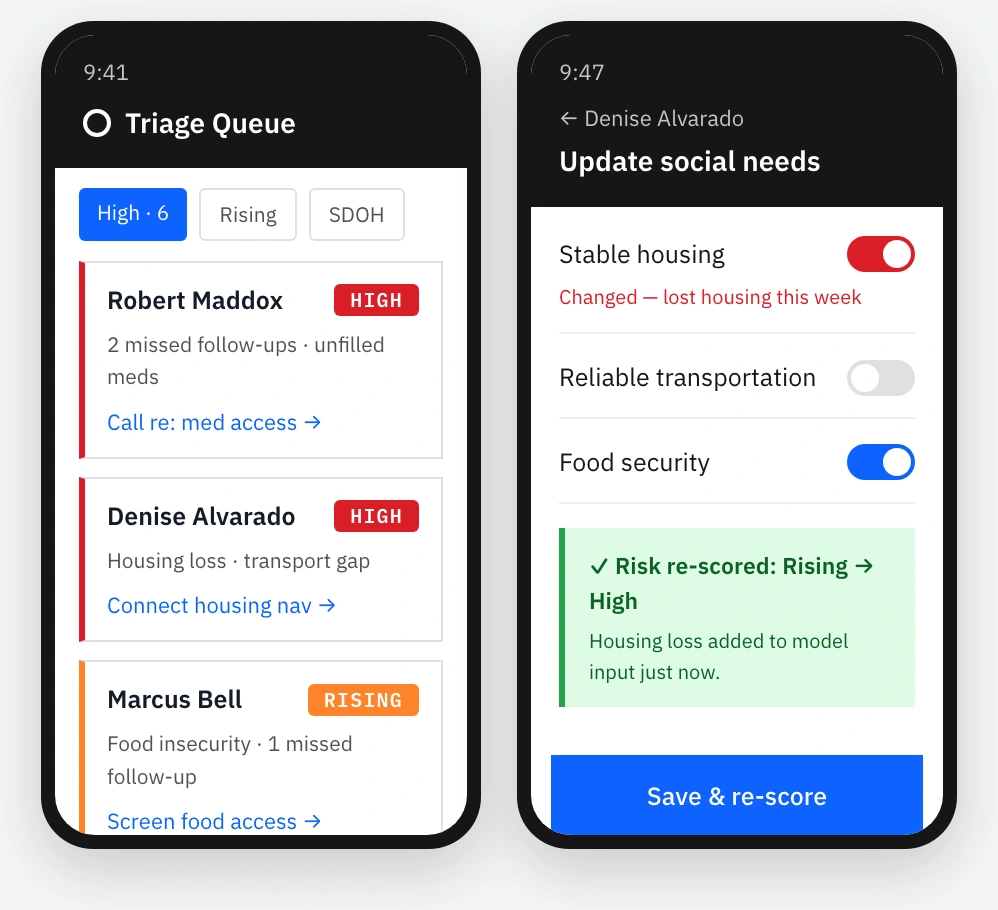
The mobile field surface re-scores risk in real time when a coordinator logs a new fact like housing loss — built for thirty seconds of attention, not a shrunken desktop.
Each model capability created an interface obligation: risk scores demanded severity indicators; SHAP explainability demanded plain-language cards; model training demanded structured override capture. Design and model weren't two workstreams — the model's honesty about its own limits was the UX. The lesson that stuck: explainability isn't a feature you add at the end. It's the entire relationship between the clinician and the AI, and the interface's real job is to make the model accountable to the human using it.
See the full case study → https://design-case-studies.vercel.app/claritycare
Like this project
Posted Aug 3, 2026
A risk score is a black box that says trust me. ClarityCare is the glass box I designed around it — turning an explainable AI risk model into a workflow a care coordinator can actually trust and stay in charge of.
Likes
0
Views
4