
Moving from AI coding assistants to an automated "Software Factory" changes where engineering failures happen.
Single-prompt code generation helps write a function. A Software Factory orchestrates requirements, implementation, testing, and integration across multiple agents. When automation scales across the entire lifecycle, speed stops being the bottleneck—verification becomes the bottleneck.
The core trade-off is autonomy versus compounding error. Every handoff between agents introduces subtle assumptions. Without strict validation gates between stages, a minor requirement drift in step one turns into broken architecture by step four.
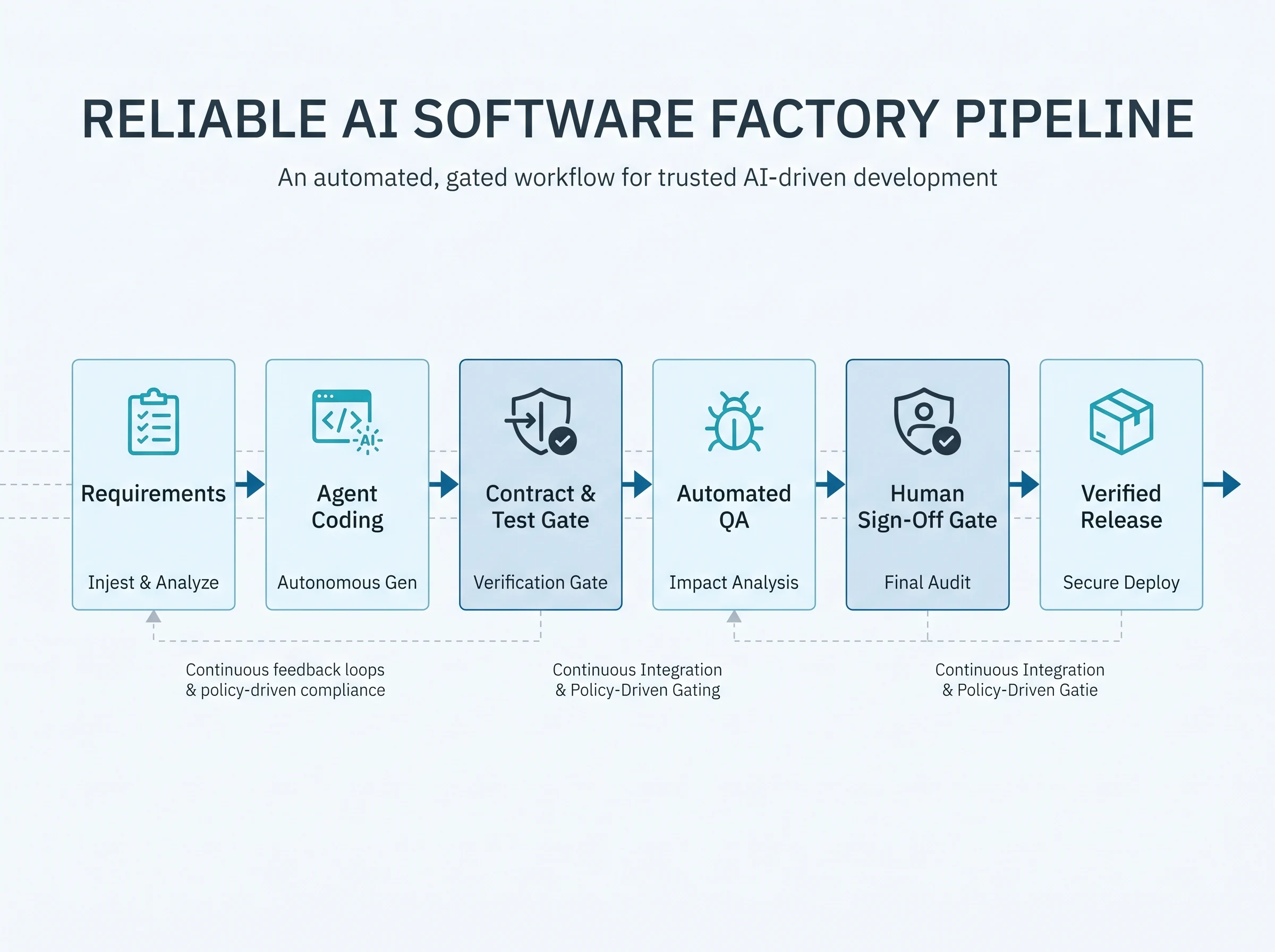
Building a reliable Software Factory requires treating orchestration like a CI/CD pipeline:
1. Enforce deterministic contracts and automated test gates between every agent handoff.
2. Keep execution environments isolated with read-only test harnesses.
3. Retain human ownership over architecture, security boundaries, and production sign-off.
AI generates the throughput; engineers own the architecture and the brakes.
Where do you see the biggest reliability gap when chaining agents across the SDLC?
#AIEngineering #DevOps #SoftwareArchitecture #AIAgents #Automation
0 likes · 0 views · Nov 22, 2026
Moving from AI coding assistants to an automated "Software Factory" changes where engineering failures happen. Single-prompt code generation helps write a fu...


