
Using an LLM to evaluate code in your CI/CD pipeline sounds efficient until you realize the judge prefers broken code that looks clean over working code that looks verbose.
Teams rush to adopt "LLM-as-a-Judge" to score PRs and agent-generated patches. But automated evaluators suffer from severe cognitive distortions:
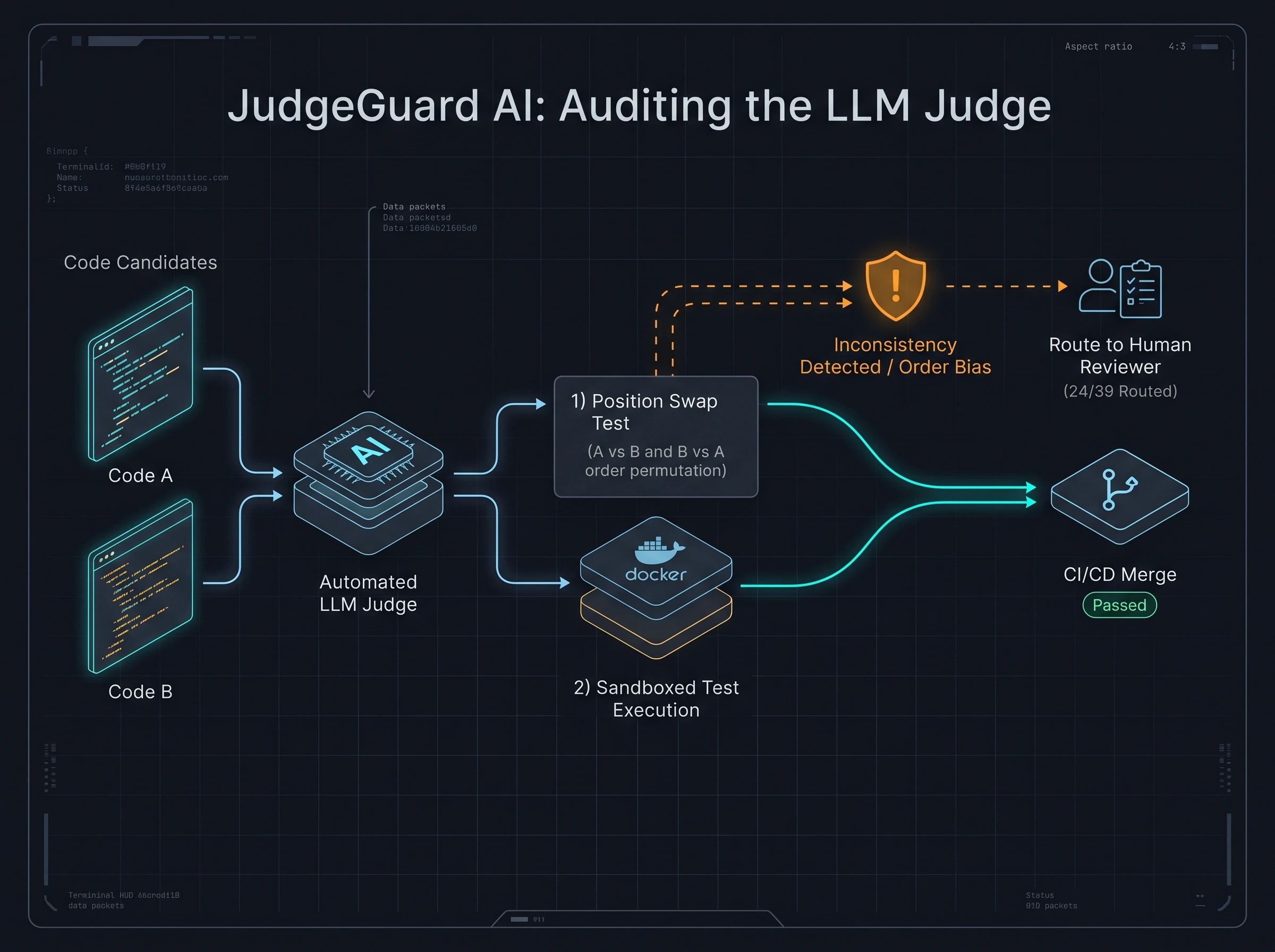
Position Bias: Swapping the order of candidates (evaluating Candidate B first instead of A) flips the model's preferred verdict up to 35% of the time.
Surface Fluency Bias: Models systematically award higher scores to elegant-looking code with formatted docstrings—even when it fails unit tests.
In our JudgeGuard AI benchmark across 13 evaluation tasks, automated judges favored failing implementations whenever formatting masked logic flaws.
To safely operationalize automated judges without breaking production:
Order Invariance Testing: Run dual evaluations (A vs B, then B vs A). If the preference flips, flag the evaluation as non-deterministic.
Sandboxed Test Grounding: Execute candidates in isolated Docker containers first. A candidate failing unit tests cannot receive a passing judge score.
Fail-Closed Human Routing: In our benchmark, 24 of 39 ambiguous or order-dependent evaluations were automatically routed to a human reviewer.
How does your team audit the accuracy and position bias of automated LLM judges?
#AIEngineering #DevOps #QA #DevSecOps #SoftwareEngineering
0 likes · 2 views · Nov 15, 2026
Using an LLM to evaluate code in your CI/CD pipeline sounds efficient until you realize the judge prefers broken code that looks clean over working code that...


