
Running your AI agent inside a standard Docker container does not mean it’s sandboxed—it’s just isolated until something breaks.
When an autonomous agent gets terminal execution privileges (Bash tools, package installs, code evaluation), naive containerization is a security illusion. If your container runs as root (UID 0), retains default Linux capabilities, or has network egress, a prompt injection or malicious patch can exploit kernel boundaries to escape to the host.
In our Escape-Lab attack simulations, default Docker runtimes failed against privilege escalation and cgroup release agents. The container boundary alone was never designed to be an adversarial security boundary.
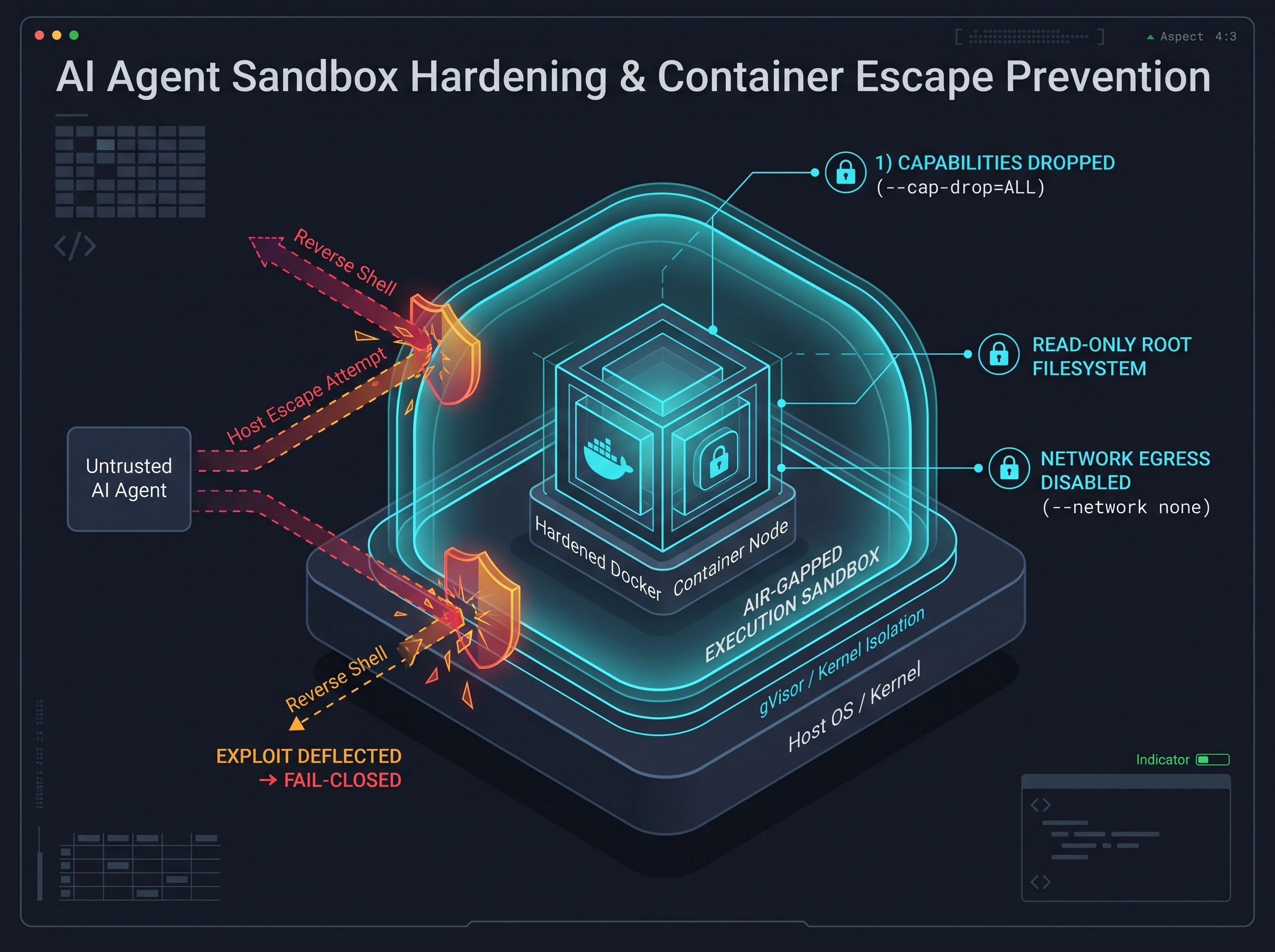
To build a truly air-gapped sandbox for autonomous tool execution:
Drop All Linux Capabilities: Enforce --cap-drop=ALL. Explicitly prevent privilege escalation with security_opt: [no-new-privileges:true].
Immutable Filesystem: Mount root as strictly read-only (--read-only) with ephemeral, non-executable in-memory tmpfs mounts for /tmp.
Zero Network Egress: Lock the container to --network none. Agents evaluating untrusted code have zero legitimate reasons to initiate outbound sockets.
How do you harden container runtimes when giving AI agents shell access?
#DevSecOps #Docker #Linux #AIEngineering #CloudSecurity
0 likes · 1 view · Nov 11, 2026
Running your AI agent inside a standard Docker container does not mean it’s sandboxed—it’s just isolated until something breaks. When an autonomous agent get...


