
Asking an LLM to "return valid JSON" in a prompt is not an API contract—it is a hope.
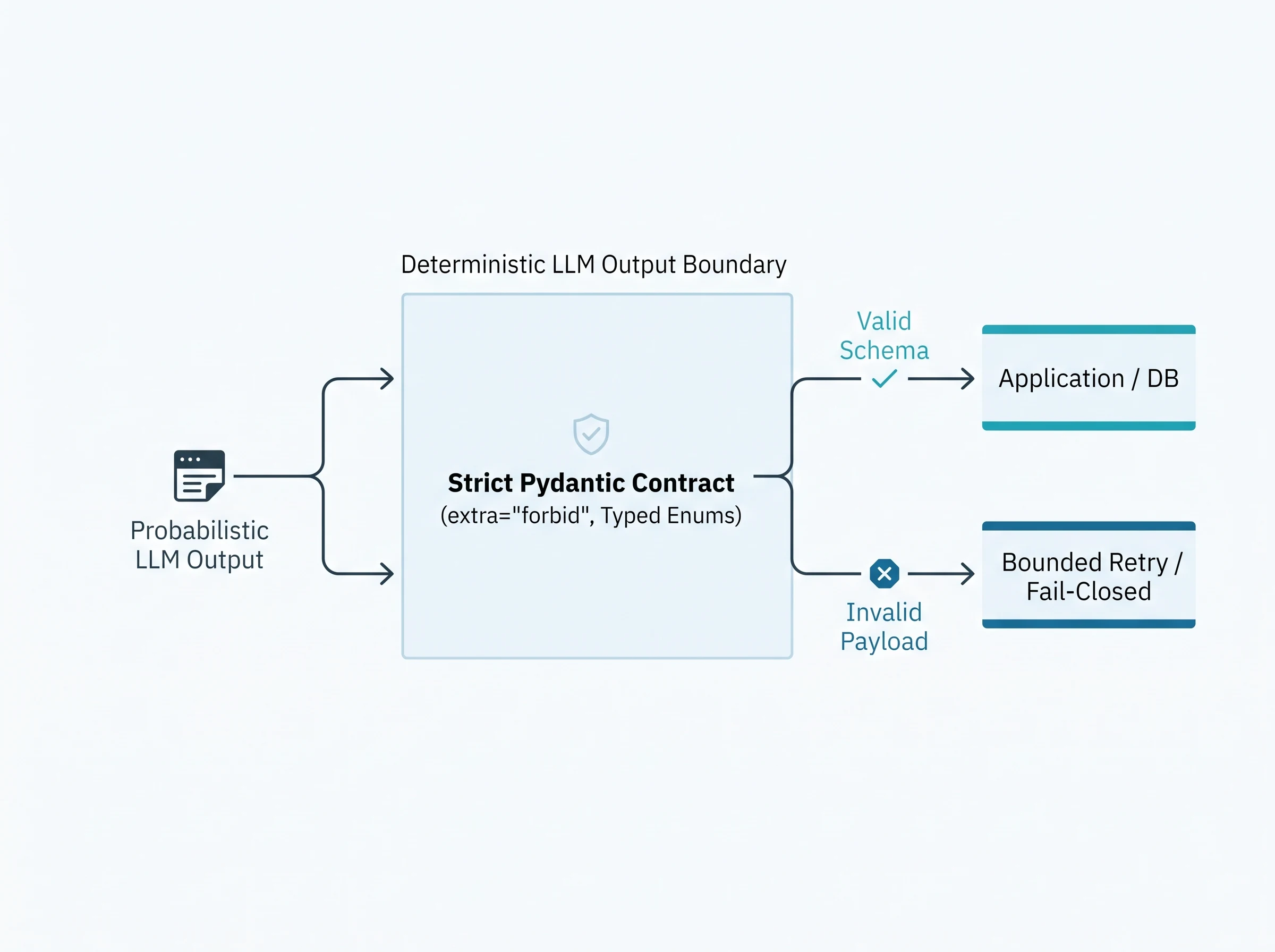
Downstream services, databases, and UIs expect deterministic data structures. Language models produce probabilistic text. When a model wraps output in markdown fences, omits a required key, or invents an enum value, unvalidated responses cause silent parsing failures or corrupt downstream state.
The architectural trade-off sits between flexibility and strictness. Enforcing rigid validation at the model boundary catches malformed payloads early, though overly complex nested schemas increase rejection rates and retry latency—especially on smaller local models.
Three rules of thumb for keeping the LLM-to-application boundary deterministic:
Treat model output as untrusted input. Validate every response through strict Pydantic schemas with explicit enums and extra="forbid".
Keep output schemas flat and minimal so smaller models can satisfy them reliably.
Cap format-repair retries at one or two attempts, then fail closed rather than passing partial data downstream.
How do you enforce strict data contracts between LLM outputs and your application layer?
#AIEngineering #FastAPI #Python #SystemDesign #SoftwareEngineering
0 likes · 0 views · Nov 22, 2026
Asking an LLM to "return valid JSON" in a prompt is not an API contract—it is a hope. Downstream services, databases, and UIs expect deterministic data struc...


