Built with Kittl
Magarifiles Car Archive Web Design

Vincent Pasili


Magarifiles - The Kenyan Car Archive
An editorial home for car imports, specs, and ownership knowledge built for the Kenyan market. This is the v1 design: the blueprint for what the product becomes.
At a glance
Role: Art direction, product design, and UI: concept to interactive prototype
Surface: A landing page and seven sections: Home, Cars, Imports, Reviews, Ownership, Culture, and an import-duty Calculator
Tooling: Magicpath AI for the design system and layout, Lummi for imagery, Kittl for imagery and the hero videography
Status: v1 design concept, a running prototype that defines the look, feel, and information architecture for build
0 - Why I made this
I love cars, and I love the specific, slightly obsessive corner of car culture that exists in Kenya: a 2018 Mark X landed from a Japanese auction, an EA888 that needs the right timing-chain service, an argument about whether the Safari Rally is still the hardest event on the calendar. All of that knowledge is real, but it lives in WhatsApp groups, dealer Instagram captions, and half-remembered forum threads. Nobody has written it down in one calm, trustworthy place.
Magarifiles is my answer. The tagline says it plainly: we don't sell cars, we archive them. It's not a marketplace and it's not a dealer site; it's an archive of imports, specs, ownership notes, and culture for the cars actually driving on Kenyan roads. This case study covers the v1 design: the brand, the seven screens, and the decisions behind them.
1 - The problem
Car content for the Kenyan buyer is either a sales funnel or noise. Listing sites push you toward a transaction; social posts are fast but disposable; the genuinely useful stuff (what does it actually cost to land this car, and what will it cost to own?) is the hardest to find.
Three principles shaped every screen:
Archive, don't sell. No pressure, no "DM for price." Editorial first. Earn trust by being the most accurate, least hype-driven source in the market.
One honest number beats ten vague ones. The headline feature is an import-duty calculator that shows the real landed cost, line by line, on current KRA rates, not a teaser.
Made for here. JDM and European cars, Mombasa-port realities, NTSA registration, KSh everywhere, workshops listed by city. The product should feel like it was written by someone who has actually done this.
2 - Design: an editorial dark theme for petrolheads
I wanted Magarifiles to read like a well-made car magazine that happens to live on the web: confident typography, real photography, and restraint. The whole system was designed in Magicpath AI, which let me move from intent to a coherent, reusable layout fast and keep every section visually consistent.
Three moves anchor the brand:
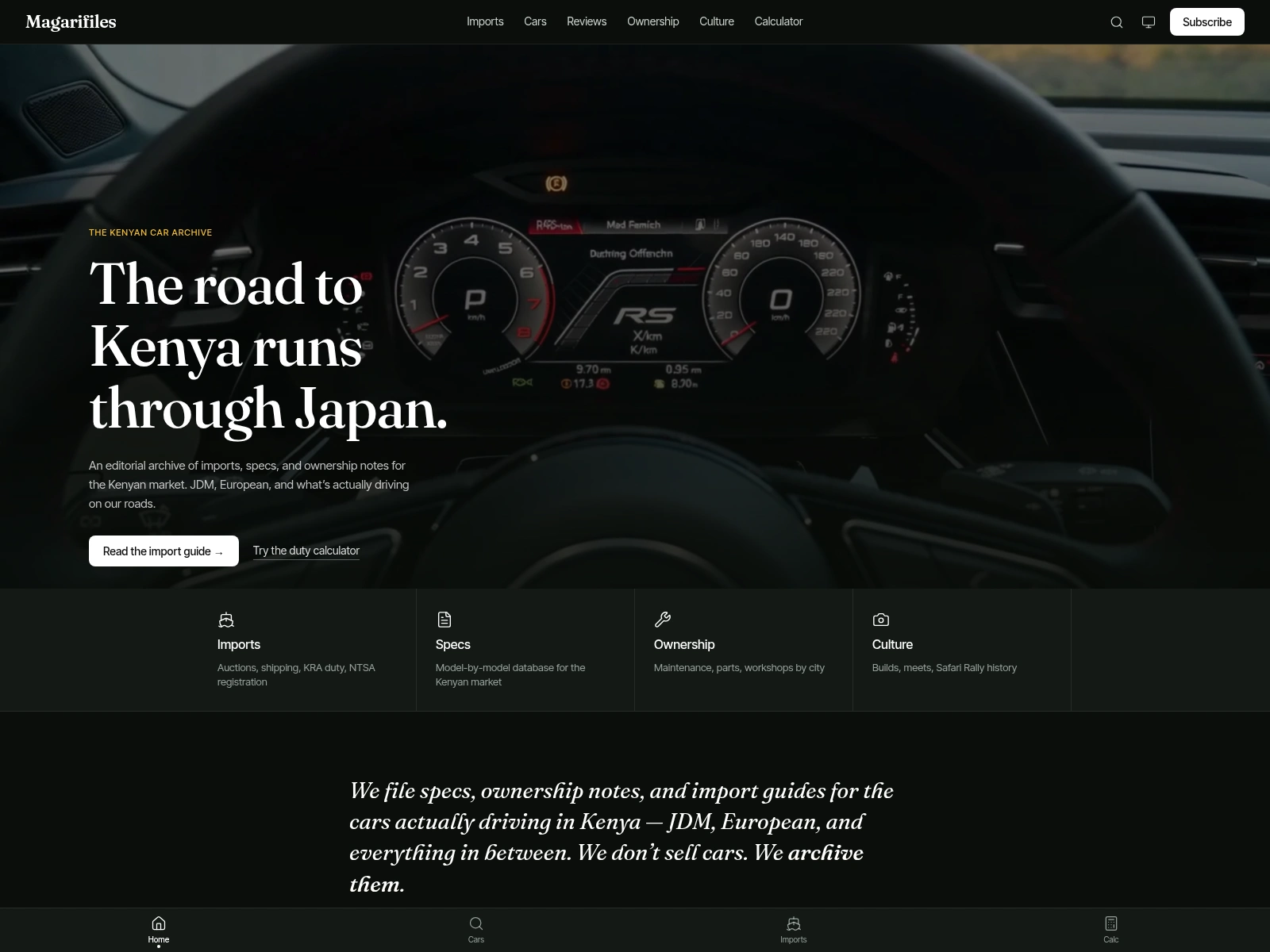
A warm near-black canvas, not pure black, so long reading sessions stay soft, and headlight-lit photography glows against it.
A single terracotta/amber accent, used only for eyebrows and emphasis (the
THE KENYAN CAR ARCHIVE kicker, status pills). Everything else is restraint.A two-voice type system: a warm display serif for headlines that gives the archive its editorial authority, paired with a clean sans for body and a monospace face for data (prices, grades, duty math). The tension between "magazine" and "spec sheet" is the whole personality.
All photography was sourced and art-directed through Lummi, and the hero motion (the slow, cinematic cockpit drive that opens the site) was produced in Kittl, which also helped generate supporting imagery. Grading everything toward the same warm-dark palette is what makes a stitched-together set of screens read as one product.
The landing - earning the scroll
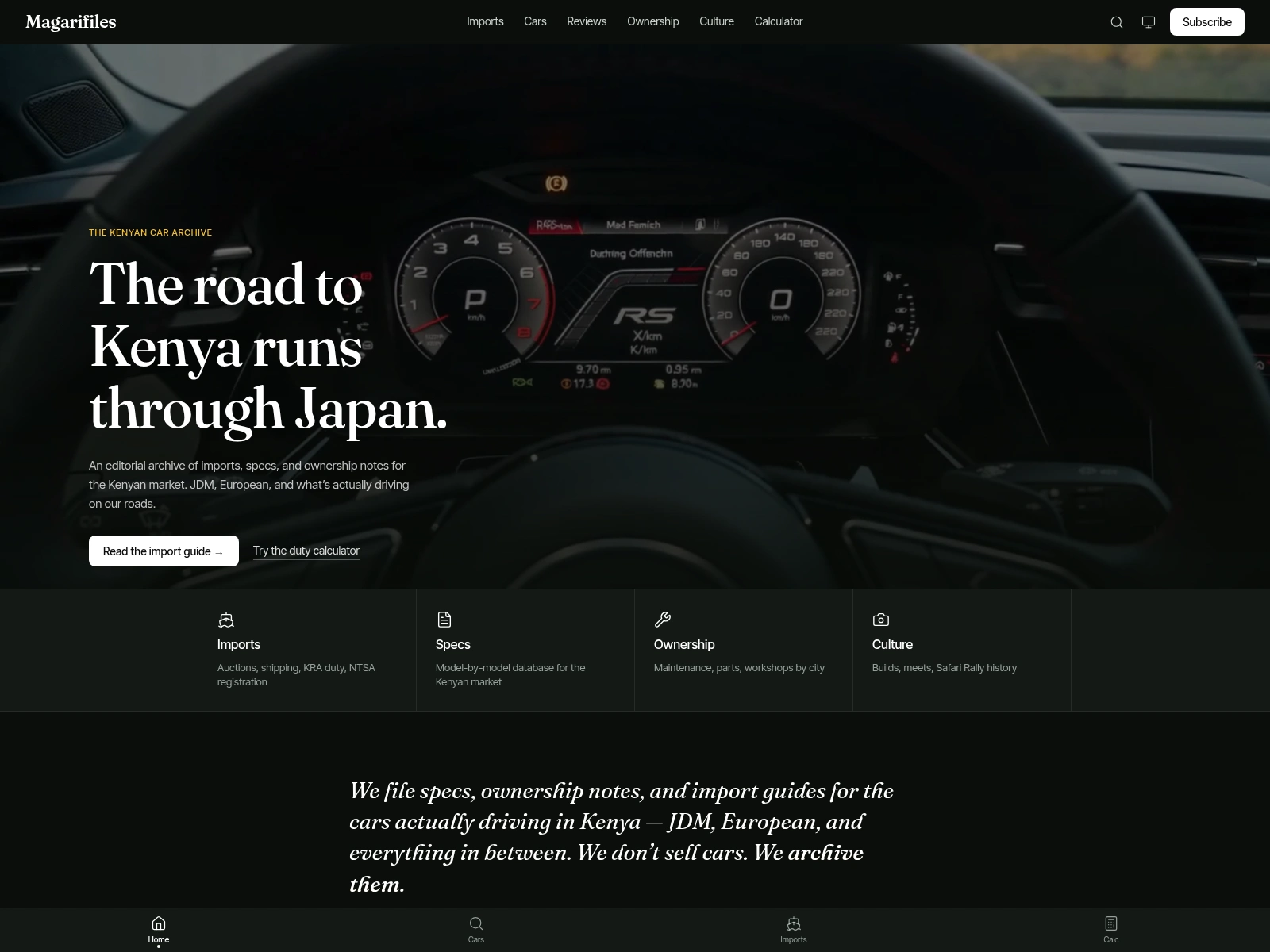
The hero pairs a single editorial line ("The road to Kenya runs through Japan.") with a quiet looping drive video. Below it, four pillars (Imports, Specs, Ownership, Culture) tell you what the archive holds, and a manifesto line states the positioning out loud: we file specs, ownership notes, and import guides… we don't sell cars, we archive them.
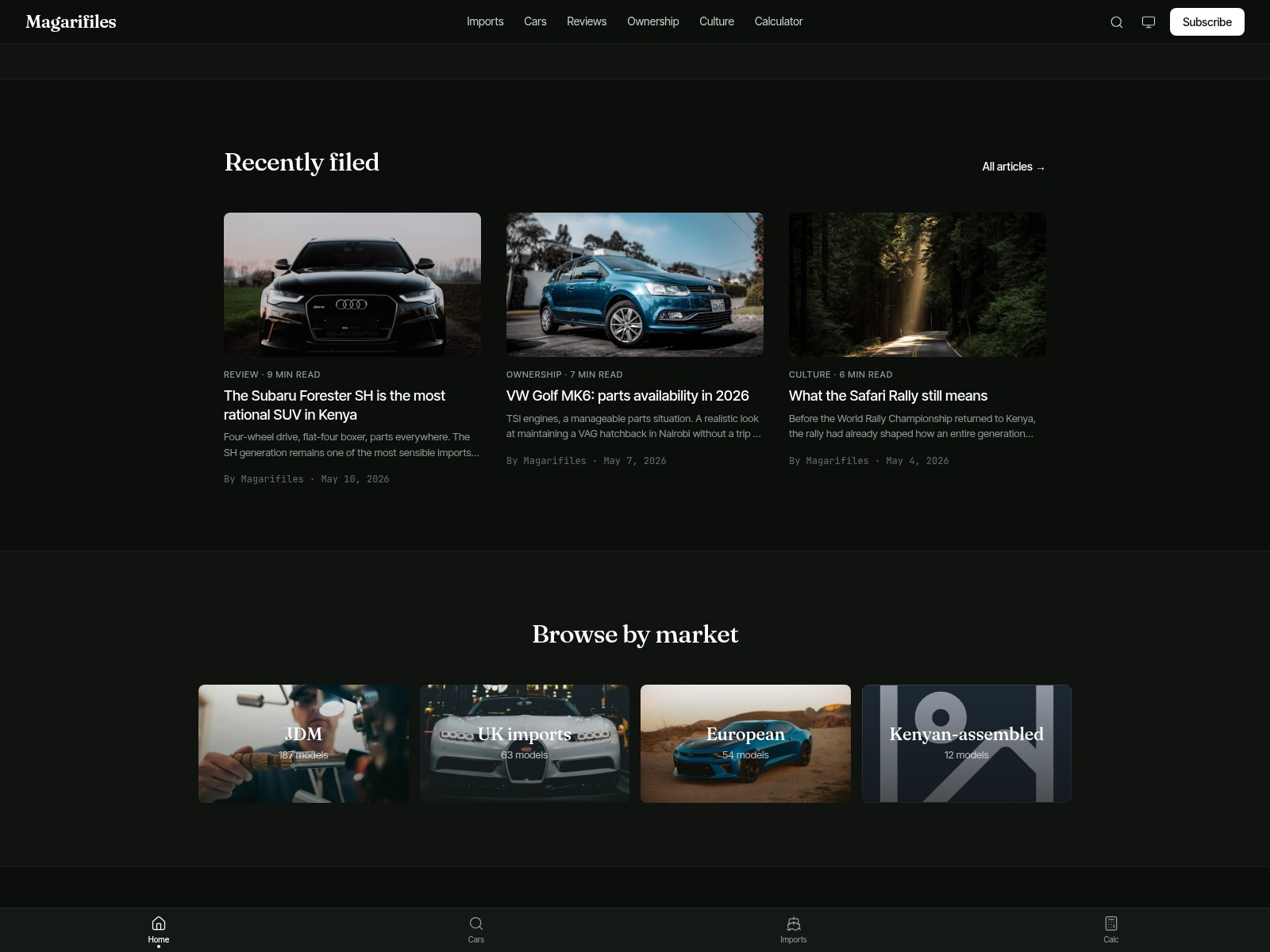
Keep scrolling and the landing turns into a magazine front page: Recently filed articles and a Browse by market rail (JDM, UK, European, Local) that doubles as the entry point into the catalogue.
3 - The product: seven sections, one shell
Every section shares the same furniture (a slim sticky nav, the serif page header with an amber eyebrow, and a consistent card vocabulary), so the archive feels like one body of work and new sections are cheap to add.
Cars - the catalogue
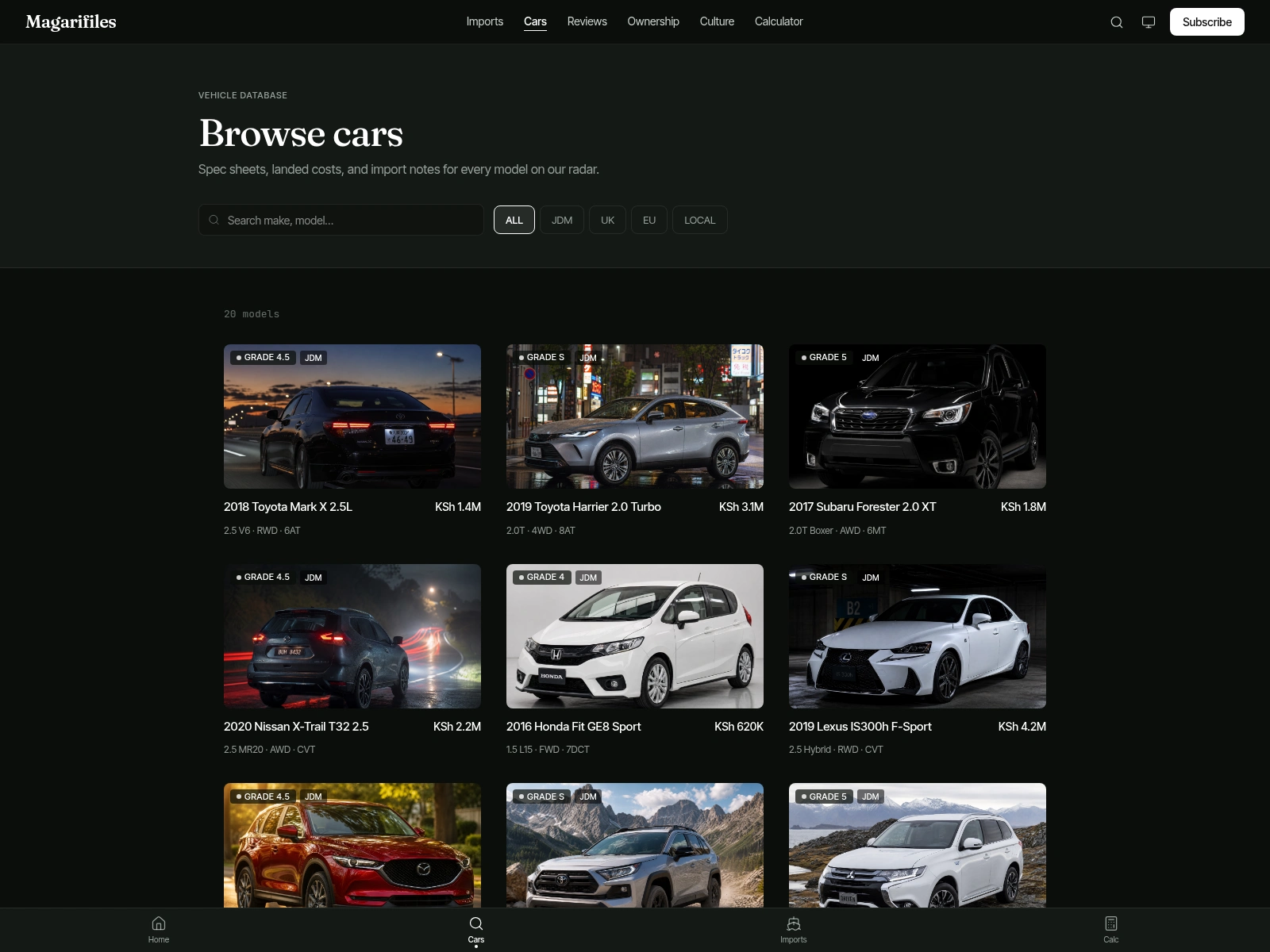
The browse view is a grid of vehicle cards, each carrying the things an importer actually cares about: year and model, auction grade, market of origin (JDM / UK / EU / Local), and an estimated landed cost in KSh. Filters sit up top. It looks like a catalogue, but it reads like a spec index.
Imports - how it actually works
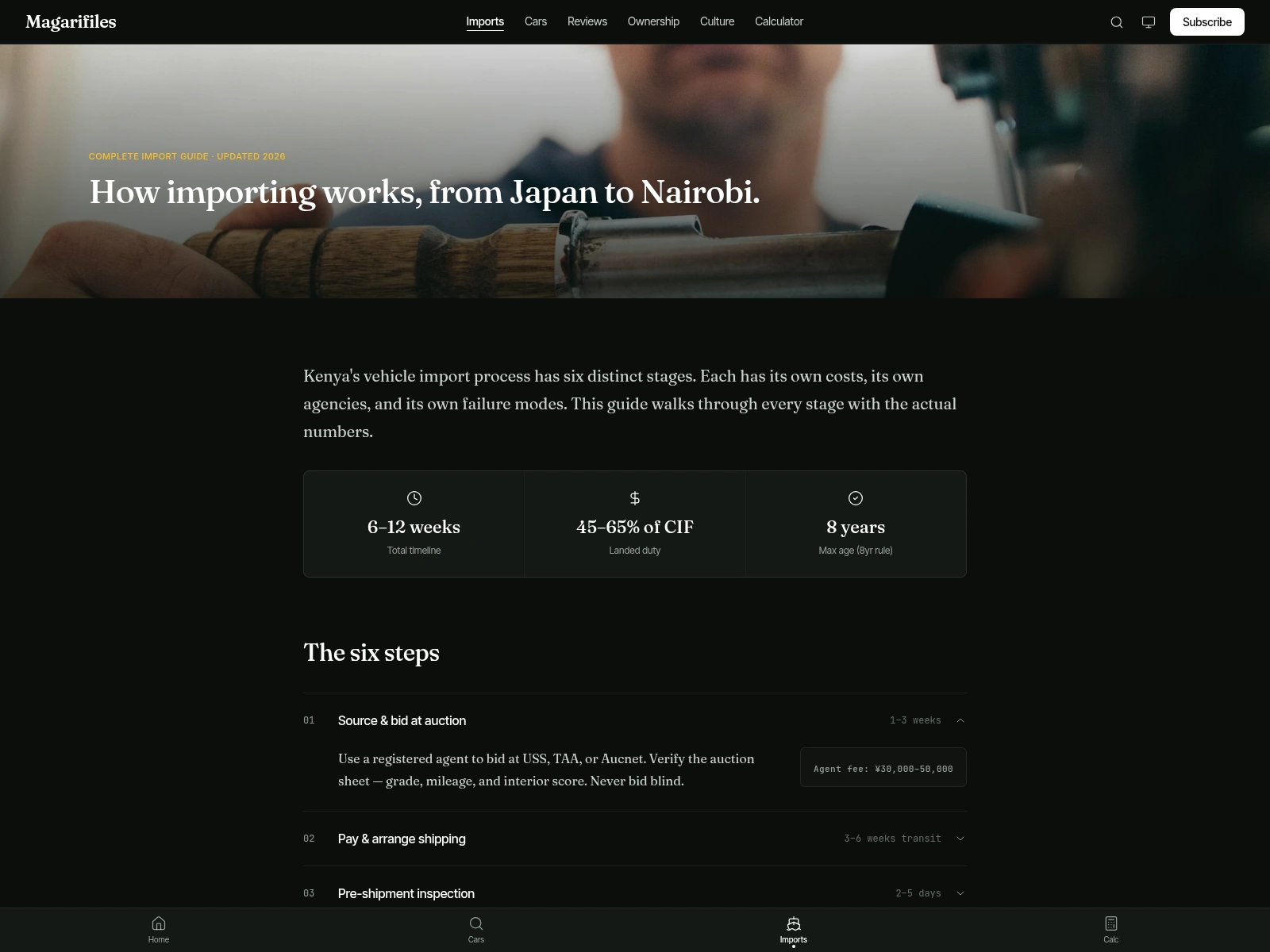
A guide page that demystifies the Japan-to-Nairobi pipeline: the realistic timeline (6 to 12 weeks), duties as a share of CIF, the age limit, and the six steps (source and bid at auction, pay and arrange shipping, pre-shipment inspection, and so on) as an accordion you can work through.
Reviews - the writing
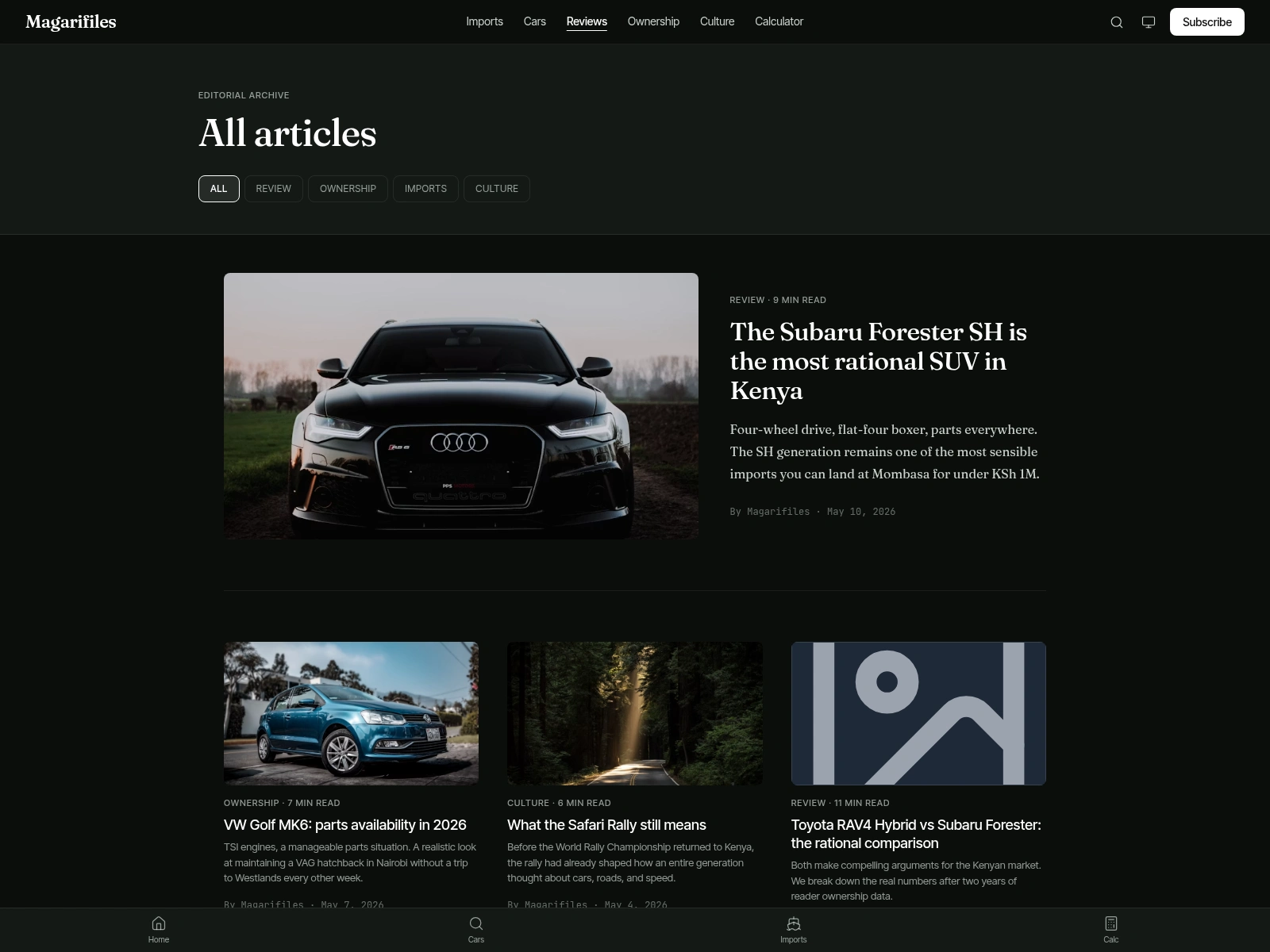
The editorial spine of the archive. Long-form, opinionated pieces ("The Subaru Forester SH is the most rational SUV in Kenya"), filterable by category, with a featured story and a clean article grid. This is where Magarifiles earns its authority.
Ownership - life after the purchase
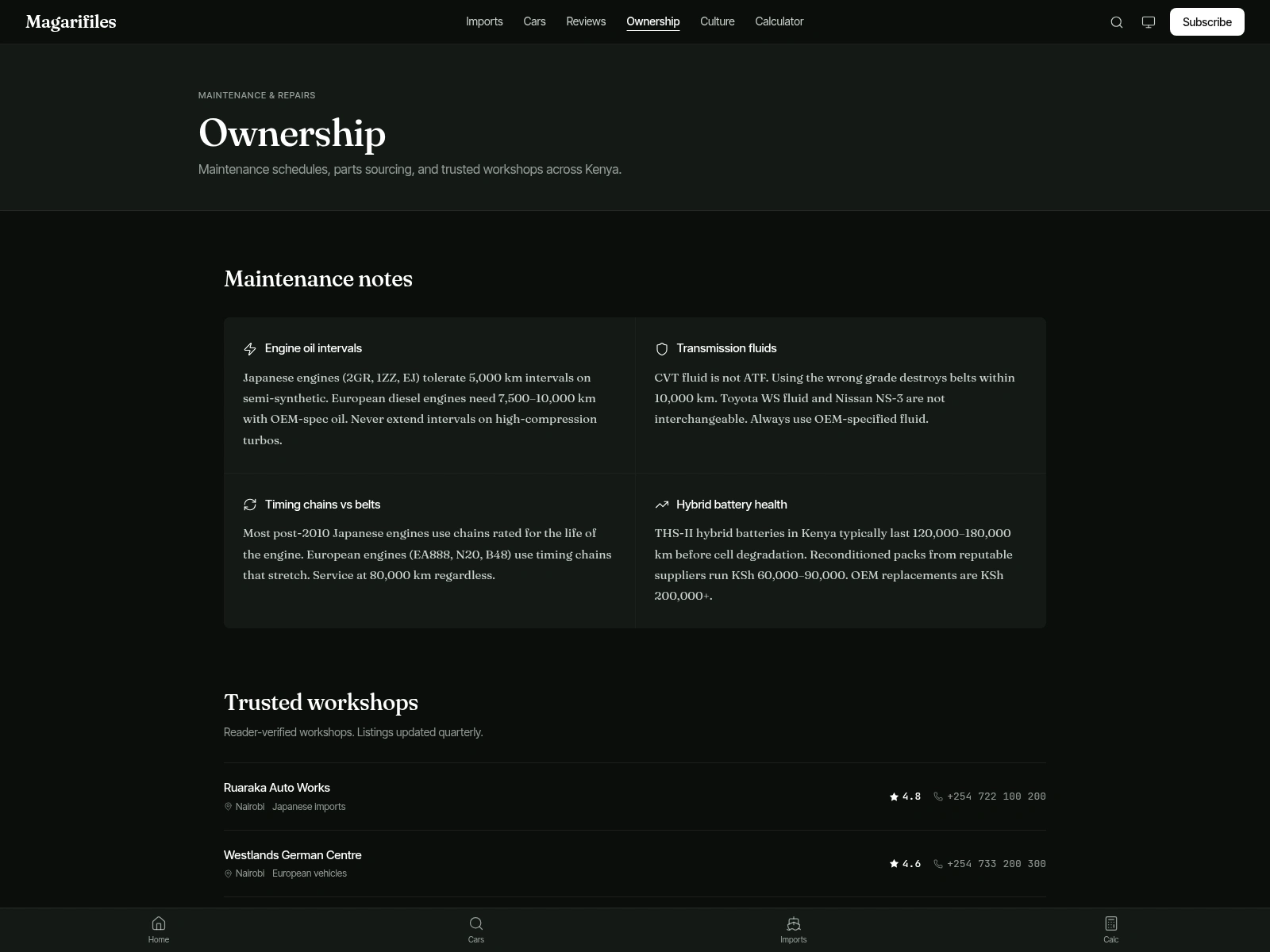
The most genuinely useful, least glamorous section, and the one I'm proudest of. Maintenance notes written for specific engines (oil intervals for Japanese vs. European blocks, CVT fluid that is not ATF, hybrid battery realities), plus a directory of reader-verified workshops by city, with ratings and numbers.
Culture - why we care
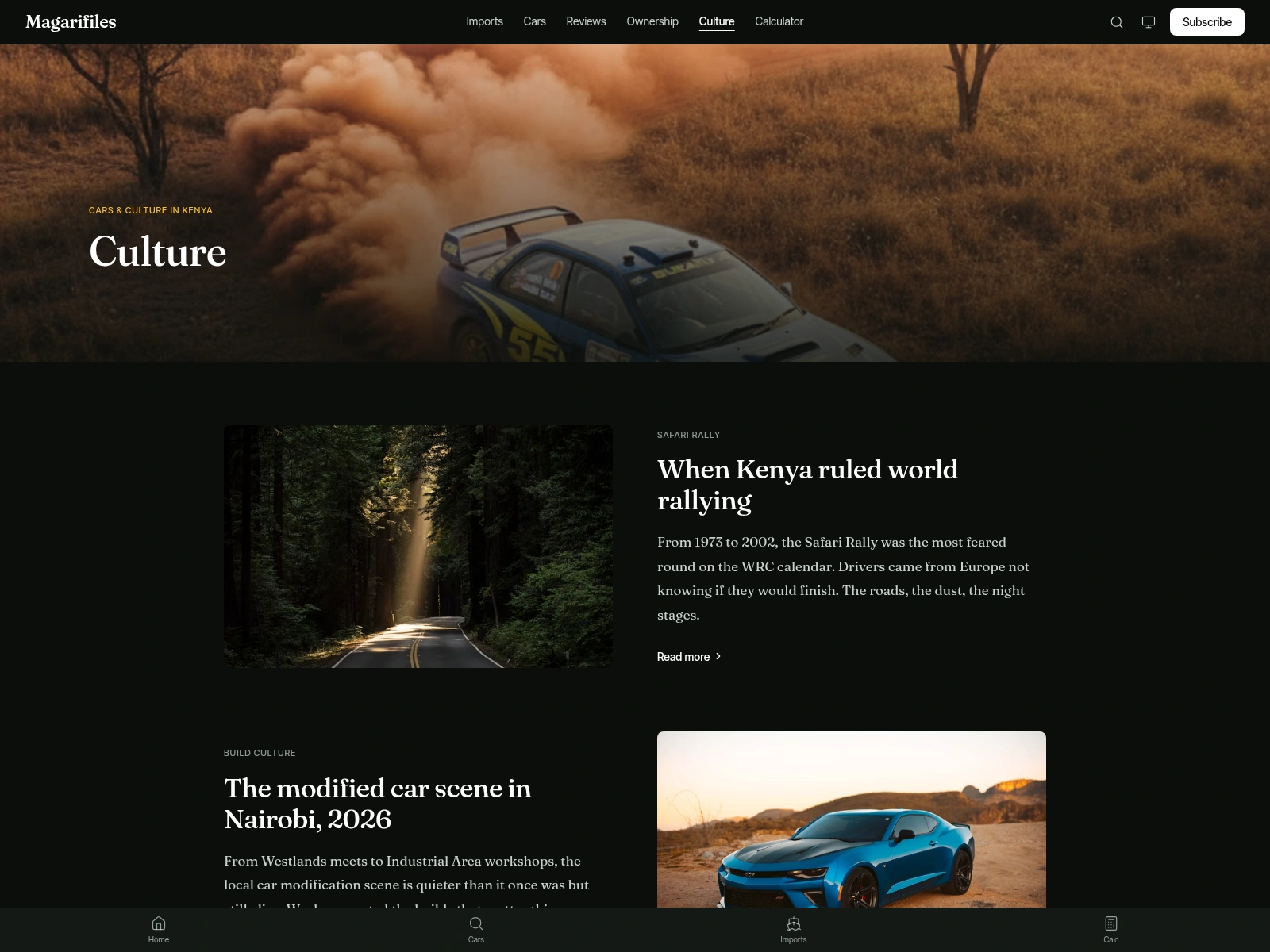
The heart behind the spec sheets. Safari Rally heritage, the modified-car scene in Nairobi, the reason any of this matters. This is the section that lets the imagery and videography breathe: a dust-and-light Safari hero leading into feature stories.
Calculator - the killer feature
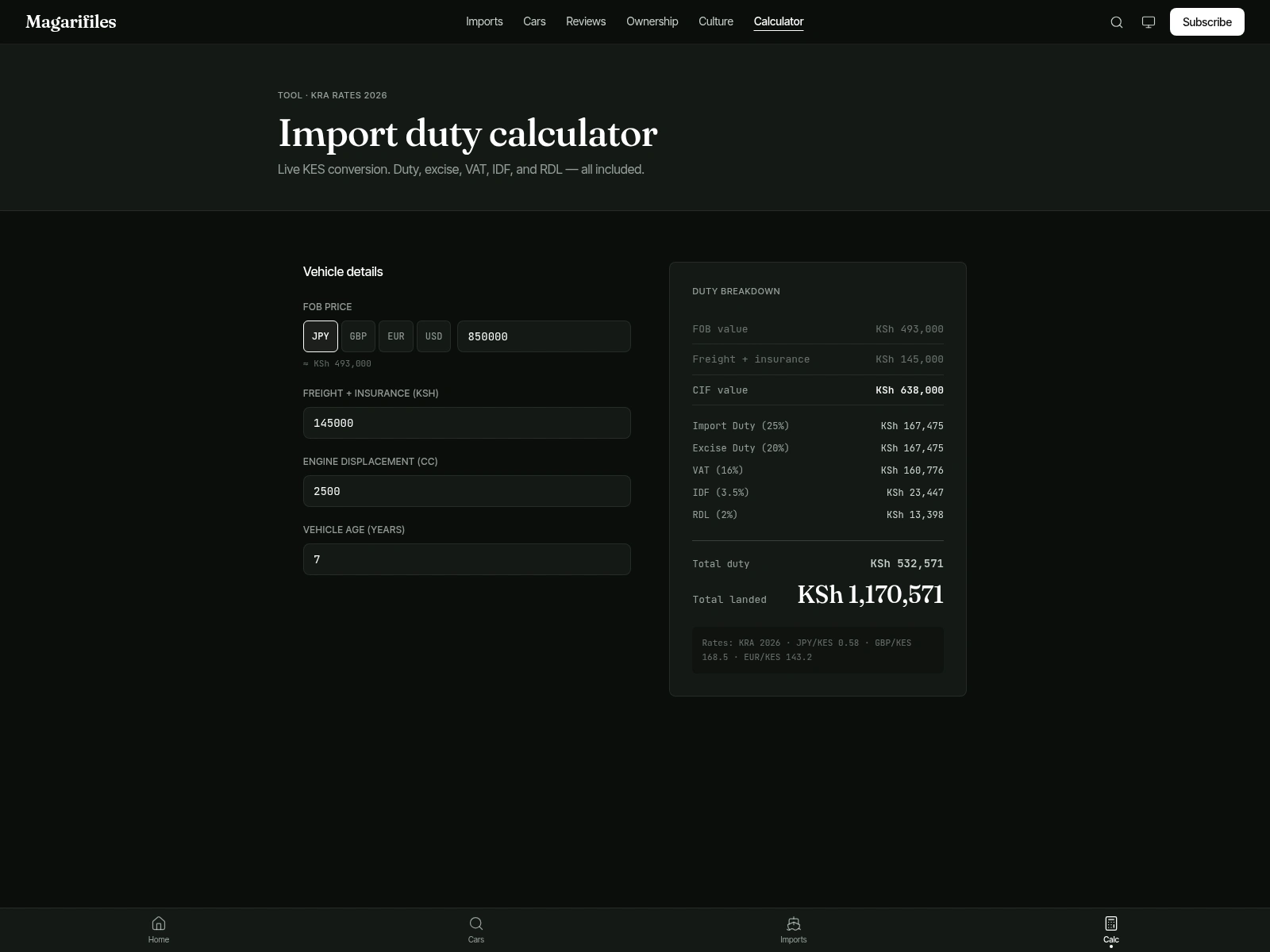
The thing the whole archive is built to support: a real import-duty calculator on current KRA rates. Enter FOB (in JPY/GBP/EUR/USD), freight, engine size, and age, and it returns the full breakdown (CIF, Import Duty, Excise, VAT, IDF, RDL) and the one number that actually matters: total landed cost in KSh. The monospace data styling makes it read like a customs worksheet, which is exactly the trust signal it needs.
4 - Design decisions worth calling out
Data deserves its own typeface. Prices, grades, and the duty breakdown are all set in mono. It's a small move that makes numbers feel precise and trustworthy, the opposite of a hype listing.
The accent is a scalpel, not a brush. One warm accent, used sparingly, keeps the dark theme calm and lets the photography carry the color.
AI as an art-direction multiplier. Magicpath AI carried the system and layout; Lummi and Kittl carried a consistent, brand-graded image and motion library. The win wasn't speed for its own sake; it was being able to hold visual consistency across seven sections while iterating like a much larger team.
Archive over funnel, on purpose. Every layout choice pushes toward reading and understanding rather than converting. That restraint is the brand.
5 - What v1 ships, and where it goes next
v1 (this design) establishes the brand, the seven-section architecture, the card and type systems, and the calculator as the centerpiece.
Next:
A real, queryable catalogue behind Cars, with deep links to individual vehicles.
Calculator presets per common import (tap a Mark X, get its numbers pre-filled).
Living duty rates so the calculator tracks KRA changes automatically.
Community-verified ownership data: let readers confirm workshops and real-world running costs.
Light mode and motion polish for the editorial pages.
Credits
Built as a personal project out of a genuine love for cars and the Kenyan import scene. Design system and layout in Magicpath AI; imagery via Lummi; imagery and hero videography via Kittl. Every image graded to one warm-dark palette so the whole archive, landing through calculator, reads as a single product.
Like this project
Posted Jun 16, 2026
Designed Magarifiles v1: an editorial car-import archive for Kenya, with a live duty calculator. UI/UX and interactive prototype, designed end to end.