Design and Development of Quell Meditation App MVP

Taylor Fredrickson


the problem.
Where to start with my gripes about meditation apps — I'll admit up front these are the problems of someone who has spent way too much time thinking about this —but I can't be alone.
The meditation app market is dominated by Calm and Headspace; broad wellness platforms that do many things adequately but breathwork poorly. Meanwhile, breathwork as a standalone practice has grown significantly, driven by renewed interest in nervous system regulation, sleep, and focus.
Most meditation apps are designed for beginners. The guidance is heavy, the hand-holding constant, and for anyone with an established practice the experience quickly becomes patronising.
The tone compounds it. Western wellness narration has a very specific voice, breathy, affirming, spiritually vague, that might work for newcomers but actively breaks the spell for anyone who knows what they're doing.
Quell is built for the practitioner who wants an environment that supports their breathing practice, and for anyone who simply wants to create a personal space for stillness, without being talked through it.
the solution.
Quell strips the experience back to what matters.
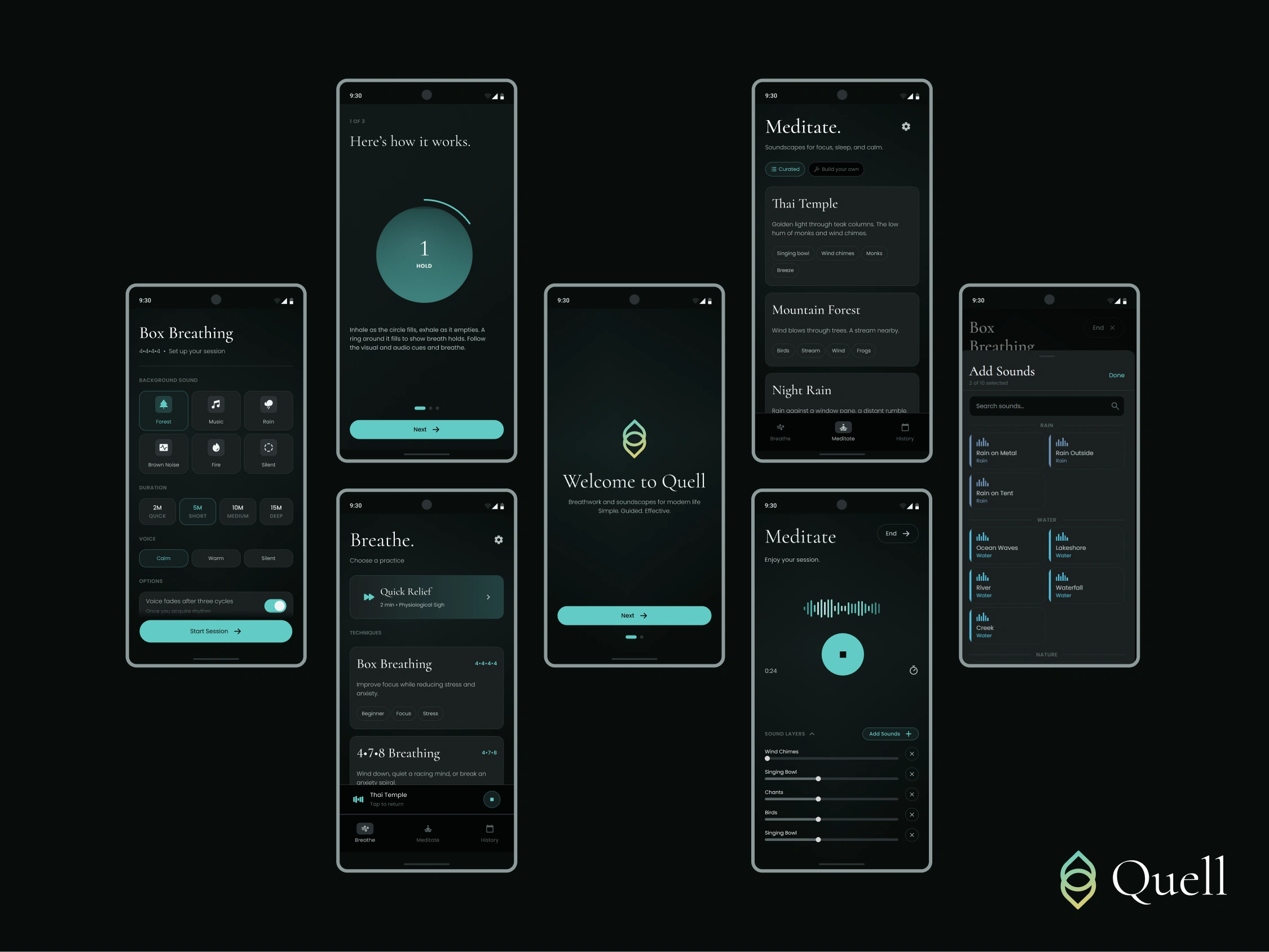
For breathing, five techniques covering a range of practice: from accessible entry points like Box Breathing and 4-7-8, through to more advanced methods like Cyclic Hyperventilation. Users can choose their ambience and the amount of help they want. Breathing patterns are communicated visually as well as with sounds.
For meditation, a library of ambient layers you control. Curated scenes for when you want something ready to go, and a full mixer for when you want to build your own; layering up to 10 sounds, balancing each one independently, and saving the combinations that work for you and when you aren't meditating you can create soundscapes for sleep, study and more.
the strategy.
Rather than jumping straight into design, I started with the product strategy. Who pays for this, what do they pay, and why would they choose it over free alternatives?
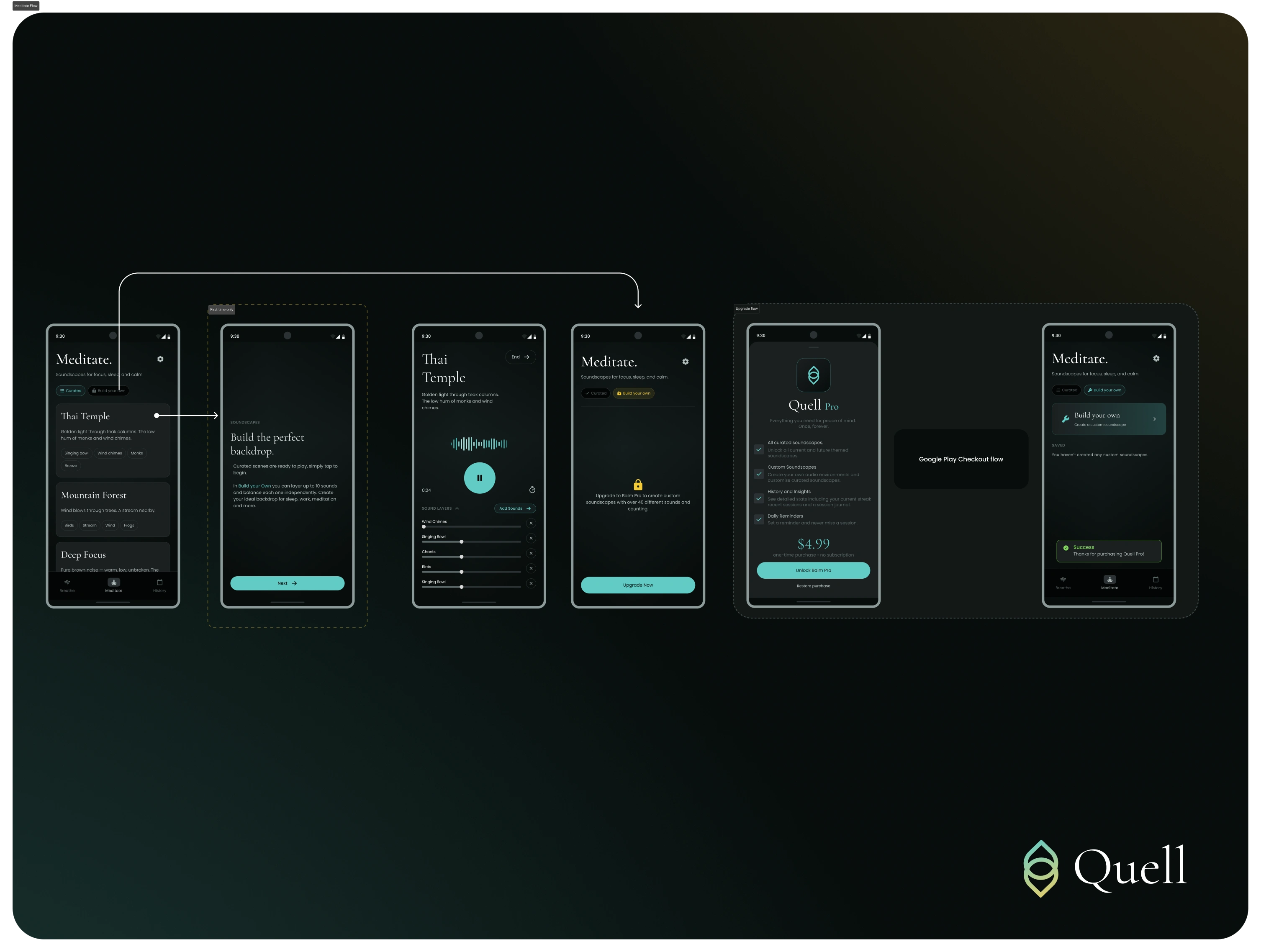
For the MVP, the monetization model landed on a $4.99 one-time unlock, deliberately chosen over subscription. At this price point, one-time purchases convert at roughly 8% versus 2–4% for subscriptions. For a solo-built MVP without a weekly content cadence, it's also more honest to the user. The free tier covers all breathing techniques. The paid unlock adds the full soundscape library, advanced history, and custom mixing.
With the business defined, I built the product around it.
the design.
First I mapped out the basic screens and logic. Then I set to work on the design system. I like to create basic components, not as final designs but as a way to see how color, type, and spacing work together in context. Once I refine it I create a semantic token system.
The app covers three core areas: Breathe (5 guided techniques with an animated phase timer), Meditate (curated soundscapes and a custom mixer with up to 10 layered sounds), and History (session tracking, streaks, and mood trends).
A few UX decisions worth noting:
Thoughtful session management. The soundscape mixer and the breath timer serve two different modes of attention, one active and editing, one passive and focused. Since breathing sessions are focused and time constrained, opening the sound mixer during a breath session automatically pauses the timer while the sounds continue. Close it and the session resumes. This way users can take their time finding the right sound balance without losing their session progress.
Safety warnings out of onboarding. Breathing practice does carry some risk, albeit small. Putting warnings in onboarding means they get skimmed. Moving them into a first-time guide that appears immediately before the first session means they're read in context, when they're relevant.
Persistent mini-player. Soundscapes have multiple contexts: active sound meditation, sleep, focus, background relaxation. The mini-player reflects this. When a soundscape is playing, a persistent control sits above the tab bar wherever you are in the app, waveform animation, scene name, play/pause and close. Breathwork is different. It demands full attention, so there is no mini-player for active sessions. The mode of the practice determines the mode of the interface.
the prototype.
I used AI tools throughout, to accelerate market research, pressure-test and quickly iterate on design decisions, and most of all build out interaction logic. The result is a fully functional React prototype built in Figma Make. Real session timers, animated breath phases, soundscape layering, and a save logic for custom soundscapes. It functions as both a design validation tool and a development handoff document. A developer has a complete functional prototype of the app which has massive impacts on development time.
Persistent and functioning save logic for custom soundscapes. When a user builds a soundscape in the mixer and saves it, it generates a custom scene card — identical in structure to the curated scenes — that lives in their Build Your Own library and can be accessed, played, or edited at any time.
Animated breath phases. The breath circle fills on inhale and empties on exhale. A separate outer ring acts as a hold timer, giving the user a clear visual cue for both the breath and the pause.
Sound layering. Each sound in the mixer has its own independent volume slider; add layers one at a time and balance them individually until the mix feels right.
the outcome.
Quell is a complete MVP from market research to interactive prototype in 5 days — with every design decision grounded in either UX rationale, business logic, or both.
The kind of work most designers don't show, because most designers don't do it.
If you need a designer who understands product strategy as well as craft, and can take an idea from first principles all the way to something you can put in a user's hands, that's where I come in.
Like this project
Posted Mar 12, 2026
Developed Quell a meditation and wellness app, from market research to UI/UX to a fully interactive React prototype in Figma Make.
Likes
0
Views
13
Timeline
Mar 8, 2026 - Mar 12, 2026