Smart Bicycle Light Design Project

Jerry Stark


Smart Bicycle Light
1. Executive Summary & Project Overview
The Smart Bicycle Light is a high-performance, weather-sealed urban commuter illumination system designed for modern cyclists. By combining multi-zone LED optics with integrated smart power management, the device provides adaptive roadway visibility, robust handlebar mounting, and thermal efficiency within a compact housing footprint.
Role: Lead Industrial Designer & CAD Hardware Engineer
Software: SolidWorks / Fusion 360 (CAD Modeling & Engineering Drawings), KeyShot (CMF & Studio Rendering)
Deliverables: Concept Ideation Sketches, Internal Structural CAD Cutaways, Color-Coded Component Mapping, 2D Production Blueprint, Photorealistic CMF Renders
2. Problem Statement & Urban Mobility Insights
Urban commuters face unpredictable lighting conditions, rapid weather transitions, and frequent vibration stress on city streets:
Inadequate Beam Control: Conventional cycle lights often blind oncoming traffic or lack peripheral road illumination.
Environmental Vulnerability: Standard USB charging ports and casing joints are prone to water ingress during heavy rain, leading to electronics failure.
Thermal Throttling: Compact high-lumen lights overheat quickly, reducing runtime and LED lifespan without structured passive cooling.
3. Optical & Industrial Design Concept
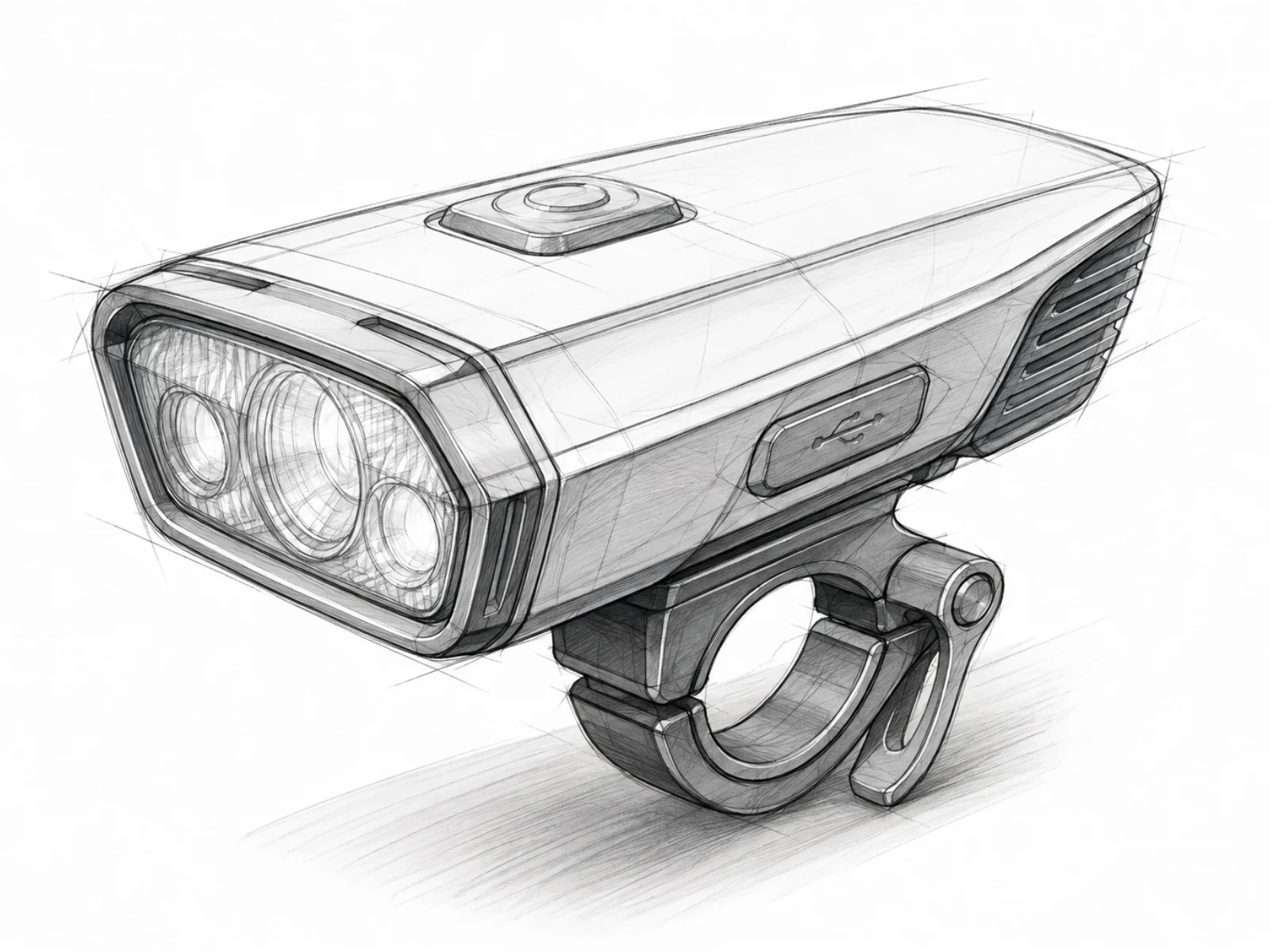
The physical architecture was developed through detailed perspective sketching to balance aerodynamic form with functional optical placement.
Triple-Lens Optical Array: A centralized primary high-lumen spot optic flanked by dual wide-angle flood lenses ensures both long-range street sightlines and peripheral lane visibility.
Form Factor: Aerodynamic, rectangular shell profile featuring subtle rear heatsink fins to dissipate thermal energy during continuous operation.
Quick-Release Mounting Interface: Integrated lower circular clamp with a cam-locking lever mechanism designed to securely fit standard Ø31.8mm handlebars.
4. Mechanical Architecture & Internal Component Layout
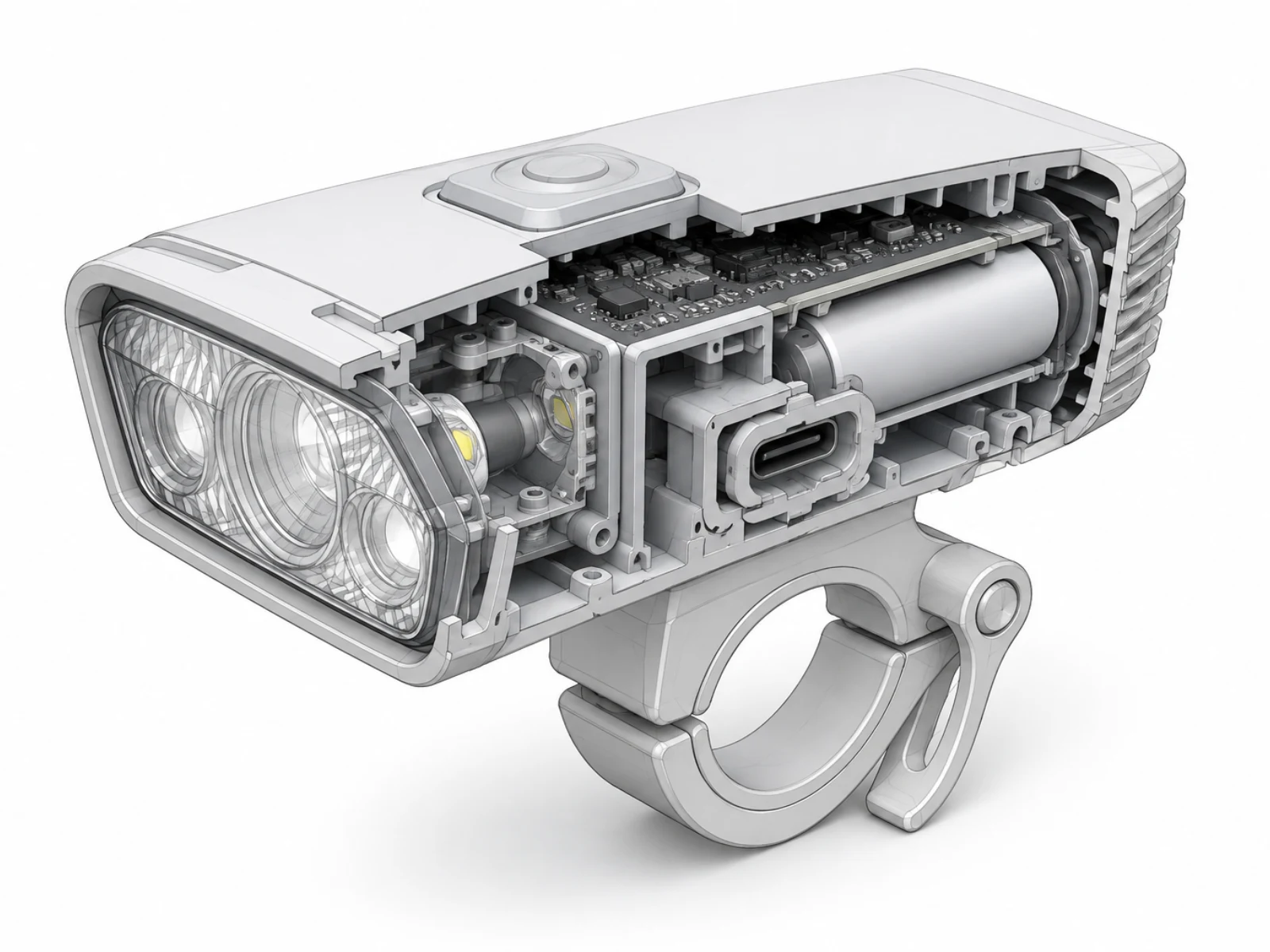
Internal cross-sections reveal a tightly packed, high-density layout designed for weight distribution and structural integrity.
(Derived from internal sectional CAD analysis)
Power Cell Positioning: The internal cylindrical lithium-ion battery sits longitudinally along the chassis core to optimize the center of gravity directly over the mounting axis.
Main Logic Board: Positioned directly above the battery, housing microcontrollers and thermal sensors for continuous power regulation.
5. DFM (Design for Manufacturing) & Engineering Specs
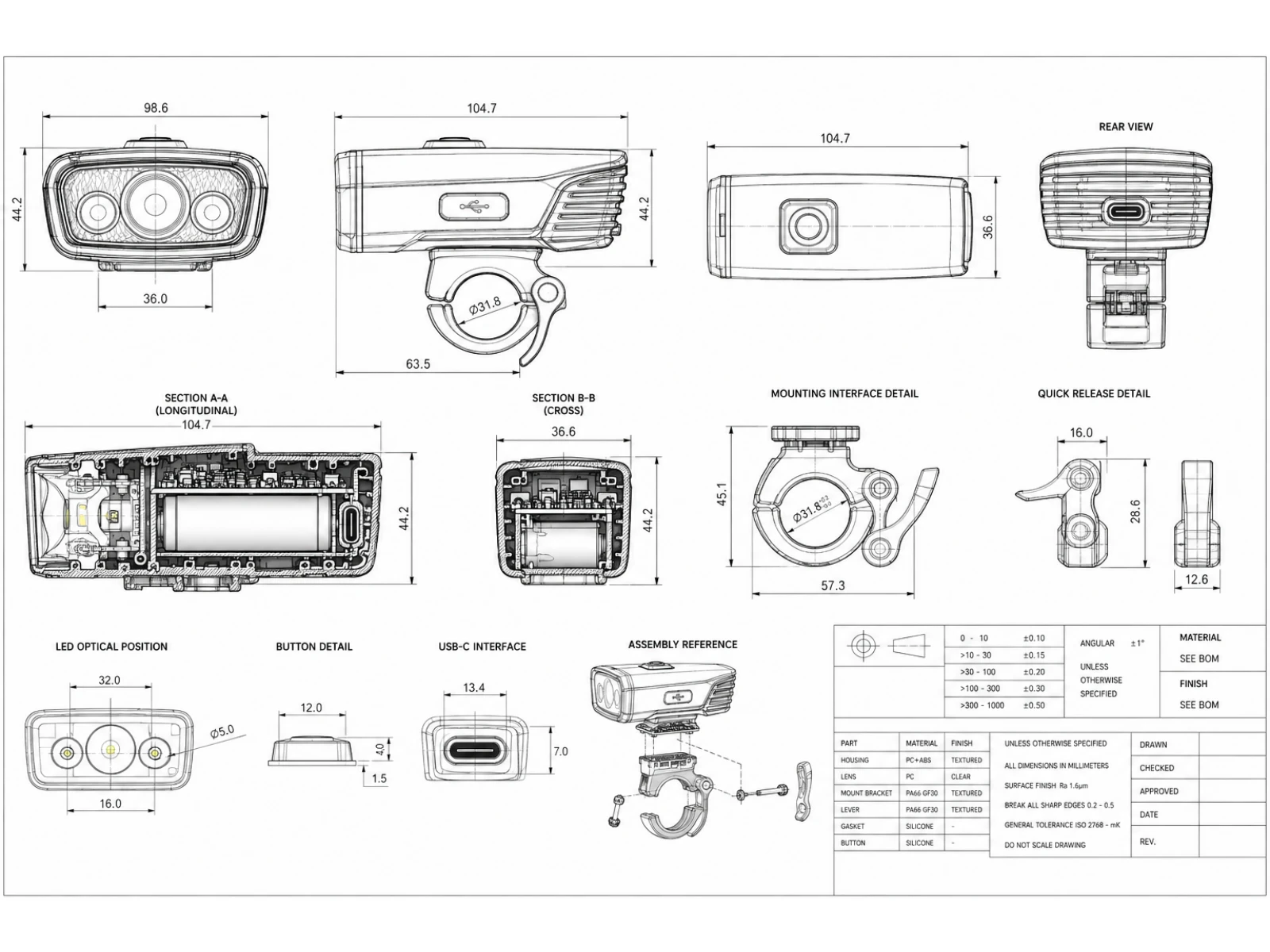
The engineering blueprint defines precise geometric dimensions, assembly stackups, and manufacturing tolerances:
Overall Envelope: 104.7mm length X 44.2mm total body height X 36.6mm width.
Optical Spacing: Center-to-center lens distance is spaced at 16.0mm and 32.0mm for optimal light diffusion across the forward reflector array.
Handlebar Clamp Specification: Designed for Ø31.8mm handlebar tubing with an interface height profile of 45.1mm and 57.3mm total clamp span.
Manufacturing Tolerances: Built to ISO 2768-mK general tolerances (±0.10mm for 0-10mm features; ±0.15mm for > 10-30mm).
6. CMF Strategy & Weatherproofing (IPX Rating & Materials)
Material selections balance impact resistance, weatherproofing, and weight reduction:
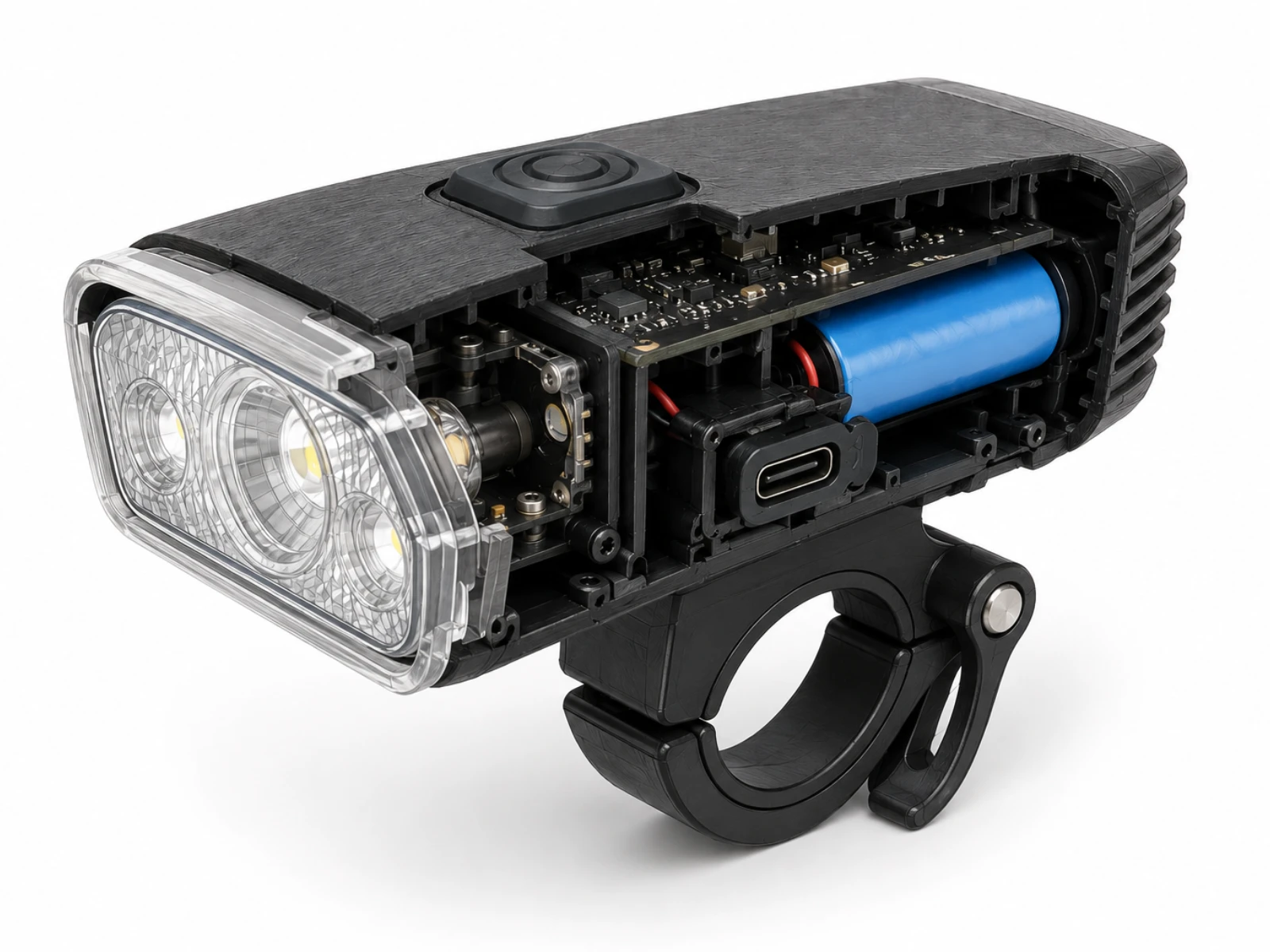
Housing Body (PC+ABS): Injection-molded textured PC+ABS blending structural durability with thermal stability.
Optical Front Lens (Clear PC): Optical-grade clear Polycarbonate with a surface finish fine-tuned for high transmission clarity.
Mounting Bracket & Lever (PA66 GF30): 30% glass-filled nylon (PA66 GF30) providing high fatigue resistance under continuous road vibration.
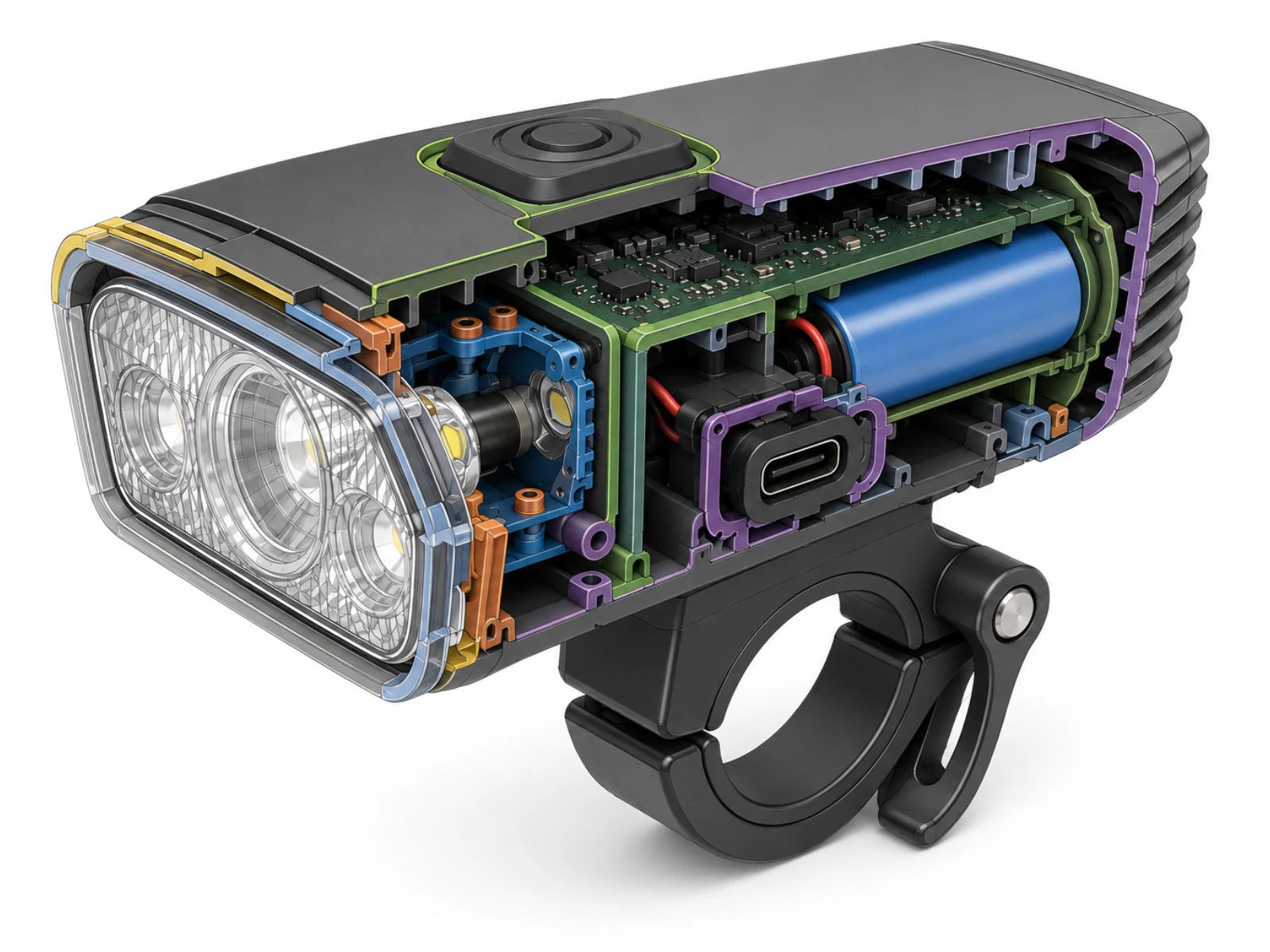
Sealing System (Silicone Gaskets & Seals): Integrated silicone perimeter gaskets, sealed top button overlays, and a tight USB-C port cap ensure full IPX-rated weatherproofing.
7. Photorealistic Studio Rendering
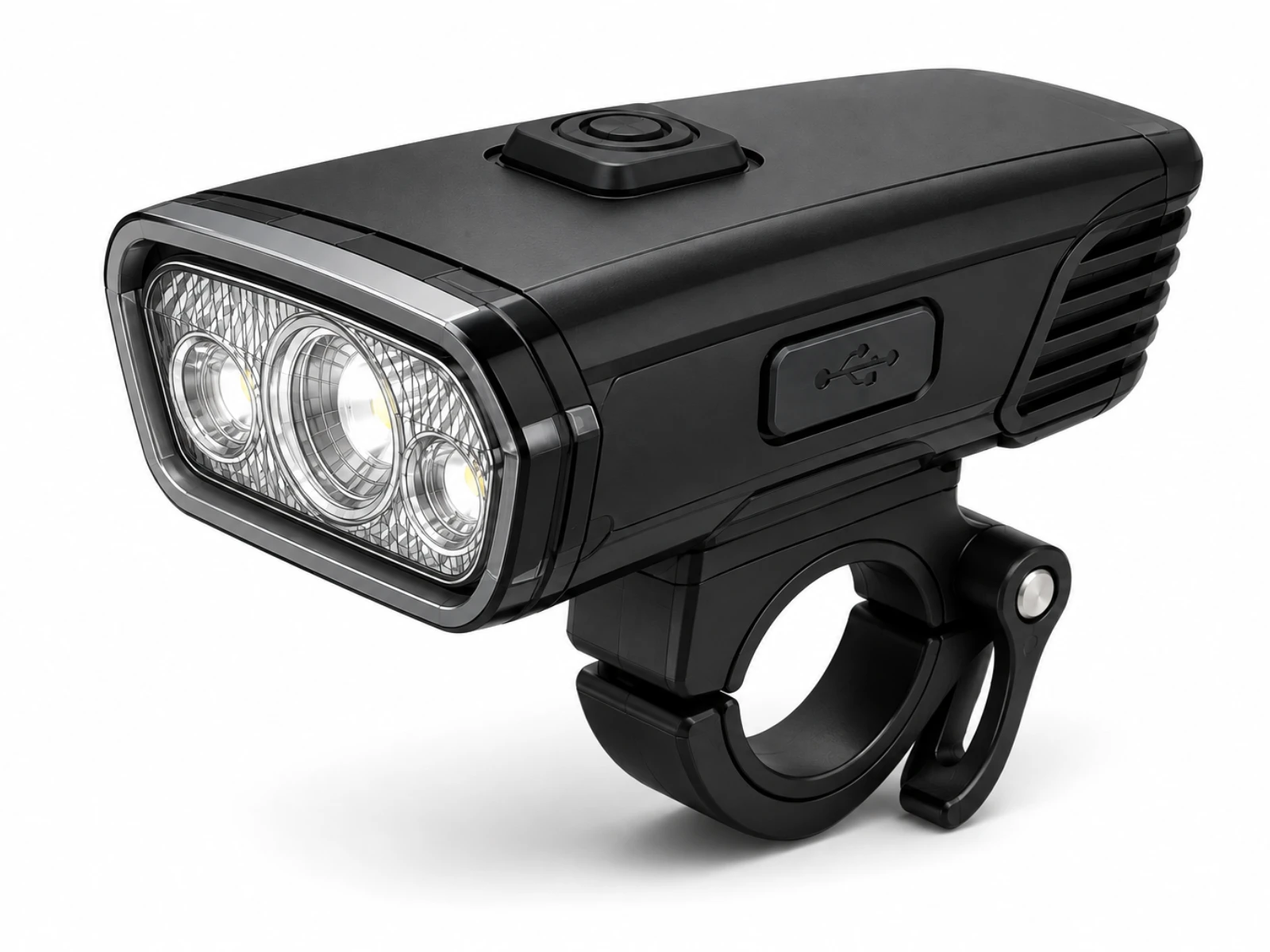
High-fidelity studio visualization highlights material textures, light refraction, and production tolerances:
Matte & Gloss Contrast: A matte black textured chassis offset by high-gloss bezel details framing the front lens assembly.
Internal CAD Cutaways: Exploded and sectioned color-coded CAD models effectively demonstrate structural ribbing, seal channels, and internal board placement to stakeholders.
Ergonomic Control Triggers: A top-mounted silicone power button with a 12.0mm X 12.0mm foot pattern ensures tactile operation even while wearing cycling gloves.
8. Results, Thermal Efficiency Testing & Final Takeaways
Compact Structural Packaging: Successfully integrated a multi-lens optical array, PCB board, and rechargeable cell into a sleek 104.7mm housing.
Passive Heat Management: Rear housing ribs dissipate thermal buildup directly away from the battery and central processor.
Production-Ready Blueprints: Complete 2D engineering drawings and color-coded CAD internal layouts ensure a smooth transition into tooling and injection molding workflows.
Like this project
Posted Sep 2, 2026
Designed a smart bicycle light system with advanced optics and thermal management.