GrowthFlow Hub

Waleed Ashraf Usmani


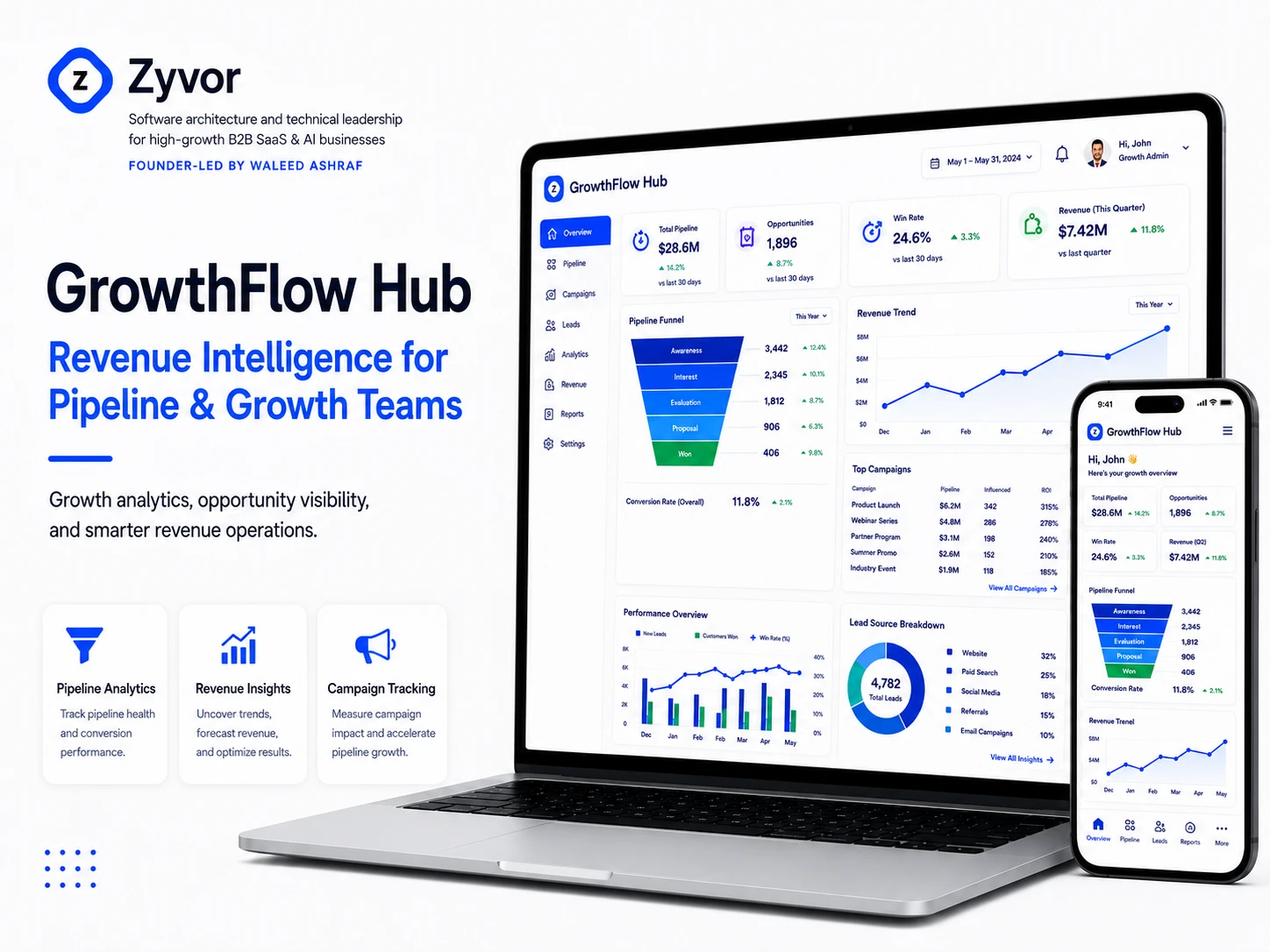
GrowthFlow Hub
The Problem
A B2B SaaS company at $4.5M ARR was scaling operations across sales, onboarding, and customer success but had no unified platform connecting these workflows. Each team ran its own tools, and the handoffs between them were where deals stalled, customers churned, and revenue leaked.
Sales closed deals in HubSpot, then emailed onboarding a spreadsheet with customer details. Average handoff time from closed-won to onboarding kickoff: 8 business days. 3 customers churned in the first 90 days citing "we signed up and then nothing happened for a week"
Onboarding was a 22-step checklist managed in Asana with no visibility into which steps were blocked, which were completed, and which were waiting on the customer. Onboarding completion averaged 34 days vs. a target of 14
Customer success had no health scoring. CSMs managed accounts based on gut feel and whoever complained loudest. Churn was discovered when the renewal invoice bounced, not weeks before when engagement dropped
Reporting required pulling data from HubSpot, Asana, Intercom, and Stripe into a master spreadsheet. The weekly leadership meeting spent 30 minutes reconciling numbers before any decisions could be made
No workflow automation between systems. When a deal closed, someone manually created an onboarding project, a Stripe subscription, an Intercom contact, and a customer success record. Missing any step caused downstream failures
Expansion revenue was invisible. Nobody tracked which customers were approaching usage limits, hitting feature walls, or showing signals that they'd upgrade with the right nudge
The company had product-market fit. It was losing customers and revenue in the operational gaps between teams.
The Approach
I built a unified operations hub that connects the entire customer lifecycle from deal close through onboarding, activation, retention, and expansion. Every team works from the same system with automated handoffs and real-time visibility into customer health.
Automated Deal-to-Onboarding Handoff
Deal closes → onboarding starts. Same hour. Zero manual steps.
✅ Webhook-triggered onboarding project creation on deal close, pre-populated with customer details, contract terms, and assigned CSM based on segment and region
✅ Automated welcome sequence: customer receives onboarding timeline, access credentials, and kickoff scheduling link within 1 hour of contract signature
✅ Handoff health tracking ensuring every closed deal has an active onboarding project within 4 hours, with escalation alerts for any that slip
📊 Outcome: Deal-to-onboarding handoff dropped from 8 business days to under 1 hour. Zero "signed up and nothing happened" complaints since launch. Early churn (first 90 days) reduced 64%
Structured Onboarding Workflows
22 steps. Clear ownership. Automatic escalation.
✅ Configurable onboarding templates with task dependencies, owner assignments, due dates, and customer-facing vs. internal steps clearly separated
✅ Automatic progress tracking with blocker detection: if a customer-dependent step stalls for 48+ hours, the system nudges the customer and alerts the onboarding lead
✅ Onboarding health dashboard showing all active onboardings with completion percentage, days elapsed, blocked steps, and projected completion date
📊 Outcome: Average onboarding completion dropped from 34 days to 16 days. Blocked step detection resolved 78% of stalls within 24 hours. Customer-reported onboarding satisfaction improved from 3.2 to 4.5/5
Customer Health Scoring
Know who's thriving and who's about to churn before they tell you.
✅ Composite health score combining product usage frequency, feature adoption depth, support ticket sentiment, NPS responses, and billing status
✅ Trend-based alerts: health score declining over 2+ weeks triggers proactive CSM outreach before the customer reaches critical status
✅ Segment-level health views showing which customer cohorts, industries, or plan tiers have the highest and lowest health distributions
📊 Outcome: Churn prediction accuracy hit 76% at 30 days before renewal. Proactive outreach recovered 38% of at-risk accounts. Net revenue retention improved from 94% to 108% through combined churn reduction and expansion
Expansion Revenue Intelligence
Spot upgrade opportunities before the customer asks.
✅ Usage-based expansion signals: customers approaching plan limits, frequently hitting feature gates, or showing usage patterns consistent with higher-tier customers
✅ Expansion opportunity queue for CSMs with recommended actions, talking points, and estimated expansion value per account
✅ Automated nurture sequences for accounts showing expansion signals but not yet ready for a direct conversation
📊 Outcome: Expansion revenue increased 42% in the first quarter. CSMs converting 28% of flagged expansion opportunities. Average expansion deal size: $18K ARR
Real-Time Operations Dashboard
One view. Every team. Every metric. Live.
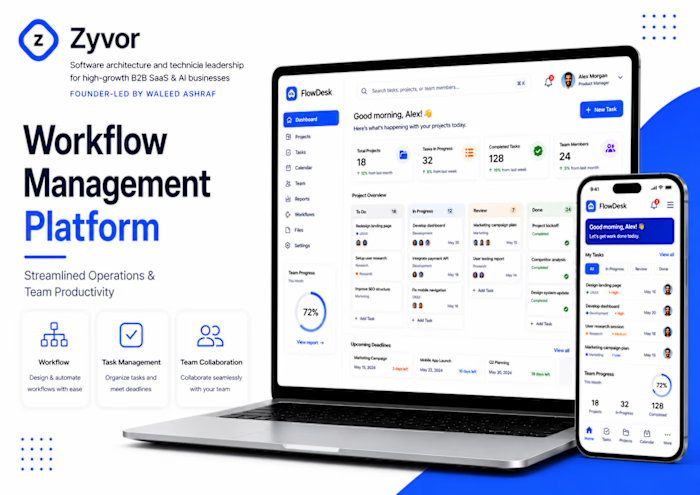
✅ Unified dashboard showing pipeline, onboarding, customer health, churn risk, expansion opportunities, and revenue metrics in a single view
✅ Automated weekly reports replacing the 30-minute reconciliation ritual with pre-computed, source-of-truth numbers
✅ Drill-down capability from high-level metrics to individual customer records without switching tools
📊 Outcome: Weekly leadership meeting reconciliation time eliminated. Decision-making shifted from "let me check the spreadsheet" to "I can see it right here." Cross-team visibility reduced finger-pointing and improved collaboration
Architecture Decisions
Why I chose this stack and what tradeoffs I made.
PostgreSQL as the unified data layer over syncing between tools — Customer data fragmented across 4 tools was the root problem. PostgreSQL serves as the single source of truth with integrations pushing data in rather than teams pulling from multiple sources. Tradeoff: migration effort upfront, but eliminated the reconciliation problem permanently
Redis for health score computation — Health scores recalculate on every relevant event (login, feature use, support ticket, payment). Redis stores the rolling computation state with sub-50ms reads for dashboard rendering. Batch recalculation runs nightly for trend analysis
SQS for cross-system workflow orchestration — Deal close triggers 5+ downstream actions (onboarding project, Stripe subscription, welcome email, CSM assignment, Intercom contact). SQS ensures every action completes even if one downstream system is temporarily unavailable
Next.js with role-based dashboards — Sales, onboarding, CS, and leadership all use the same application with different default views. Server-side role detection renders the appropriate dashboard. Shared components ensure metric definitions are consistent across all views
The Results
Timeframe | What Happened |
|---|---|
Week 1 | Automated handoff live. Deal-to-onboarding time dropped from 8 days to under 1 hour. Welcome sequences sending within 60 minutes of close |
Week 3 | Structured onboarding deployed. Average completion time started declining from 34 days. Blocker detection resolving stalls within 24 hours |
Month 1 | Health scoring live. First batch of at-risk accounts identified and flagged for proactive outreach. Onboarding completion down to 16 days |
Month 2 | Expansion intelligence identifying upgrade opportunities. CSMs converting 28% of flagged accounts. Early churn reduced 64% |
Month 5 | Net revenue retention improved from 94% to 108%. Expansion revenue up 42%. Platform managing full customer lifecycle from deal close through renewal across 200+ accounts |
Like this project
Posted May 16, 2026
B2B SaaS operations platform built with modular architecture, workflow orchestration, real-time analytics, async processing, and scalable reporting for operational growth.
Likes
0
Views
7
Timeline
Nov 1, 2024 - Feb 28, 2025
Clients
GMS Paints