WorkFlow Management Platform

Waleed Ashraf Usmani


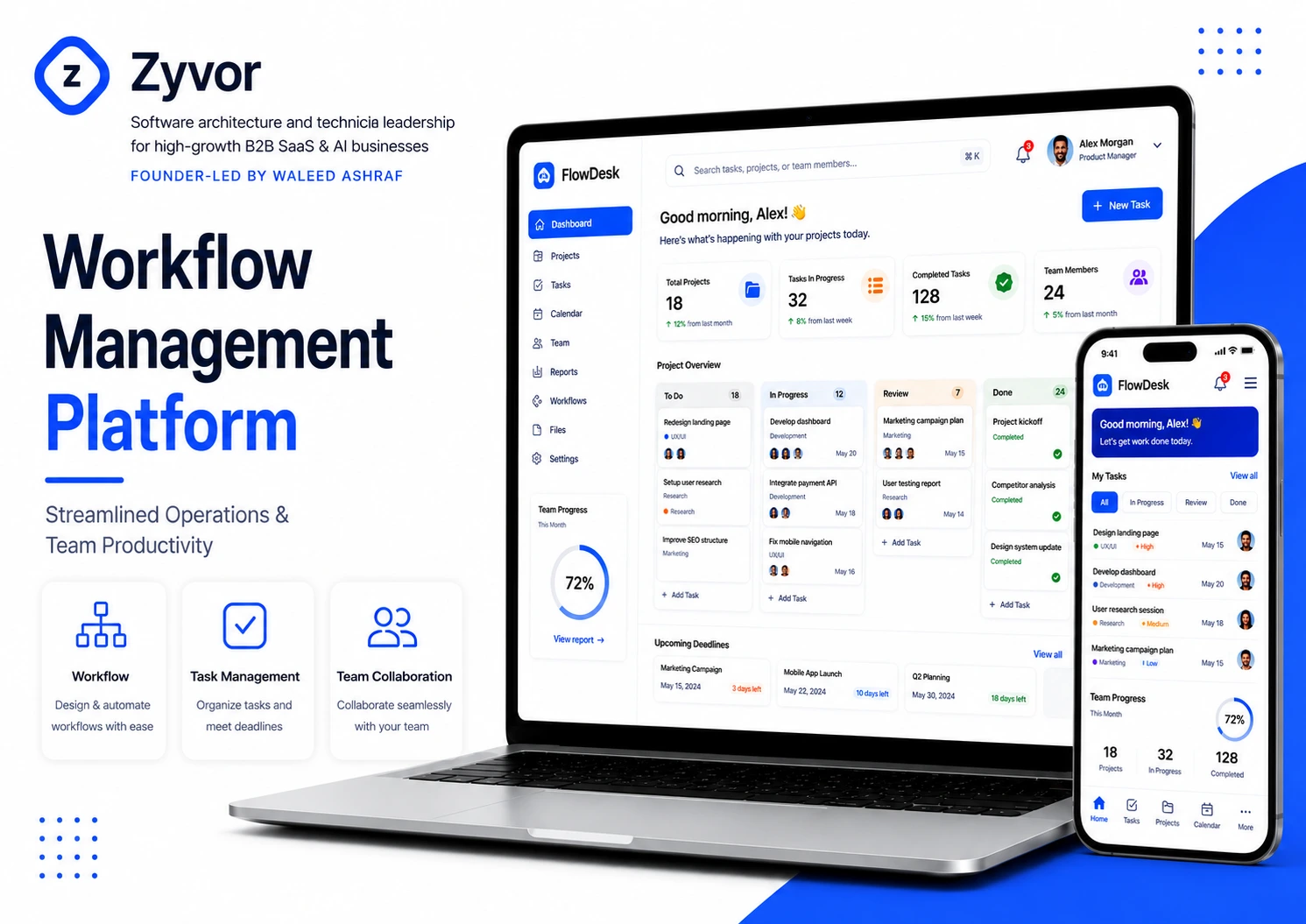
WorkFlow Management Platform
The Problem
A 120-person company operating across 4 offices and 3 time zones had no single source of truth for project status. Work lived in a patchwork of Trello boards, shared spreadsheets, Slack threads, and email chains. Nobody could answer "what's the status of Project X?" without pinging 3 people and waiting half a day.
14 active Trello boards with inconsistent column names, no standardized workflow stages, and no cross-board visibility. Each team ran their own system
Project deadlines tracked in spreadsheets that were outdated the moment they were shared. The Monday status meeting spent 40 minutes just reconciling what was actually done
Task assignments lived in Slack DMs. When someone went on leave, their work disappeared into unread message history
No workload visibility. Managers couldn't see who was overloaded and who had capacity. Resource allocation was gut feel and whoever complained loudest
Progress reporting required a project coordinator to manually compile updates from 6 team leads every Friday. The report took 5 hours to assemble and was stale by Monday
Cross-team dependencies were invisible. Team A would block Team B for 2 weeks before anyone realized the dependency existed
The company wasn't disorganized by choice. They'd outgrown their tools and every workaround made the problem worse.
The Approach
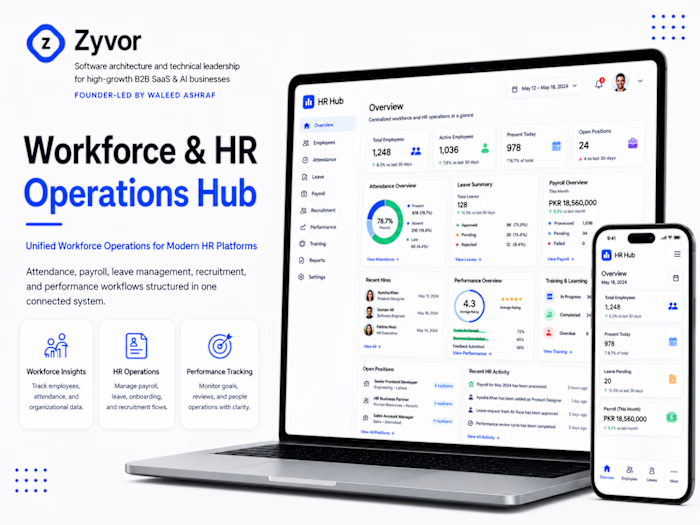
I built a unified project and task management platform that replaced the scattered tooling with a single system designed for distributed teams. Core principle: every question about project status should be answerable in one click, by anyone, without asking someone else.
Kanban Workflow Engine
Standardized project stages without killing team flexibility.
✅ Configurable board templates with default columns (Backlog, In Progress, Review, Done) that teams can customize per project
✅ Drag-and-drop task movement with automatic timestamp logging, status change notifications, and audit trail
✅ Swimlane views by assignee, priority, due date, or custom tags for different perspectives on the same board
📊 Outcome: 14 inconsistent Trello boards consolidated into 1 platform. Monday status meetings cut from 40 minutes to 12 minutes
Cross-Team Dependency Tracking
See blockers before they become 2-week delays.
✅ Task-level dependency linking across projects and teams with visual dependency graphs showing critical path
✅ Automatic blocker alerts when an upstream task slips, notifying downstream owners immediately
✅ Dependency health dashboard showing all active cross-team blockers, time-in-blocked-state, and escalation status
📊 Outcome: Cross-team blocking time reduced 64%. Dependencies that previously went unnoticed for weeks now surface within hours
Workload and Capacity Management
Stop guessing who has bandwidth.
✅ Real-time workload heatmap showing task count, estimated hours, and deadline density per team member across all projects
✅ Capacity planning view with drag-and-drop task rebalancing between team members
✅ Overload alerts when any team member exceeds configurable thresholds (task count, hours, or concurrent high-priority items)
📊 Outcome: Resource allocation shifted from gut feel to data. Overload incidents dropped 45% in the first month. Managers reassigned 30+ tasks in the first week using the heatmap
Automated Progress Reporting
Kill the Friday compilation ritual.
✅ Auto-generated weekly progress reports pulling completion rates, velocity trends, blocker summaries, and milestone status from live project data
✅ Configurable report templates per stakeholder level: team leads get task-level detail, executives get milestone summaries and risk flags
✅ Scheduled delivery to email and Slack. No manual compilation, no stale data
📊 Outcome: 5-hour weekly report assembly eliminated entirely. Reports now auto-generate and deliver every Friday at 9am with real-time accuracy
Real-Time Collaboration Layer
Work together without waiting for status updates.
✅ In-task commenting with @mentions, file attachments, and threaded discussions replacing Slack DMs for project communication
✅ Live presence indicators showing who's viewing or editing a task, preventing duplicate work
✅ Activity feed per project showing every status change, comment, and assignment in chronological order
📊 Outcome: Project-related Slack messages dropped 58%. Task handoff context preserved in-platform instead of disappearing into chat history
Architecture Decisions
Why I chose this stack and what tradeoffs I made.
PostgreSQL with row-level security over separate tenant databases — Multi-team access control needed granular permissions without the operational overhead of per-team database instances. Row-level security policies enforce team and project visibility at the database layer
Redis for real-time presence and notifications — Live presence indicators and instant status change notifications require sub-50ms delivery. Redis pub/sub handles 120 concurrent users across 4 offices without polling
Docker for consistent deployment — 4 offices with varying infrastructure. Containerized deployment ensures identical environments across staging and production. Rolling updates with zero downtime during business hours
WebSocket layer over polling — Kanban board updates, presence indicators, and notification delivery all use persistent WebSocket connections. Eliminated the 5-second polling lag that made collaborative boards feel sluggish
The Results
Timeframe | What Happened |
|---|---|
Week 1 | 14 Trello boards migrated. All 120 users onboarded. Monday status meeting dropped from 40 minutes to 12 minutes on the first try |
Week 2 | Dependency tracking surfaced 8 cross-team blockers that had been invisible. 3 were already causing delays. All resolved within the sprint |
Month 1 | Workload heatmap drove 30+ task reassignments. Overload incidents dropped 45%. Friday report compilation eliminated entirely |
Month 2 | Project-related Slack messages down 58%. Cross-team blocking time reduced 64%. Velocity increased 22% with no headcount change |
Month 5 | Platform handling 2,400+ active tasks across 35 projects. Average task cycle time reduced from 6.2 days to 3.8 days. Zero unplanned downtime |
Like this project
Posted May 6, 2026
Project and task management platform designed for kanban workflows, team collaboration, deadline tracking, progress reporting, and operational visibility across distributed teams.
Likes
0
Views
7
Timeline
Aug 1, 2022 - Nov 30, 2022
Clients
Sarwar Group