Workforce & HR Operations Hub

Waleed Ashraf Usmani


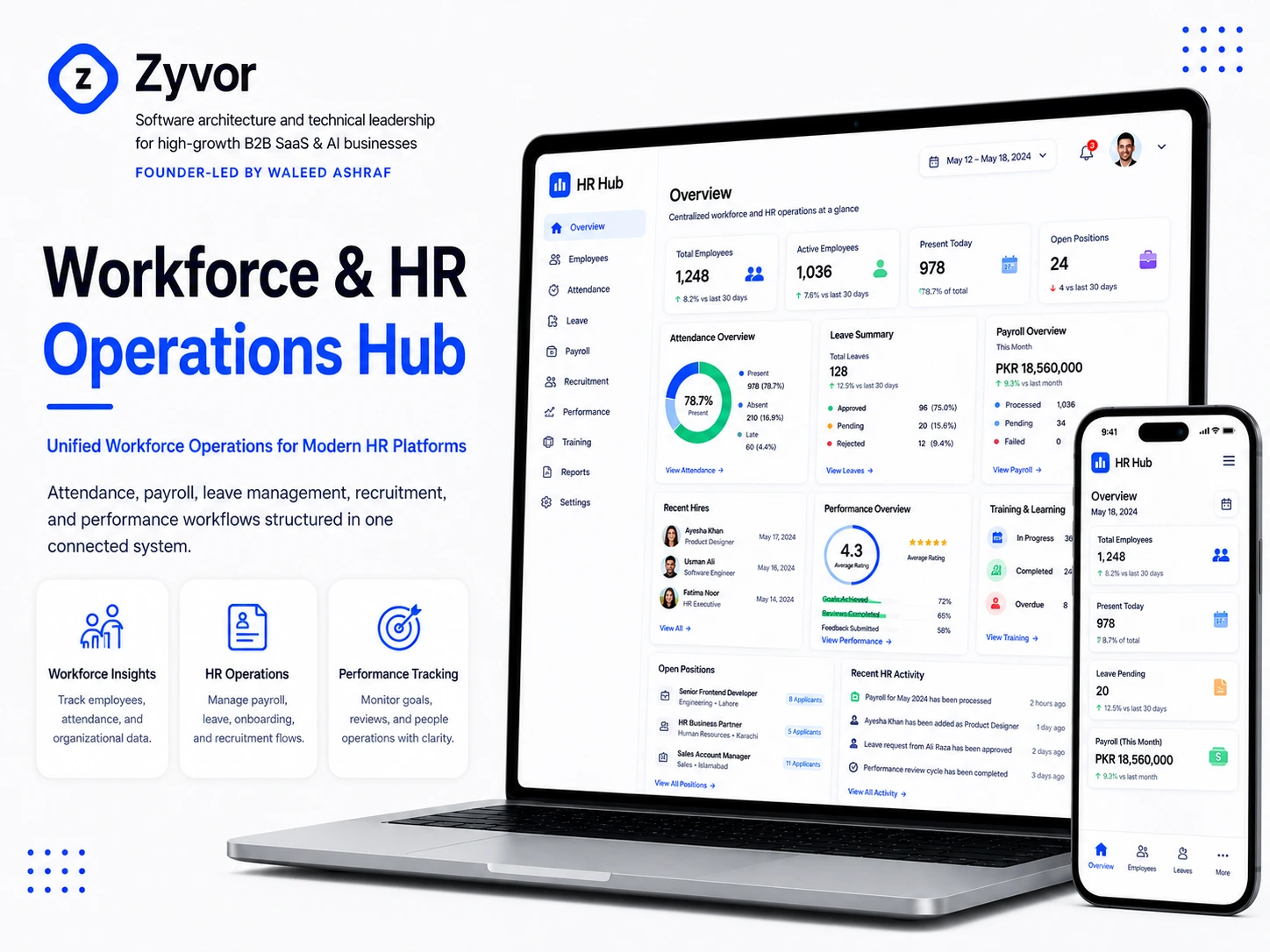
Workforce & HR Operations Hub
The Problem
A 450-person company operating across 3 countries was running HR on a patchwork of spreadsheets, email chains, and a legacy HRIS that hadn't been updated since 2019. Every HR process, from onboarding a new hire to processing a leave request, required manual coordination between 4+ people and took 3-5x longer than it should.
Employee onboarding involved 32 manual steps across HR, IT, facilities, and the hiring manager. Average time from offer accepted to fully productive: 18 business days. New hires routinely showed up on day 1 without a laptop, email account, or building access
Leave management was email-based. Employees emailed their manager, who forwarded to HR, who updated a spreadsheet. Leave balance discrepancies averaged 12% because the spreadsheet was always behind
Approval chains for promotions, salary changes, and role transfers required physical signature routing. A promotion approval touched 4 people and took an average of 11 business days. The employee often found out they were promoted weeks after the decision was made
Performance reviews happened annually in Google Docs with no standardized format, no historical tracking, and no connection to compensation decisions. Managers spent 6+ hours per review cycle filling out forms that nobody referenced afterward
Compliance reporting for 3 countries required pulling data from 5 different sources and manually reconciling headcount, compensation, leave balances, and contract types. Each quarterly report took 2 weeks to compile
The HR team of 6 spent 70% of their time on administrative tasks (data entry, chasing approvals, answering "what's my leave balance?" questions) and 30% on strategic work. The ratio was unsustainable at the company's growth rate
HR was supposed to be a strategic function. Instead, it was a data entry department with a compliance problem.
The Approach
I built a workforce management platform that automates HR operations, standardizes approval workflows, centralizes employee data, and delivers compliance reporting on demand. Designed so the HR team spends time on people, not paperwork.
Automated Employee Onboarding
32 manual steps → 1 automated pipeline.
✅ Onboarding workflow engine triggered on offer acceptance: IT provisioning (laptop, email, access), facilities setup (desk, badge, parking), HR documentation (contracts, tax forms, benefits enrollment), and manager tasks (team intro, first-week schedule) all orchestrated automatically
✅ New hire portal with self-service document upload, benefits selection, and onboarding progress tracker showing what's done and what's pending
✅ AI-powered onboarding assistant answering common new hire questions (office location, dress code, IT setup, benefits details) without HR involvement
📊 Outcome: Onboarding time dropped from 18 business days to 5. Day-1 readiness (laptop, email, access all working) improved from 62% to 98%. HR time per onboarding reduced from 8 hours to 45 minutes
Self-Service Leave and Attendance
No more email chains for a day off.
✅ Employee self-service portal showing real-time leave balances, team calendar with absence visibility, and one-click leave requests with automatic manager routing
✅ Policy engine enforcing country-specific leave rules (accrual rates, carryover limits, public holidays, mandatory leave) automatically across all 3 countries
✅ Manager dashboard showing team availability, pending requests, and coverage gaps before approving or declining
📊 Outcome: Leave balance discrepancies eliminated (from 12% error rate to real-time accuracy). "What's my leave balance?" questions to HR dropped 94%. Average leave request processing time: 2 hours (from 3+ days)
Multi-Level Approval Orchestration
Promotions, salary changes, and transfers processed in days, not weeks.
✅ Configurable approval chains with role-based routing, parallel approvals, delegation rules, and automatic escalation on SLA breach
✅ Mobile-friendly approval interface: review context, approve, reject, or request changes from any device
✅ Full audit trail on every approval decision with timestamps, comments, and the complete chain of custody
📊 Outcome: Promotion approval cycle dropped from 11 business days to 3. Salary change processing from 8 days to 2. Employees notified of decisions within hours of final approval, not weeks
AI-Enhanced Performance Management
Reviews that connect to outcomes, not just checkboxes.
✅ Continuous feedback system with peer recognition, manager check-ins, and goal tracking replacing the annual review cycle
✅ AI-generated review summaries pulling from continuous feedback, goal completion, and peer input to give managers a starting point instead of a blank page
✅ Performance-to-compensation linking: review outcomes feed directly into compensation planning with budget impact modeling
📊 Outcome: Manager time per review cycle reduced from 6+ hours to 1.5 hours. Review completion rate improved from 72% to 96%. Continuous feedback adoption hit 68% of employees within the first quarter
Automated Compliance Reporting
Three countries. One click. Audit-ready.
✅ Real-time compliance dashboards showing headcount, compensation distribution, leave utilization, contract status, and regulatory requirements per country
✅ Auto-generated quarterly reports with country-specific formatting, currency conversion, and regulatory categorization
✅ Contract expiry tracking with automatic renewal reminders and compliance alerts for visa-dependent employees
📊 Outcome: Quarterly compliance reporting dropped from 2 weeks to 1 click. Contract expiry surprises eliminated (90-day advance alerts). HR compliance audit prep reduced from 3 weeks to 2 days
Architecture Decisions
Why I chose this stack and what tradeoffs I made.
PostgreSQL with country-scoped partitioning — Employee data across 3 countries has different regulatory requirements. Table partitioning by country enables country-specific data retention policies and access controls while supporting cross-country aggregation for global reporting
OpenAI for onboarding assistant and review summaries — Onboarding questions and review summarization are natural language tasks that change as company policies evolve. RAG with company policy documents as context adapts immediately when policies update. No retraining needed
AWS with multi-region for data residency — Employee data for each country stored in the nearest AWS region to comply with local data residency requirements. Cross-region read replicas for global dashboards with sub-2-second replication lag
Next.js with role-based rendering — Employees, managers, HR admins, and executives all use the same application with different views. Server-side role detection renders the appropriate dashboard. Reduces codebase complexity and ensures consistent data definitions across all user types
The Results
Timeframe | What Happened |
|---|---|
Week 1 | Self-service leave portal live. Leave balance discrepancies eliminated. "What's my leave balance?" questions dropped 94% |
Week 3 | Automated onboarding pipeline deployed. First 12 new hires onboarded in 5 days vs. previous 18. Day-1 readiness at 98% |
Month 1 | Approval orchestration live. Promotion cycle from 11 days to 3. Continuous feedback system launched with 68% adoption in first month |
Month 2 | Compliance reporting automated across 3 countries. Quarterly report generation: 1 click. HR team time on admin tasks dropped from 70% to 30% |
Month 4 | Platform managing 450+ employees across 3 countries. Review completion rate at 96%. Contract expiry tracking preventing compliance gaps. HR team refocused on strategic initiatives |
Like this project
Posted May 16, 2026
Workforce management infrastructure platform designed for complex HR workflows, approval chains, operational reporting, and enterprise workforce processes.
Likes
0
Views
10
Timeline
Jul 1, 2025 - Oct 31, 2025
Clients
PeopleI