Multi-Tenant Operations Suite

Waleed Ashraf Usmani


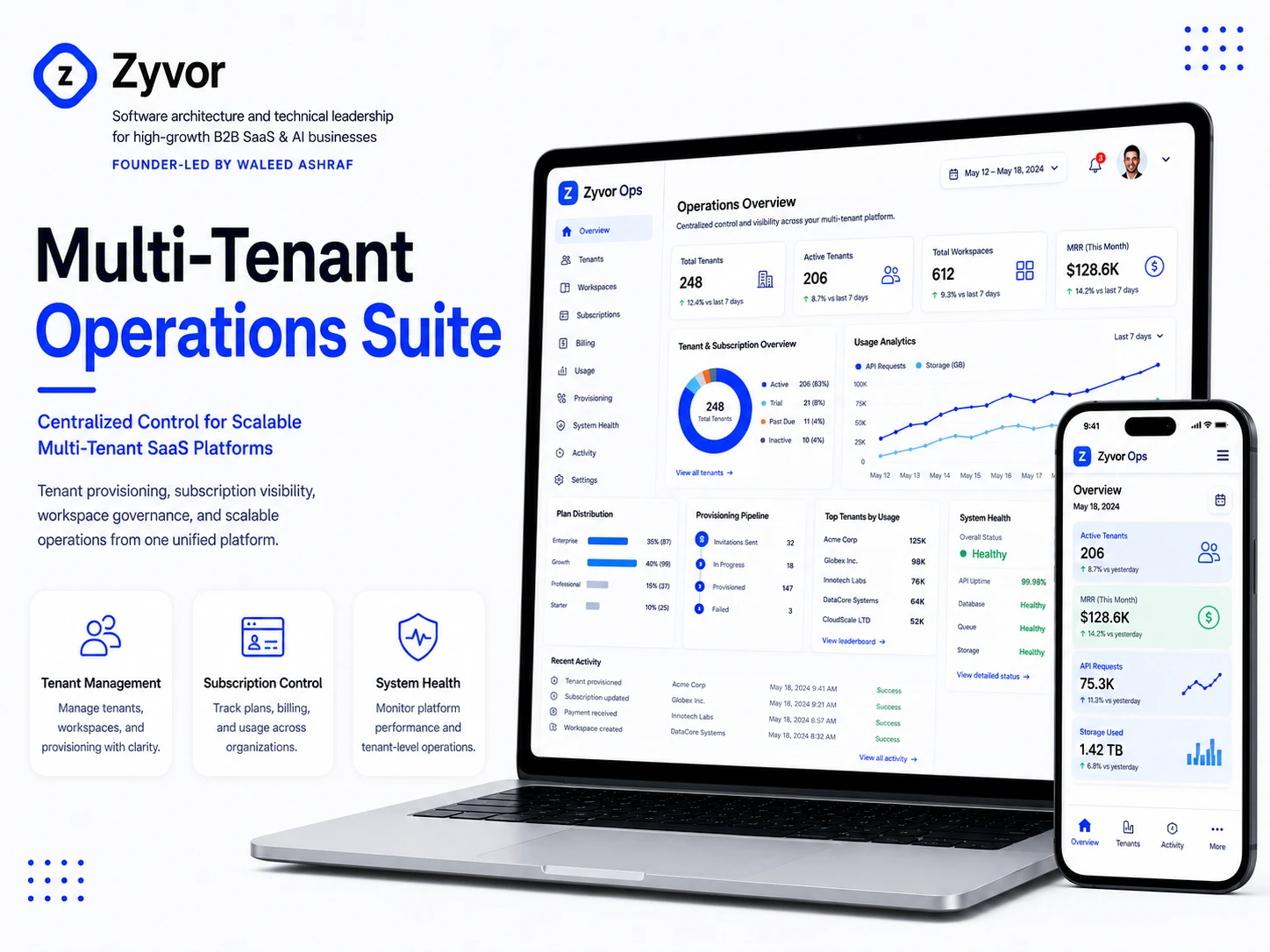
Multi-Tenant Operations Suite
The Problem
A B2B SaaS company onboarding 3-5 new enterprise clients per month was hitting a wall. Every new tenant required custom infrastructure provisioning, manual database setup, and 2 weeks of engineering time before the client could even log in. The platform was architecturally single-tenant, and bolting on each new client was becoming the engineering team's full-time job.
New tenant provisioning required an engineer to manually create a database, configure environment variables, set up DNS, deploy a tenant-specific instance, and run seed scripts. Average time from contract signed to tenant live: 14 business days
No tenant isolation at the application layer. A bug in one tenant's custom configuration could (and did) crash the shared application server, taking all tenants offline. This happened 3 times in 6 months
Role-based access control was hardcoded per tenant. Adding a new permission level required a code change, a deployment, and a prayer that it didn't break another tenant's access rules
Each tenant ran on a separate application instance with its own deployment pipeline. 18 tenants meant 18 deployments for every release. A single feature update took 2 full days to roll out across all tenants
Resource usage was invisible. The company couldn't tell which tenants consumed the most compute, storage, or bandwidth. Pricing was flat-rate, meaning heavy-usage tenants were subsidized by light-usage ones
Tenant-specific customizations (branding, workflows, integrations) were implemented as code branches. 18 tenants, 18 branches, 18 merge conflicts on every release
The company was selling a SaaS product but operating it like a managed hosting business. Every new client made the engineering team slower, not faster.
The Approach
I rebuilt the platform as a true multi-tenant architecture with shared infrastructure, tenant isolation at the data layer, automated provisioning, and a configurable permissions system. Goal: onboard a new tenant in minutes, not weeks, with zero engineering involvement.
Automated Tenant Provisioning
Contract signed → tenant live. Same day.
✅ Self-service tenant creation with automated database schema provisioning, DNS configuration, SSL certificate generation, and seed data population
✅ Tenant configuration wizard for branding (logo, colors, domain), default roles, and initial user setup completed by the client's admin, not an engineer
✅ Health check validation running automatically post-provisioning, confirming database connectivity, API access, and SSO configuration before marking the tenant as live
📊 Outcome: Tenant provisioning dropped from 14 business days to under 30 minutes. Engineering time per new tenant reduced from 2 weeks to zero. 5 tenants onboarded in the first week post-launch without engineering involvement
Tenant Data Isolation on Shared Infrastructure
Every tenant's data is isolated. The infrastructure is shared.
✅ Schema-per-tenant in PostgreSQL with connection pooling and query routing ensuring tenants never see each other's data
✅ Row-level security as a defense-in-depth layer: even if application logic has a bug, the database enforces tenant boundaries
✅ Tenant-scoped encryption keys for data at rest, ensuring a compromised key affects only one tenant
📊 Outcome: Cross-tenant data leakage risk eliminated at the database layer. Single shared infrastructure serving 30+ tenants vs. 18 separate instances previously. Infrastructure cost reduced 62%
Dynamic Role-Based Access Control
Permissions configured per tenant without code changes.
✅ Configurable role and permission system with tenant-specific role definitions, resource-level access rules, and inheritance hierarchies
✅ Admin UI for tenant administrators to create custom roles, assign permissions, and manage user access without contacting support
✅ Permission changes take effect immediately with no deployment required. Audit log captures every permission modification
📊 Outcome: Permission change requests to engineering dropped to zero. Tenant admins self-managing access for 500+ users across 30 tenants. Average time to configure a new role: 3 minutes
Unified Deployment Pipeline
One deployment. All tenants. Zero downtime.
✅ Single codebase with tenant-specific configuration stored in the database, not in code branches. Feature flags control tenant-specific functionality
✅ Rolling deployments with automatic canary testing: new version deployed to 2 tenants first, monitored for 15 minutes, then rolled out to all remaining tenants
✅ Instant rollback capability: any tenant can be reverted to the previous version independently if an issue is detected
📊 Outcome: Release cycle dropped from 2 days (18 separate deployments) to 25 minutes (1 rolling deployment). 18 code branches eliminated. Merge conflicts reduced to zero
Tenant Usage Analytics and Fair Pricing
Know exactly what each tenant consumes.
✅ Per-tenant resource metering tracking API calls, storage consumption, compute time, and bandwidth with daily granularity
✅ Usage dashboards for both the platform team (cross-tenant comparison) and tenant admins (their own consumption trends)
✅ Configurable usage alerts and soft limits preventing any single tenant from degrading performance for others
📊 Outcome: Usage data revealed 3 tenants consuming 60% of total compute. Pricing restructured to usage-based tiers, increasing revenue 22% while reducing costs for light-usage tenants
Architecture Decisions
Why I chose this stack and what tradeoffs I made.
Schema-per-tenant over database-per-tenant — 30+ tenants on separate databases means 30+ connection pools, 30+ backup schedules, and 30+ migration runs. Schema isolation provides equivalent data separation with shared infrastructure. Tradeoff: slightly more complex migration tooling, but dramatically simpler operations
Docker with Kubernetes over bare EC2 — Multi-tenant workloads need resource isolation and automatic scaling. Kubernetes namespaces provide compute isolation per tenant when needed, and horizontal pod autoscaling handles traffic spikes without manual intervention
Feature flags over code branches — Tenant-specific functionality controlled via LaunchDarkly-style feature flags stored in the database. No more branch-per-tenant. A single codebase serves all tenants with configuration-driven behavior differences
PostgreSQL connection pooling via PgBouncer — 30+ tenant schemas sharing one database cluster. PgBouncer manages connection pooling across tenants, preventing any single tenant from exhausting the connection limit during peak usage
The Results
Timeframe | What Happened |
|---|---|
Week 1 | Automated provisioning live. 5 tenants onboarded in the first week without engineering involvement. Provisioning time: under 30 minutes each |
Week 3 | 18 separate instances migrated to shared infrastructure. 18 code branches eliminated. Infrastructure cost dropped 62% |
Month 1 | Unified deployment pipeline running. Release cycle from 2 days to 25 minutes. Dynamic RBAC live, permission requests to engineering dropped to zero |
Month 2 | Usage analytics revealed pricing imbalance. 3 heavy-usage tenants identified. Pricing restructured to usage-based tiers, revenue up 22% |
Month 6 | Platform serving 30+ tenants on shared infrastructure. Zero cross-tenant data incidents. Tenant onboarding fully self-service. Engineering team refocused on product development |
Like this project
Posted May 16, 2026
Enterprise SaaS platform built with tenant isolation, automated onboarding, role-based permissions, shared infrastructure, and scalable multi-tenant architecture for secure platform growth.
Likes
0
Views
9
Timeline
Nov 1, 2025 - Feb 28, 2026
Clients
Sarwar Group