AI Workflow Automation Suite

Waleed Ashraf Usmani


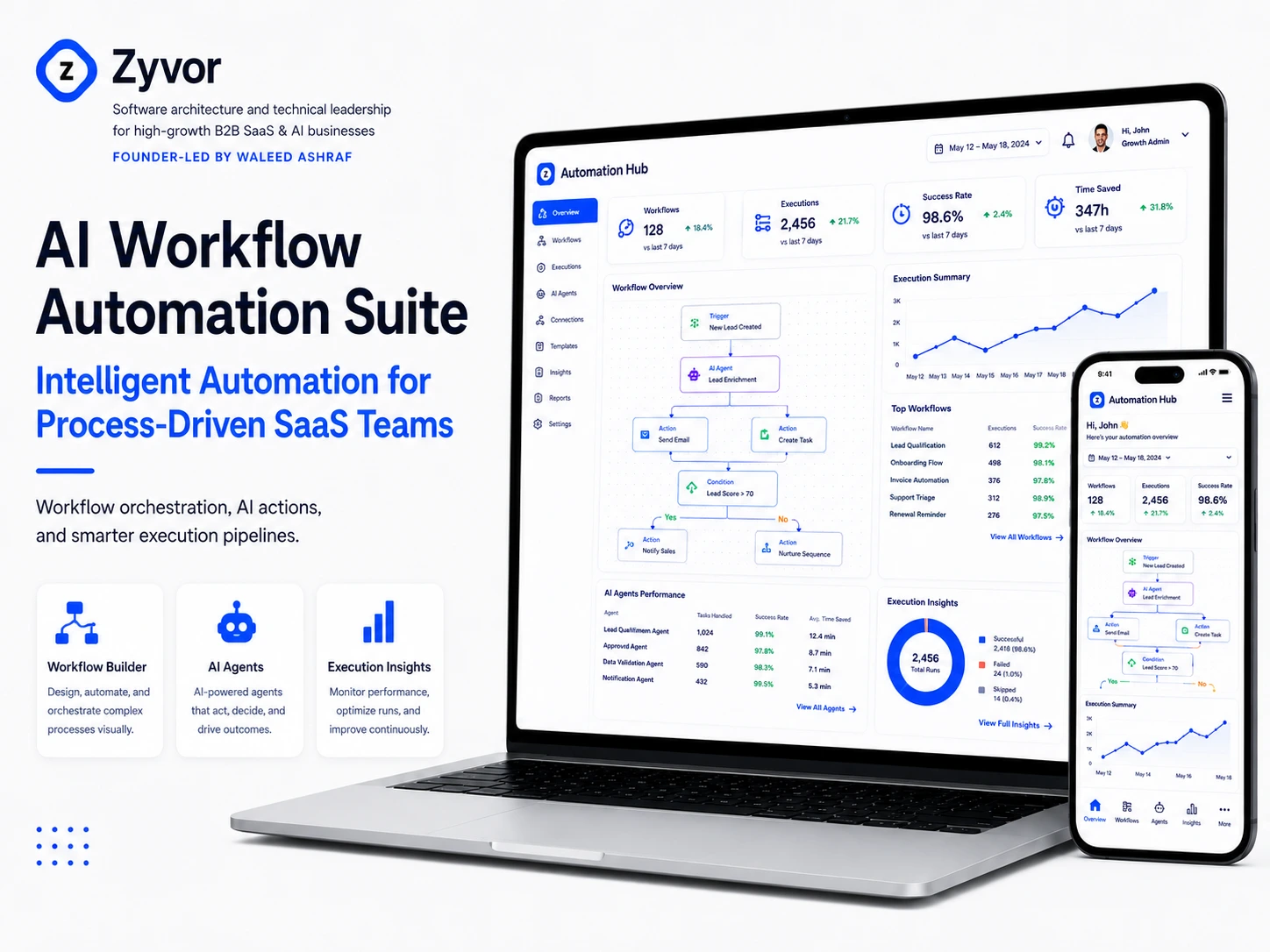
AI Workflow Automation Suite
The Problem
An operations-heavy SaaS company processing 2,000+ daily tasks across 5 departments was running on manual workflows held together by Slack messages, shared spreadsheets, and tribal knowledge. Every task required human routing, human approval, and human follow-up. The operations team was growing headcount 30% year-over-year just to keep up with volume, not to improve quality.
Task routing was manual. When a customer submitted a request, an operations coordinator read it, decided which team should handle it, and forwarded it via Slack. Average routing time: 2.4 hours. Misrouted tasks (sent to the wrong team): 18%
Approval workflows required chasing managers through Slack DMs. A $500 refund approval sat in someone's unread messages for 3 days while the customer waited. No escalation logic, no SLA tracking, no visibility into bottlenecks
Document processing was entirely manual. The team processed 400+ documents daily (invoices, contracts, support attachments) by reading each one, extracting key fields, and entering data into the system. Error rate: 6%. Processing time: 8 minutes per document
No workflow templates. Every recurring process (employee onboarding, vendor setup, quarterly reviews) was executed from memory. When the person who "knew how to do it" was out, the process stalled or was done incorrectly
Execution pipelines had no monitoring. Multi-step processes (order fulfillment, account provisioning, compliance checks) ran as a series of manual handoffs. If step 3 of 7 failed, nobody knew until step 7 produced wrong results
The operations team spent 60% of their time on routing, chasing approvals, and data entry. 40% on actual decision-making and problem-solving. The ratio was getting worse every quarter
The company was hiring people to do work that machines should handle, and burning out the people who should be doing the work that machines can't.
The Approach
I built an AI-powered workflow automation platform that handles intelligent task routing, document processing, approval orchestration, and execution monitoring. Human-in-the-loop where judgment matters. Fully automated where it doesn't.
AI-Powered Task Routing
The right task reaches the right team in seconds, not hours.
✅ Natural language classification using OpenAI to analyze incoming requests and route them to the correct department based on content, urgency, and historical routing patterns
✅ Confidence-based routing: high-confidence classifications route automatically, low-confidence ones queue for human review with AI-suggested routing and reasoning
✅ Continuous learning: human corrections on misrouted tasks feed back into the model, improving accuracy over time
📊 Outcome: Task routing time dropped from 2.4 hours to under 30 seconds for auto-routed tasks. Misrouting rate dropped from 18% to 3%. Operations coordinator routing workload reduced 85%
Intelligent Document Processing
400 documents/day processed in minutes, not hours.
✅ AI-powered extraction pulling key fields (dates, amounts, names, line items, terms) from invoices, contracts, and support attachments with structured output
✅ Validation rules checking extracted data against business logic (amount thresholds, date ranges, required fields) before system entry
✅ Human review queue for low-confidence extractions with AI-highlighted fields and suggested corrections, reducing review time to under 1 minute per document
📊 Outcome: Document processing time dropped from 8 minutes to 45 seconds per document (including human review for low-confidence items). Error rate reduced from 6% to 0.8%. Team processing 400+ documents/day with 70% less manual effort
Approval Queue Orchestration
No more chasing approvals through Slack DMs.
✅ Configurable approval workflows with role-based routing, parallel and sequential approval chains, and delegation rules for out-of-office approvers
✅ SLA tracking with automatic escalation: if an approval isn't actioned within the configured window, it escalates to the next level with full context
✅ Mobile-friendly approval interface: approve, reject, or request changes with one tap from email or Slack notification
📊 Outcome: Average approval turnaround dropped from 3 days to 4 hours. SLA compliance hit 94% (vs. unmeasured previously). Escalation logic resolved 100% of stalled approvals within 24 hours
Execution Pipeline Monitoring
See every step of every process. Know instantly when something breaks.
✅ Visual pipeline builder for multi-step workflows with conditional branching, parallel execution, and error handling at each step
✅ Real-time execution dashboard showing all active pipelines, current step, elapsed time, and health status
✅ Automatic retry with configurable policies per step. Failed steps trigger alerts with full context, and the pipeline pauses until the issue is resolved (no more silent failures propagating downstream)
📊 Outcome: Silent pipeline failures eliminated. Mean time to detect a failed step dropped from "whenever someone noticed the wrong output" to under 2 minutes. Pipeline completion rate improved from 82% to 98%
Human-in-the-Loop Decision Framework
AI handles the routine. Humans handle the judgment calls.
✅ Configurable automation boundaries: each workflow step can be set to fully automated, AI-suggested-human-approved, or fully manual based on risk and complexity
✅ Decision audit trail capturing AI recommendations, human overrides, and reasoning for every decision point
✅ Automation confidence dashboards showing which workflow steps are candidates for increased automation based on human override frequency
📊 Outcome: Operations team time allocation shifted from 60% routine / 40% decision-making to 20% routine / 80% decision-making. Team handling 35% more volume with the same headcount. Automation confidence data identified 12 additional steps ready for full automation
Architecture Decisions
Why I chose this stack and what tradeoffs I made.
OpenAI with RAG over fine-tuned models for task routing — Routing categories change as the business evolves. RAG with company-specific context documents adapts immediately when new departments or task types are added. Fine-tuned models would require retraining on every organizational change
Redis for pipeline state and execution tracking — Active pipeline state needs sub-50ms reads for the real-time dashboard. Redis stores current execution state per pipeline. PostgreSQL persists completed pipeline history for analytics and audit
SQS for step-to-step handoffs — Each pipeline step publishes its output to SQS, and the next step consumes it. Queue-based handoffs provide natural retry boundaries and prevent one slow step from blocking the entire pipeline
Next.js with WebSocket for real-time dashboards — Pipeline monitoring requires live updates as steps complete, fail, or escalate. WebSocket connections push state changes to the dashboard in real time. Server-rendered initial load with client-side live updates
The Results
Timeframe | What Happened |
|---|---|
Week 1 | AI task routing live. Routing time dropped from 2.4 hours to under 30 seconds. Misrouting rate started declining from 18% |
Week 3 | Document processing automated. 400+ documents/day processing in 45 seconds each vs. 8 minutes. Error rate dropped from 6% to 0.8% |
Month 1 | Approval orchestration deployed. Average turnaround from 3 days to 4 hours. Pipeline monitoring catching failures in under 2 minutes |
Month 2 | Misrouting rate stabilized at 3%. Operations team shifted to 80% decision-making work. Pipeline completion rate at 98% |
Month 5 | Platform processing 2,000+ daily tasks with 35% more volume on same headcount. 12 additional workflow steps identified for full automation. Zero silent pipeline failures since launch |
Like this project
Posted May 16, 2026
AI-powered automation system designed to manage intelligent task routing, approval queues, execution pipelines, and human-in-the-loop workflows through a scalable SaaS architecture.
Likes
0
Views
8
Timeline
Mar 1, 2026 - Ongoing
Clients
PeopleI