API Gateway Console

Waleed Ashraf Usmani


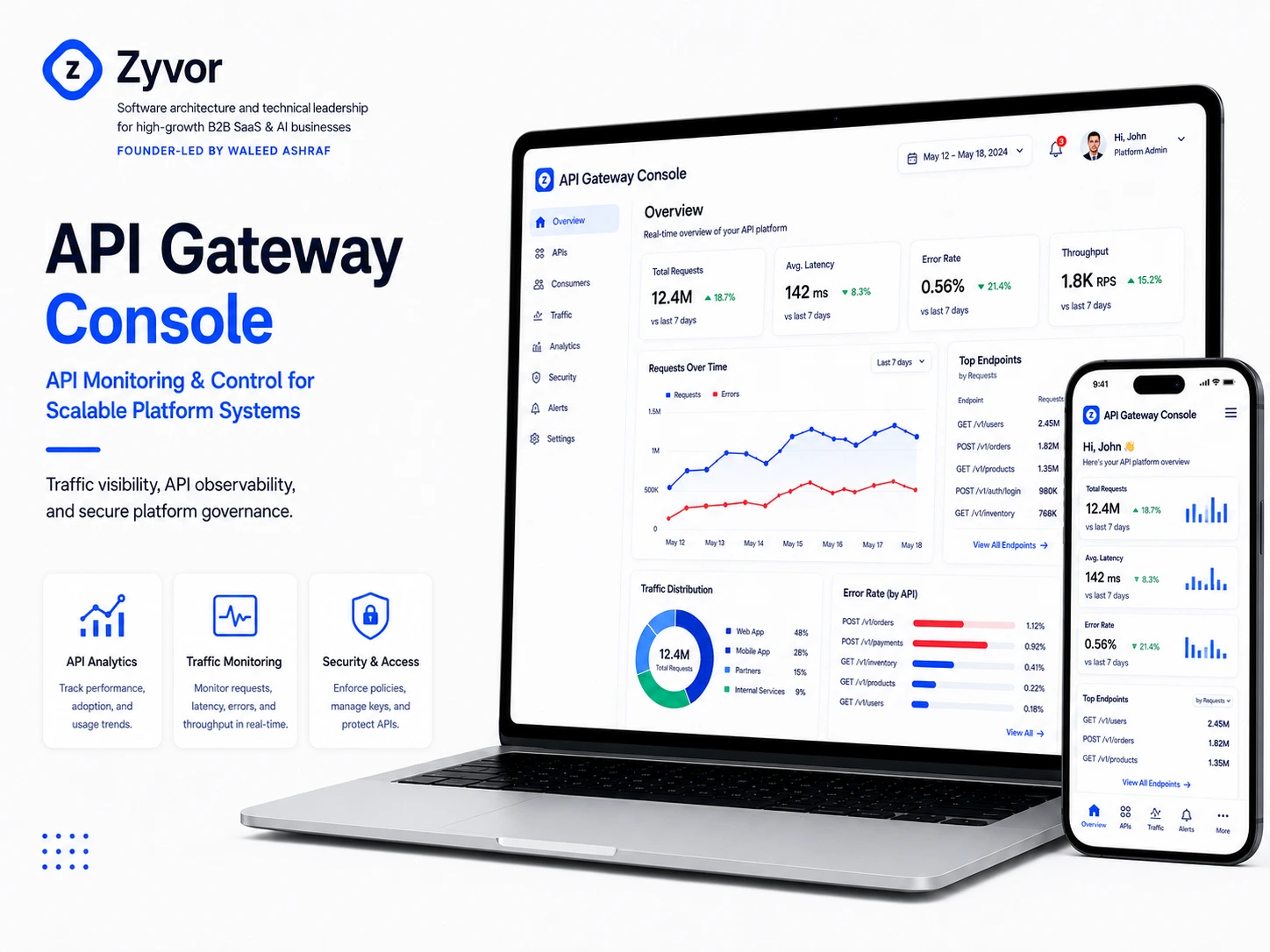
API Gateway Console
The Problem
A platform company exposing APIs to 60+ external partners had no centralized gateway. Each API was deployed independently with its own authentication, rate limiting, and documentation. Partners complained about inconsistent behavior, and the engineering team spent more time managing API access than building API features.
Authentication was implemented differently across 8 API services. Some used API keys, some used OAuth, some used both. Partners integrating with multiple services needed separate credentials for each
Rate limiting was per-service with no global coordination. A partner could exhaust their rate limit on Service A and still hammer Service B. No aggregate throttling, no partner-level quotas
API documentation was scattered across 4 Notion pages, 2 Swagger files, and a README in a private GitHub repo. 35% of support tickets were "the API doesn't match the documentation"
No request validation at the gateway level. Malformed requests passed through to backend services, causing cryptic 500 errors instead of clear 400 responses
Usage analytics didn't exist. The business team couldn't answer "which partners use which APIs?" Pricing decisions were based on guesses
Onboarding a new API partner took 2 weeks of engineering time: credential provisioning, rate limit configuration, documentation walkthrough, and sandbox setup
The APIs were the product. The access layer was the bottleneck.
The Approach
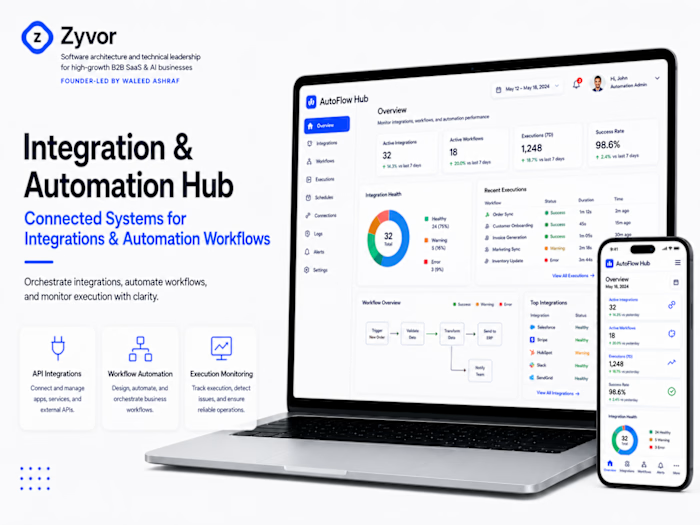
I built a centralized API gateway and management console that handles authentication, rate limiting, request validation, documentation, analytics, and partner onboarding in a single platform.
Unified Authentication Layer
One credential set. Every API. Consistent behavior.
✅ Centralized API key and OAuth 2.0 management with partner-scoped credentials that work across all services
✅ Key rotation with grace periods: new keys activate immediately, old keys remain valid for 72 hours preventing integration downtime
✅ Scoped access control: partners granted access to specific endpoints, methods, and data scopes
📊 Outcome: Partner credential management consolidated from 8 systems to 1. Authentication-related support tickets dropped 82%
Intelligent Rate Limiting
Partner-level quotas that protect every service simultaneously.
✅ Global rate limiting per partner with configurable quotas across all API services
✅ Tiered policies: free partners get 1K requests/hour, standard get 10K, enterprise get custom limits with burst allowances
✅ Rate limit headers on every response showing remaining quota and retry-after on 429s
📊 Outcome: API abuse incidents dropped to zero. Backend service overload events eliminated. Fair usage enforced across 60+ partners
Request Validation and Error Standardization
Bad requests caught at the door, not in the basement.
✅ Schema-based request validation at the gateway checking every request against OpenAPI specs before reaching backends
✅ Standardized error responses with consistent codes, human-readable messages, and documentation links
✅ Request transformation normalizing headers, date formats, and pagination parameters before forwarding
📊 Outcome: Malformed requests reaching backends dropped 94%. "API doesn't match docs" tickets dropped from 35% to under 3%
Auto-Generated API Documentation
Always accurate. Always current. Zero manual maintenance.
✅ Documentation auto-generated from OpenAPI specs with interactive "try it" functionality and code examples in 6 languages
✅ Changelog tracking every API change with version history and migration guides
✅ Sandbox environment with pre-populated test data for integration testing without affecting production
📊 Outcome: Documentation accuracy hit 100%. Partner onboarding reduced from 2 weeks to 2 days. Sandbox eliminated 90% of "testing in production" incidents
API Analytics and Partner Intelligence
Know exactly who uses what, how much, and how well.
✅ Real-time usage dashboards showing request volume, latency, error rates, and endpoint popularity per partner
✅ Partner health scoring based on error rates, retry patterns, and usage trends
✅ Business intelligence views: revenue per API, cost per request, and tier optimization recommendations
📊 Outcome: Usage data revealed 3 APIs generating 80% of partner value. Pricing restructured, API revenue up 26%
Architecture Decisions
Node.js gateway over Kong or AWS API Gateway — Custom rate limiting, request transformation, and validation rules needed more flexibility than off-the-shelf gateways. Custom gateway handles 15K+ requests/second with sub-10ms overhead
Redis for rate limiting and session state — Rate limit counters need atomic increment-and-check on every request. Sliding window counters per partner in sub-1ms. Token bucket algorithm for burst allowances
PostgreSQL for analytics and audit logging — Every request logged with partner ID, endpoint, response code, and latency. Materialized views pre-compute dashboard aggregations. Partitioned by month for historical queries
Docker with horizontal scaling — Stateless gateway containers scale behind a load balancer. Auto-scaling based on request volume handles traffic spikes without manual intervention
The Results
Timeframe | What Happened |
|---|---|
Week 1 | Gateway deployed. 60+ partners migrated to unified authentication. Credential management consolidated from 8 systems to 1 |
Week 3 | Rate limiting and request validation live. Malformed requests to backends dropped 94%. API abuse eliminated |
Month 1 | Auto-generated docs deployed. Partner onboarding from 2 weeks to 2 days. Doc mismatch tickets from 35% to under 3% |
Month 2 | Analytics revealing usage patterns. Pricing restructured around high-value endpoints, API revenue up 26% |
Month 5 | Gateway processing 15K+ requests/second across 60+ partners. Sub-10ms overhead. Zero authentication outages since launch |
Like this project
Posted May 16, 2026
Centralized API management platform built with gateway architecture, request validation, rate limiting, access policies, and observability dashboards for scalable service communication.
Likes
0
Views
12
Timeline
Mar 1, 2025 - Jun 30, 2025
Clients
Zyvor