LearnSpace Academy

Waleed Ashraf Usmani


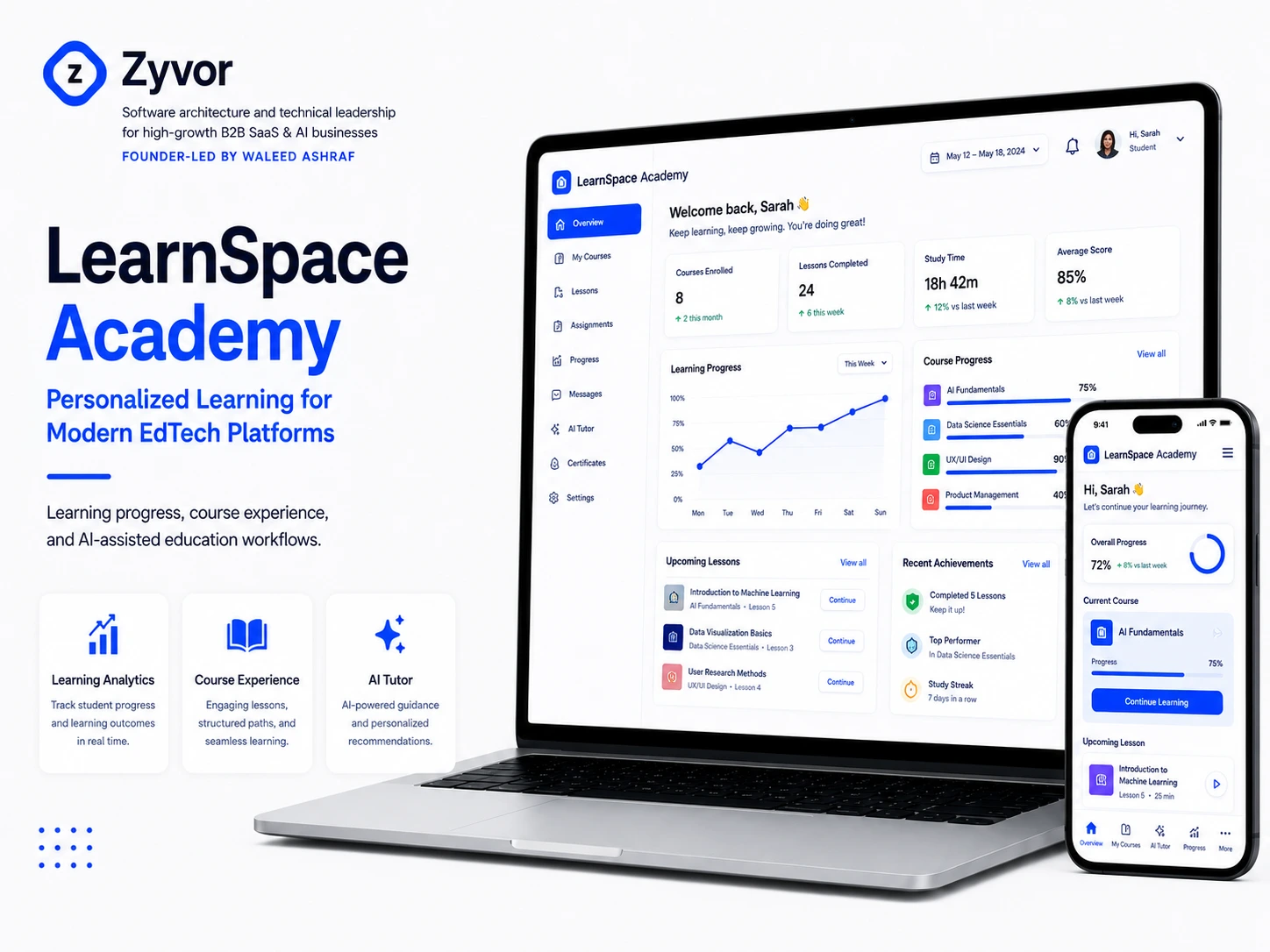
LearnSpace Academy
The Problem
A professional training organization delivering 45+ courses to 8,000 enrolled learners had no centralized platform for course delivery, progress tracking, or instructor collaboration. Content lived in Google Drive folders, assessments were emailed as PDFs, and instructors had no visibility into whether learners were actually engaging with the material or just downloading files and disappearing.
Course content was distributed as Google Drive links organized by folder. Learners received a folder URL on enrollment and were expected to navigate 15-30 files per course in the correct order. 40% of support tickets were "which file do I open next?"
Assessments were PDF forms emailed to instructors, who graded them manually and emailed scores back. Average grading turnaround: 5 business days. Learners had no visibility into their scores until the email arrived
No progress tracking existed. Instructors couldn't tell if a learner had completed Module 3 or hadn't logged in for 2 weeks. Course completion was self-reported via a final survey
Instructor collaboration was nonexistent. 12 instructors creating content independently with no shared templates, no peer review process, and no version control. Duplicate and contradictory content across courses was common
Certificate generation was manual. After course completion, an admin created certificates in Canva, exported PDFs, and emailed them individually. Backlog averaged 3 weeks during peak enrollment periods
Reporting to corporate clients (who purchased bulk enrollments) required manually compiling completion data from email threads and survey responses. Each client report took 4+ hours to assemble
The organization had strong content and experienced instructors. The delivery infrastructure was holding everything back.
The Approach
I built a structured learning management platform that handles course delivery, assessment workflows, progress tracking, instructor collaboration, and automated certification. Designed so instructors focus on teaching and learners focus on learning, with the platform handling everything in between.
Structured Course Delivery Engine
No more folder diving. Every course has a clear path from start to finish.
✅ Sequential module delivery with prerequisite enforcement: learners must complete Module N before accessing Module N+1
✅ Multi-format content support: video lessons, text content, downloadable resources, embedded exercises, and external links organized within a consistent course structure
✅ Bookmarking and resume functionality: learners pick up exactly where they left off across devices
📊 Outcome: "Which file do I open next?" support tickets eliminated entirely. Course navigation time reduced 70%. Learner-reported satisfaction with content delivery improved from 3.1 to 4.6/5
Assessment and Grading Workflows
Submit, grade, and return. All in-platform. No email chains.
✅ In-platform assessment submission with support for text responses, file uploads, and auto-graded multiple choice/true-false questions
✅ Instructor grading dashboard with rubric-based scoring, inline feedback, and batch grading for multiple submissions
✅ Automatic score release with configurable timing (immediate for auto-graded, on-publish for manual assessments)
📊 Outcome: Grading turnaround dropped from 5 business days to 1.2 days average. Learners see scores immediately for auto-graded assessments. Email-based assessment workflow eliminated completely
Real-Time Progress Tracking
Know exactly where every learner is and who's falling behind.
✅ Per-learner progress dashboard showing module completion, assessment scores, time-on-content, and engagement patterns
✅ At-risk detection flagging learners with declining engagement (missed modules, skipped assessments, login gaps exceeding 7 days)
✅ Cohort progress views for instructors managing group enrollments, showing class-wide completion rates and common struggle points
📊 Outcome: At-risk detection identified 340+ disengaging learners in the first quarter. Proactive instructor outreach recovered 42% of flagged learners. Course completion rate improved from 56% to 74%
Instructor Collaboration Hub
12 instructors building together instead of in silos.
✅ Shared content library with version-controlled modules, peer review workflows, and approval gates before content goes live
✅ Content templates ensuring consistent structure, formatting, and assessment design across all 45+ courses
✅ Instructor analytics showing which content formats drive the highest engagement and assessment performance
📊 Outcome: Duplicate content across courses reduced 85%. Peer review caught 60+ content issues before they reached learners. New course creation time reduced 40% through template reuse
Automated Certification Pipeline
Course completed → certificate generated → delivered. Instantly.
✅ Auto-generated certificates triggered on course completion with learner name, course title, completion date, and unique verification code
✅ Branded certificate templates configurable per course or per corporate client with digital verification URL
✅ Bulk certificate generation for corporate cohorts with delivery to both learner and sponsoring organization
📊 Outcome: Certificate backlog eliminated entirely (from 3-week average to instant). Corporate clients receive completion reports automatically. Admin certificate generation time: zero
Architecture Decisions
Why I chose this stack and what tradeoffs I made.
PostgreSQL with JSONB for flexible course schemas — Course structures vary significantly across 45+ courses. JSONB columns store module configurations, assessment rubrics, and prerequisite rules without requiring schema migrations for every new course format. Structured queries still work via GIN indexes on JSONB fields
Redis for session state and progress caching — Learner progress reads happen on every page load. Redis caches current progress state with sub-10ms reads. PostgreSQL syncs on module completion events, not on every interaction. Handles 500+ concurrent learners without database pressure
AWS S3 with signed URLs for content delivery — Course materials (videos, PDFs, resources) served via time-limited signed URLs preventing unauthorized sharing. CloudFront edge caching for video content reduces buffering. Storage lifecycle policies archive completed course materials after 12 months
Next.js with SSR for the learner experience — SEO matters for course discovery pages. Server-rendered course catalogs and landing pages rank for "[skill] training" searches. Authenticated learner dashboard uses client-side rendering for real-time progress updates
The Results
Timeframe | What Happened |
|---|---|
Week 1 | Course delivery platform live. 45 courses migrated from Google Drive. "Which file next?" support tickets eliminated immediately |
Week 3 | Assessment workflows running. Grading turnaround dropped from 5 days to 1.2 days. Auto-graded assessments returning scores instantly |
Month 1 | Progress tracking identified 340+ at-risk learners. Proactive outreach recovered 42%. Certificate automation eliminated the 3-week backlog |
Month 2 | Course completion rate improved from 56% to 74%. Instructor collaboration hub reduced duplicate content 85%. Corporate client reporting automated |
Month 5 | Platform serving 8,000+ learners across 45+ courses. New course creation 40% faster through templates. Learner satisfaction up from 3.1 to 4.6/5 |
Like this project
Posted May 16, 2026
EdTech platform designed for course management, learner progress tracking, assessment workflows, content delivery, and instructor collaboration across structured learning programs.
Likes
0
Views
7
Timeline
May 1, 2025 - Jun 30, 2025
Clients
Zyvor