Logistics Control Center

Waleed Ashraf Usmani


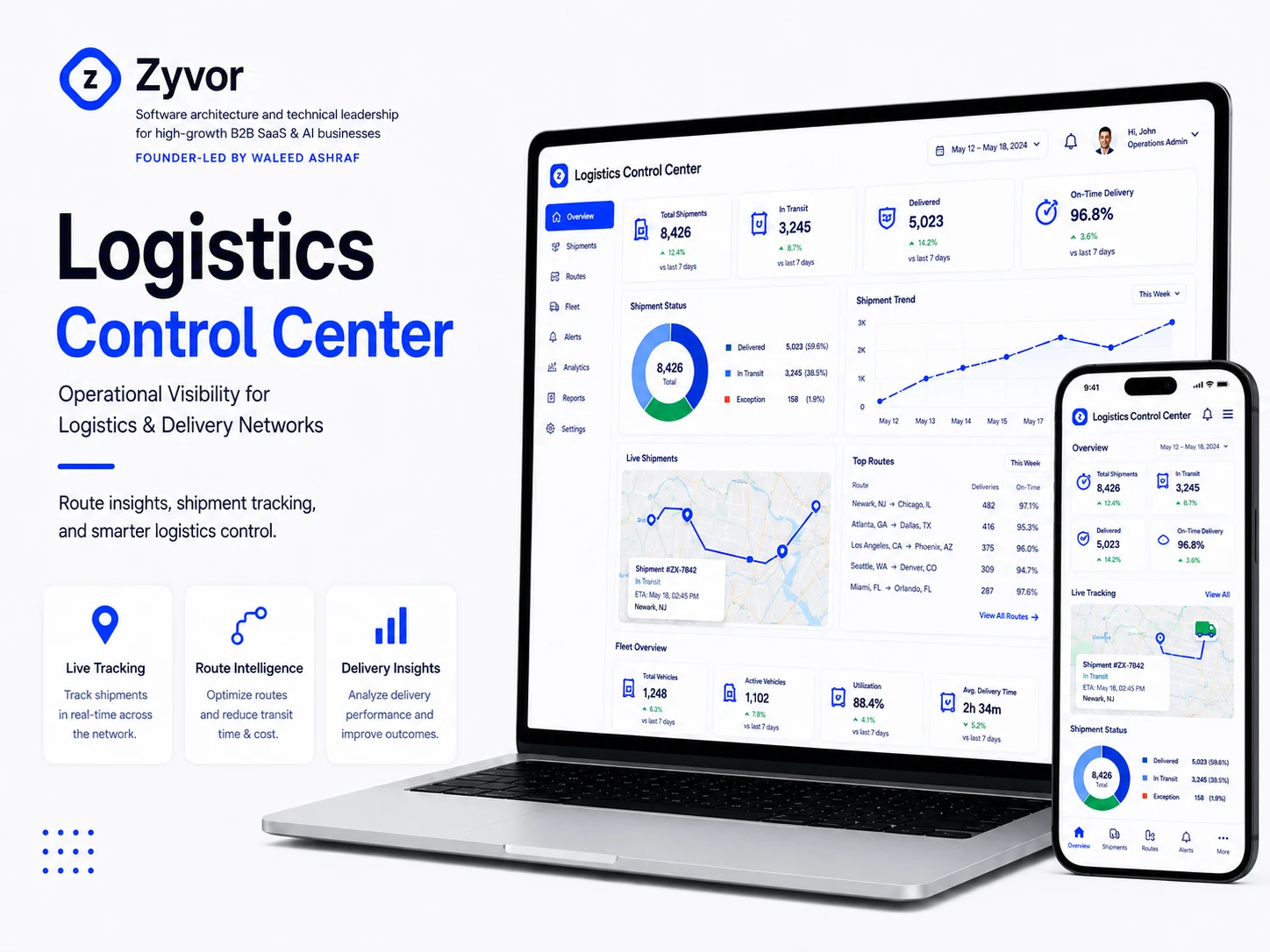
Logistics Control Center
The Problem
A facility services company dispatching 60+ field teams daily across metropolitan Sydney had no centralized system for job scheduling, route planning, or real-time field coordination. Operations ran on whiteboards, phone calls, and a dispatcher who held the entire schedule in her head.
Job scheduling lived on a physical whiteboard in the office. Field teams received their daily schedule via a group text message at 6am. Any changes after that required individual phone calls to each affected team
No route optimization. Teams were assigned jobs geographically by gut feel. A technician might drive 45 minutes across the city for a 30-minute job, then drive 40 minutes back for the next one
Real-time job status was invisible. The office had no idea whether a team was on-site, running late, or finished early until someone called in. Customers asking "when will they arrive?" got "we'll check and call you back"
Resource allocation was reactive. When a team called in sick, the dispatcher spent 45+ minutes reshuffling the day's schedule manually, calling each affected team and customer individually
Service completion documentation was paper-based. Teams filled out job sheets on-site, drove them back to the office, and admin staff manually entered data into spreadsheets. Average delay from job completion to system entry: 3 business days
Monthly operational reporting required the operations manager to compile data from whiteboards, text messages, paper job sheets, and the dispatcher's memory. The report took 2 full days to assemble
The company was adding 3-4 new field teams per quarter, and every new team made the coordination problem exponentially harder.
The Approach
I built a centralized operations platform that handles job scheduling, route optimization, real-time field tracking, and automated reporting. Designed so the dispatcher manages 60+ teams from a single screen instead of a whiteboard and a phone.
Intelligent Job Scheduling Engine
60+ teams. 200+ daily jobs. One screen.
✅ Drag-and-drop scheduling board with team availability, skill matching, and geographic proximity factored into assignment suggestions
✅ Conflict detection preventing double-booking of teams, flagging overlapping time windows, and accounting for travel time between jobs
✅ Bulk rescheduling: when a team calls in sick, one click redistributes their jobs across available teams weighted by proximity and capacity
📊 Outcome: Daily schedule creation dropped from 90 minutes to 15 minutes. Sick-day reshuffling from 45+ minutes of phone calls to 1 click and 2 minutes of review
Route Optimization
Less driving. More working.
✅ Automatic route sequencing minimizing total travel time per team per day using real-time traffic data and job duration estimates
✅ Dynamic re-routing when jobs are added, cancelled, or rescheduled mid-day with updated ETAs pushed to affected teams automatically
✅ Travel time analytics showing actual vs. estimated drive times per route, identifying chronic underestimates
📊 Outcome: Average daily drive time per team reduced 32%. Teams completing 1.4 additional jobs per day on average from recovered travel time. Fuel costs down 24%
Real-Time Field Tracking
Know where every team is and what they're doing. Right now.
✅ Mobile app with GPS check-in/check-out at each job site, automatic time logging, and status updates (en route, on-site, completed)
✅ Live dispatch map showing all team locations, current job status, and next assignment with ETA
✅ Customer-facing ETA notifications: "Your technician is 15 minutes away" sent automatically based on GPS and traffic data
📊 Outcome: "When will they arrive?" calls to the office dropped 78%. Customer satisfaction scores improved from 3.4 to 4.5 out of 5. Real-time visibility into 100% of field operations
Digital Job Documentation
Paper job sheets eliminated. Data captured on-site, available instantly.
✅ Mobile job completion forms with photo capture, customer signature, notes, and checklist verification submitted from the field
✅ Automatic sync to the operations dashboard within seconds of submission. No manual data entry, no 3-day delays
✅ Job history searchable by customer, location, team, date, or service type for warranty claims and service history lookups
📊 Outcome: Job completion to system entry dropped from 3 business days to real-time. Admin data entry eliminated (15+ hours/week recovered). Complete digital audit trail for every job
Automated Operations Reporting
Real-time dashboards replacing the 2-day monthly compilation.
✅ Live KPI dashboards: jobs completed, on-time rate, average job duration, team utilization, customer satisfaction, and revenue per team
✅ Automated daily and weekly reports delivered to operations managers via email with trend analysis and exception flags
✅ Historical comparison views showing performance trends by team, region, service type, and time period
📊 Outcome: Monthly operations report assembly eliminated (2 full days recovered). Operations manager reviewing live dashboards daily instead of waiting for month-end compilation
Architecture Decisions
Why I chose this stack and what tradeoffs I made.
PostgreSQL with PostGIS for geospatial queries — Route optimization and proximity-based job assignment require spatial queries (nearest team, travel distance calculations). PostGIS handles these natively without a separate geospatial service. Tradeoff: slightly more complex schema, but eliminated an external dependency
Redis pub/sub for real-time dispatch updates — 60+ field teams sending GPS pings every 30 seconds. Redis pub/sub pushes location updates to the dispatch map in real time without polling. WebSocket connections from the dispatch dashboard subscribe to team-specific channels
SQS for job documentation processing — Photo uploads from field teams are bursty (most arrive between 3-5pm as jobs complete). SQS buffers uploads and feeds them to image processing workers at a steady rate. Zero dropped submissions even during peak hours
AWS S3 with CloudFront for job photos — Field documentation generates 500+ photos per day. S3 for storage, CloudFront for fast retrieval when operations staff review completed jobs. Lifecycle policies archive photos older than 12 months to Glacier for cost optimization
The Results
Timeframe | What Happened |
|---|---|
Week 1 | Scheduling board live. Daily schedule creation dropped from 90 minutes to 15 minutes. Whiteboard retired |
Week 2 | Route optimization deployed. Average daily drive time per team reduced 32%. Teams completing 1.4 additional jobs per day |
Month 1 | Real-time tracking live. "When will they arrive?" calls dropped 78%. Digital job documentation replacing paper forms across all 60 teams |
Month 2 | Customer satisfaction improved from 3.4 to 4.5/5. Admin data entry eliminated (15+ hours/week). Fuel costs down 24% |
Month 5 | Platform managing 200+ daily jobs across 60+ teams. On-time arrival rate at 94%. Monthly operations report auto-generating. Zero scheduling conflicts since launch |
Like this project
Posted May 16, 2026
Operations management platform designed for job scheduling, resource allocation, field team coordination, and real-time service tracking across distributed service operations.
Likes
0
Views
7
Timeline
Apr 1, 2024 - Aug 31, 2024
Clients
MJ Facility Services