AI Learning System

Waleed Ashraf Usmani


AI Learning System
The Problem
An EdTech company with 6,000+ active learners was delivering the same course content to everyone regardless of skill level, learning pace, or knowledge gaps. Completion rates had stalled at 34%, and the content team had no data on why learners were dropping off or which modules were actually effective.
Every learner got the same linear course path. A senior developer and a complete beginner sat through identical introductory modules. Advanced learners got bored, beginners got overwhelmed, and both churned
Assessment was limited to end-of-module multiple choice quizzes with no adaptive difficulty. Learners who scored 95% and learners who scored 55% both moved to the same next module
Instructors had no visibility into individual learner struggles. A learner could fail the same concept 4 times and nobody would know until the final assessment
Course recommendations were manual editorial picks updated quarterly. "If you liked Course A, try Course B" was based on the content team's intuition, not learner behavior data
Content effectiveness was unmeasured. The team had published 240+ modules but couldn't tell which ones actually improved learner outcomes vs. which ones learners just clicked through
Support tickets for "I'm stuck" and "what should I learn next?" consumed 25+ hours per week of instructor time
The platform had good content. It just delivered it the same way to everyone and hoped for the best.
The Approach
I built an AI-powered adaptive learning engine that personalizes every learner's path based on their demonstrated knowledge, learning velocity, and engagement patterns. The system continuously adjusts difficulty, recommends content, and flags struggling learners before they drop off.
Adaptive Learning Path Engine
Every learner gets a path shaped by what they actually know, not what module comes next in the list.
✅ Diagnostic assessment at course entry that maps existing knowledge across topic areas and skips already-mastered content
✅ Dynamic path adjustment after every assessment: strong performance accelerates through foundational content, weak performance triggers targeted reinforcement modules
✅ Difficulty scaling within modules based on response accuracy and time-to-answer patterns
📊 Outcome: Average time-to-completion dropped 28% for advanced learners (skipped redundant content). Beginner completion rates improved 41% (received appropriate pacing and reinforcement)
AI-Powered Tutoring Assistant
Instant help when learners get stuck, without waiting for an instructor.
✅ Context-aware Q&A powered by OpenAI that understands the specific module, lesson, and concept the learner is working on
✅ Socratic method responses that guide learners toward understanding rather than giving direct answers
✅ Escalation to human instructors when the AI detects repeated confusion on the same concept after 3 attempts
📊 Outcome: "I'm stuck" support tickets dropped 62%. Instructor time on basic Q&A reduced from 25 hours/week to 9 hours/week. Learner satisfaction with help response time improved from 3.1 to 4.6 out of 5
Intelligent Recommendation Engine
What to learn next, based on where you've been and where you're going.
✅ Collaborative filtering combining learner behavior patterns with content effectiveness data across 240+ modules
✅ Skill gap analysis recommending modules that address specific weak areas identified through assessment performance
✅ Career path alignment suggesting courses that map to stated learning goals (e.g., "become a backend engineer" triggers a curated sequence)
📊 Outcome: Recommendation click-through rate hit 38% vs. 7% for the old editorial picks. Learners following AI-recommended paths completed 2.1x more courses than self-directed learners
Learner Progress Intelligence
Instructors see who's thriving, who's struggling, and exactly where the friction is.
✅ Real-time learner dashboard showing progress, velocity, assessment scores, engagement depth, and predicted completion probability per learner
✅ At-risk detection flagging learners showing disengagement patterns (declining login frequency, skipped assessments, time-on-page drops) before they churn
✅ Cohort comparison views showing how different learner segments perform across the same content
📊 Outcome: At-risk detection caught 78% of eventual dropouts 2+ weeks before they stopped logging in. Proactive instructor outreach recovered 31% of flagged learners
Content Effectiveness Analytics
Know which modules actually teach and which ones learners just click through.
✅ Per-module effectiveness scoring based on pre/post assessment improvement, time-on-content, engagement depth, and downstream performance
✅ A/B testing framework for content variations with statistical significance tracking
✅ Content gap identification showing topics where learners consistently underperform with no available reinforcement material
📊 Outcome: Content team identified 18 modules with near-zero learning impact. 6 were rewritten, 12 were replaced. Post-assessment scores improved 22% across affected topic areas
Architecture Decisions
Why I chose this stack and what tradeoffs I made.
OpenAI GPT for tutoring over fine-tuned models — Course content changes frequently. A fine-tuned model requires retraining on every content update. GPT with retrieval-augmented generation (RAG) using course content as context adapts immediately when modules are updated. Tradeoff: higher per-query cost, but eliminated the retraining pipeline entirely
PostgreSQL for learner state over a graph database — Learner paths look like graphs, but the query patterns are relational (cohort analysis, assessment aggregation, progress reporting). PostgreSQL with JSONB columns for flexible learner metadata handles both structured queries and semi-structured learning state without a second database
Redis for session-level learning state — Adaptive difficulty adjustments need sub-100ms reads of recent learner performance within a session. Redis stores the rolling window of last 20 interactions per active learner. PostgreSQL handles persistence after session end
AWS Lambda for AI inference — Tutoring queries are bursty (peak during evening study hours, near-zero at 3am). Lambda scales to zero between bursts. Cost-effective vs. keeping GPU instances warm for sporadic inference loads
The Results
Timeframe | What Happened |
|---|---|
Week 1 | Adaptive paths live. Advanced learners immediately skipping 30-40% of introductory content. Beginner pacing adjusted automatically |
Week 3 | AI tutor handling 180+ questions/day. Support tickets for "I'm stuck" dropped 62%. Instructor Q&A time cut from 25 to 9 hours/week |
Month 1 | Course completion rate improved from 34% to 52%. Recommendation engine click-through at 38% vs. 7% for old editorial picks |
Month 2 | At-risk detection flagging dropouts 2+ weeks early. Proactive outreach recovering 31% of flagged learners. Content team identified 18 low-impact modules |
Month 5 | Completion rate stabilized at 58%. Learners on AI-recommended paths completing 2.1x more courses. Post-assessment scores up 22% from content rewrites driven by effectiveness analytics |
Like this project
Posted May 5, 2026
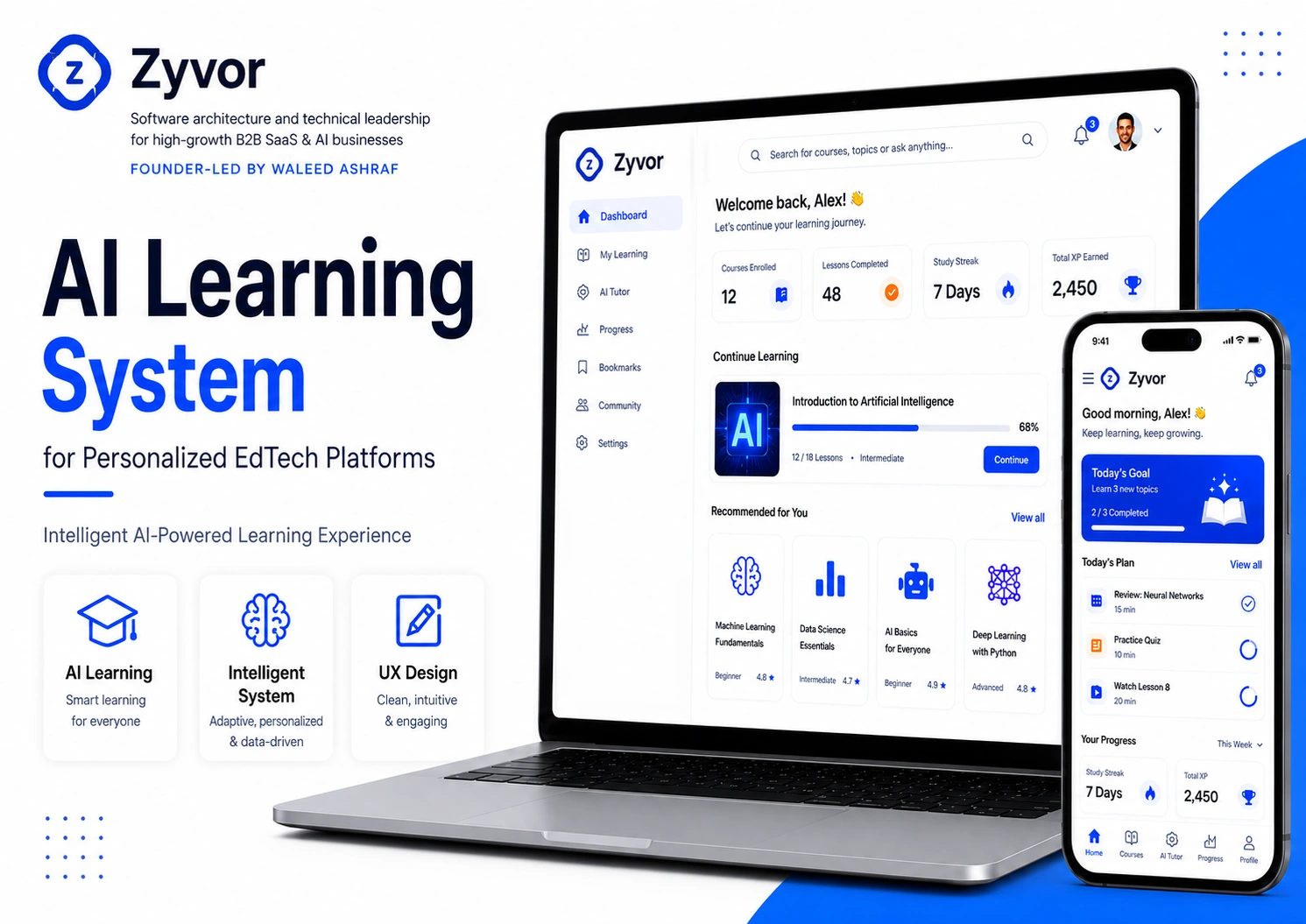
AI-powered learning platform designed for adaptive course delivery, intelligent tutoring, progress tracking, and personalized recommendations across structured education programs.
Likes
0
Views
7
Timeline
Apr 1, 2023 - Aug 31, 2023
Clients
Zyvor