Built with Lovart
Folio Brand Identity Development

Révolté


Folio — Brand Case Study
The Brief
Build a SaaS brand for a contract and document intelligence platform. The product sits in a crowded, undifferentiated category — CLM software, document management, legal tech — where the visual language defaults to trust-blue, rounded corners, and the word "seamless" used without irony. The brief had one hard constraint: nothing that looks like software.
The target user is not a developer. It's a lawyer at a mid-size firm, a head of partnerships at a scale-up, an agency principal managing fifty client agreements simultaneously. Someone who works with documents the way a craftsperson works with materials — with attention, with consequence, with the understanding that what's written down is what's real.
The Insight
Contracts are civilization's oldest technology. Before software, before spreadsheets, before the filing cabinet — there were agreements written down, witnessed, sealed. The Roman Twelve Tables. The Magna Carta. The bill of sale, the deed, the promissory note. Every institution humanity has built rests on the premise that written agreements hold.
Software forgot this. The entire legal tech category is designed as if contracts were a friction to be removed rather than a foundation to be honored. The aesthetic is disposable. The copy is optimistic. The product looks like it was designed for a world where nothing written down carries any real weight.
Folio's brand premise inverts this entirely: what if a document intelligence platform looked like it understood what documents actually are?
The Name
Folio. A sheet of paper folded once to make two leaves. The standard unit of manuscript pagination. The word predates printing — it comes from the Latin folium, leaf, and entered English through the counting houses and scriptoria of medieval Europe. It is not a metaphor. It is the thing itself.
It required no explanation and no tagline to justify it. It arrived with four centuries of meaning already attached.
Creative Direction: Dithered Marble
The central visual idea emerged from a single tension: classical permanence meeting computational process.
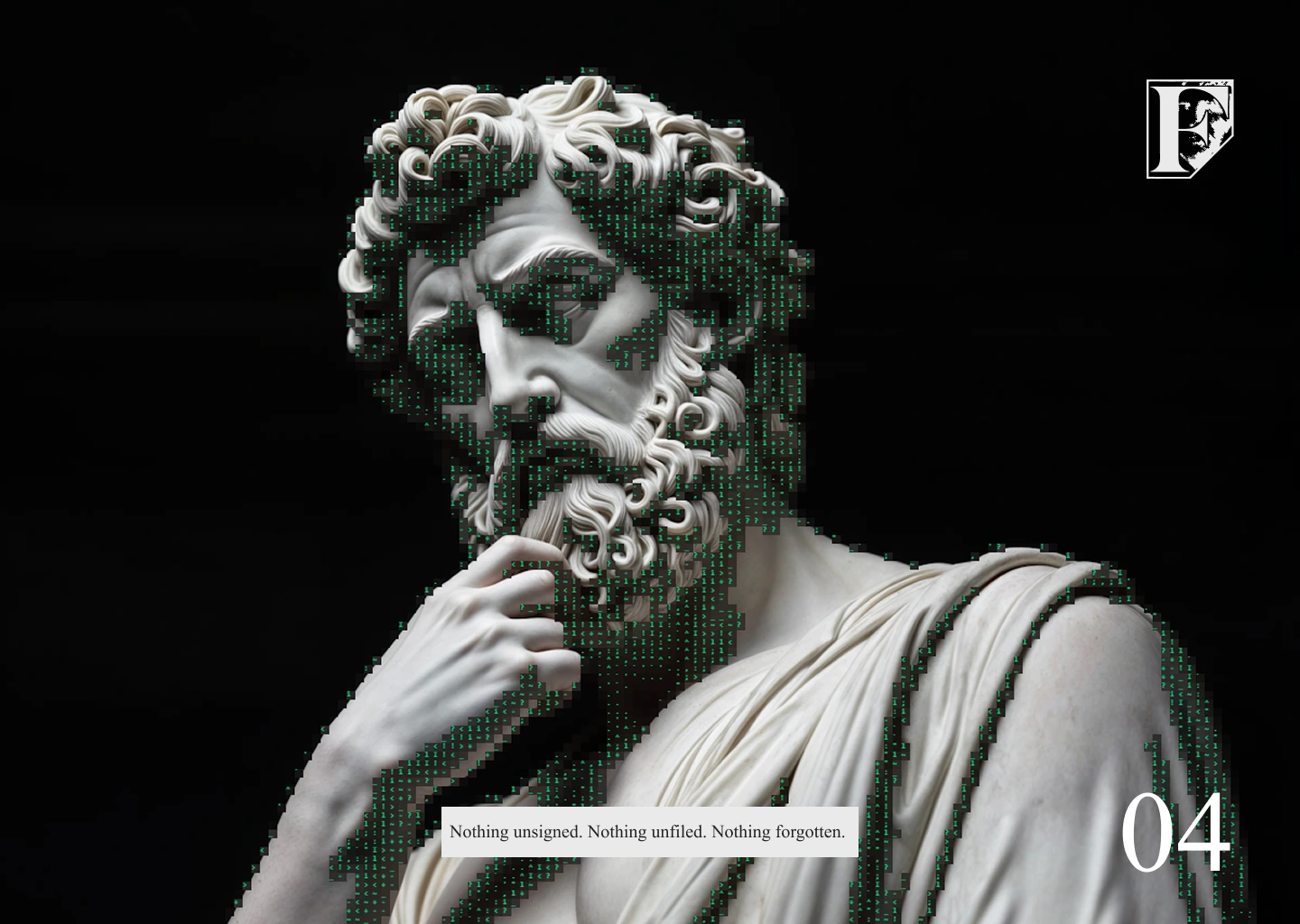
Greek and Roman statuary was the ancient world's attempt to make authority physical — to carve law, virtue, and power into a material that would outlast the people who commissioned it. Dithering is what happens when you attempt to reproduce that permanence through a machine with finite resolution. The algorithm cannot hold the marble. What remains is still recognizable, still weighty, but marked by the attempt at transmission.
That gap — between the original authority and the medium carrying it — is precisely what contract intelligence addresses. The agreement is the statue. Folio is the resolution.
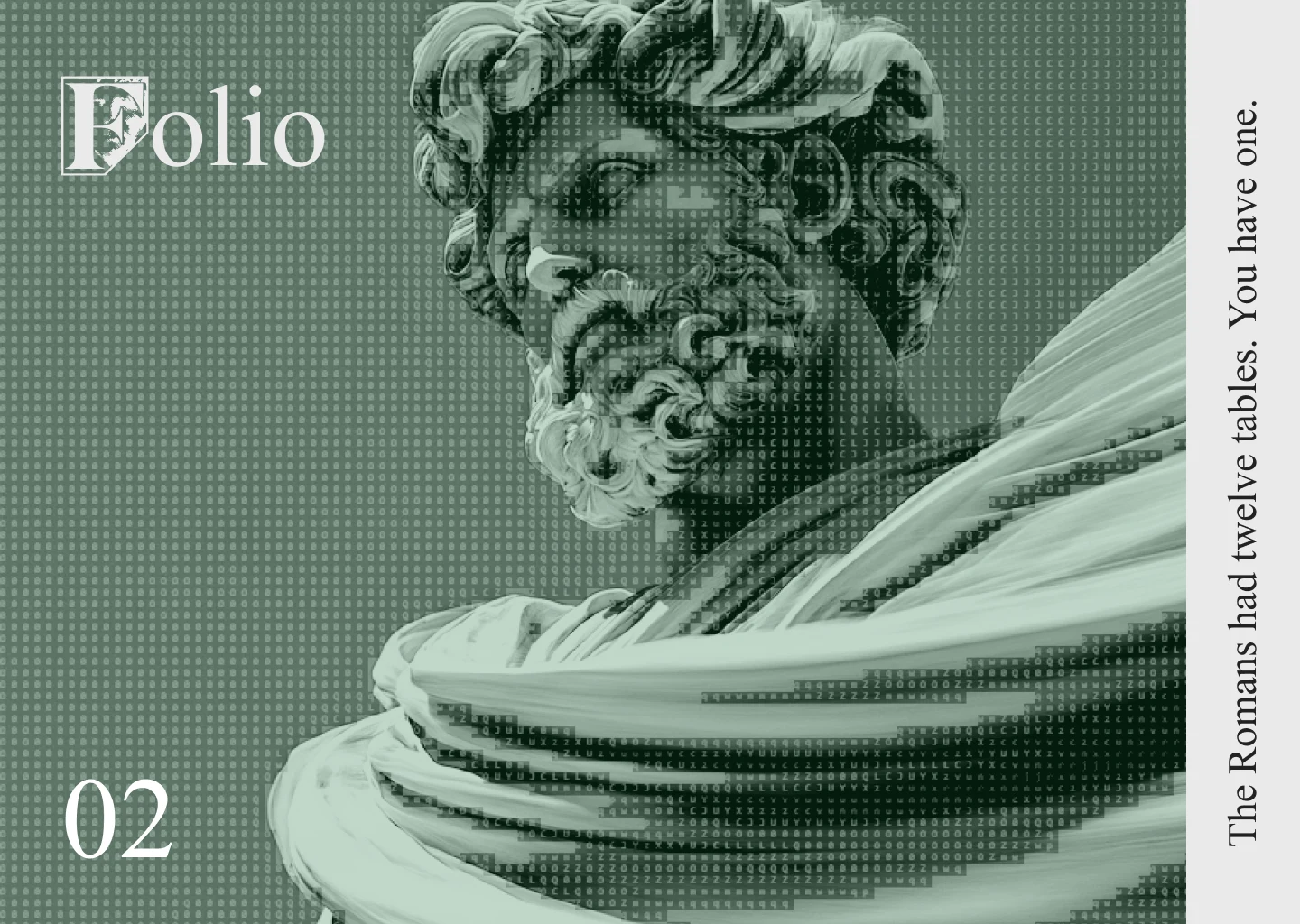
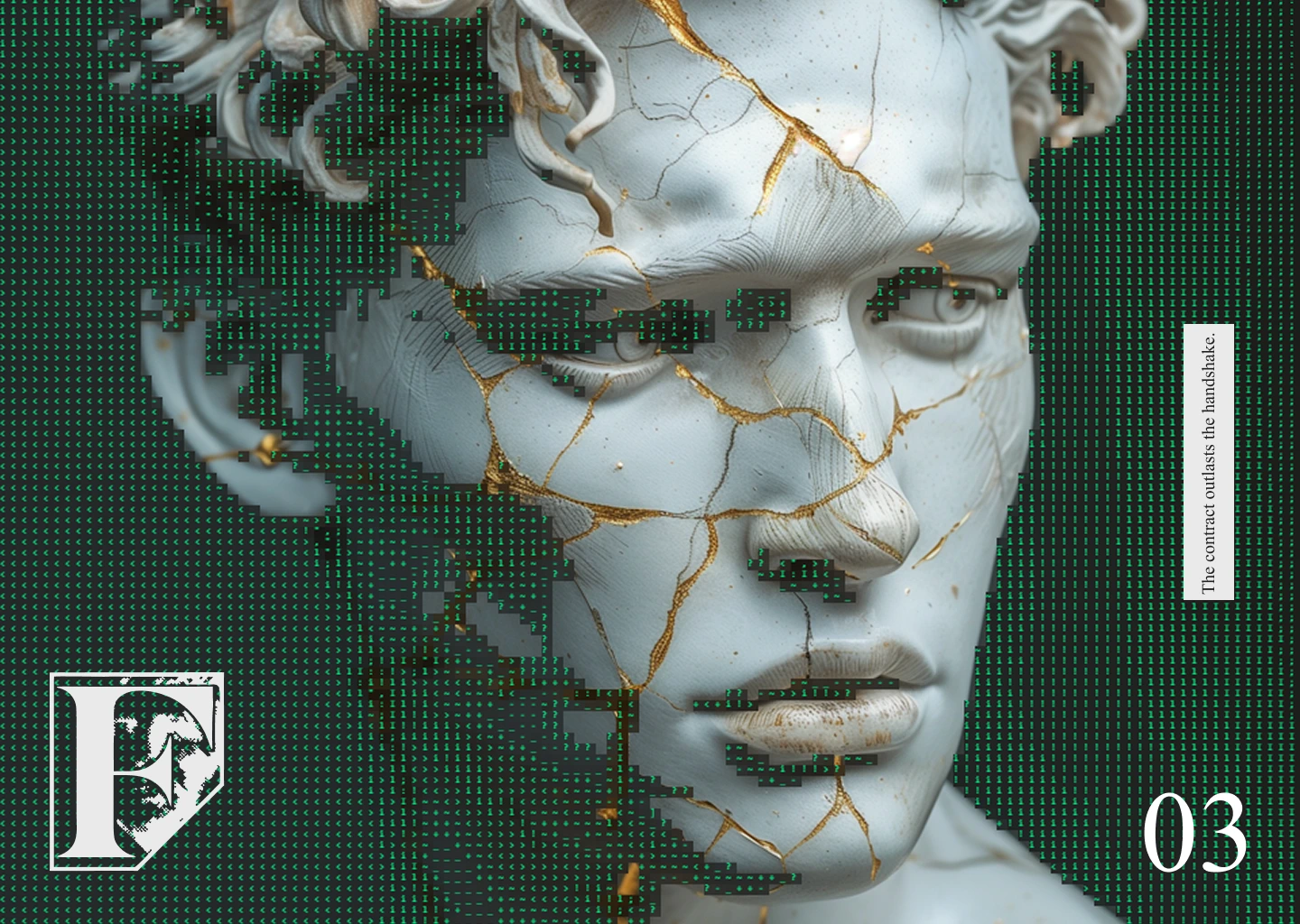
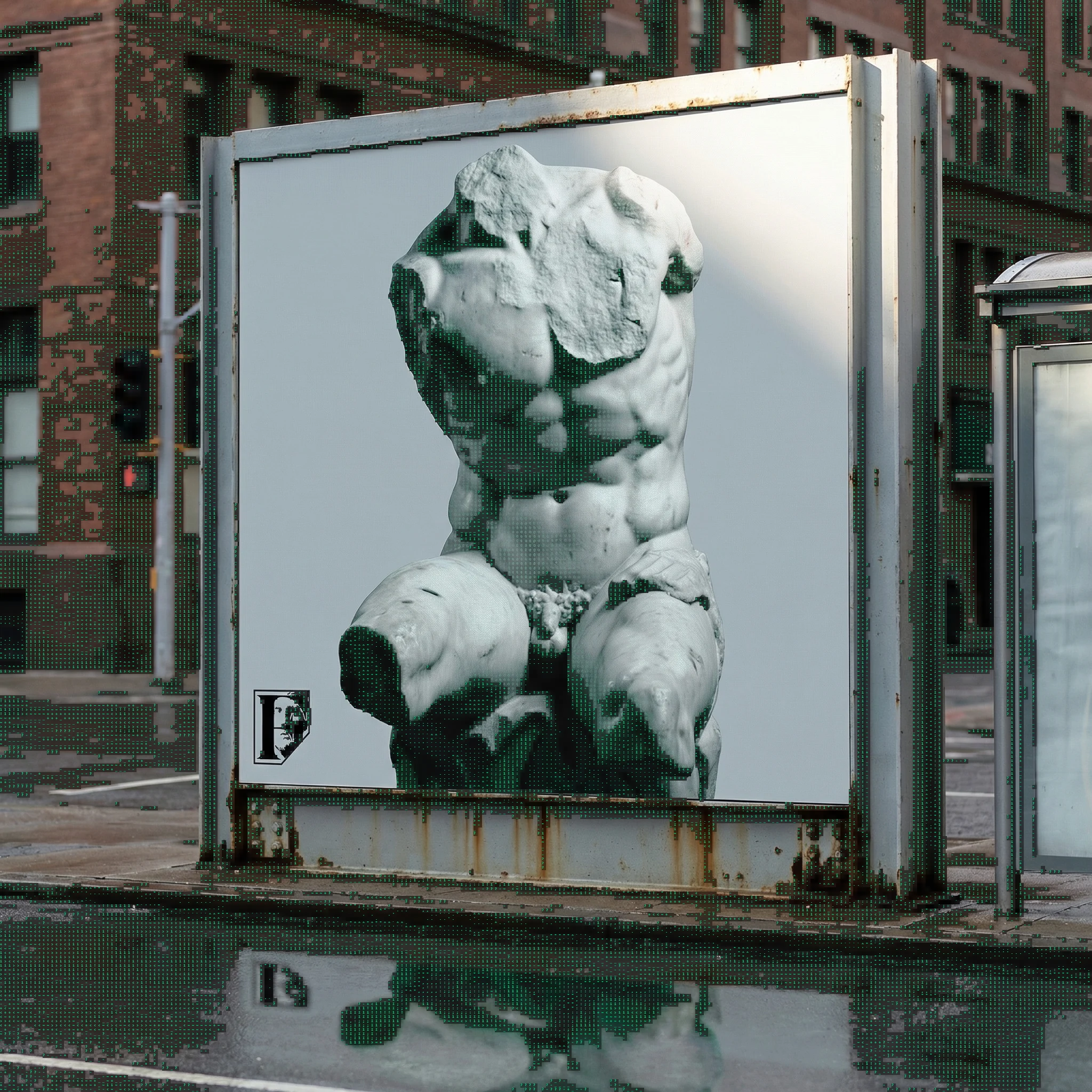
The technique is specific and non-negotiable: Floyd-Steinberg dithering applied to actual photographs of classical sculpture, rendered at a controlled resolution that reads as mechanical rather than aesthetic. The grain looks necessary — as if it happened during reproduction, not as a stylistic choice. The sources are real works: the Nike of Samothrace, the Capitoline Brutus, the Dying Gaul, the Belvedere Torso. Figures with civic and legal resonance, not merely decorative beauty.
The Logo

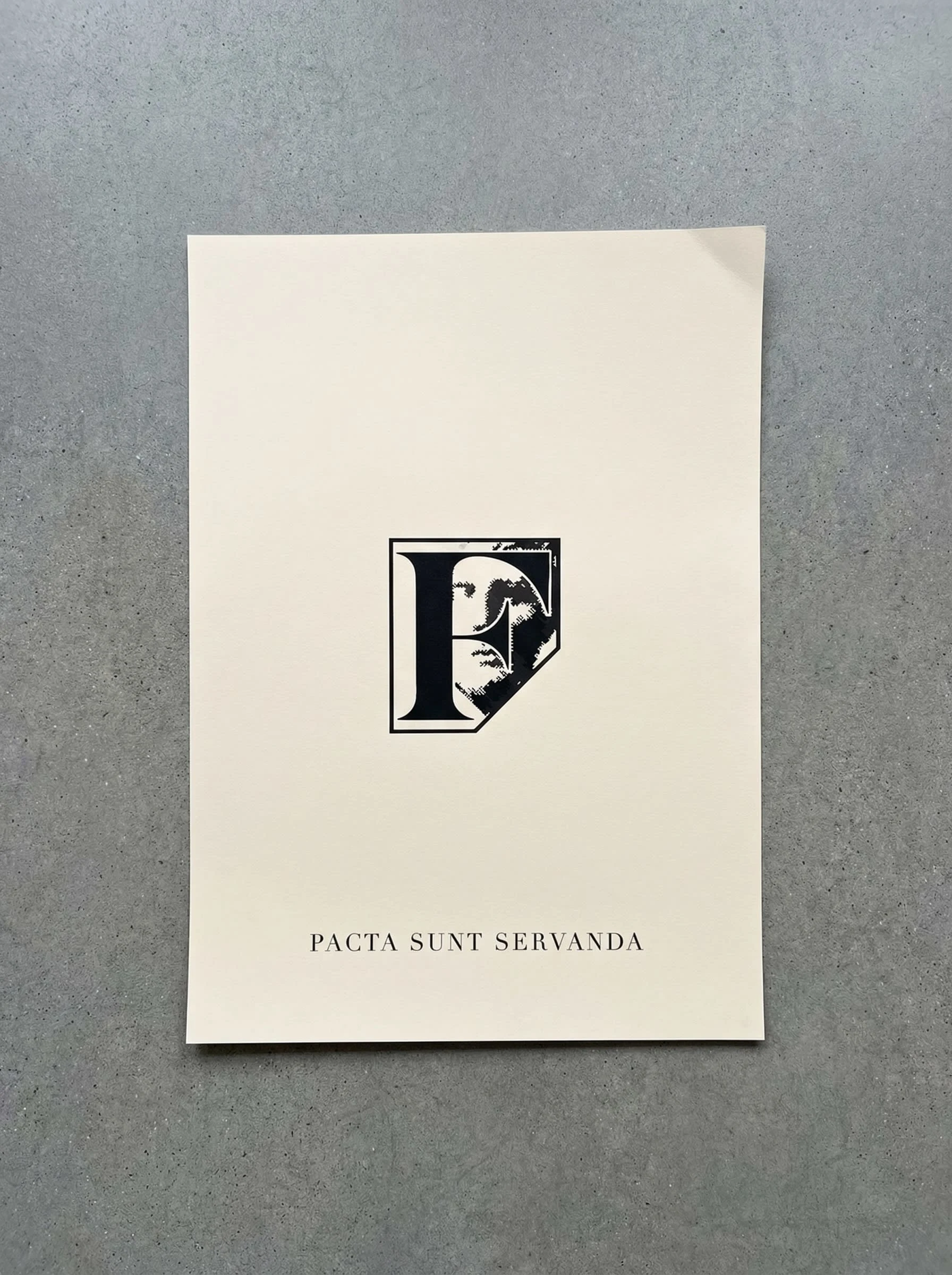
A constructed capital F — not drawn from any existing typeface but drafted with the proportions of Roman lapidary lettering, the kind carved into the Trajan Column. High contrast strokes, terminals sheared at 15°, crossbar positioned above mathematical center as in authentic inscription lettering.
The F is enclosed in a shape that reads first as an abstract geometric form and only second as a page: a near-square with the bottom-right corner removed by a clean 45° diagonal. The enclosure is a stroke only, no fill.
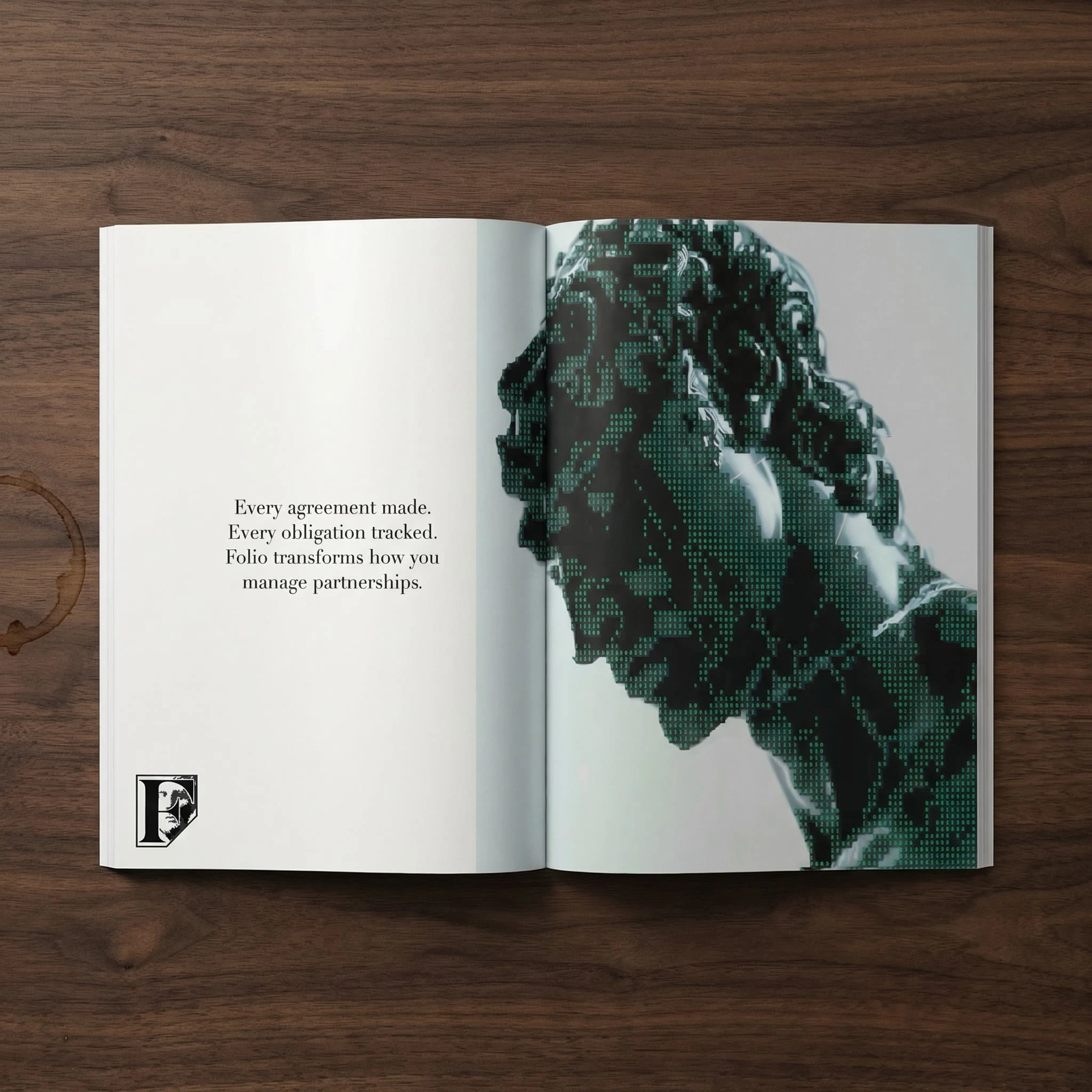
The counter space — the negative area surrounding the F inside the enclosure — contains a dithered halftone of the Capitoline Brutus, a Roman bronze associated with the founding of the Republic and the establishment of civic law. At small sizes the dithering dissolves into texture. At large sizes a face looks back at you from inside the document.
The logo operates at two scales: small and precise as a stamp or seal, and very large as a full-bleed graphic element. Never medium. Medium makes it decorative.
The Palette
Two visual registers, kept strictly separate:
Identity system — ink black (#1A1612) on bone white (#F5EDDB). No grays, no blues. The warmth of the near-black reads as ink rather than screen. The off-white reads as paper rather than background. Every physical brand application — the hardcover brand manual, the wax-sealed envelope, the rubber stamp on cotton laid paper, the laptop sticker in clear vinyl — lives in this register.
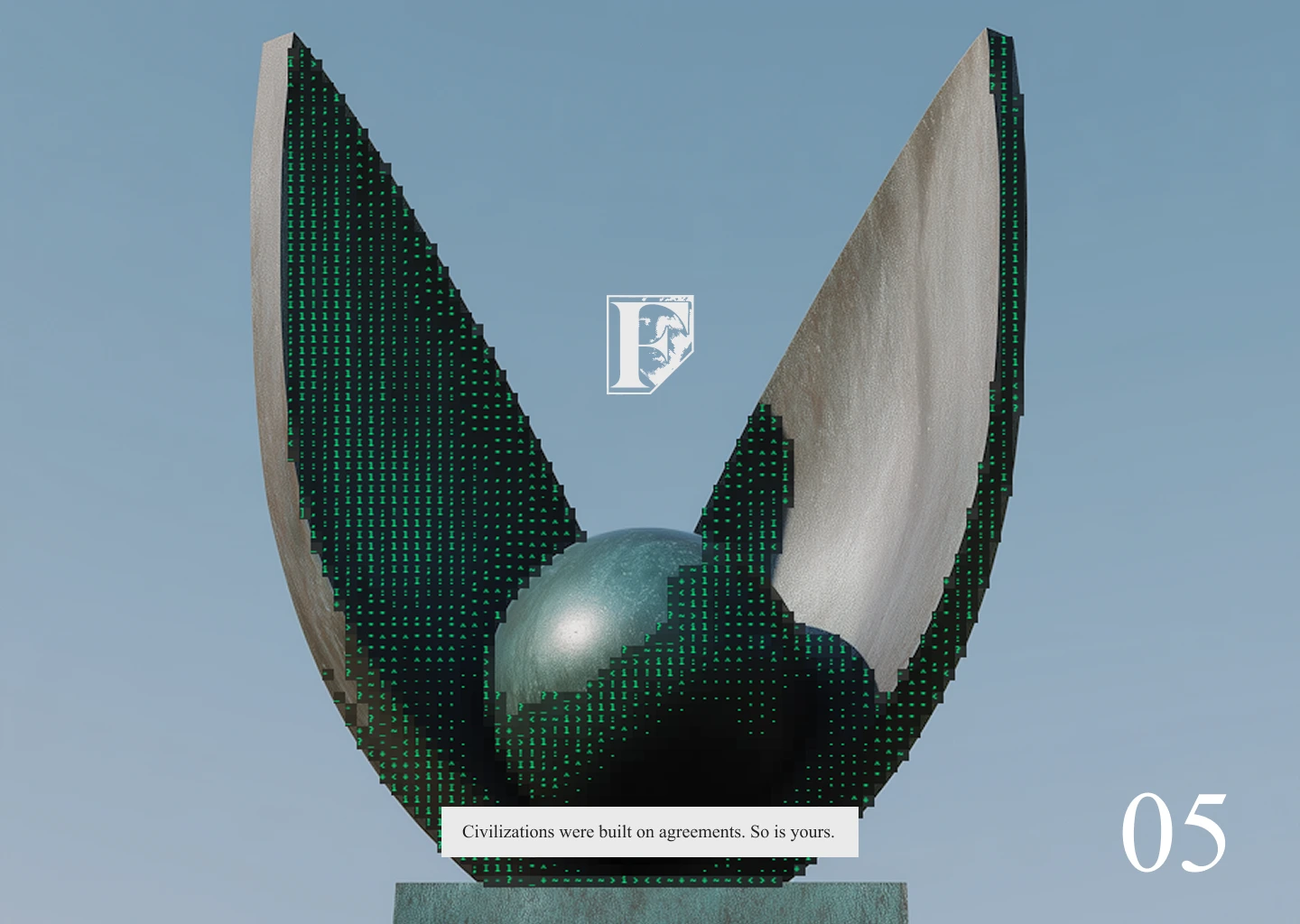
Campaign visual world — sage green field, dark forest green ASCII/dot halftone overlay, marble white figure emerging from the computational texture. The green was not in the original brief. It arrived through the work and proved to be correct: it added a third register — classical, computational, and something verdant and alive — that pure black and white couldn't sustain across a full campaign. The two registers never mix in the same frame.
Typography
Two typefaces, no others.
A high-contrast Didot-derived serif for all display use: headlines, the wordmark FOLIO in tracked small capitals, pull quotes, section markers. The extreme thick-to-thin ratio of a Didot references both the history of legal printing and the high-contrast strokes of the logo mark itself. The typeface earns its place by sharing DNA with the letterform.
A monospaced workhorse — Pitch or Courier Prime — for all functional text: metadata, timestamps, matter references, status labels, microcopy. The mono signals data, process, record-keeping. It is the voice of the machine. The serif is the voice of the institution. The two never blend.
No sans-serif anywhere in the system.
Brand Voice
Pacta sunt servanda. Agreements must be kept. The Roman legal principle used untranslated as the primary brand line. For those who know it, it lands immediately. For those who don't, it demands to be looked up — which is itself a brand interaction, a small test of seriousness.
The voice is declarative, short, never optimistic. It does not use the word "seamless." It does not promise transformation. It states facts about documents and lets the weight of those facts do the work.
Selected lines from the campaign:
The contract outlasts the handshake.
Every agreement, remembered.
Nothing unsigned. Nothing unfiled. Nothing forgotten.
Civilizations were built on agreements. So is yours.
They carved it in stone. You have Folio.
What endures is what was written.
The copy rule: cut the last word of any sentence. Folio copy tends to end one word too late.
Applications
Print campaign — A series of large-format landscape pieces, numbered sequentially, each pairing a dithered classical figure with a single campaign line. The figure bleeds from center to right edge. The logo sits bottom-left or top-left, small. A rotated copy strip runs the right margin. The ground is the sage green field. The pieces work as a set and individually.
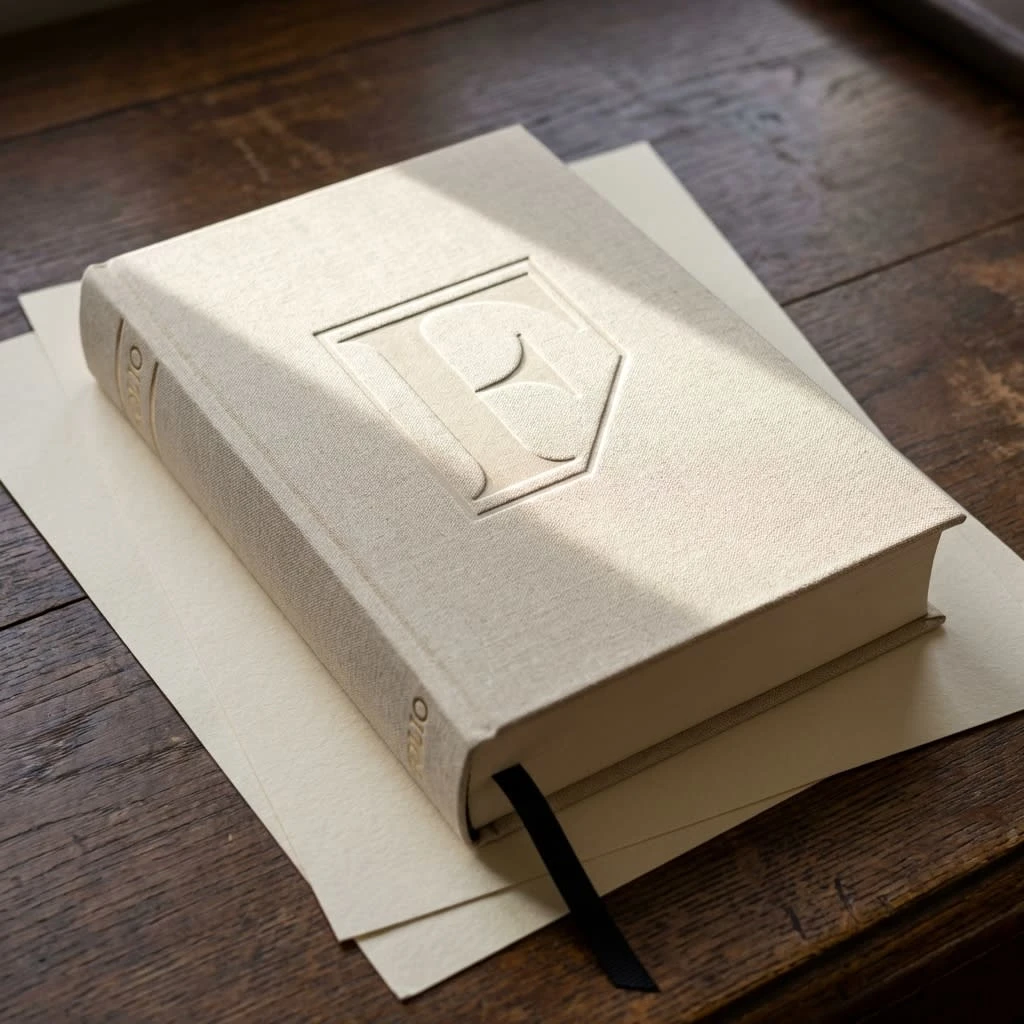
Hardcover brand manual — Natural linen cloth, blind-debossed logo on the cover, gilt FOLIO on the spine, black grosgrain ribbon. The manual itself as a physical argument for the brand's premise: documents are objects, objects have weight.
Wax seal correspondence — The logo impressed into burgundy-black wax on cotton laid envelopes. The seal impression carries the dithered bust in relief. The correspondence piece is the brand promise made physical: this arrived sealed, witnessed, with a mark of authenticity.
Stamp on document — The logo applied as a rubber stamp impression on cotton laid paper, slightly uneven pressure, the enclosure border broken where the rubber didn't fully contact. The imperfection is the point. Authenticity is analog.
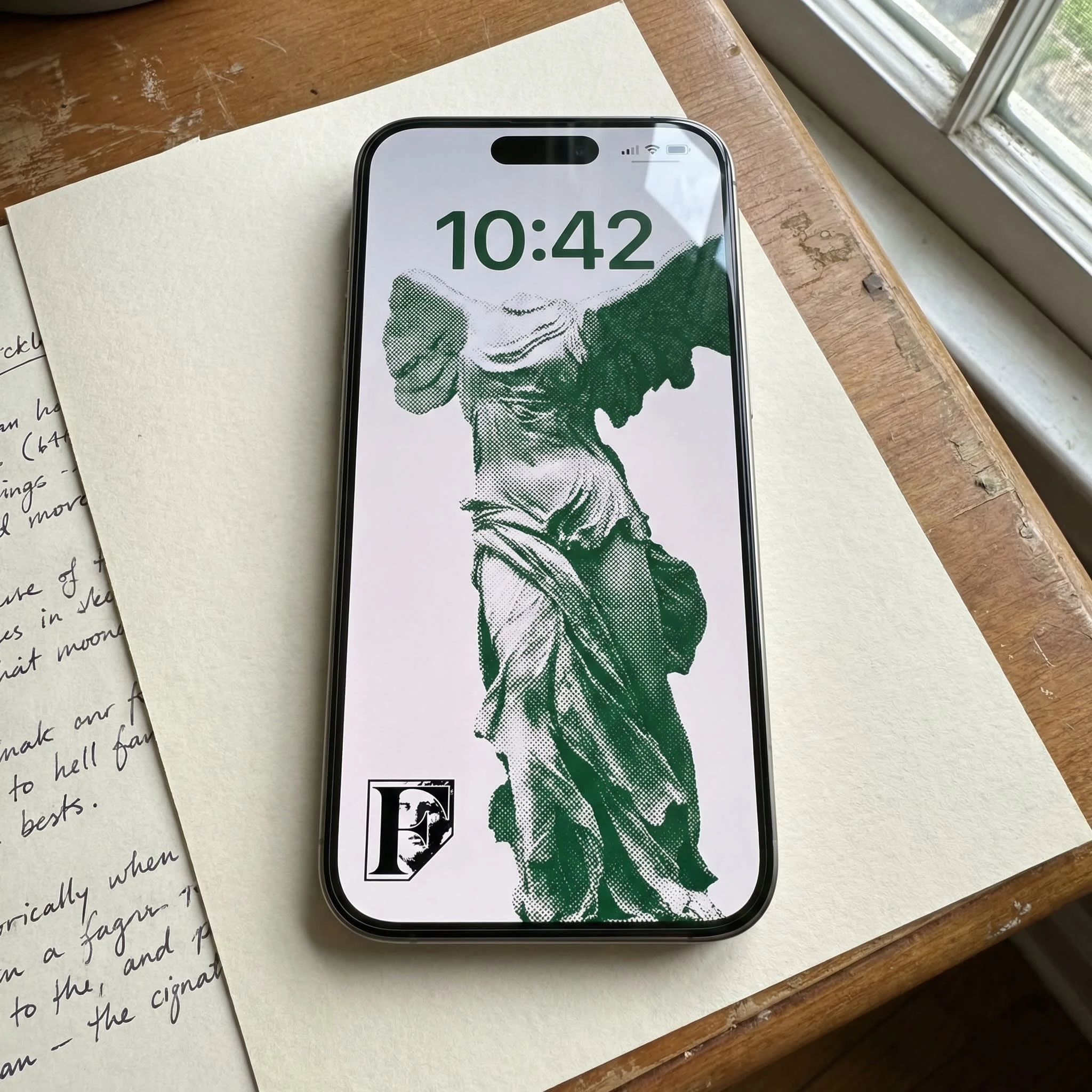
Phone lock screen — The Nike of Samothrace in dark green halftone on pale ground. The logo at bottom-left. The time reading 10:42. The piece that confirms the brand translates to every surface without losing its register.
Billboard — The Belvedere Torso, headless and armless, on a rusting steel street billboard, wet pavement reflection below. No copy except the logo. The fragment as a statement: what survives is what was made to last.
What the Brand Argues

Every category has a default aesthetic that encodes a set of assumptions about what the product is and who it's for. Legal tech's default says: this is paperwork, and paperwork is a problem we're solving. It treats the document as friction.
Folio's brand makes the opposite argument. The document is not friction. It is the record. It is what civilization runs on. Building software that treats it with the seriousness it deserves is not a niche positioning — it is the only honest position available.
The brand doesn't just look different from competitors. It disagrees with them.
Deliverables
Logo mark and wordmark system. Color palette. Typography specification. Campaign visual direction and execution. Print collateral suite. Physical brand applications. Copy framework and voice guidelines. Campaign poster series. Digital applications including lock screen and billboard.
Pacta sunt servanda.
Like this project
Posted Mar 23, 2026
Folio, A contract intelligence platform built to look like it understands what contracts actually are. Law carved in stone. Software that remembers.
Likes
1
Views
38
Timeline
Mar 2, 2026 - Mar 23, 2026