CRM-to-Membership Access Reliability

Md Arifur Rahman


Overview
Original methodology disclosure: This is an original reliability framework created to demonstrate how I diagnose CRM-to-membership access failures. It does not represent a named client, confidential account, paid Contra project, verified engagement, or guaranteed result.
Membership access failures rarely live in one tool. A payment can succeed while the CRM record, tag logic, WordPress user, course enrollment, or cancellation path remains wrong. This framework shows how I diagnose and improve the full journey without exposing private client data.
It is designed for coaches, course creators, membership businesses, and service teams that connect a CRM with WordPress, an LMS, payment processing, email follow-up, or fulfillment access.
Why access fails
The visible complaint is often “the customer cannot log in,” but the actual cause may be upstream or shared across several systems. Common failure patterns include:
The order completed but the expected product, tag, or subscription state was not recorded.
Duplicate contacts or mismatched email addresses created two competing identities.
More than one plugin or integration attempted to control the same access state.
A cancellation, refund, failed payment, or reactivation event did not reach every dependency.
A returning customer followed a different path from a first-time buyer.
The happy path was tested, but duplicate, delayed, missing, or out-of-order events were not.
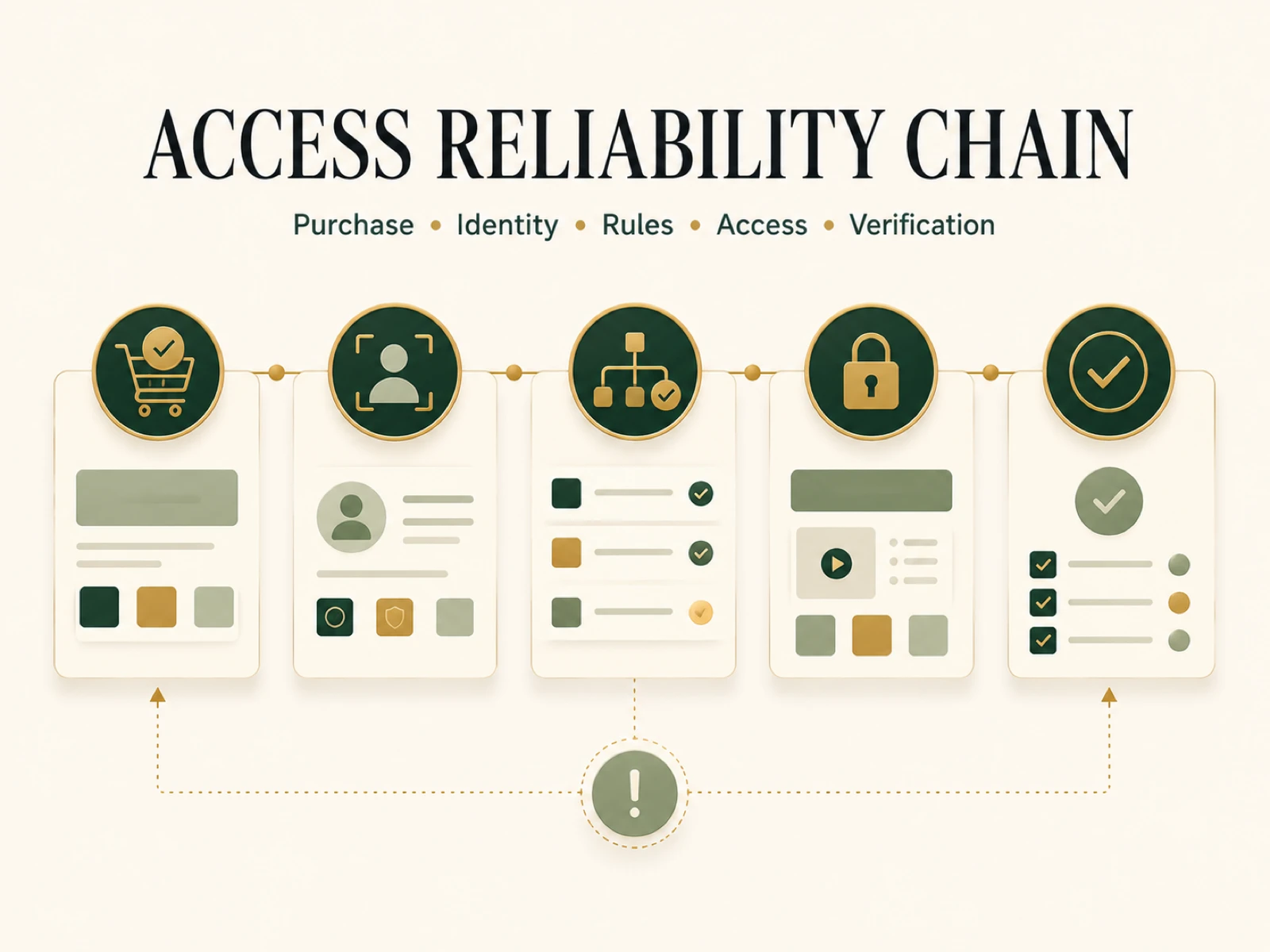
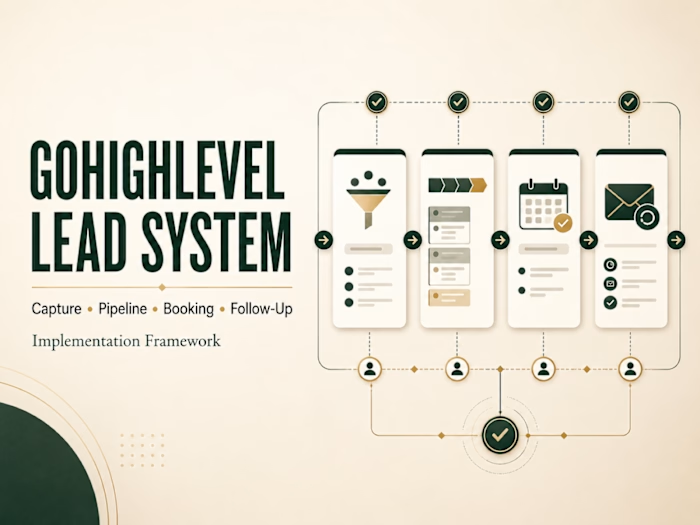
Purchase-to-access state chain — Payment, CRM identity, eligibility, access provisioning, confirmation, and cancellation or refund handling are treated as distinct transitions that can be tested independently.
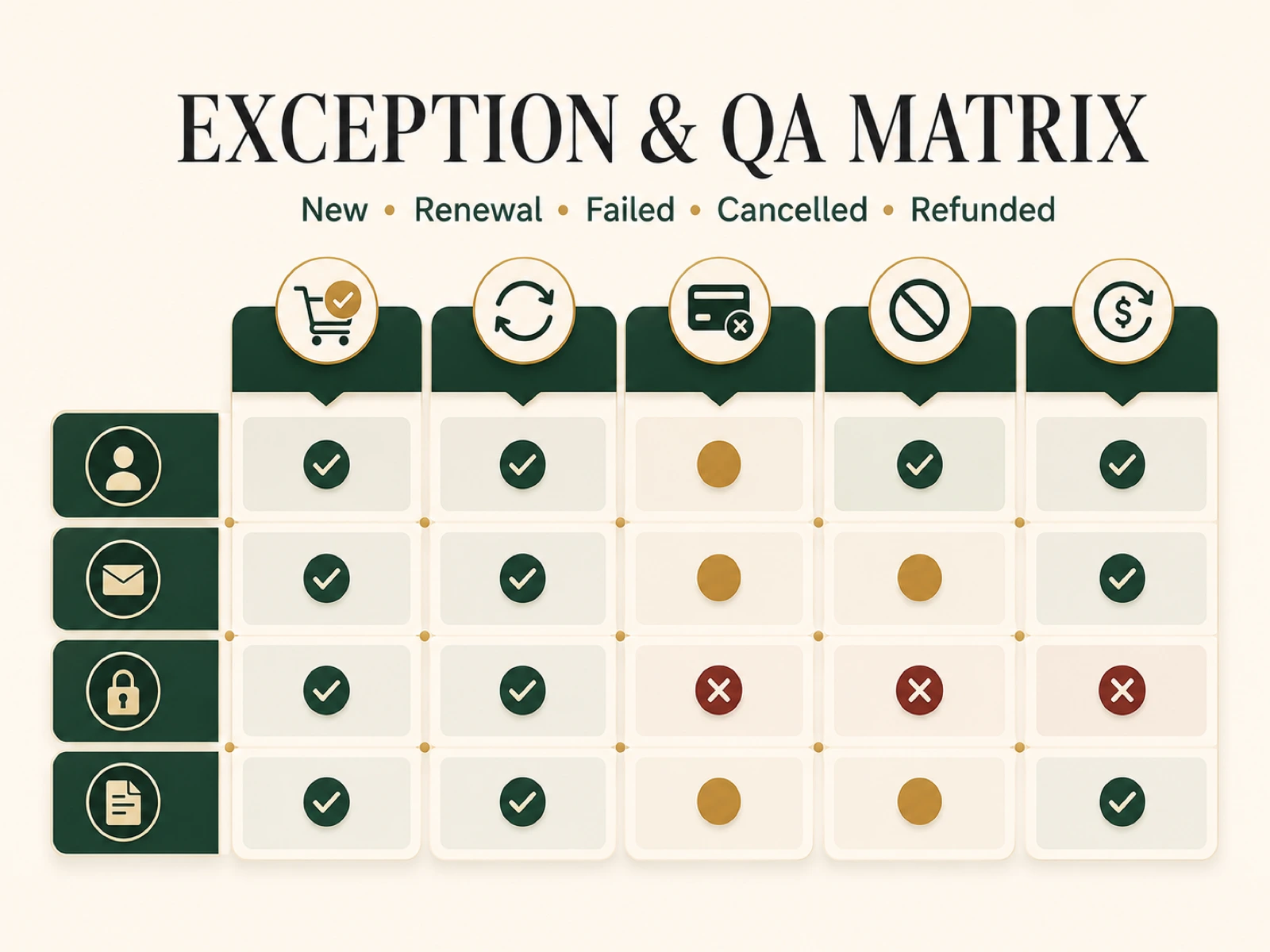
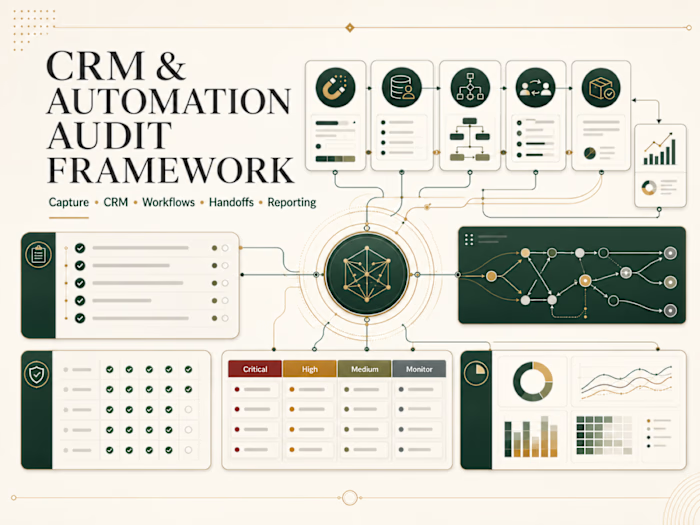
Exception and QA model — Controlled records verify duplicate purchase, retry, cancellation, refund, wrong or missing access, alerting, issue severity, repair, and retest before handoff.
Reliability model
Entitlement source
Define the exact event that grants access: a successful purchase, an active subscription, a CRM tag, a membership tier, or a manual enrollment. One source of truth must own the decision.
CRM identity and state
Verify the canonical contact, email, product or offer, tags, custom fields, subscription status, and automation entry point. Duplicate or incomplete records are treated as system risks, not isolated data-cleanup issues.
Access bridge
Trace the integration, webhook, native connector, or WordPress plugin responsible for translating CRM state into user creation, role changes, membership access, and course enrollment. Overlapping controllers are identified before any repair.
Membership and LMS state
Confirm that the WordPress user, membership level, course enrollment, login path, and content permissions all reflect the intended entitlement. A successful tag alone is not accepted as proof of access.
Cancellation and exception paths
Document failed payment, retry, cancellation, refund, expiry, grace-period, reactivation, and manual-exception behavior. Revocation must happen only after the correct business event and must remain reversible when appropriate.
QA and evidence
Use privacy-safe test records, timestamps, screenshots, logs, and state comparisons to prove what happened at each layer. Each finding is linked to a reproducible condition and a verification step.
Diagnostic and repair method
Map the current journey
Document the intended purchase-to-access and cancellation-to-revocation flows, including systems, owners, inputs, outputs, and known exceptions.
Establish responsibility
Choose the source of truth for identity, entitlement, payment state, and access. This prevents two tools from making conflicting decisions.
Trace representative records
Follow a safe test record through payment, CRM, automation, WordPress, membership, LMS, email, and reporting layers to locate the first incorrect state.
Test success and failure paths
Verify new purchase, existing user, failed payment, retry, cancellation, refund, reactivation, duplicate event, and delayed-event scenarios within the agreed scope.
Repair in dependency order
Correct upstream identity and entitlement rules before rebuilding downstream access or communication. Every change includes a test condition and, where relevant, a rollback boundary.
Typical deliverables
Current-state purchase, CRM, and access journey map
Entitlement and responsibility matrix
Prioritized issue register with severity and dependency notes
Recommended repair sequence and implementation boundaries
Test matrix with pass, fail, and exception evidence
Recorded walkthrough or written operational handoff
One follow-up clarification round
Platform scope
The method adapts to Keap, Ontraport, GoHighLevel, WordPress, LearnDash, Memberium, iMember360, WP Fusion, WooCommerce, Shopify, Stripe, PayPal, Zapier, and documented API or webhook connections. Exact checks depend on the live stack and access provided.
Outcome
The outcome is a testable access model: what grants access, which system owns each state, how exceptions are handled, what should be repaired first, and how the team can verify the result.
Related service: Keap CRM + Membership Automation Repair — focused diagnosis and repair across CRM state, WordPress or LMS access, payment events, exception paths, QA, and handoff.
Like this project
Posted Jul 16, 2026
A testable framework for connecting purchases, CRM tags, WordPress/LMS access, cancellations, refunds, and handoff QA without exposing client data.