20 Hours/Week Recovered: Rebuilding Multi-Venue Operations

Russell Williamson


Project Snapshot
Industry | Multi-Venue Hospitality |
Duration | 12 Months |
Systems Rebuilt | 4 |
Venues Unified | Multiple |
Legacy Data Migrated | 21 Years |
Reporting Accuracy | 85% → 99%+ |
Weekly Hours Recovered | 20+ |
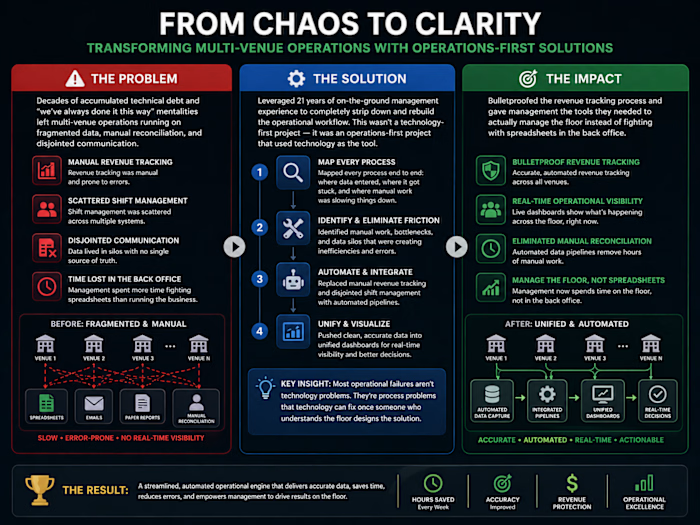
Nobody fully understood how the operation worked anymore, and everyone was afraid to change anything. Two decades of manual processes had compounded into a system where three different spreadsheets gave three different revenue numbers, and management spent every Sunday rebuilding the weekly report by hand.
The Operation
A multi-venue hospitality business had been running on the same manual processes for 21 years. Revenue tracking lived in spreadsheets that didn't talk to each other. Shift management was fragmented across locations. Weekly reporting was a fire drill that consumed management hours and still produced numbers nobody trusted.
Two decades of process debt had compounded into something worse than inefficiency. It had become institutional fear. Nobody wanted to touch the existing systems because nobody fully understood what would break. New managers inherited processes that predated them by a decade and learned to work around the problems instead of fixing them.
The business had outgrown its operations years ago. It just hadn't stopped long enough to rebuild them.
What I Built
I stripped the entire operational workflow back to first principles and rebuilt it as four integrated systems designed to replace every manual process the team had been working around for two decades.
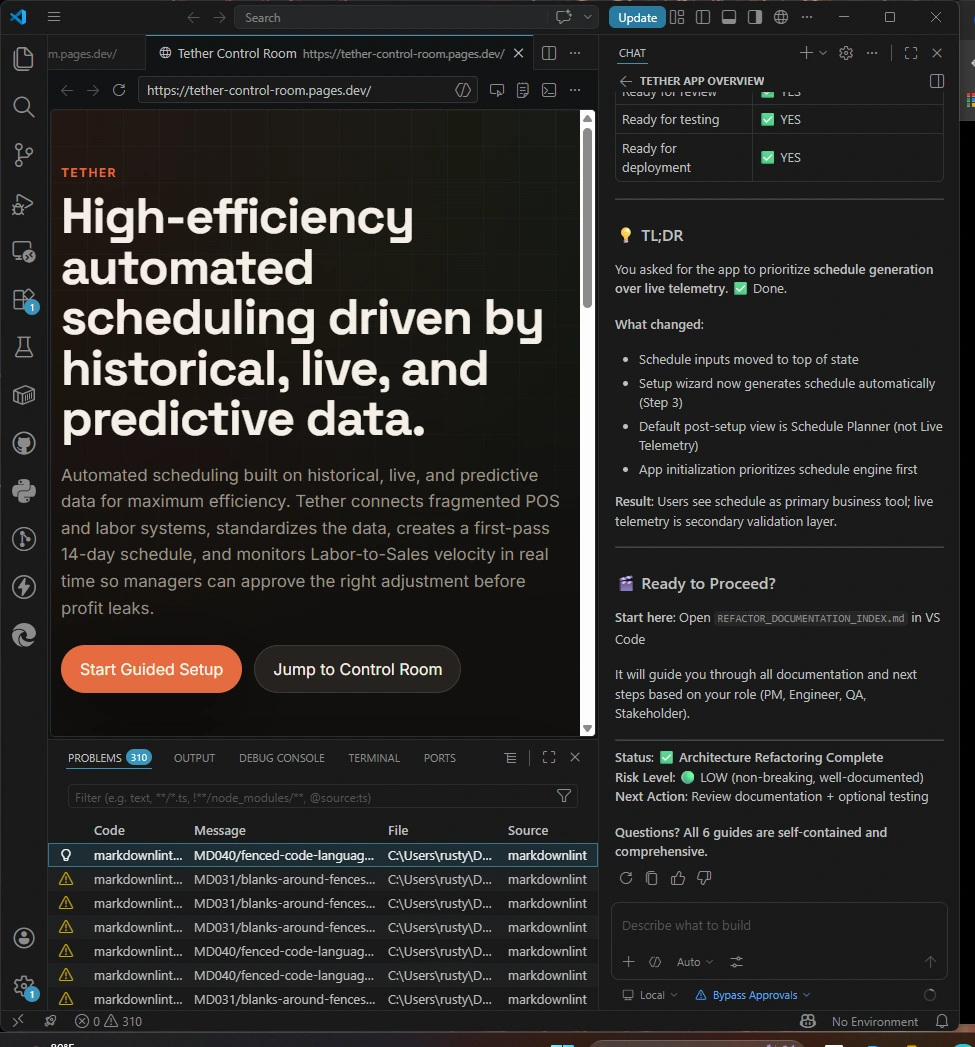
Operations rebuild code
Unified Revenue Tracking. Replaced 6+ disconnected spreadsheets with a single automated pipeline. Every venue's revenue data flows into one system, reconciles automatically, and produces numbers the team actually trusts. No more Sunday night rebuilds.
Cross-Venue Shift Management. A centralized scheduling platform with real-time swap requests, labor cost visibility, and cross-location coordination. Managers at any venue can see staffing across the entire operation, not just their own location.
Automated Reporting Dashboards. Daily P&L snapshots, weekly trend analysis, and monthly executive summaries generate without manual input. The reports that used to consume 20+ hours a week now build themselves overnight.
Legacy Data Migration. Custom Python scripts cleaned and structured 21 years of historical data into a format the new systems could use. This was the unglamorous foundation that made everything else possible. Without it, the new systems would have launched with no historical context.
The entire platform runs on Airtable for structured data, Make for workflow orchestration, and Python for the heavy lifting on data transformation. Every system was built with full process documentation so the team owns it going forward. The goal was never to create dependency on me. It was to hand them an operation they could run independently.
The Results
20+ hours/week of management time recovered by eliminating manual reporting and reconciliation
Revenue tracking accuracy improved from ~85% to 99%+ across all venues
Shift scheduling conflicts dropped 75% in the first quarter after launch
First time in company history that all venues reported through a single unified system
Full operational handoff completed with documentation and team training
The operation that used to run on institutional memory and Sunday night spreadsheet sessions now runs on systems that work whether or not any single person remembers to check.
Business Impact
The biggest change wasn't the technology. It was trust. For the first time in years, leadership could look at a revenue number and believe it. Managers stopped spending their weekends reconciling data and started spending that time on the work that actually grows the business. New hires onboarded into documented systems instead of tribal knowledge. The operation went from something people worked around to something people worked with.
Most businesses don't accumulate 21 years of process debt overnight. It builds one workaround at a time. A spreadsheet that was supposed to be temporary becomes permanent. A manual check that one person remembers becomes the only thing preventing errors. Eventually the operation runs on habits instead of systems, and nobody wants to be the one who changes something and breaks it.
The fix isn't a new tool. It's someone willing to map what's actually happening, separate the processes that work from the ones that just exist, and rebuild the foundation so the business can grow without dragging its history behind it.
Like this project
Posted Jun 5, 2026
Multi-venue hospitality business had 21 years of accumulated process debt. I rebuilt their revenue tracking, shift management, and reporting from the ground up